Spa is seven kilometres long and a driver brakes just six times. Here is the whole lap, corner by corner, from real telemetry, and the one braking zone that decided pole last year.
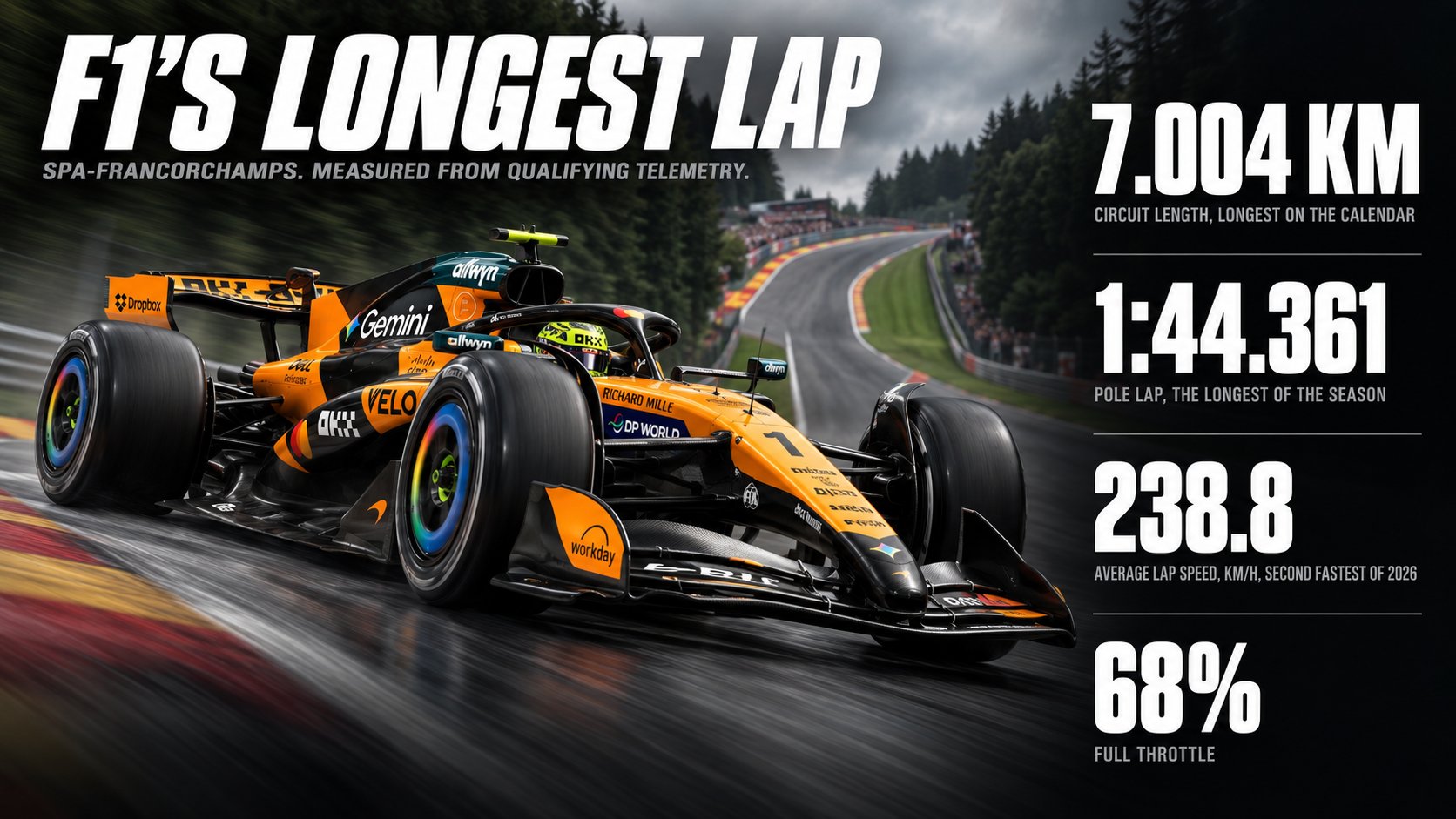
Spa-Francorchamps is the longest lap in Formula One, seven kilometres through the Ardennes forest. It is also one of the least busy. Across the whole lap a driver touches the brake pedal just six times. Everything else is held. That single number, six, tells you most of what you need to know about the 2026 Belgian Grand Prix, so let us build the lap around it.
What the drivers said about this circuit while driving it is in our
Every figure below comes from real session telemetry, not a stopwatch. The circuit has not changed for 2026, so the layout numbers hold, and last year's qualifying and race give us the story the timing sheet hides.
Six braking zones, and nothing else
Split the 6,962 metres of racing line into the places a driver is actually on the brakes, and you get six red marks. La Source, Les Combes, Rivage, Fagnes, Campus, and the Bus Stop. That is the entire braking workload of a Spa lap.
The only six places a driver brakes across the seven-kilometre lap.
The heaviest is the Bus Stop chicane, where the car goes from 308 km/h to 76 km/h in 107 metres, roughly the length of a football pitch. The lightest is Campus, barely a dab: 253 down to 170. Between those six points the car is either flat out or holding a corner on commitment alone.
Five straights, two-thirds of the lap
If braking is rare here, full throttle is everywhere. Measure the sections where the throttle sits pinned at 100 percent and Spa gives you five straights that together make up 68 percent of the lap.
Five straights, 4,745 metres of the lap taken flat out.
For 2026 there is no DRS anywhere in Formula One. In its place, Spa runs five Straight Mode Zones where the cars flatten their wings for less drag. The straights are where the racing happens now.
The longest flat-out run in Formula One
One of those five straights is not really a straight at all. From the exit of La Source, the throttle goes flat and stays flat down through the compression, up through Eau Rouge, over the blind crest at Raidillon, and all the way along the Kemmel. That is 1,818 metres and 21.8 seconds without lifting, ending at 339 km/h.
The throttle never leaves the floor from La Source to Les Combes.
No other stretch of tarmac on the calendar asks a driver to hold it that long, and it is why low drag matters so much here.
Pouhon: the corner they lift for but never brake
Now for the corner that makes Spa Spa. Pouhon is a long, double-apex left taken at 306 km/h. It is the only corner on the entire lap where a driver lifts the throttle but never touches the brake.
Throttle drops to 77 percent through Pouhon. The brake pedal never moves.
Eau Rouge, Raidillon, and Blanchimont are all taken with no lift at all, throttle at 99 percent. Pouhon is the one place the driver eases off and simply holds on. Remember this corner, because it comes back at the end of the story.
The speed picture
Put speed against distance for the whole lap and the character of the circuit is obvious. A third of the lap is spent above 300 km/h, topping out at 339. The six braking zones show up as sharp red valleys, and between them the trace lives near the top of the chart.
A third of the lap sits above 300 km/h.
You can explore the same session yourself. Open the Gap Visualizer to see how the three fastest cars stacked up through every part of the lap.
Where the lap was won last year
Here is where it gets interesting. Colour the racing line by whoever was fastest through each minisector in qualifying, and one car owns it. Charles Leclerc was quickest across 63.3 percent of the lap.
Leclerc was fastest over most of the lap. He still did not take pole.
Leclerc owned the lap and did not start from pole. Norris took it. To understand why, you have to look not at where the drivers were fastest, but at where they braked.
Why Leclerc lost pole
This is the payoff, and it lives at Pouhon, the corner nobody is supposed to brake for.
At Pouhon, Norris and Piastri do not brake at all. Leclerc does.
Count the brake applications across the lap and the difference is stark:
Norris braked six times
Piastri braked six times
Leclerc braked seven
That seventh brake was at Pouhon. Norris and Piastri took it flat and committed, Leclerc did not. And even where all three did brake, the margins were tiny: into Fagnes, Piastri braked a full 44 metres later than Leclerc.
Leclerc was fastest across nearly two thirds of the lap and lost pole by a third of a second, to the one corner he did not fully commit to.
Norris took pole with a 1:40.562. The gap to Leclerc was +0.338s. A single corner, taken flat by two drivers and not by the third, is the whole difference.
Race day
On race day it rained, and the qualifying picture went out of the window. Piastri won it on a one-stop, starting on Intermediates behind the safety car and switching to Mediums on lap 12.
One stop, wet to dry: Intermediates then Mediums.
A pit stop at Spa costs around 19 seconds, which is why track position is worth defending and why the race was a one-stop. Piastri won from Norris and Leclerc.
The 2026 preview
The braking zones, the straights, the flat-out run through Eau Rouge, the commitment at Pouhon, all of it carries straight into 2026. What changes is the aero. No DRS, five Straight Mode Zones, and a manual boost onto the main straight. On a track where two-thirds of the lap is flat and the racing happens on the straights, that is a bigger change than it sounds. For the full picture of how 2026 reshapes qualifying, see our Track Domination guide, then walk the 2026 grid in the Showroom.
The Spa-Francorchamps circuit hub pulls together everything we hold for this venue in one place: every qualifying gap drawn as real distance, the track domination maps where we have them, and the team radio from previous races here.
What the drivers said here
The radio is the part of a weekend that does not make the highlights. We hold every message Formula 1 broadcast from Spa in 2026, 47 of them across the whole weekend, transcribed with the original audio and the driver and engineer colour coded, on the Spa 2026 team radio page.
It is worth a scroll before a race here, because the complaints repeat. Drivers tend to raise the same two or three things about a circuit every year, and reading last season back is the quickest way to know what to listen for in this one.
Spa is the second fastest circuit of the 2026 season by average lap speed, behind only Monza. The full ranking, measured from qualifying telemetry, is in the fastest F1 circuits of 2026.
Follow the weekend live
Telemetry explains Spa after the fact. Watching it arrive is a different experience, especially at a circuit where the gaps swing this hard.
The Formula Dream app runs a live Dashboard through every session: every car moving on the circuit map, and a timing tower with lap times, gaps and intervals, tyre compound and age, pit counts and positions, plus flag and safety car alerts the moment race control calls them. You also get live driver radio as it is broadcast, and every FIA document of the weekend collected as it is published, which is where the stewards' decisions that change results actually appear.
Free, no subscription, no ads, independent. Not affiliated with Formula 1.
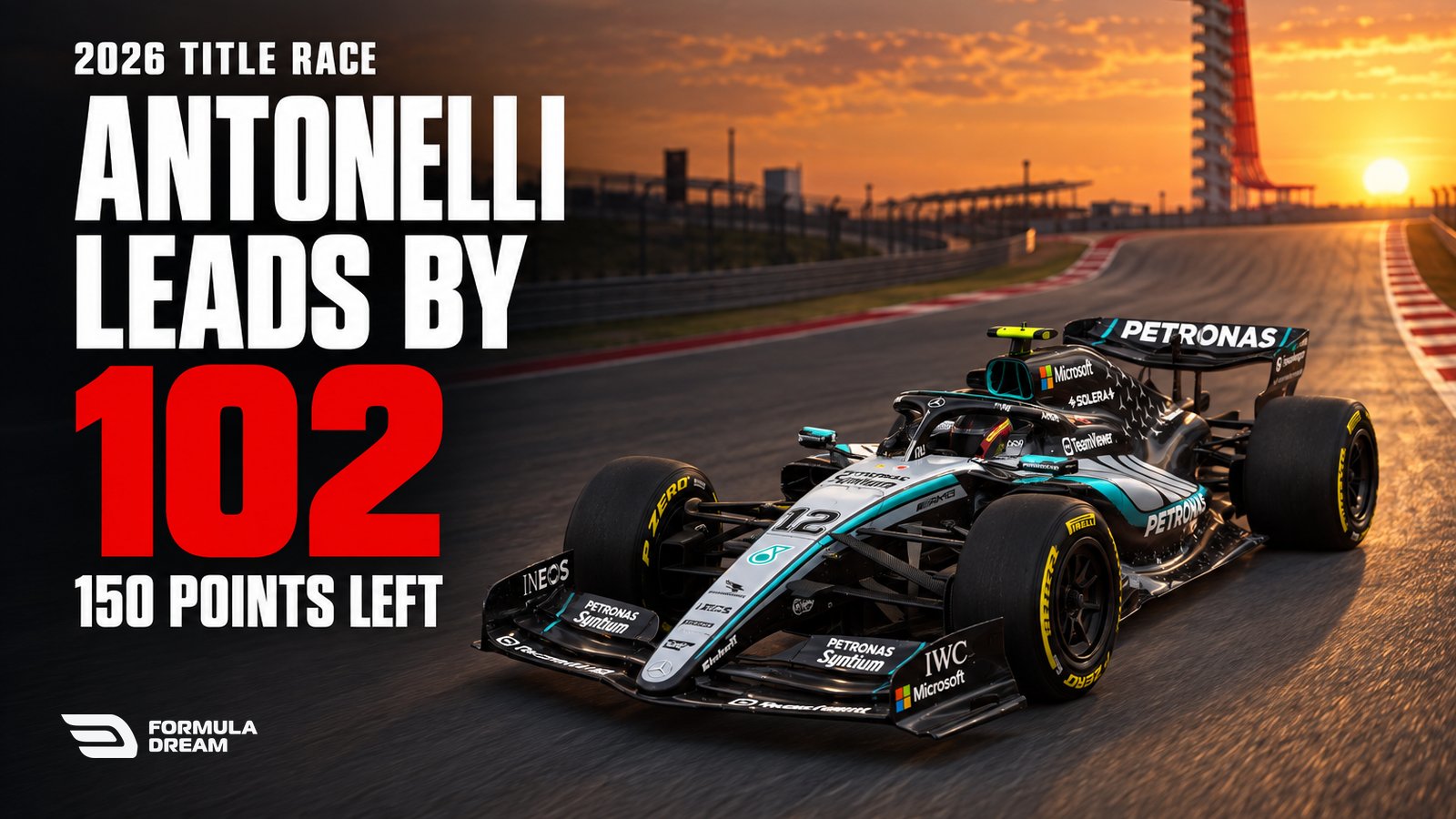
When Can Antonelli Win the 2026 Title? Every Round, Every Rival
Antonelli leads by 102 points with 150 left. Here is how many points he can lose to Russell, Hamilton, Verstappen, Leclerc and Norris at each round and still clinch.