
Bhavin Lathia
🏆🏆🏆
236 stories
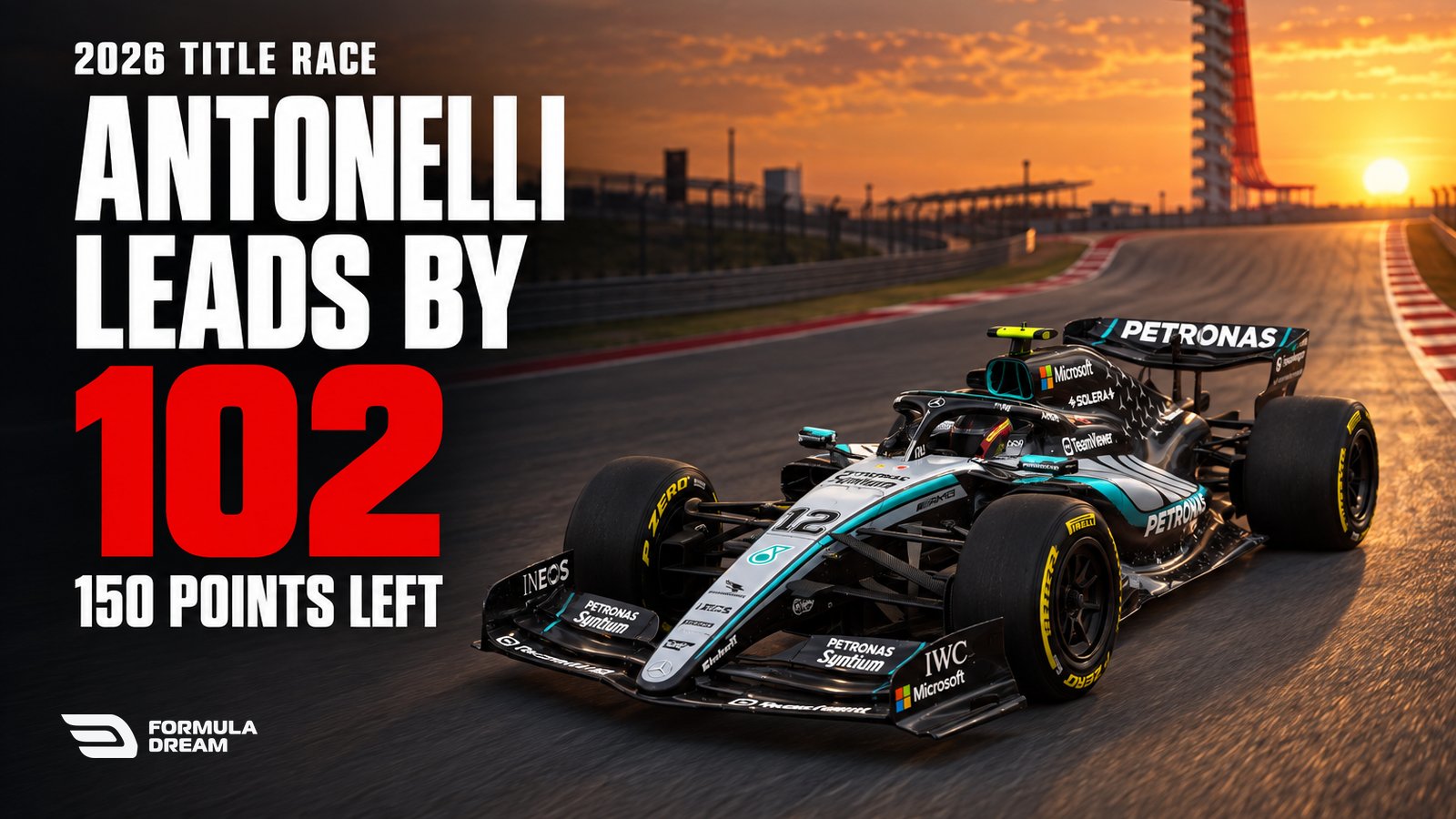
When Can Antonelli Win the 2026 Title? Every Round, Every Rival
Antonelli leads by 102 points with 150 left. Here is how many points he can lose to Russell, Hamilton, Verstappen, Leclerc and Norris at each round and still clinch.
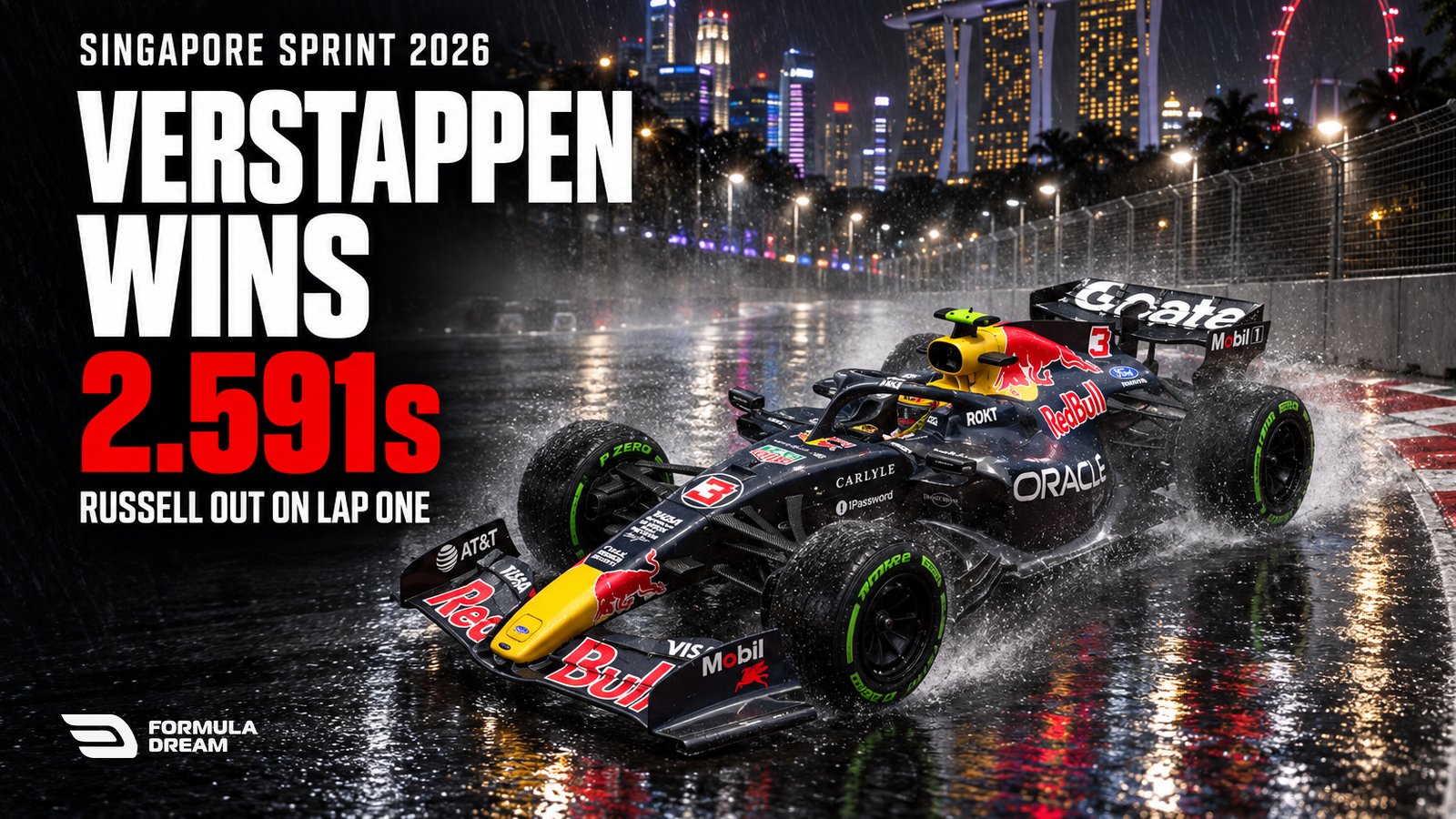
Singapore Sprint 2026 Results: Russell Crashes From the Lead
Russell took the lead at turn one and crashed at the final corner of the same lap. Verstappen won, Hamilton charged to second, and the McLarens hit each other.
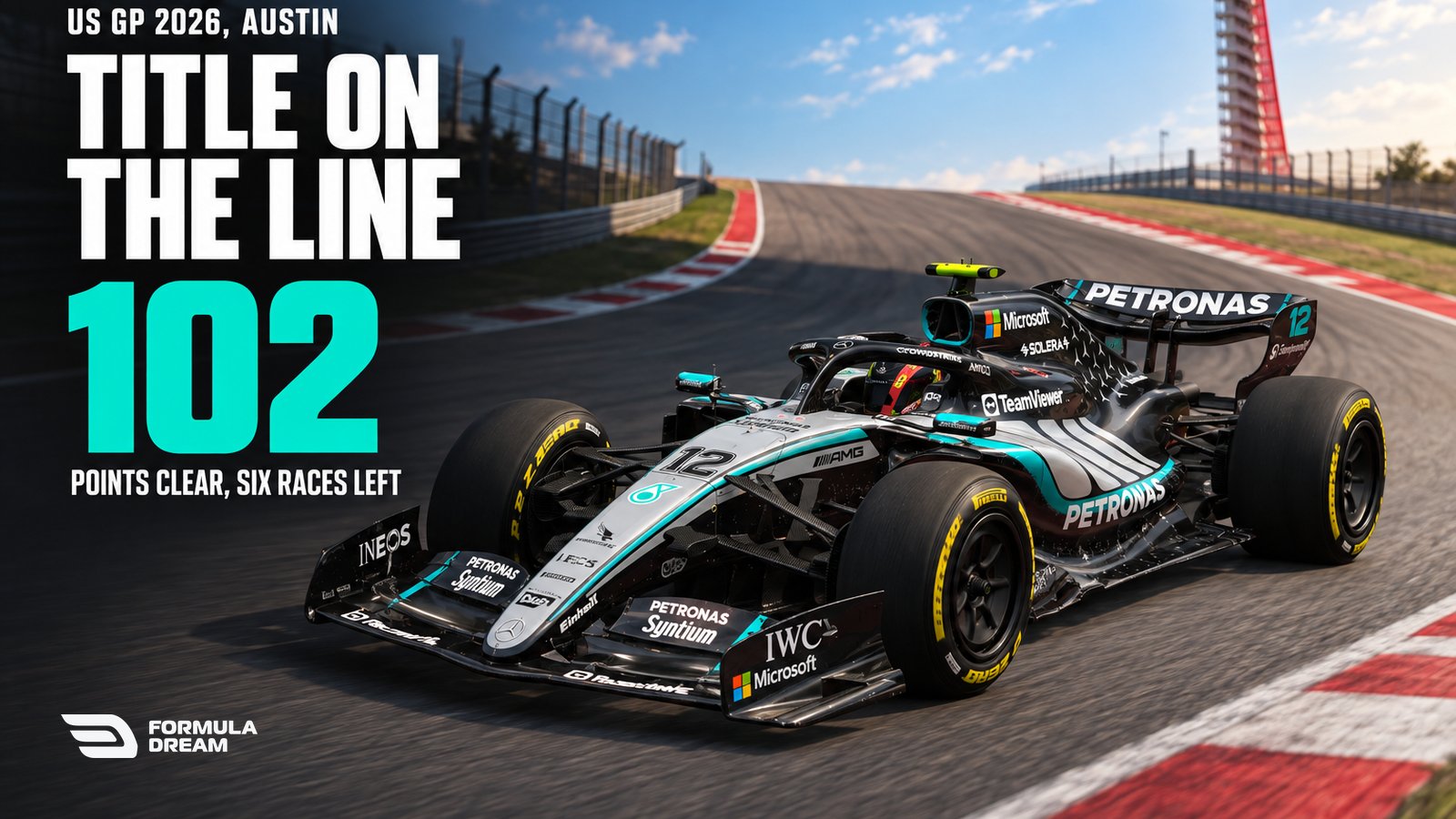
US GP 2026 Preview: Antonelli Can Win the Title in Austin
Kimi Antonelli arrives in Austin 102 points clear with six races left. Win, and have Russell and Hamilton finish low enough, and he is champion on Sunday.
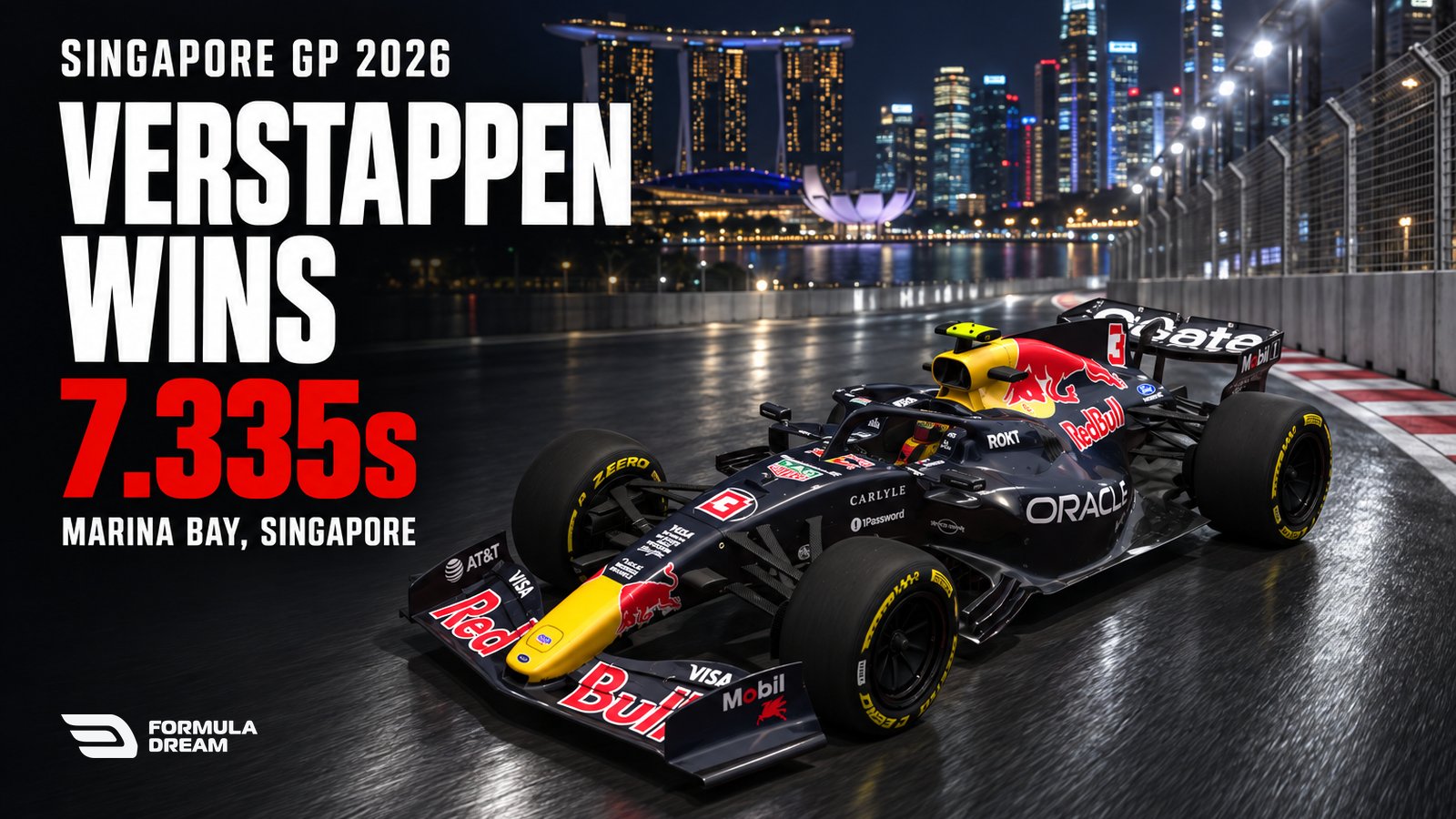
Singapore GP 2026 Race Results: Verstappen Wins With No Radio
Verstappen led all 62 laps at Marina Bay for his first Singapore win, while his team could hear nothing he said. Leclerc was second, Antonelli third.
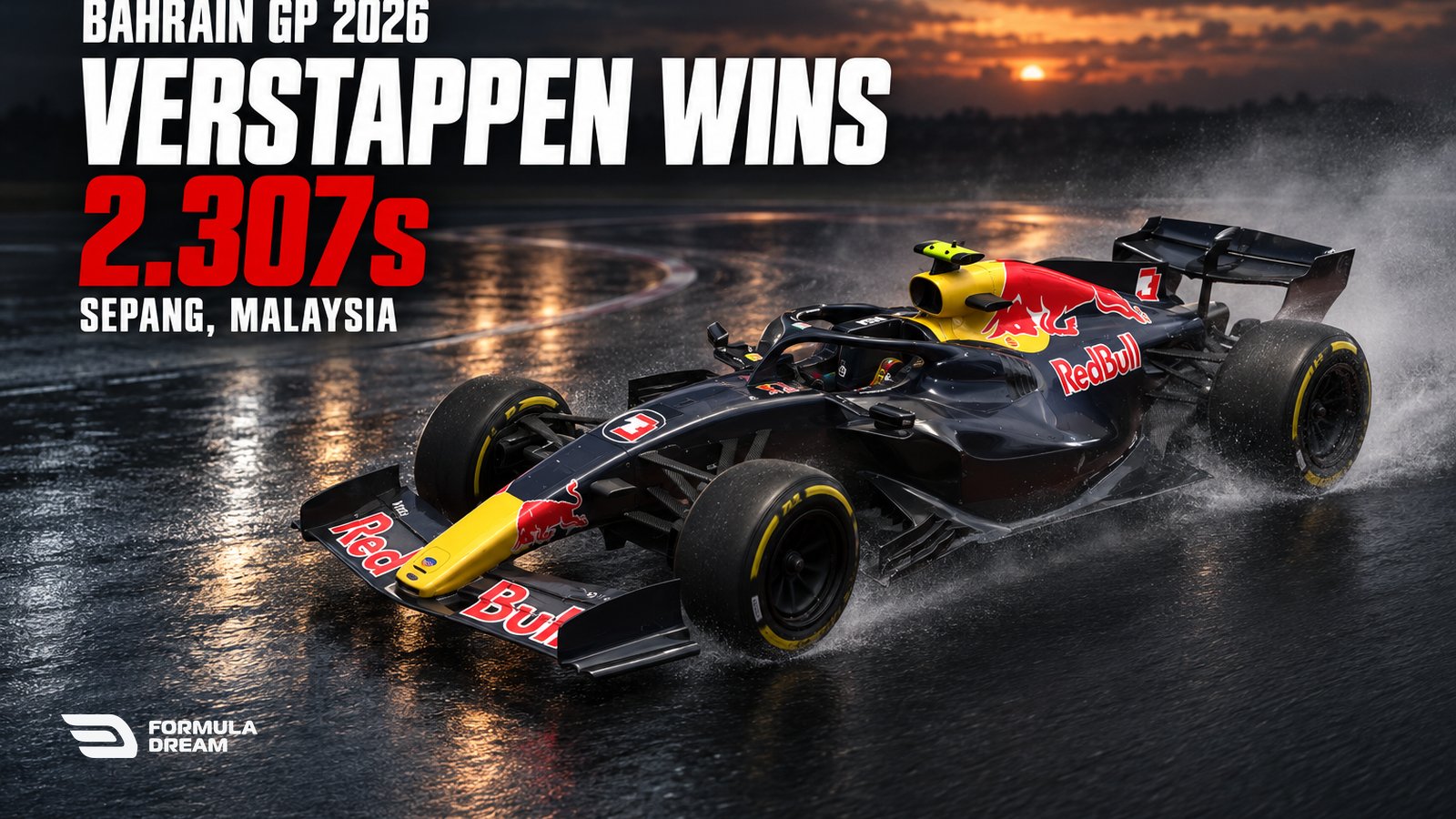
Bahrain GP 2026 Race Results: Verstappen Wins at Sepang
Verstappen took his first win of 2026 at Sepang. Hamilton started on slicks in the wet, fell to 17th, refused to pit, and finished on the podium.
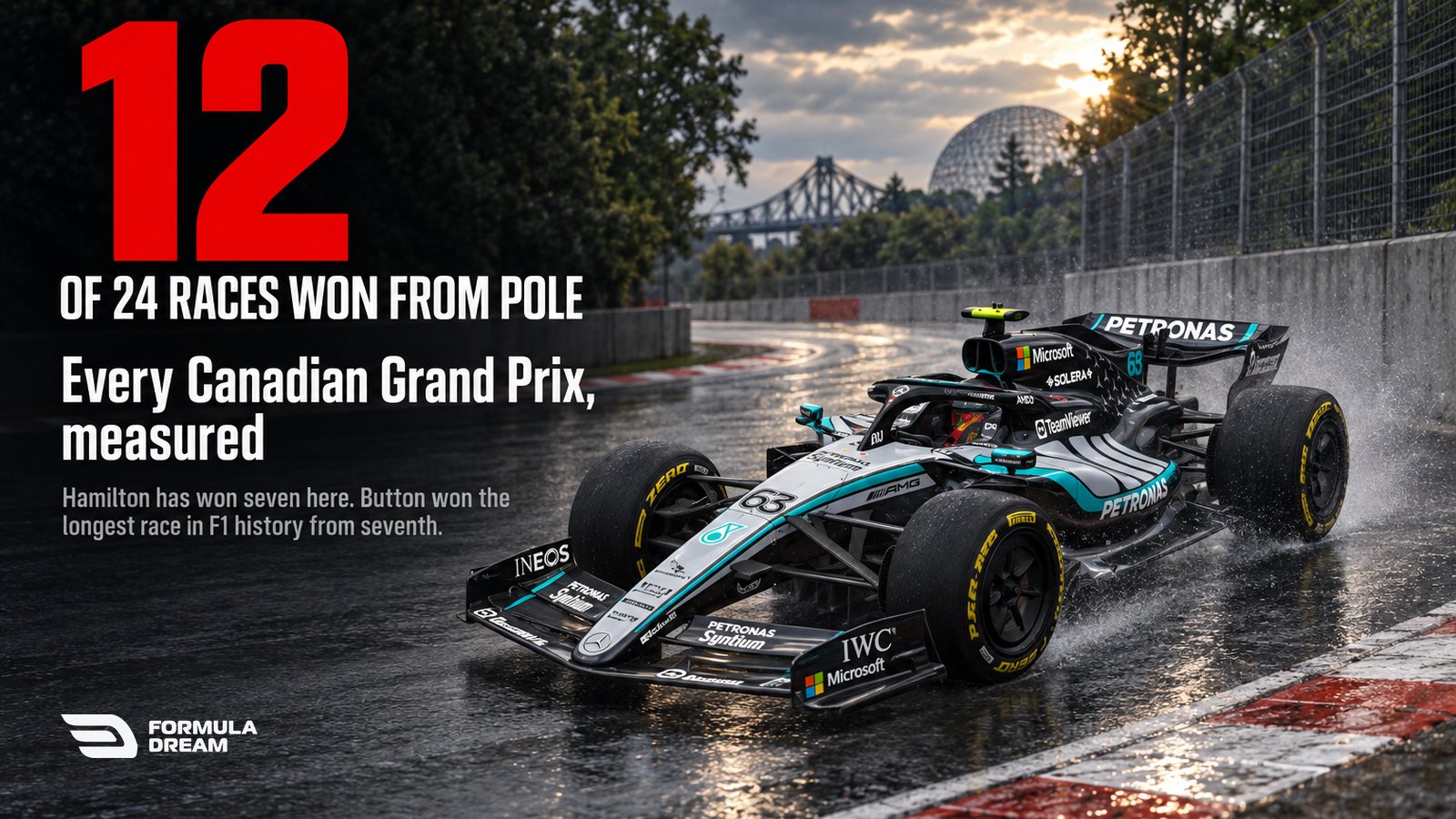
Every Canadian Grand Prix winner, measured: 24 races at Montreal, and pole wins exactly half of them
Twenty four Canadian Grands Prix have been held at the Circuit Gilles Villeneuve since 2000, and exactly twelve were won from pole. Lewis Hamilton has won seven, more than anyone has won at any other circuit bar Silverstone. Every winner, grid slot and safety car, measured.
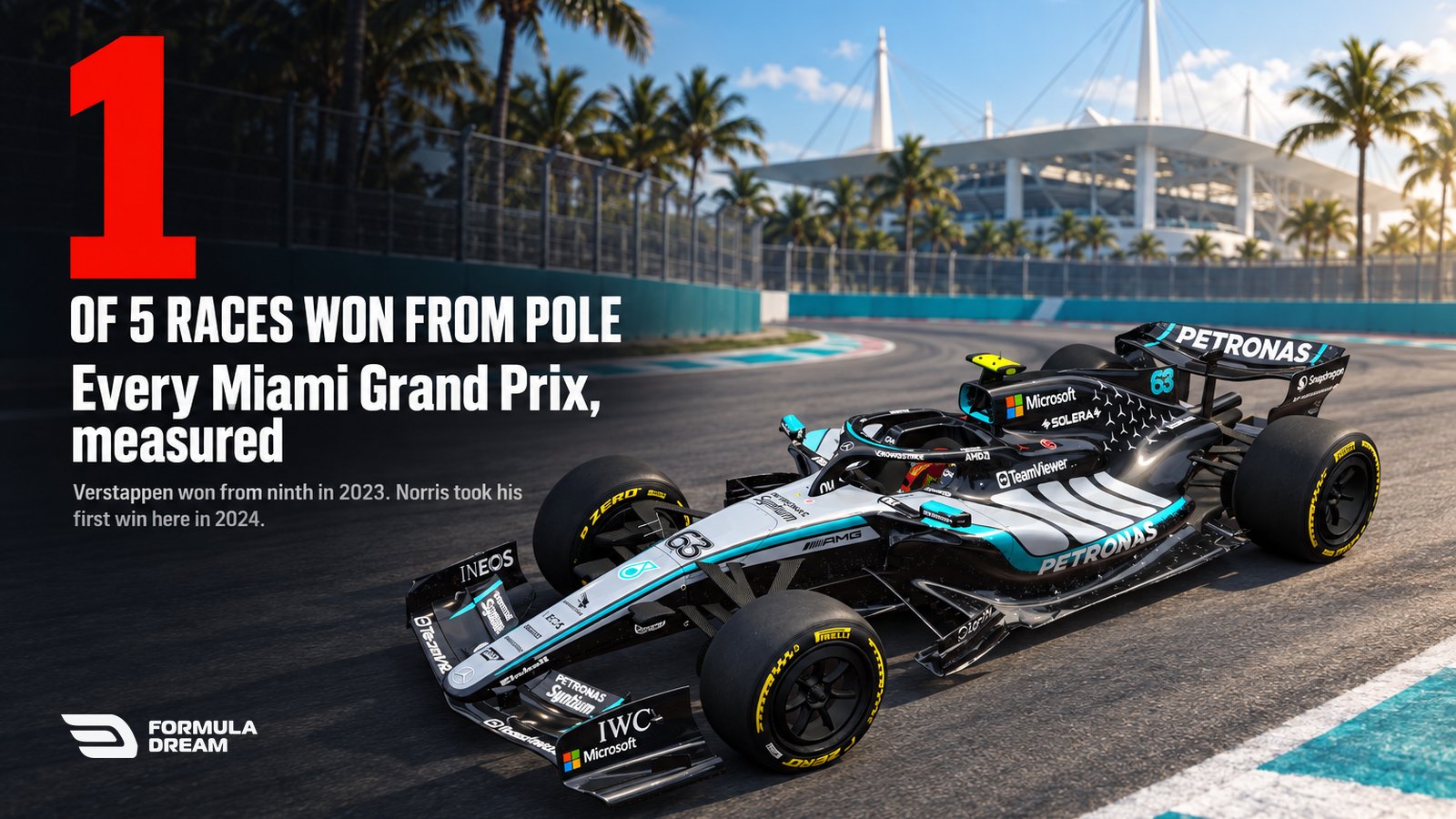
Every Miami Grand Prix winner, measured: five races, and pole has won only one of them
Five Miami Grands Prix have been held since 2022, and only one was won from pole: Kimi Antonelli's in 2026. Max Verstappen won from ninth in 2023, and Lando Norris took his first win there in 2024. Every winner, grid slot and safety car, measured.
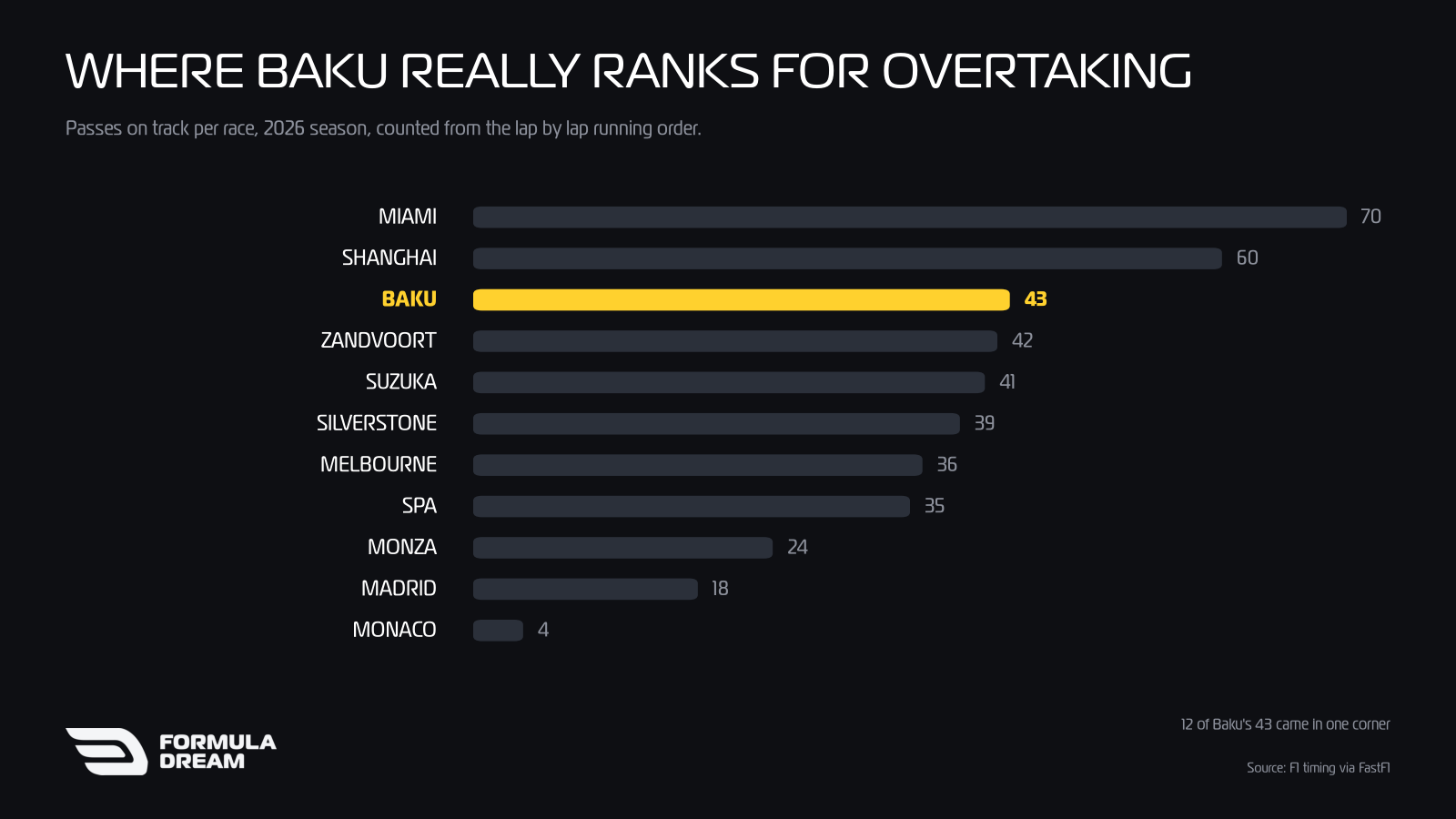
Baku 2026 had 43 passes on track, and twelve of them happened in one corner
We counted every on-track pass in the 2026 Azerbaijan Grand Prix from the lap by lap running order. There were 43, but twelve came in a single corner when Oscar Piastri locked up at the restart. Baku ranks seventh of the fifteen races of 2026, which is not what its reputation says.
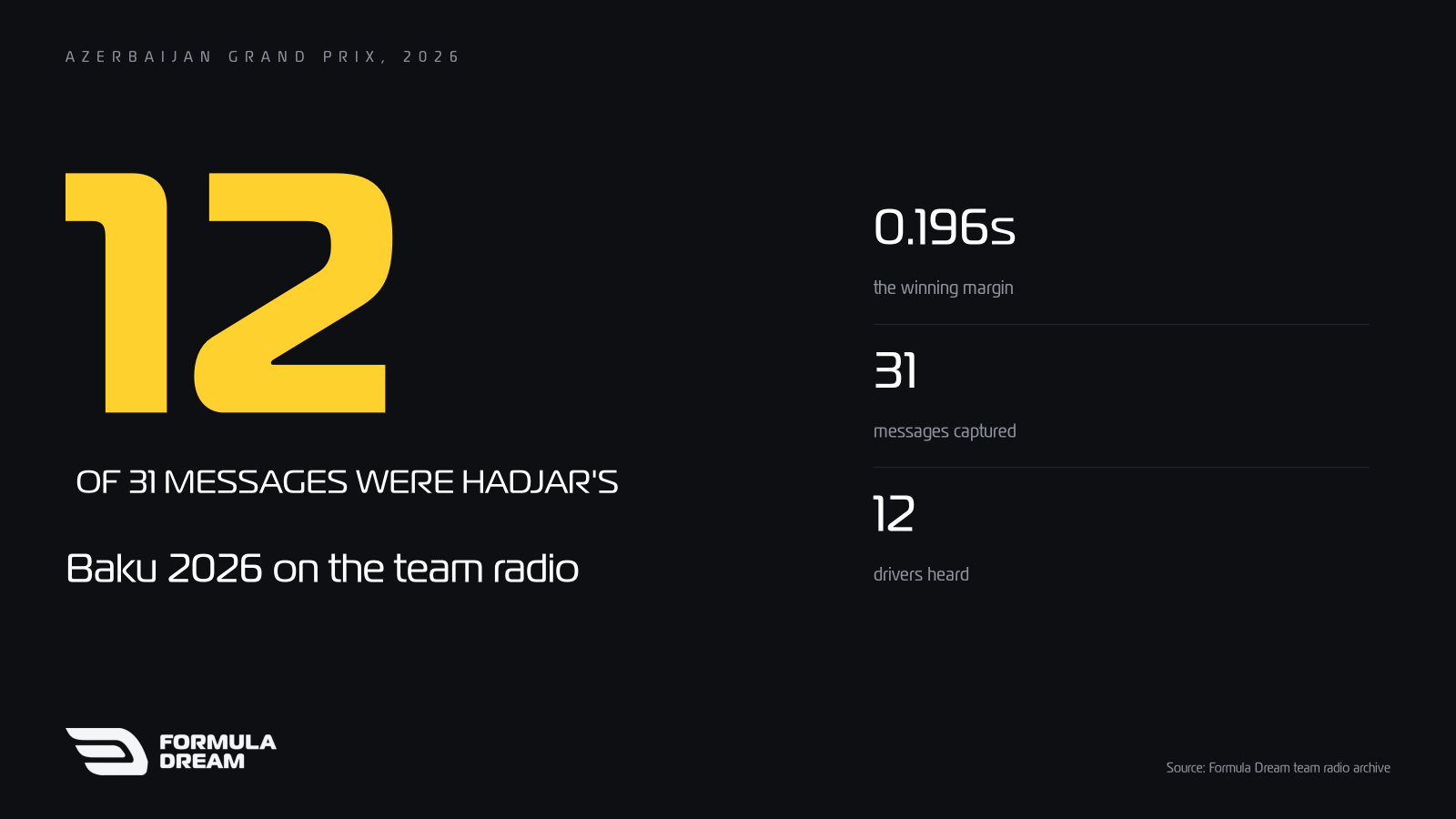
Azerbaijan GP team radio: the messages that explain Baku, from Russell's lost power to Gasly's lost points
The best team radio from the 2026 Azerbaijan Grand Prix, with the audio and a colour-coded transcript. George Russell explains the last lap that nearly cost him the win, Pierre Gasly reacts to being taken out by his own team mate, and Isack Hadjar takes a podium with a gearbox vibration.
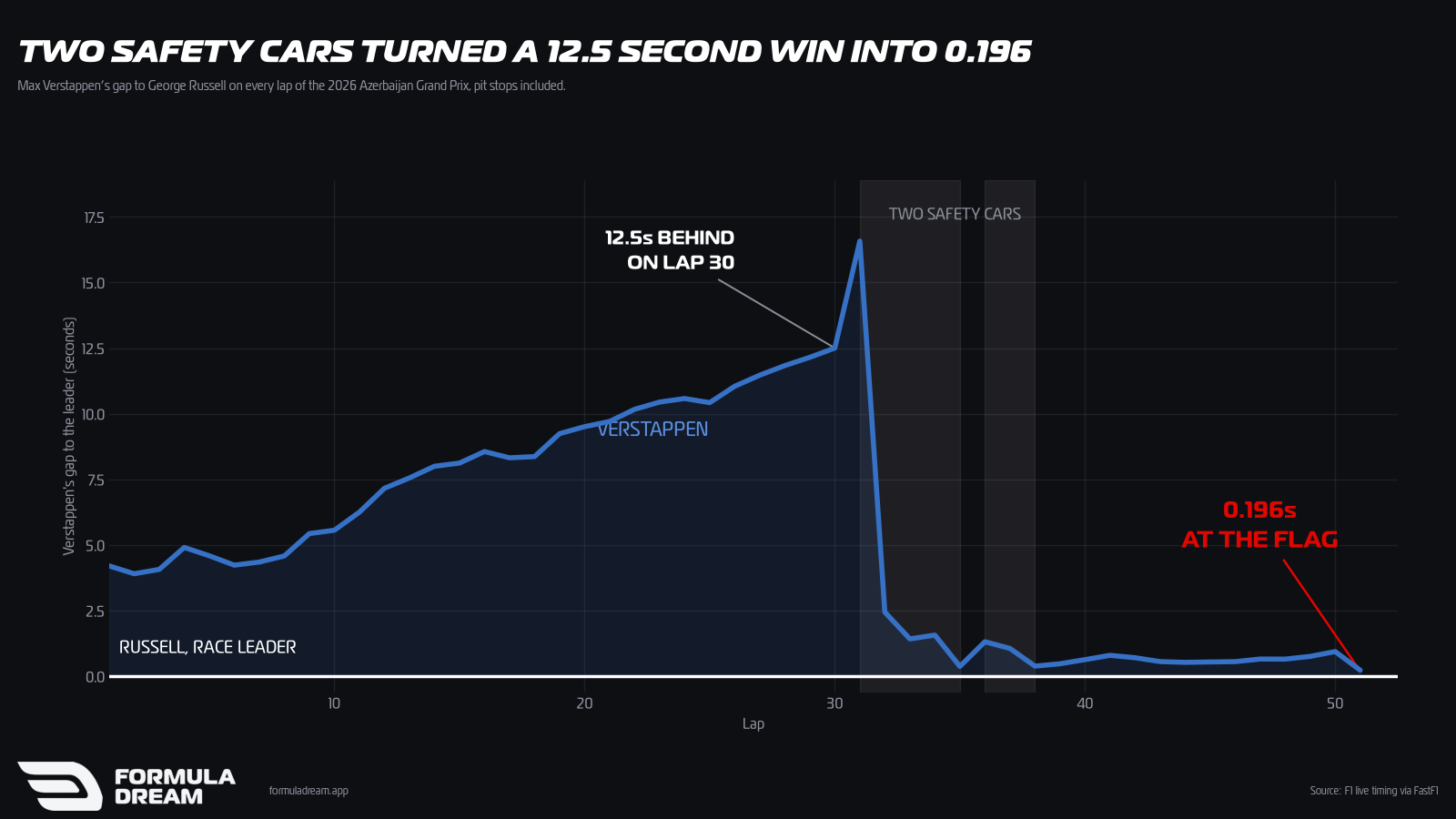
Azerbaijan GP results: Russell wins Baku by 0.196s, and his own radio explains the last lap
George Russell won the 2026 Azerbaijan Grand Prix by 0.196 seconds from Max Verstappen after two safety cars wiped out a 12.5 second lead. On the last lap a double yellow cost him seven tenths, and he said so on the radio. Full results, penalties and retirements.
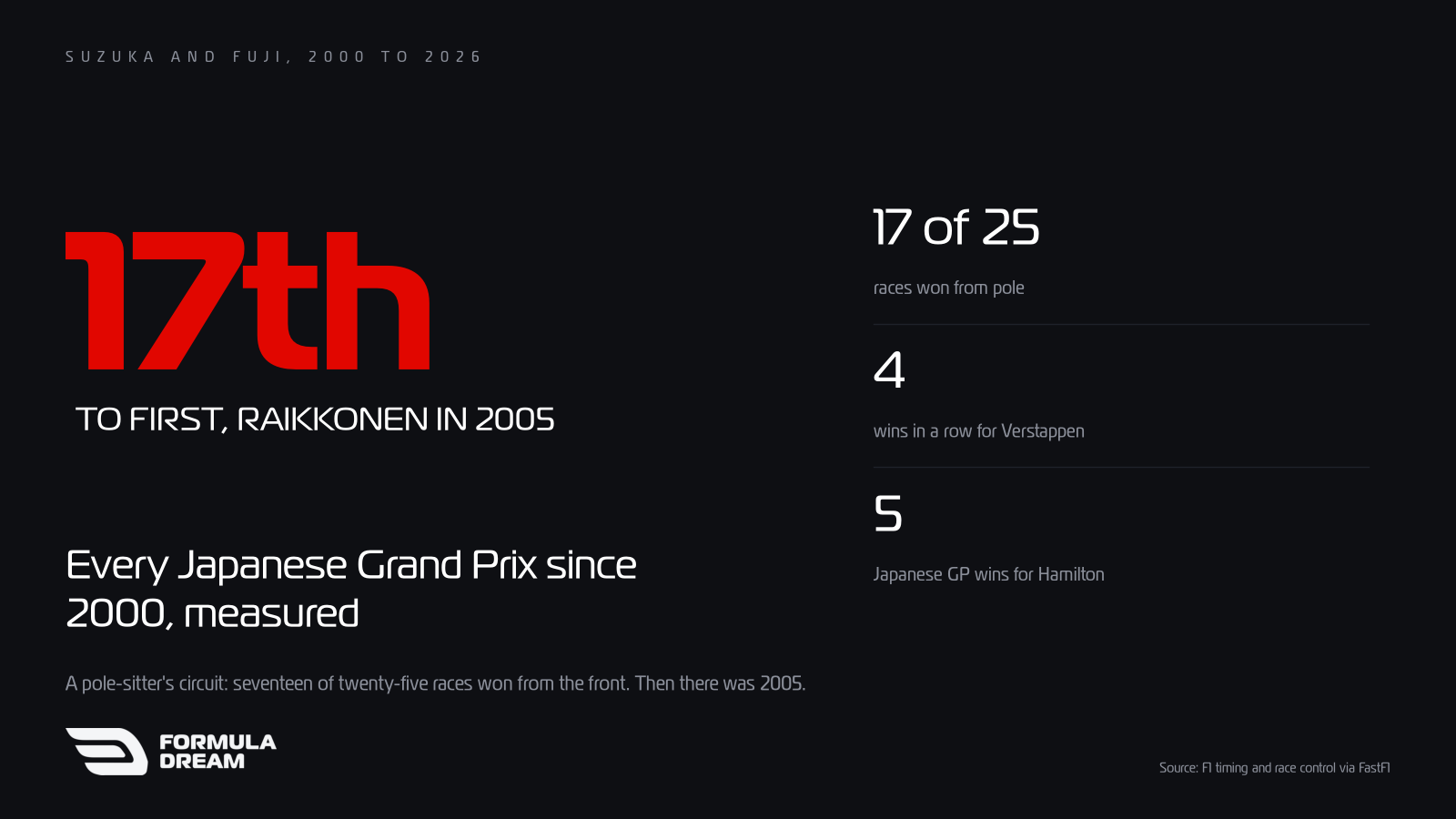
Every Japanese Grand Prix winner since 2000, measured: a pole-sitter's circuit, and Raikkonen's win from seventeenth
Twenty-five Japanese Grands Prix have been held since 2000, all at Suzuka except two at Fuji. Pole won seventeen, Max Verstappen won four in a row from 2022, and Kimi Raikkonen won from seventeenth in 2005 with a last-lap pass. Every winner, grid slot and safety car, measured.
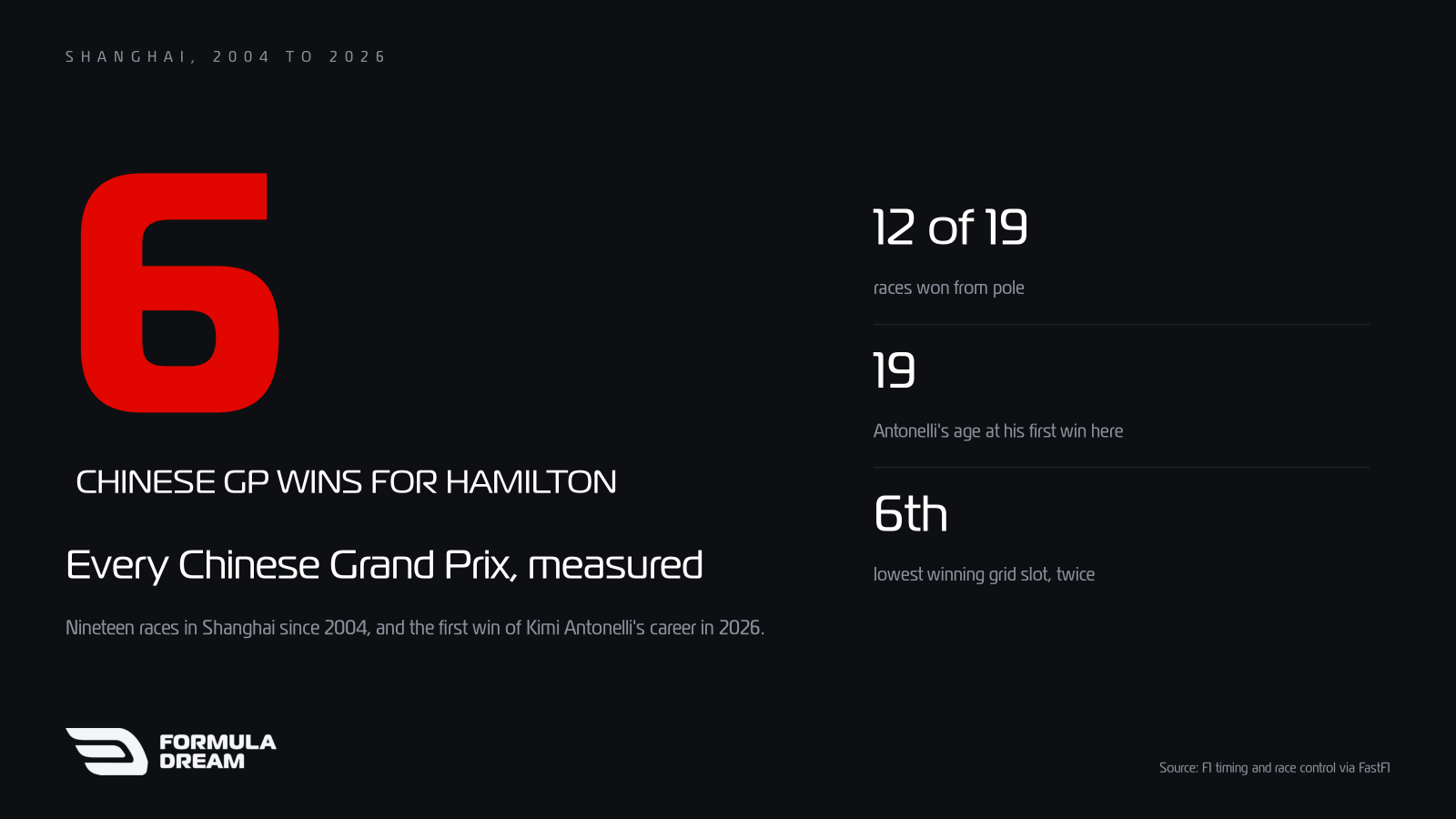
Every Chinese Grand Prix winner, measured: Hamilton's six, and where Kimi Antonelli won for the first time
Nineteen Chinese Grands Prix have been held in Shanghai since 2004. Lewis Hamilton won six, pole won twelve, and in 2026 Kimi Antonelli took the first win of his career there, at 19, with Hamilton on the podium for Ferrari for the first time. Every winner, grid slot and safety car, measured.
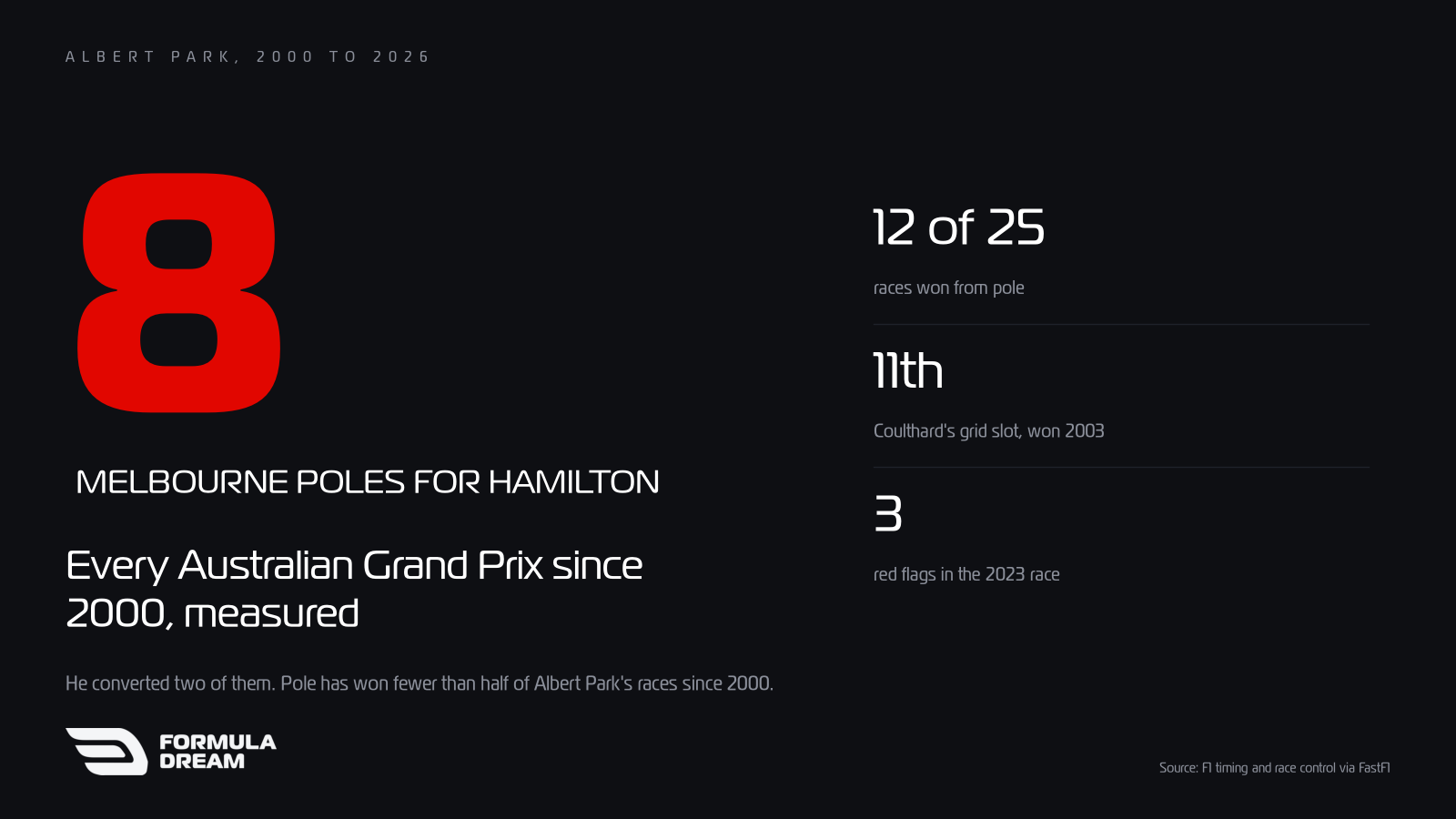
Every Australian Grand Prix winner since 2000, measured: Hamilton's eight poles, and the race that needed three red flags
Twenty-five Australian Grands Prix have been held at Albert Park since 2000. Lewis Hamilton took pole eight times and won twice, David Coulthard won from eleventh, and the 2023 race was stopped three times. Every winner, grid slot, safety car and red flag, measured.
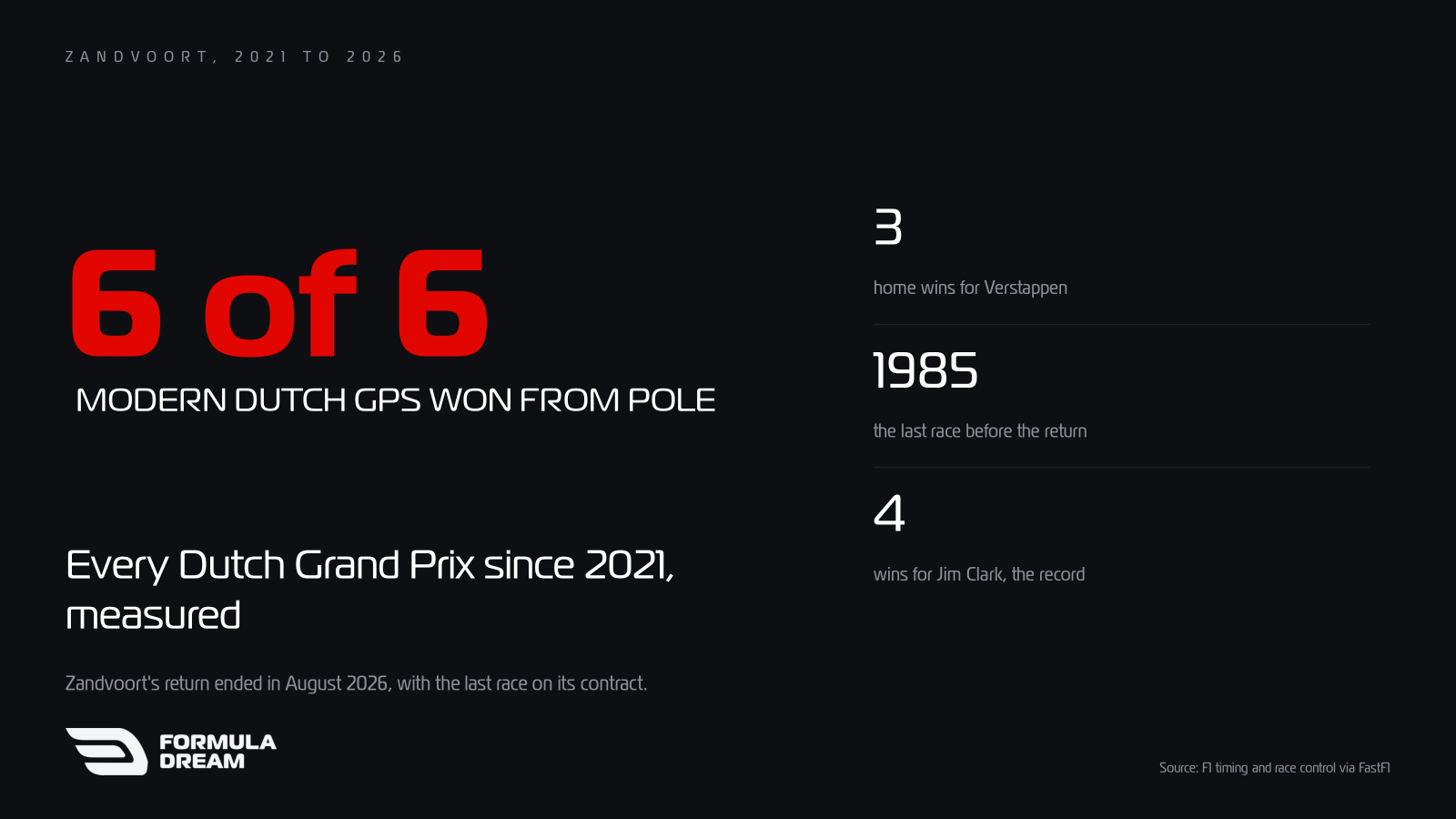
Every Dutch Grand Prix winner since 2021, measured: six races, six wins from pole, and the last one at Zandvoort
Formula 1 returned to Zandvoort in 2021 and left again after the 2026 race, the last on its contract. Every one of the six modern Dutch Grands Prix was won from pole. Max Verstappen won the first three at home. Every winner, grid slot and safety car, measured, and the history before 1985.
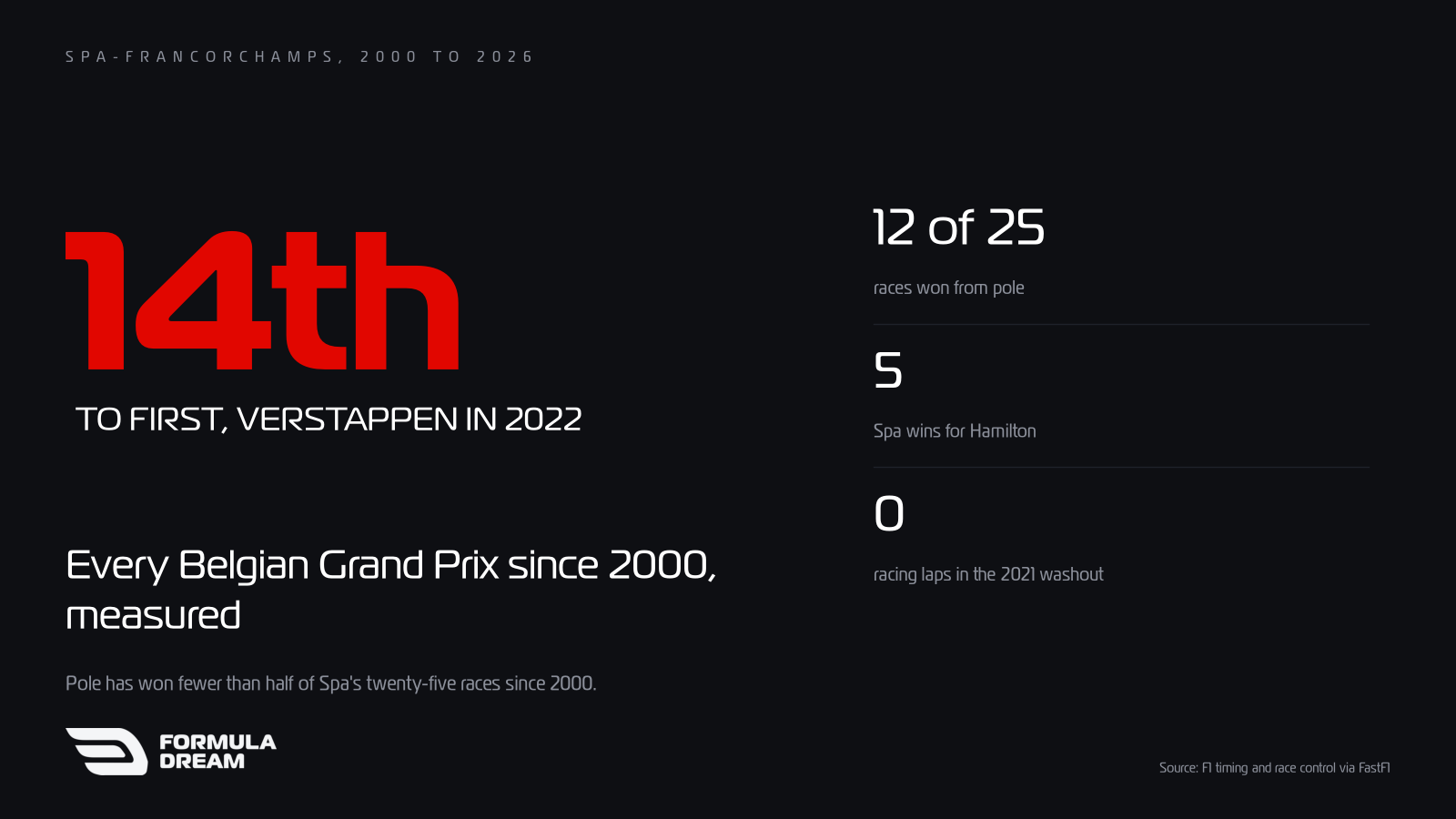
Every Belgian Grand Prix winner since 2000, measured: Spa's comebacks, disqualifications and a race with no racing
Twenty-five Belgian Grands Prix have been held at Spa-Francorchamps since 2000. Pole won twelve. Max Verstappen won from fourteenth in 2022, George Russell lost a win to the scales in 2024, and in 2021 the race ran entirely behind the safety car. Every winner, grid slot and safety car, measured.
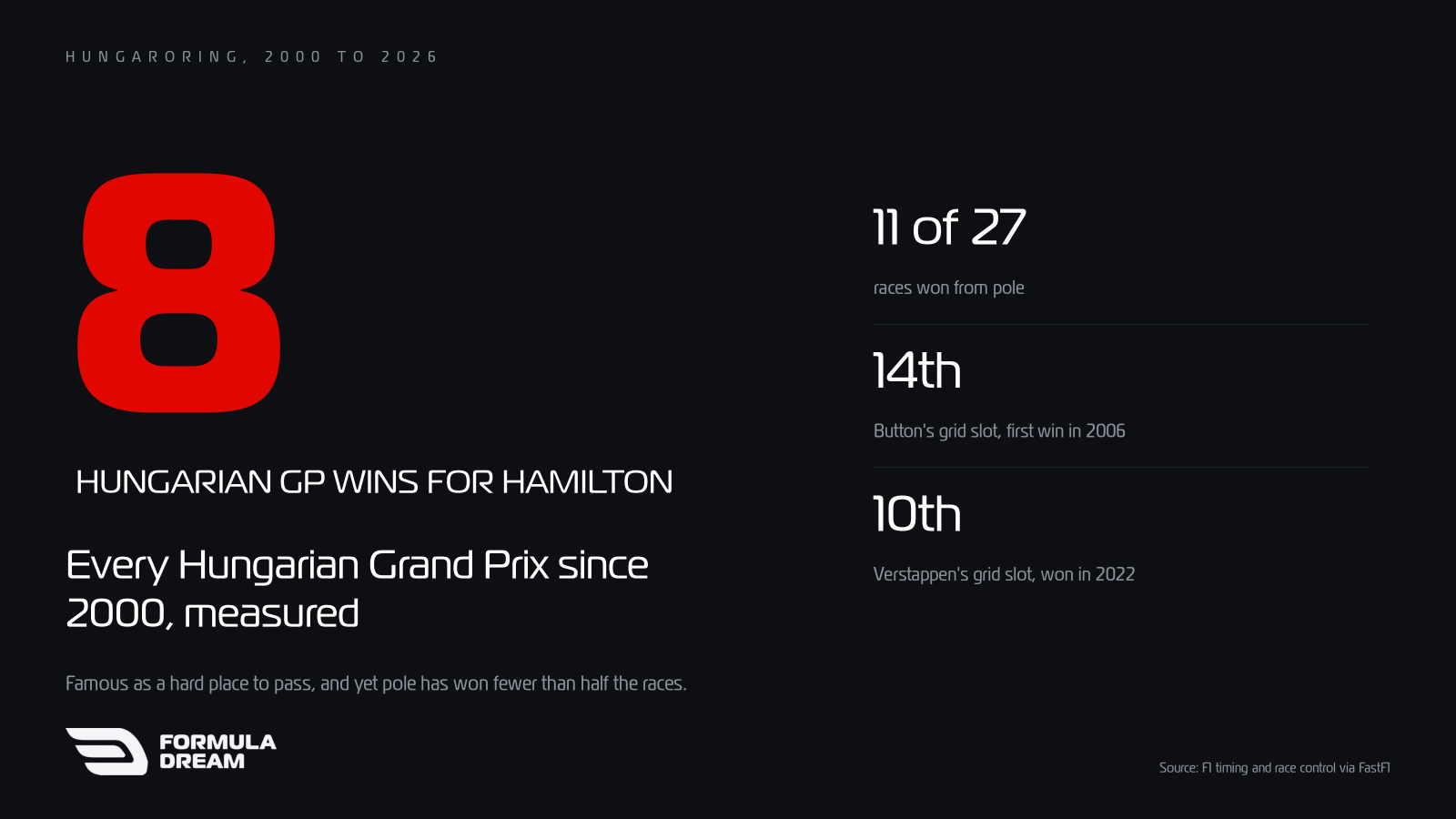
Every Hungarian Grand Prix winner since 2000, measured: Hamilton's eight, and the first wins it keeps producing
Twenty-seven Hungarian Grands Prix have been held at the Hungaroring since 2000. Lewis Hamilton won eight, pole won only eleven, and the race has produced a remarkable run of first wins, from Alonso in 2003 to Ocon in 2021 and Piastri in 2024. Every winner, grid slot and safety car, measured.
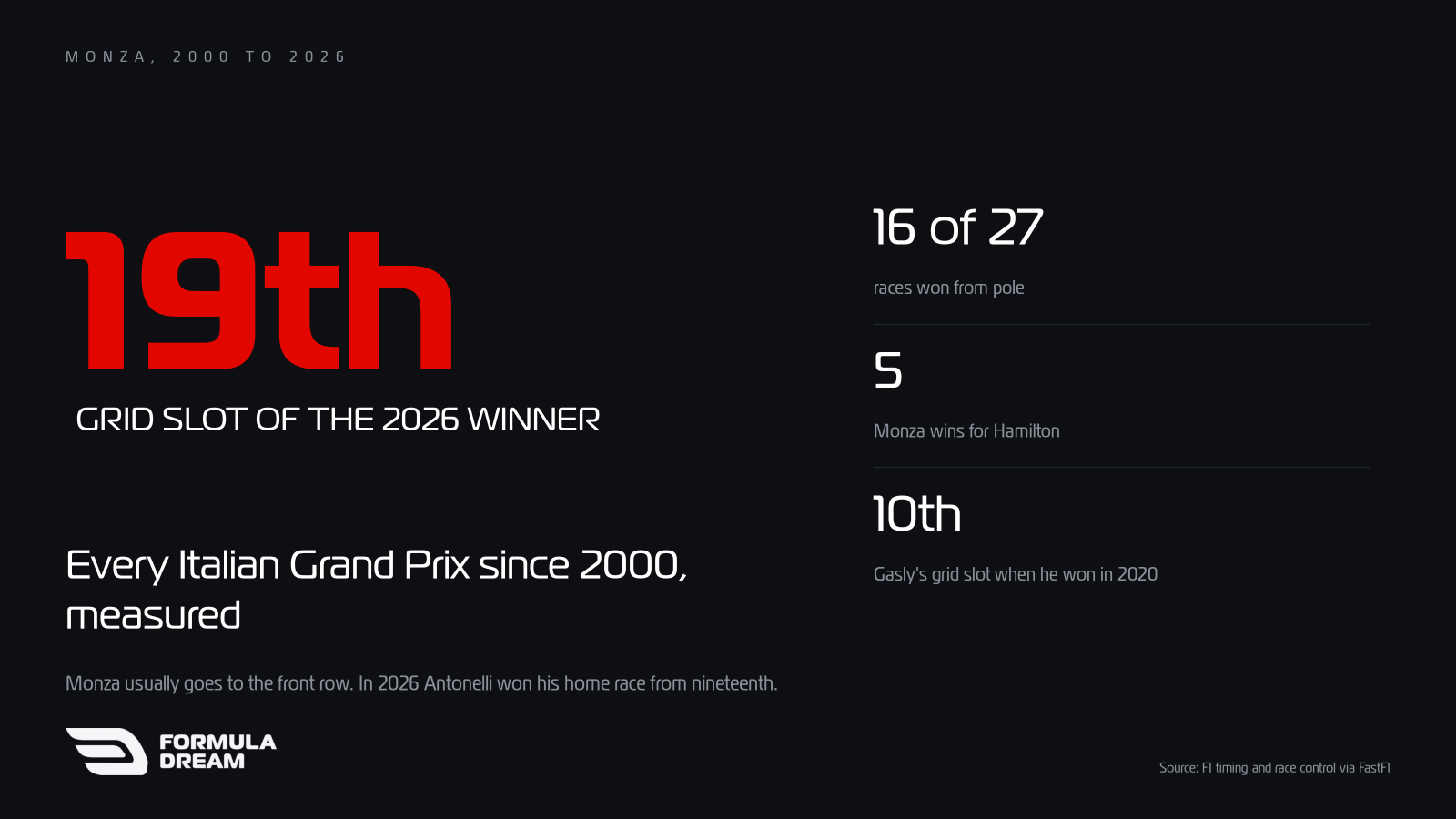
Every Italian Grand Prix winner since 2000, measured: Monza belongs to the front row, except when it does not
Twenty-seven Italian Grands Prix have been held at Monza since 2000, and pole won sixteen. The exceptions are some of the strangest wins of the era: Gasly from tenth in 2020, and Kimi Antonelli from nineteenth at his home race in 2026. Every winner, grid slot, safety car and red flag, measured.
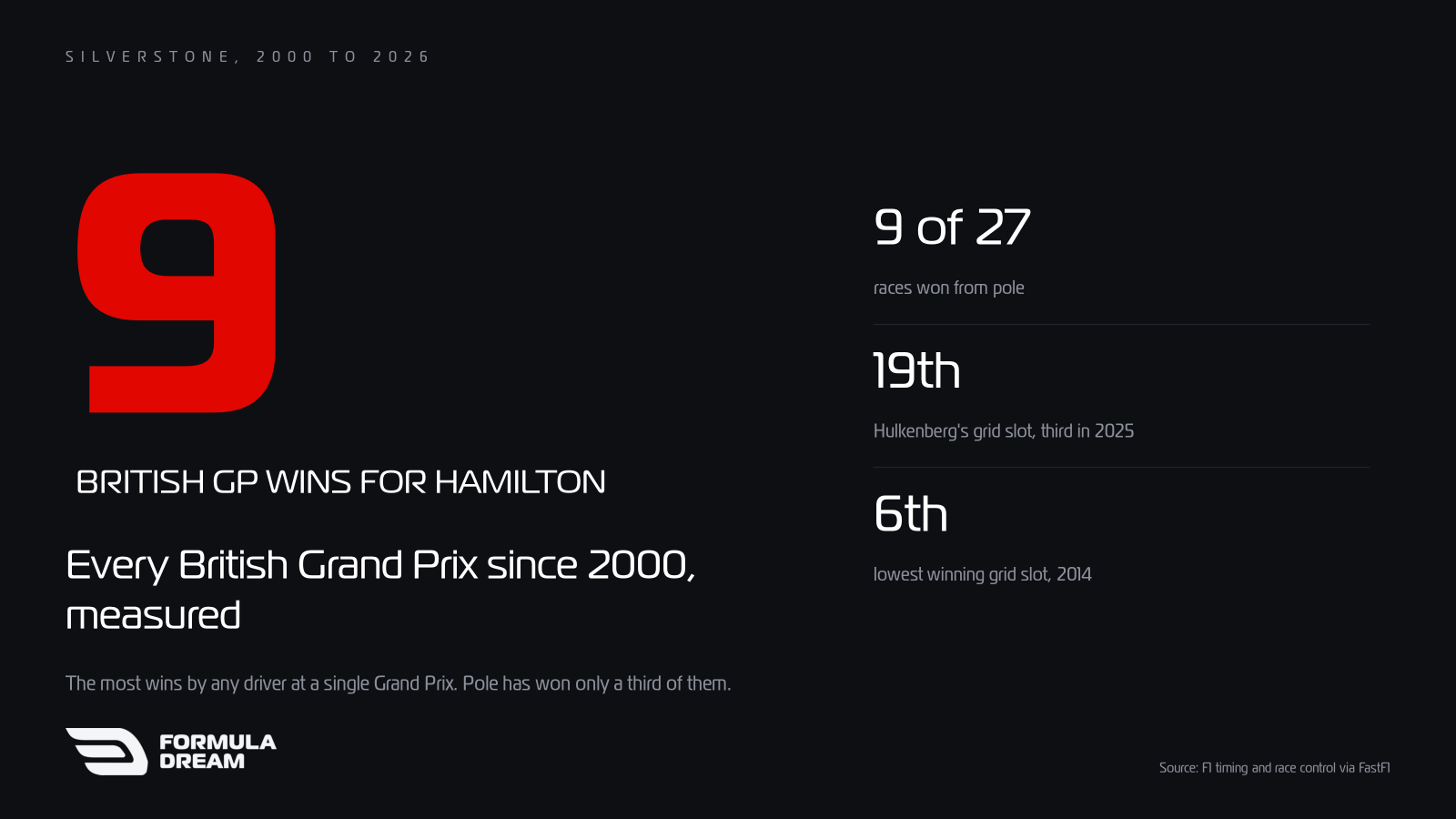
Every British Grand Prix winner since 2000, measured: Hamilton's nine, and why pole wins only a third of the time
Lewis Hamilton has won the British Grand Prix nine times, more than any driver has won any single Grand Prix. Yet since 2000 pole has won only nine of the twenty-seven races at Silverstone. Every winner, grid slot, safety car and red flag, measured, and the radio from the last three.
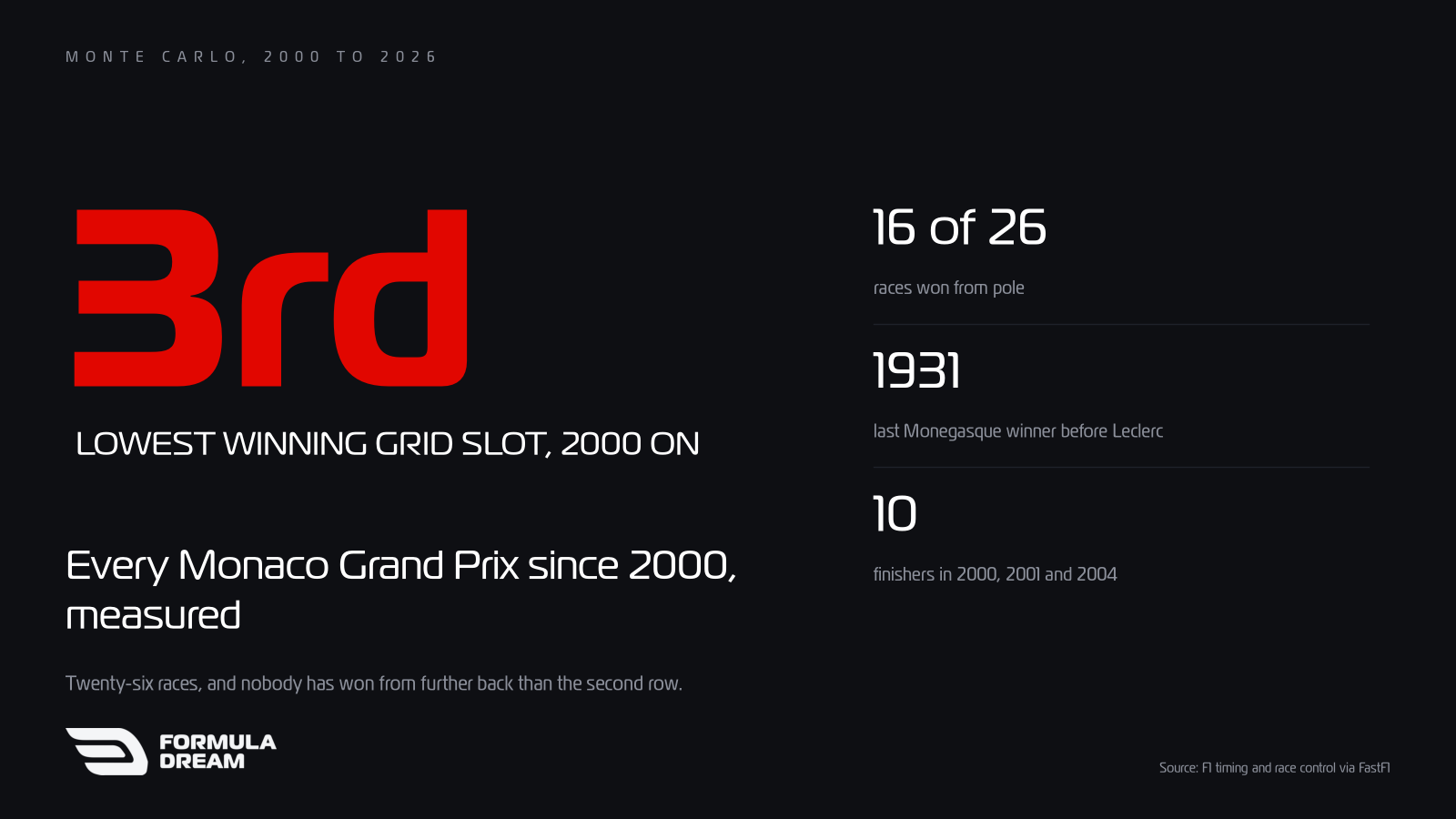
Every Monaco Grand Prix winner since 2000, measured: 26 races, and nobody has won from further back than third
Twenty-six Monaco Grands Prix have been held since 2000, and no winner started lower than third. Pole won sixteen. Charles Leclerc became the first Monegasque winner since 1931, and Kimi Antonelli won from pole in 2026. Every winner, grid slot, safety car and red flag, measured.
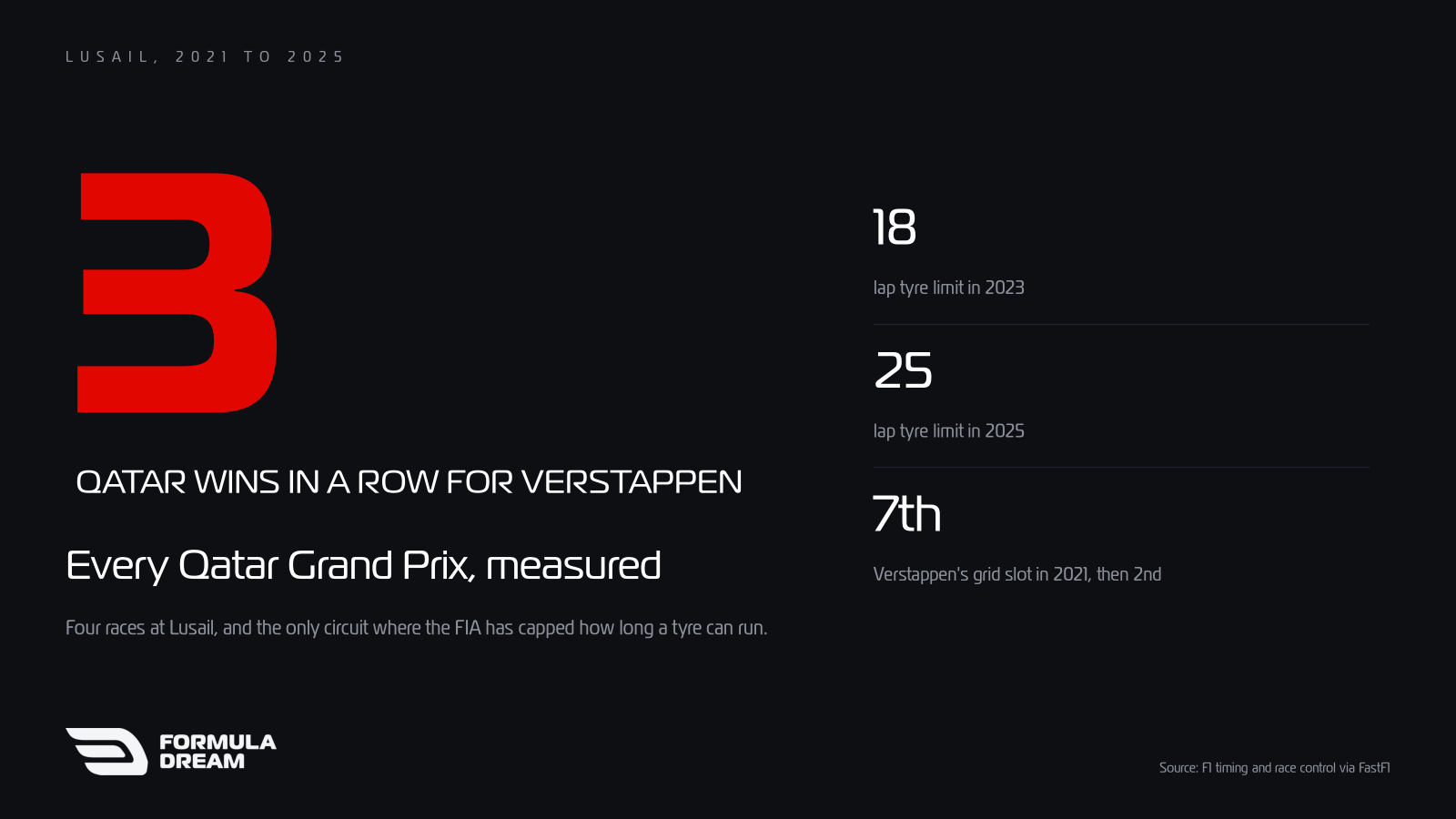
Every Qatar Grand Prix winner, measured: four races at Lusail, three for Verstappen, and the tyre limits no other circuit has needed
Four Qatar Grands Prix have been held at Lusail since 2021. Max Verstappen won the last three, Lewis Hamilton the first. It is the only circuit where the FIA has capped tyre life, twice, and the 2025 race was decided by a safety car McLaren chose not to use. Every race, measured.
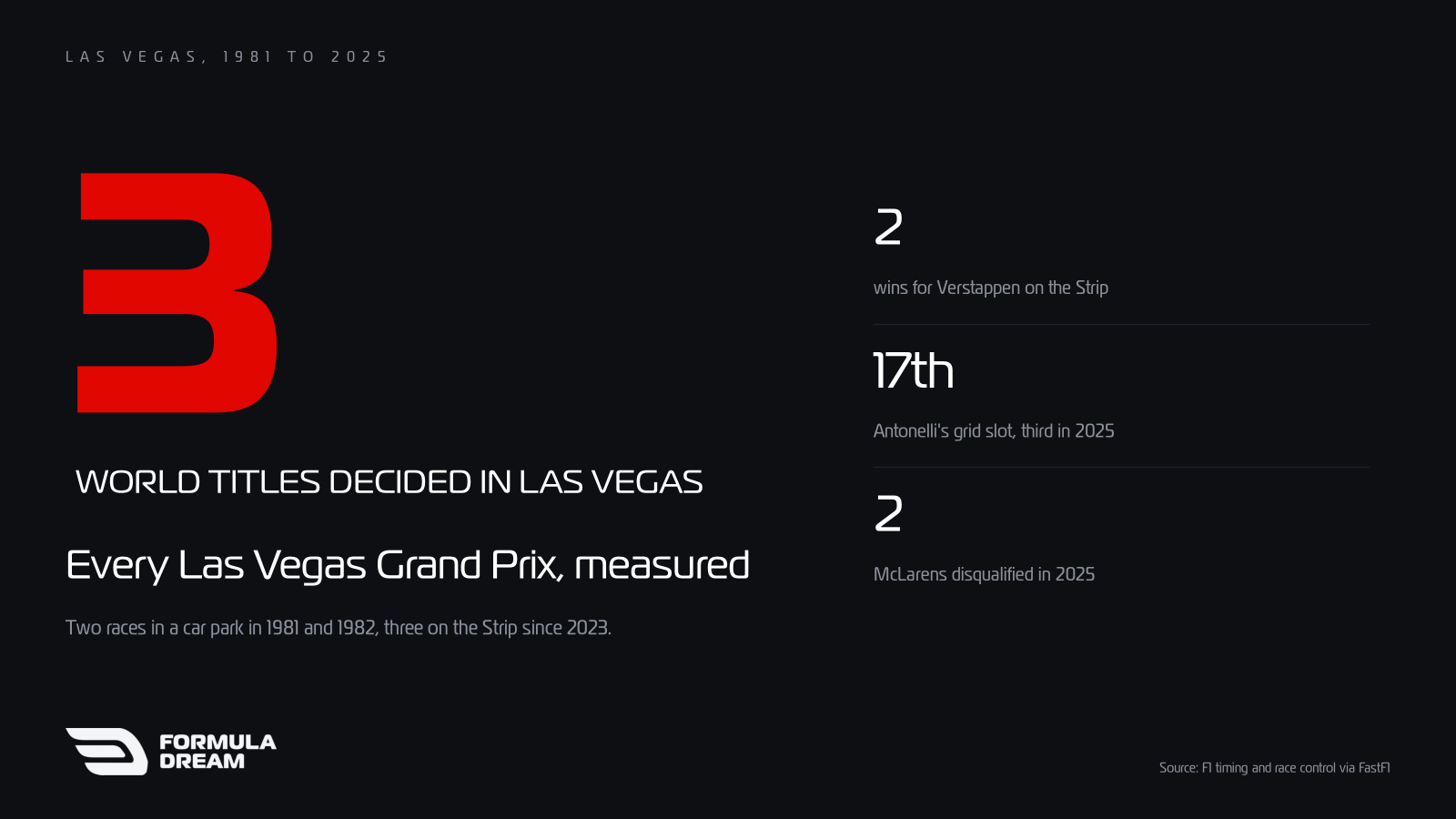
Every Las Vegas Grand Prix winner, measured: from a casino car park to the Strip, and three world titles decided
Formula 1 has raced in Las Vegas five times: twice in a Caesars Palace car park in 1981 and 1982, and three times on the Strip since 2023. Three world titles were settled there. Every winner, grid slot, safety car and disqualification, measured.
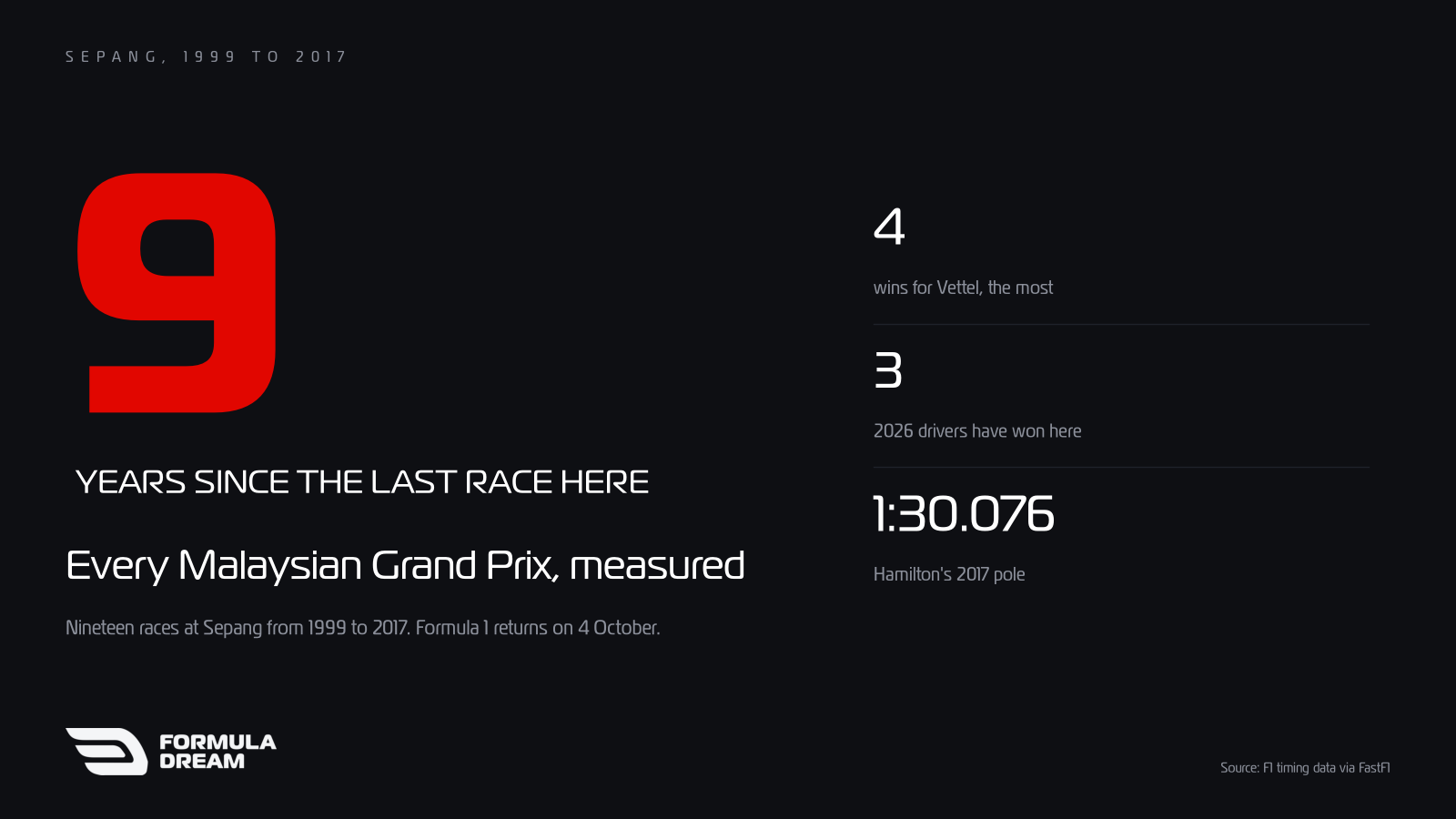
Every Malaysian Grand Prix winner, measured: 19 races at Sepang, and the three 2026 drivers who have won there
Formula 1 raced at Sepang nineteen times, from 1999 to 2017, and returns on 4 October 2026 for the relocated Bahrain Grand Prix. Sebastian Vettel won four, pole won nine, and three drivers on the 2026 grid have won there. Every winner, grid slot and story, measured.
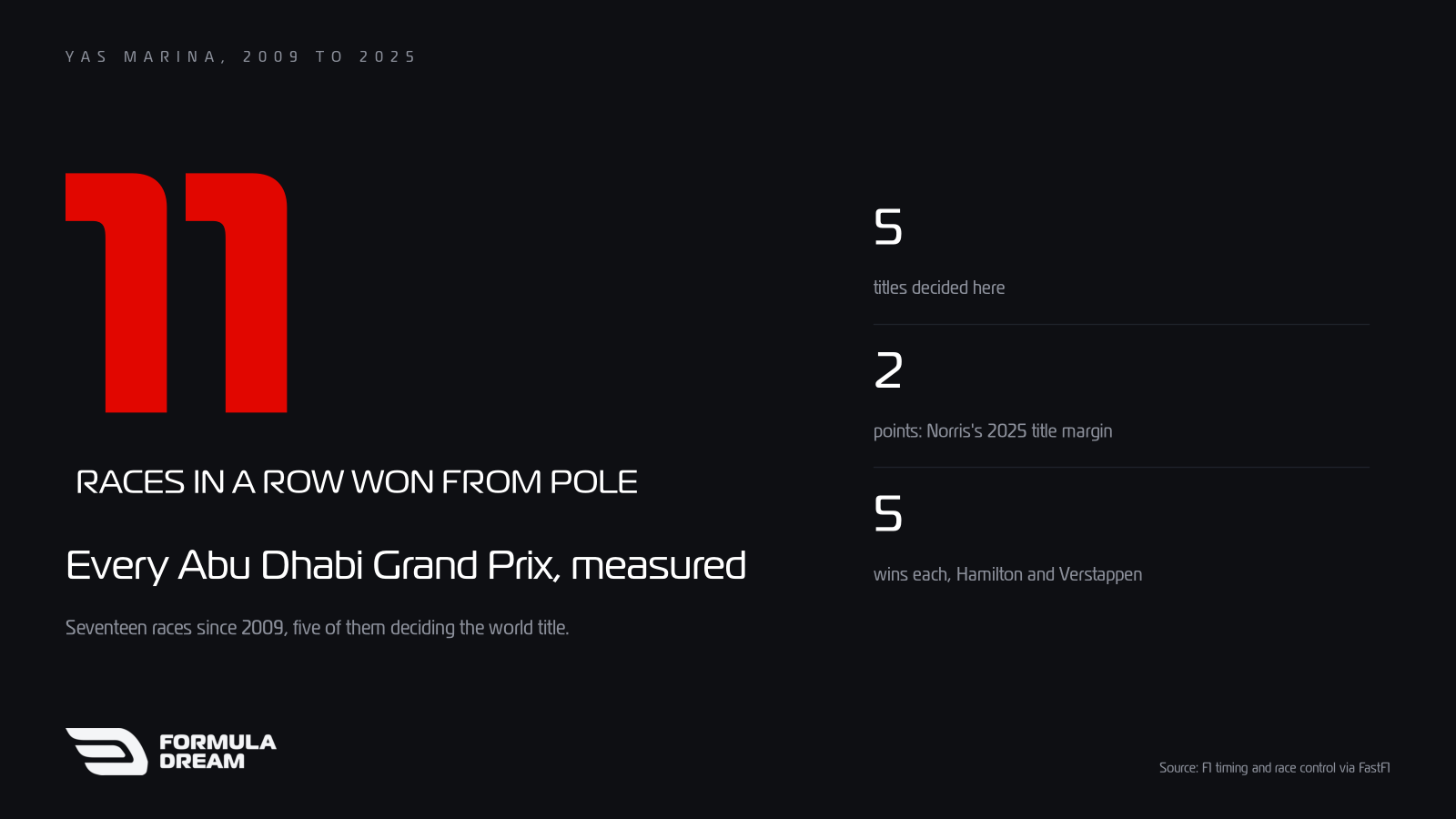
Every Abu Dhabi Grand Prix winner, measured: eleven poles in a row converted, and five titles decided
Seventeen Abu Dhabi Grands Prix have been held at Yas Marina since 2009. Pole has won the last eleven in a row. Five world titles were decided there, from Vettel's first in 2010 to Norris's by two points in 2025. Every winner, grid slot and safety car, measured.
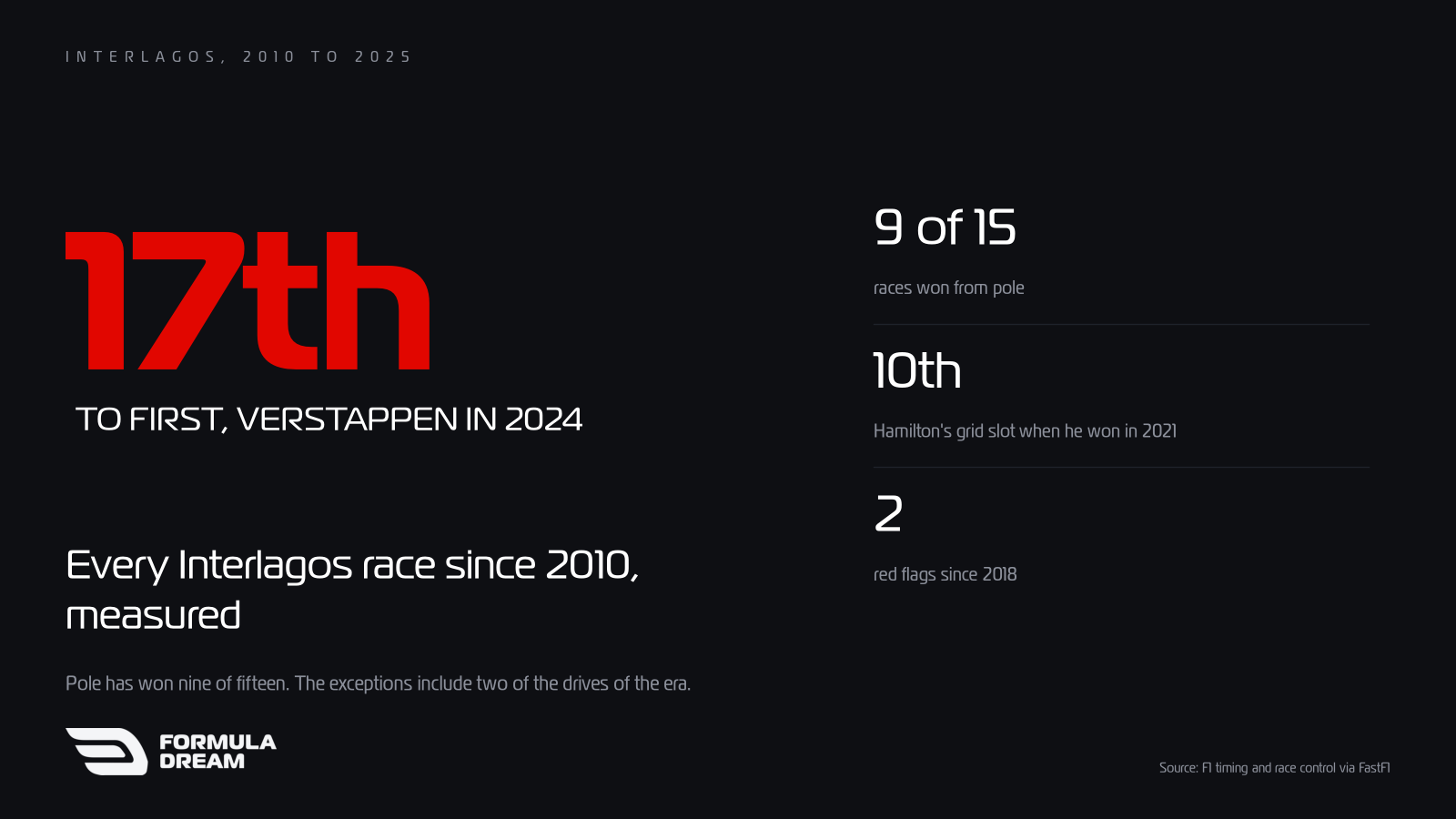
Every Sao Paulo and Brazilian Grand Prix winner since 2010, measured: pole usually wins at Interlagos, except when it really does not
Fifteen Formula 1 races have been held at Interlagos since 2010. Pole won nine of them. The other six include Max Verstappen's win from seventeenth in the rain in 2024 and Lewis Hamilton's from tenth in 2021. Every winner, grid slot and safety car, measured.
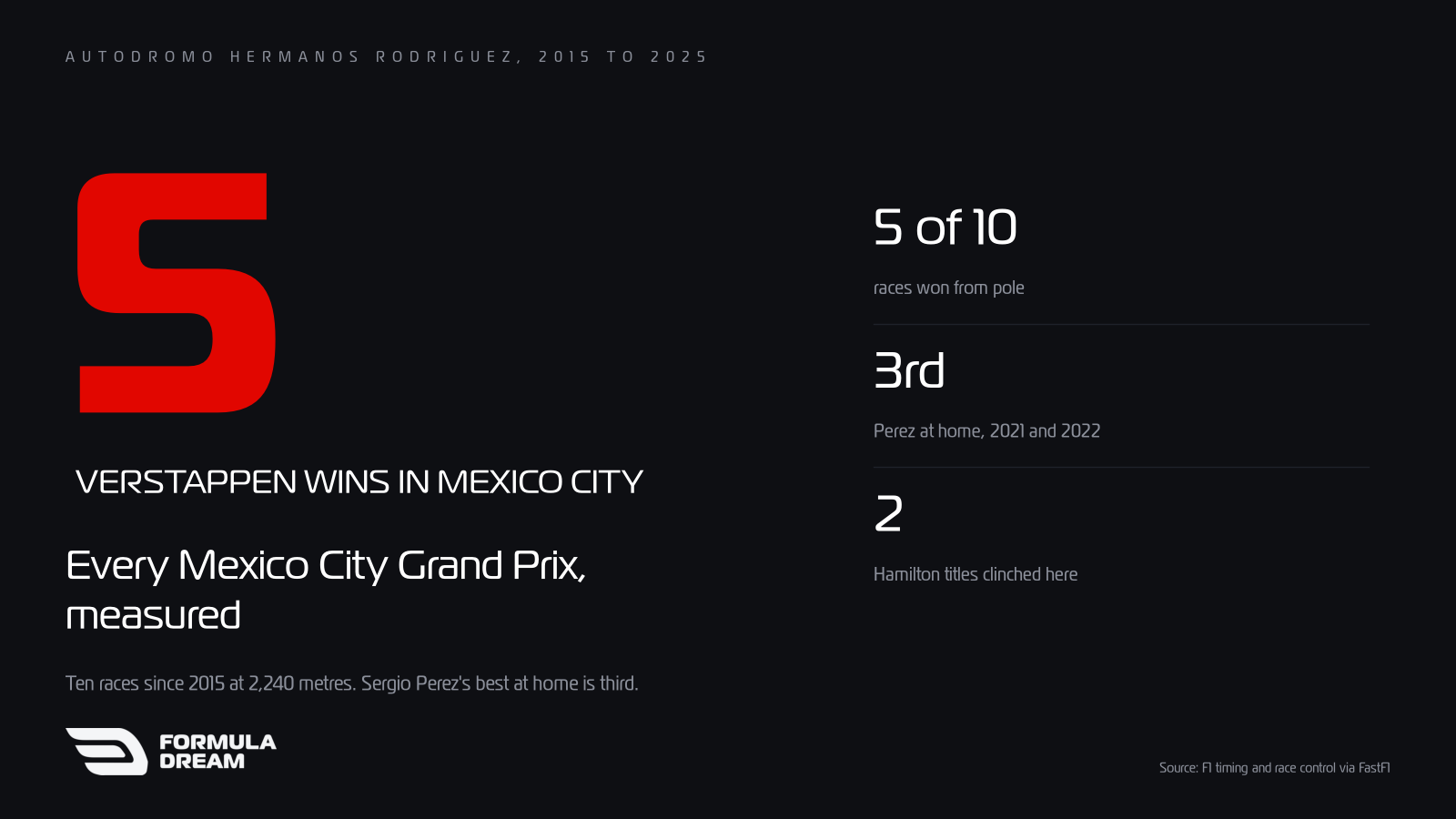
Every Mexico City Grand Prix winner, measured: ten races since 2015, five for Verstappen
Ten Formula 1 races have been held in Mexico City since the Grand Prix returned in 2015. Max Verstappen won five, pole has won five, Lewis Hamilton clinched two titles here, and Sergio Perez's best at home is third. Every winner, grid slot and safety car, measured.
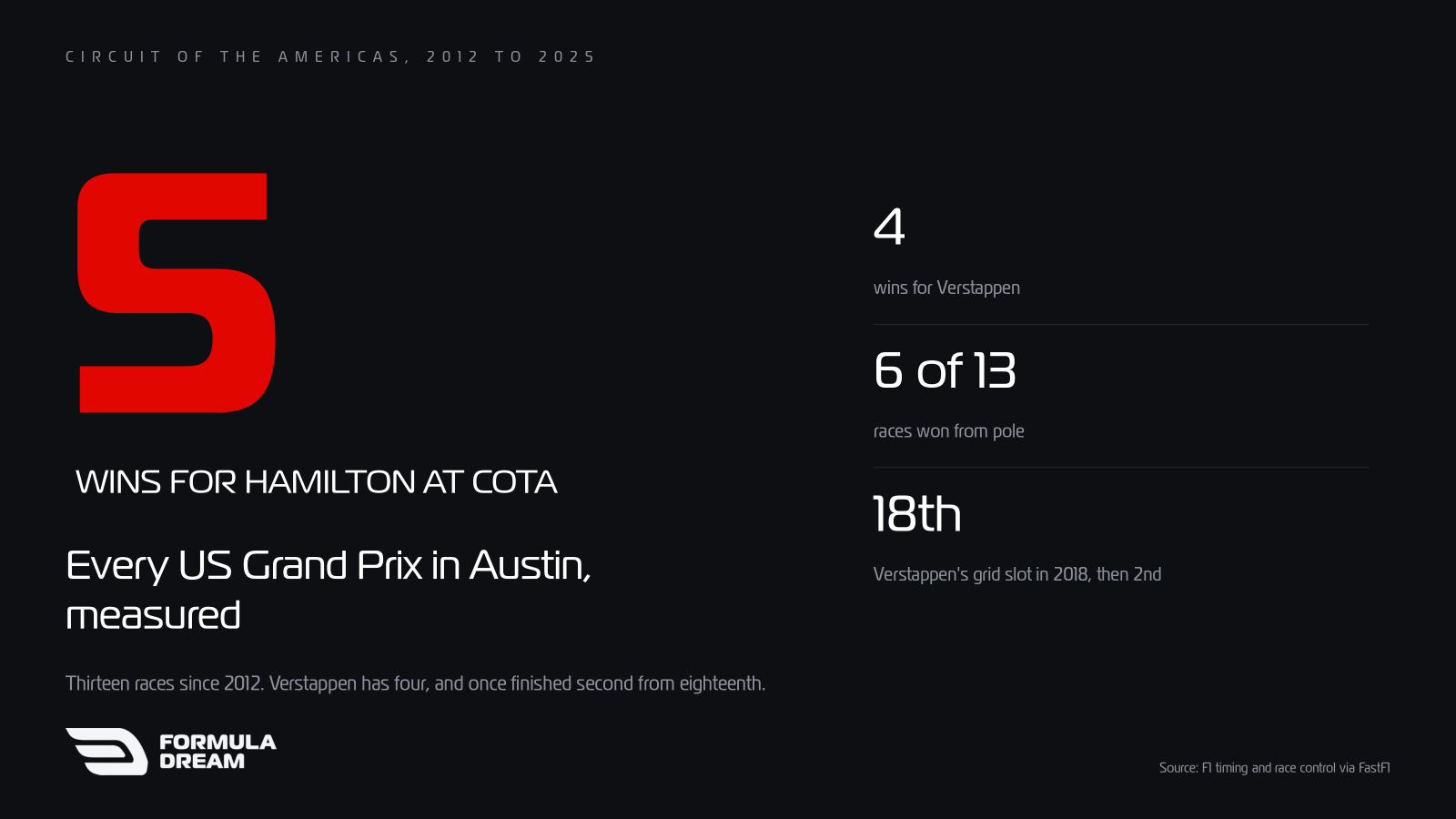
Every United States Grand Prix winner at COTA, measured: 13 races in Austin, Hamilton five, Verstappen four
Thirteen United States Grands Prix have been held at the Circuit of the Americas since 2012. Lewis Hamilton won five, Max Verstappen four, and pole has won six. Unlike Baku or Singapore, safety cars are rare here. Every winner, grid slot and safety car, measured.
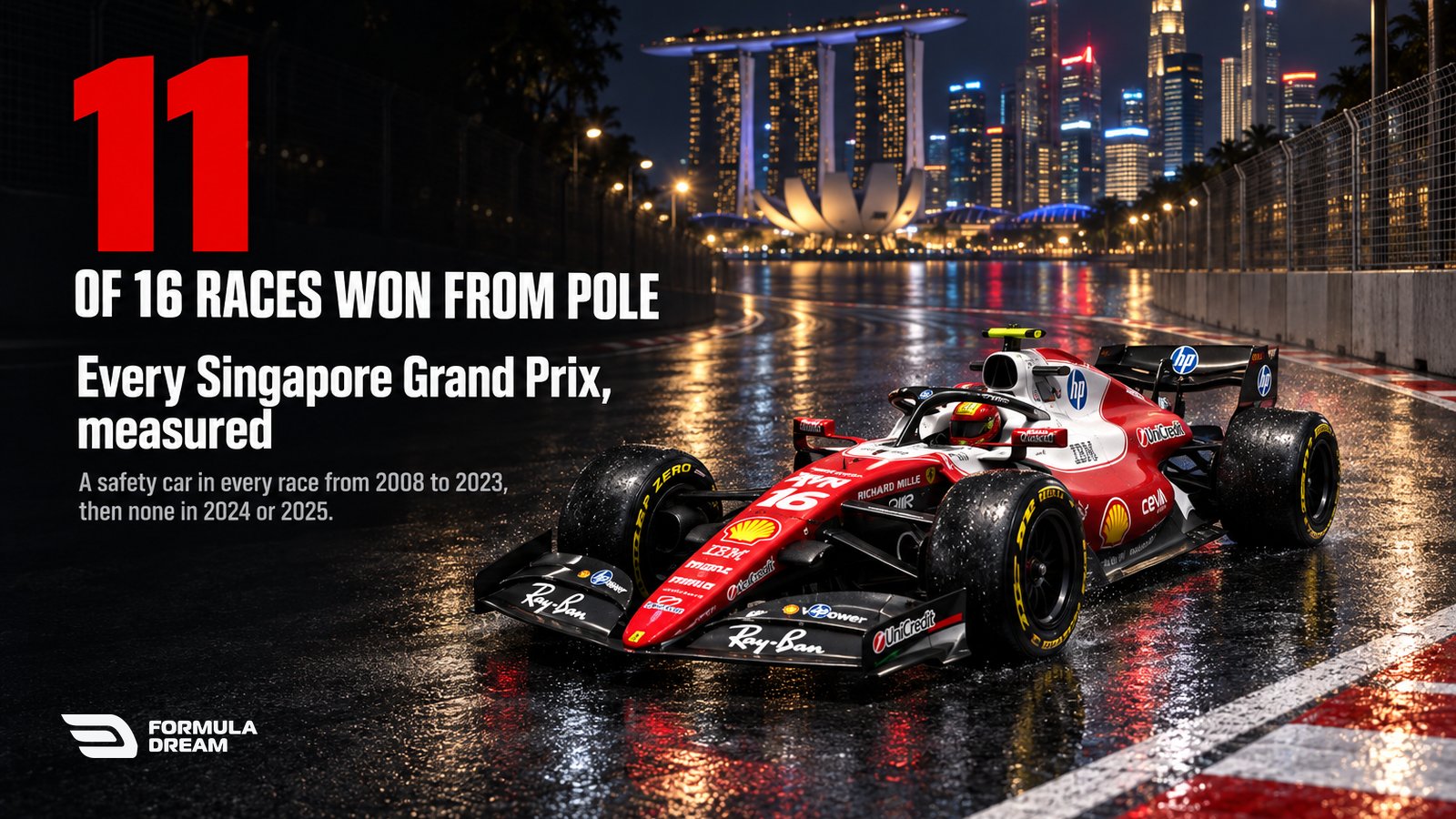
Every Singapore Grand Prix winner, measured: 16 races at night, 11 won from pole
Sixteen Formula 1 races have been held in Singapore since 2008. Eleven were won from pole, Sebastian Vettel won five, and a safety car came out in every race until 2024. The last two have had none. Every winner, grid slot and safety car, measured.
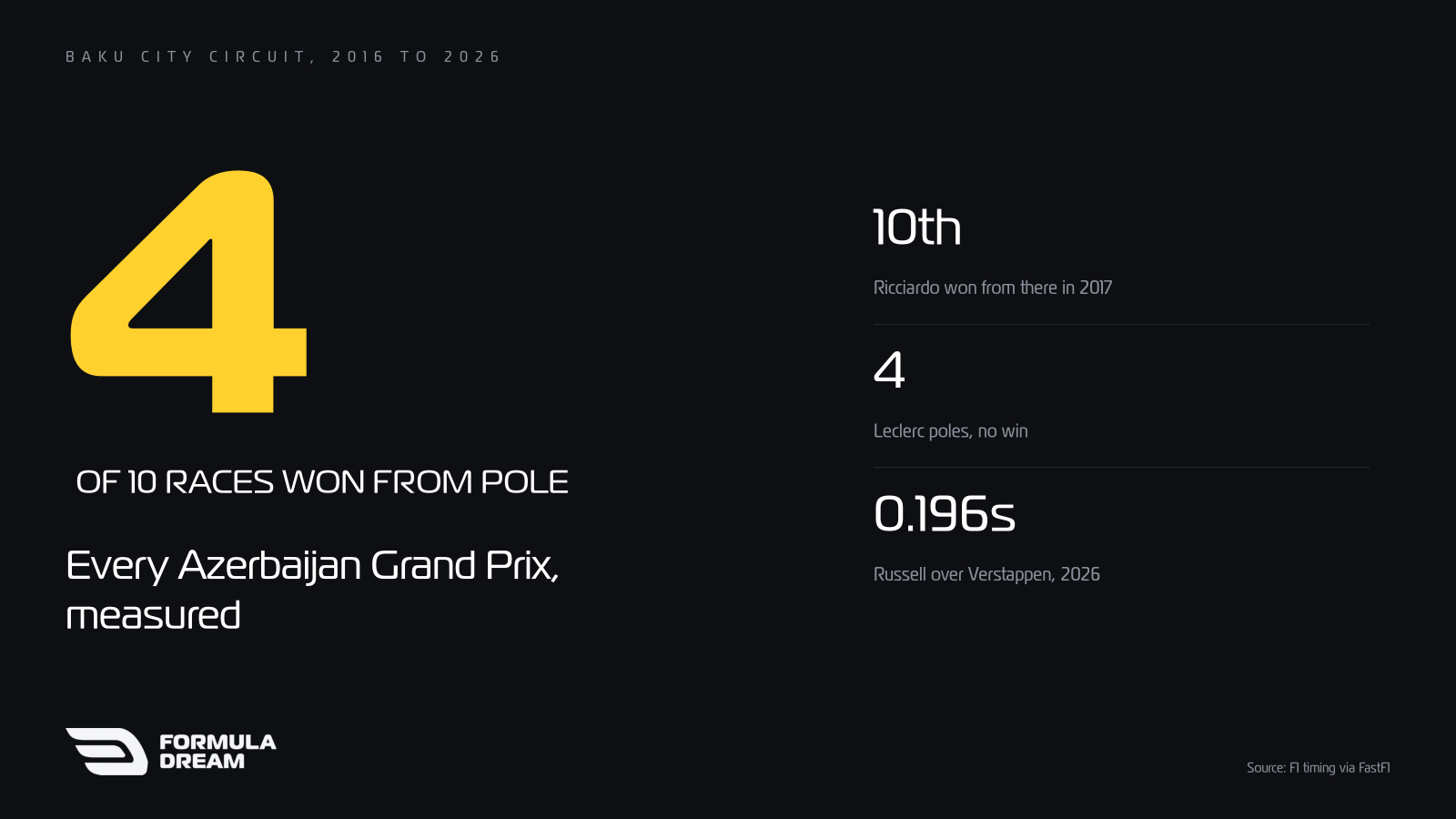
Every Azerbaijan Grand Prix winner, measured: ten races at Baku, four won from pole
Ten Formula 1 races have been held at the Baku City Circuit since 2016. Only four were won from pole, Charles Leclerc started first four years running without winning, and Daniel Ricciardo won from tenth. Every winner, grid slot, safety car and red flag, measured.
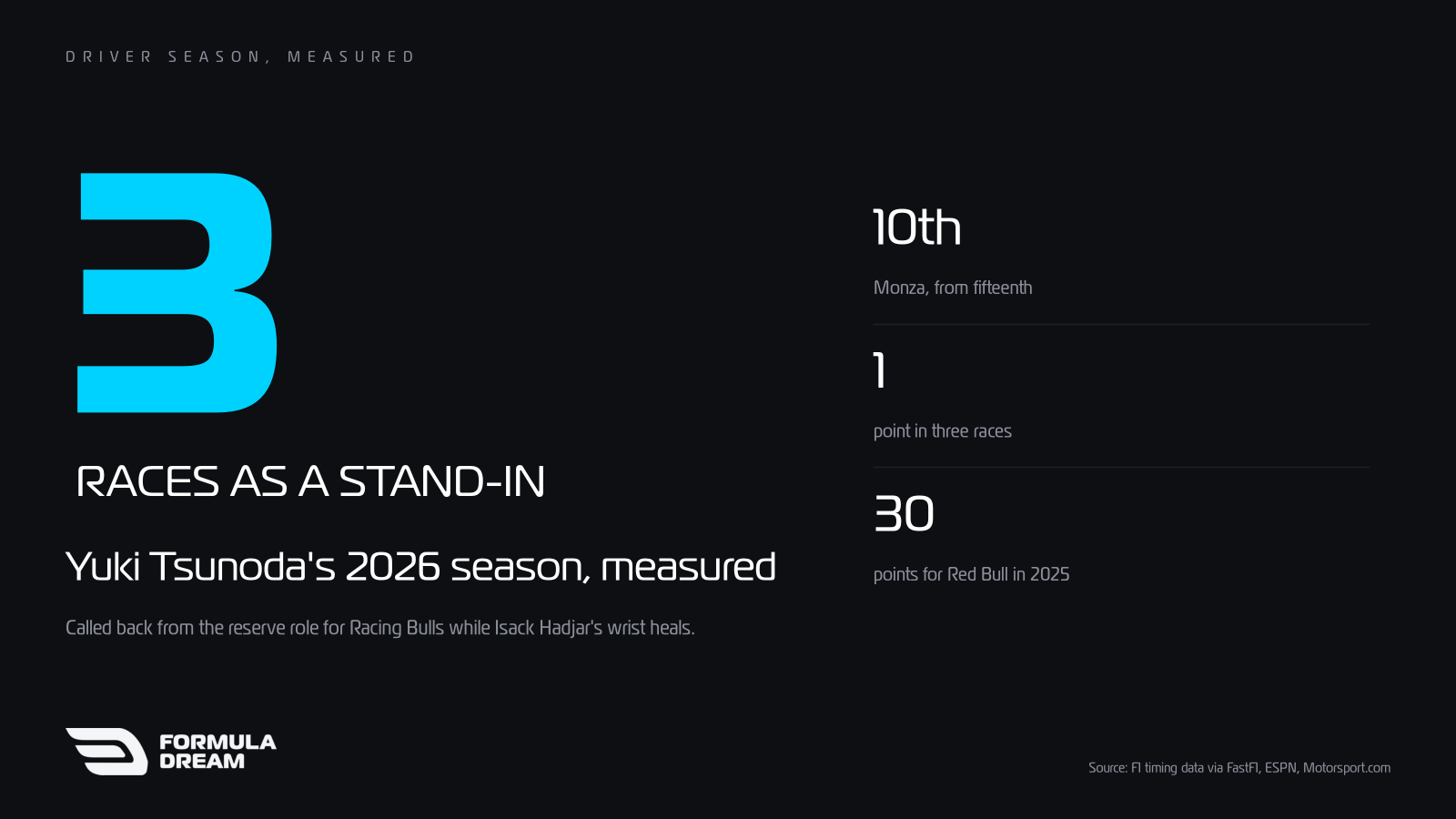
Yuki Tsunoda's 2026 season, measured: from Red Bull reserve to three races at Racing Bulls, and a point at Monza
Yuki Tsunoda lost his Red Bull seat at the end of 2025 and began 2026 as the team's reserve. When Isack Hadjar broke his wrist, he was called back to drive for Racing Bulls at Zandvoort, Monza and Madrid, and scored a point. Hadjar returned in Baku, and Tsunoda went back to the reserve role.
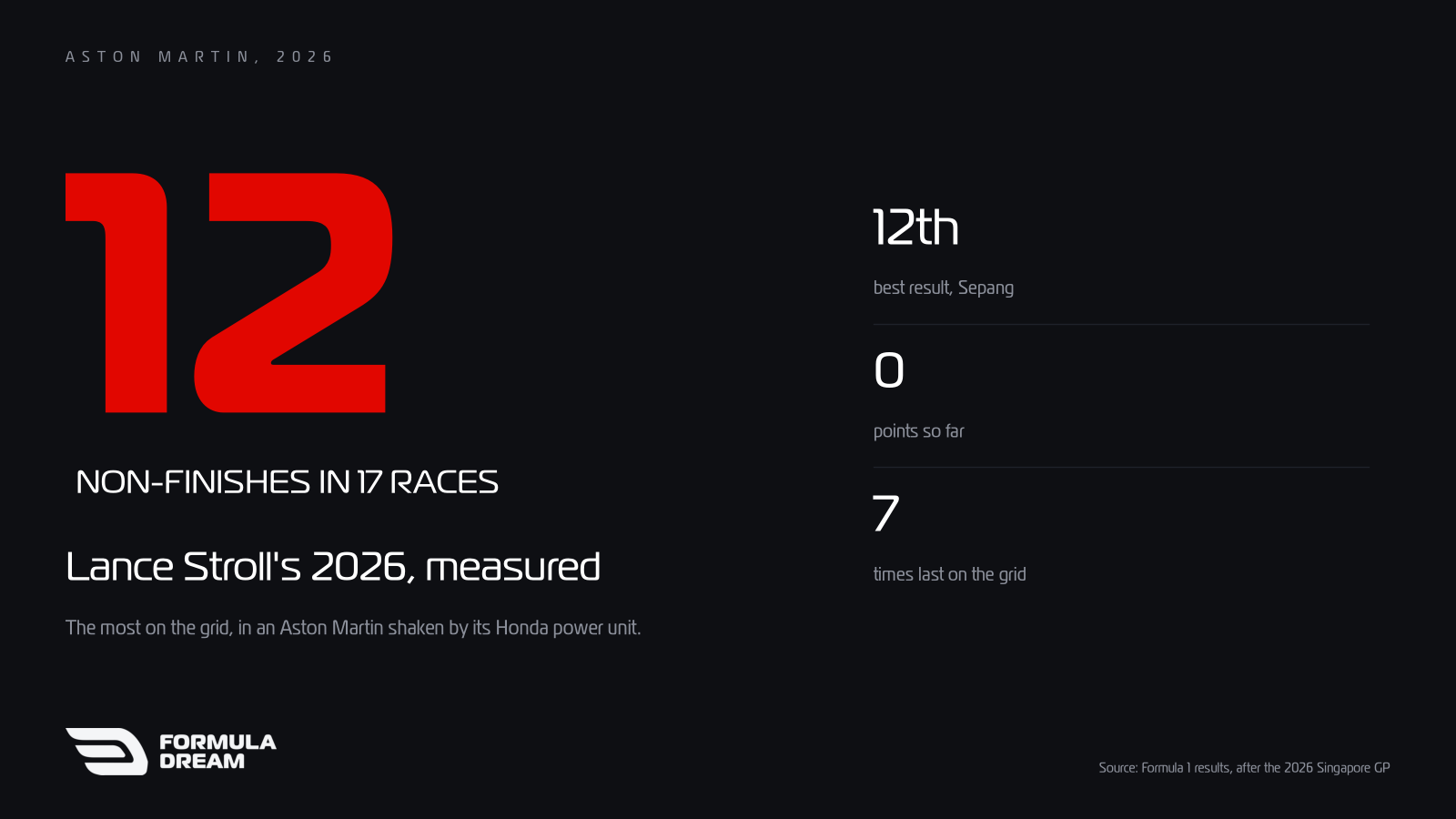
Lance Stroll's 2026 season, measured: twelve non-finishes in seventeen races, the most on the grid
Lance Stroll has failed to finish twelve of seventeen races in 2026, five more than any other driver, in an Aston Martin shaken by vibration from Honda's new power unit. His best result is twelfth, at Sepang. Every race, measured, and the radio.
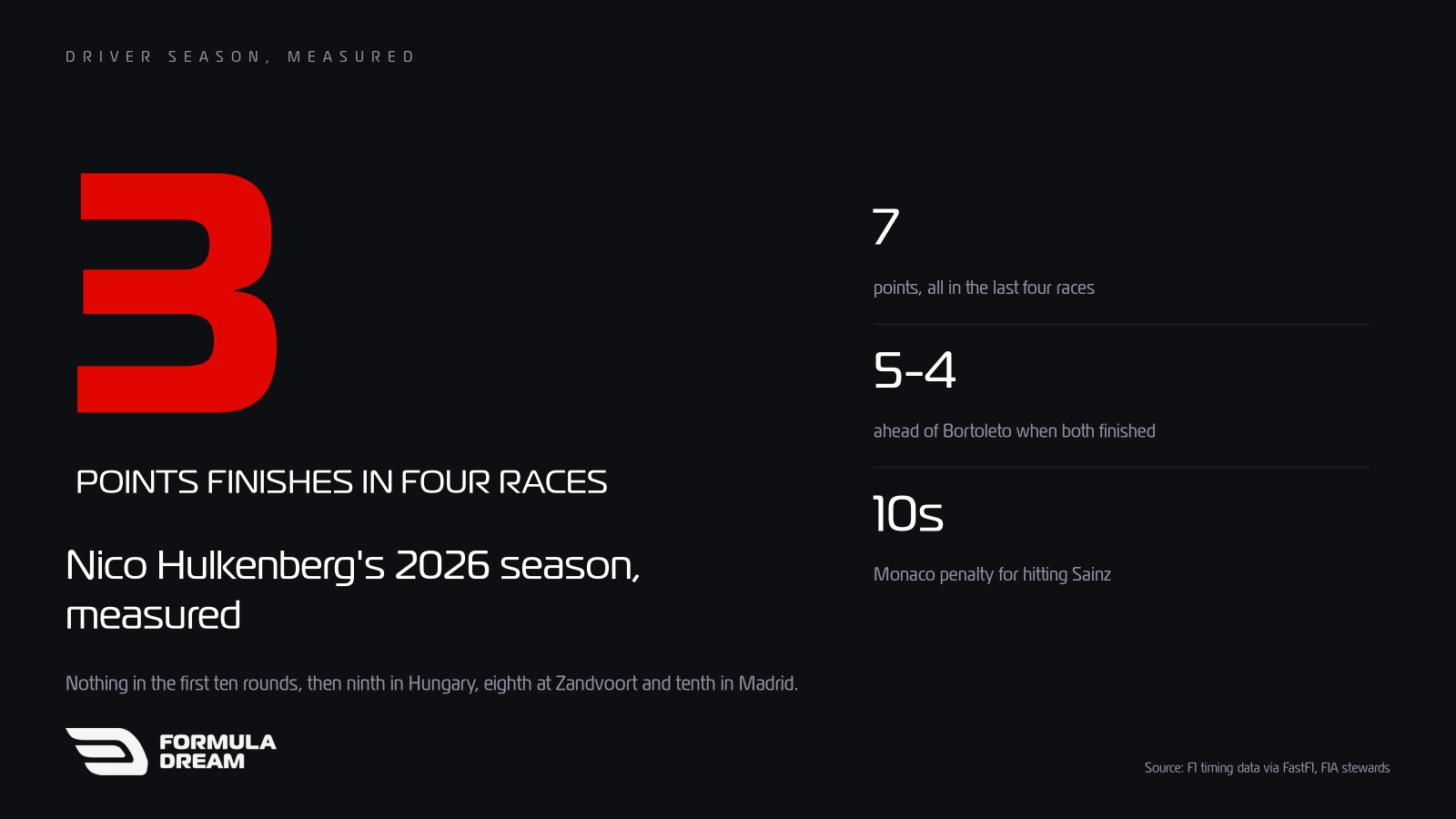
Nico Hulkenberg's 2026 season, measured: nothing for ten rounds, then points in three of the last four
Nico Hulkenberg did not score in the first ten rounds of Audi's first season, after a non-start in Melbourne, three retirements and a Monaco penalty. Then came ninth in Hungary, eighth at Zandvoort and tenth in Madrid. Every race, measured.
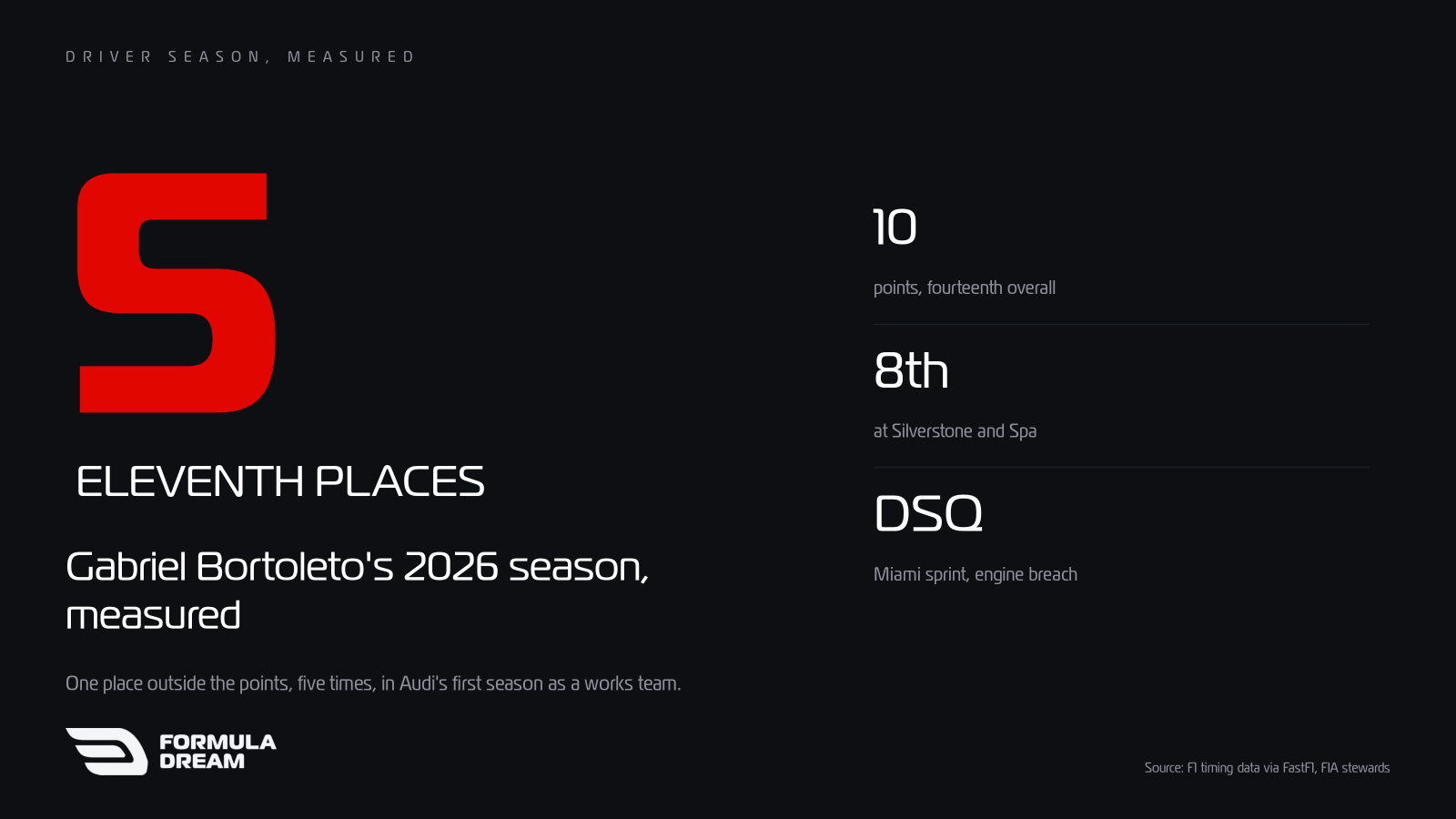
Gabriel Bortoleto's 2026 season, measured: eleventh five times, and the points that came at Silverstone and Spa
Gabriel Bortoleto has finished eleventh, one place outside the points, five times in 2026. His ten points came from ninth in Melbourne and eighth at Silverstone and Spa, in Audi's first season as a works team. Every race, measured, the Miami disqualification, and the radio.
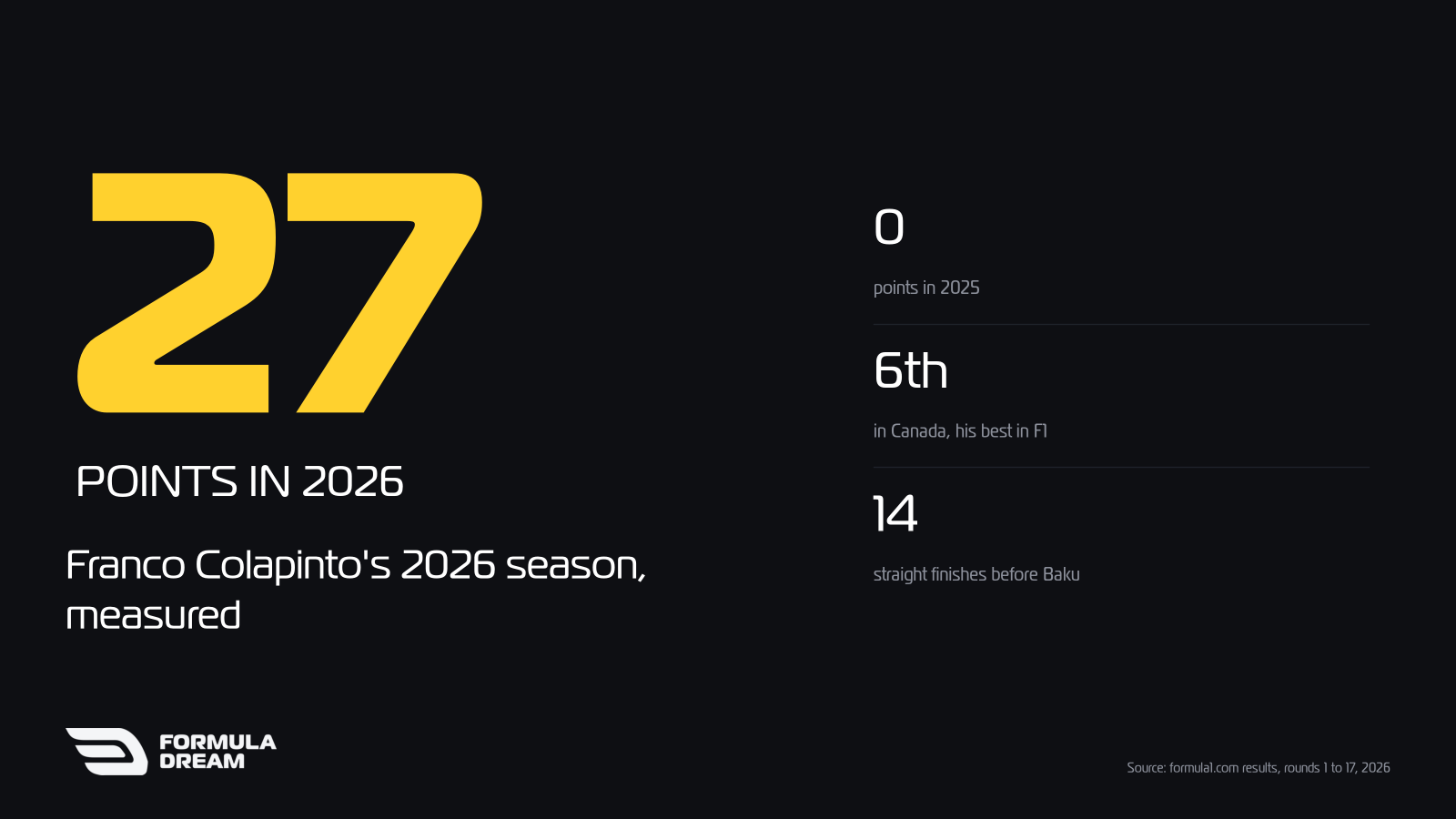
Franco Colapinto's 2026 season, measured: 27 points after a year with none, and a perfect finishing run that ended in Baku
Franco Colapinto went through 2025 without a point. In 2026 he has 27, a career-best sixth in Canada, and he finished the first fourteen races, the only driver to do so, before retiring in Baku and Singapore. Every race for the Alpine driver, measured, and the radio.
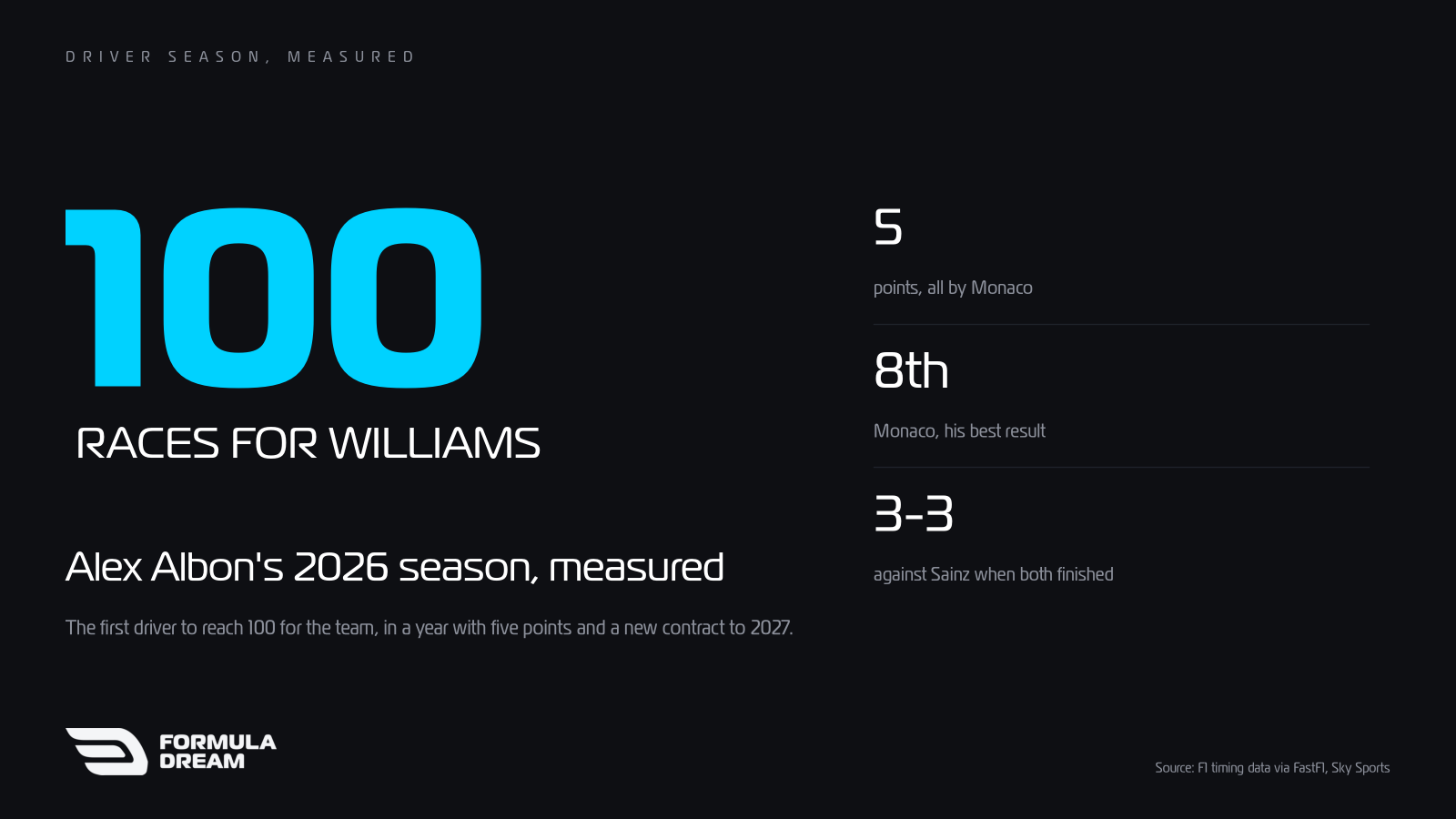
Alex Albon's 2026 season, measured: 100 races for Williams, five points, and a contract to 2027
Alex Albon became the first driver to start 100 races for Williams in 2026, in a season with five points, four retirements and a start he never made in China. In August the team extended his contract to 2027. Every race, measured, and the radio.
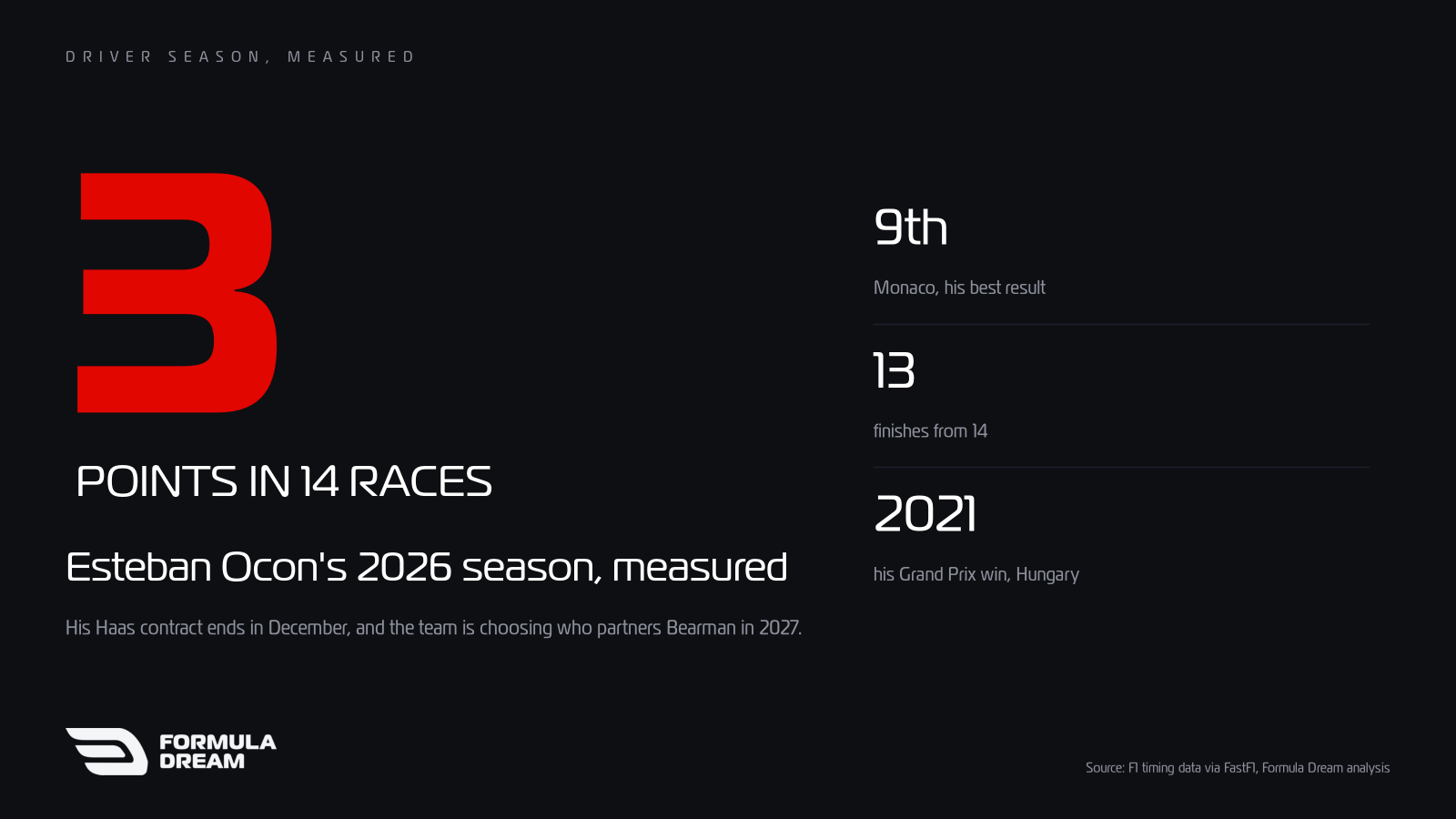
Esteban Ocon's 2026 season, measured: three points, thirteen finishes, and a Haas seat under review
Esteban Ocon has three points from fourteen races in 2026, and his Haas contract ends in December with the team weighing its 2027 line-up. He has finished thirteen of fourteen races. Every race, measured, and what he has said about his future.
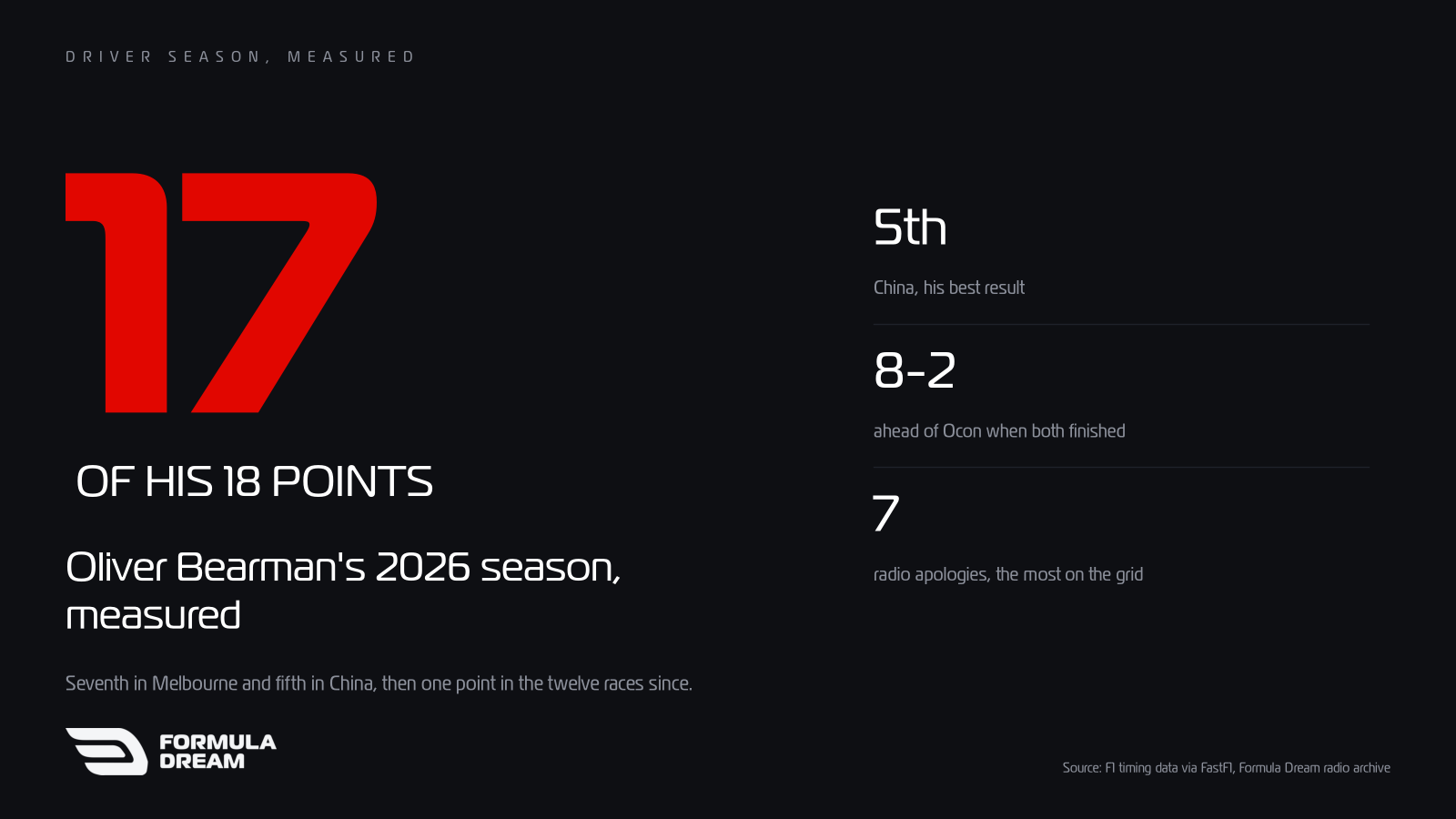
Oliver Bearman's 2026 season, measured: fifth in China, and one point since
Oliver Bearman scored 17 of his 18 points in the first two rounds of 2026, seventh in Melbourne and fifth in China. In the twelve races since he has one point and four retirements. Every race for the Haas driver, measured, and the radio.
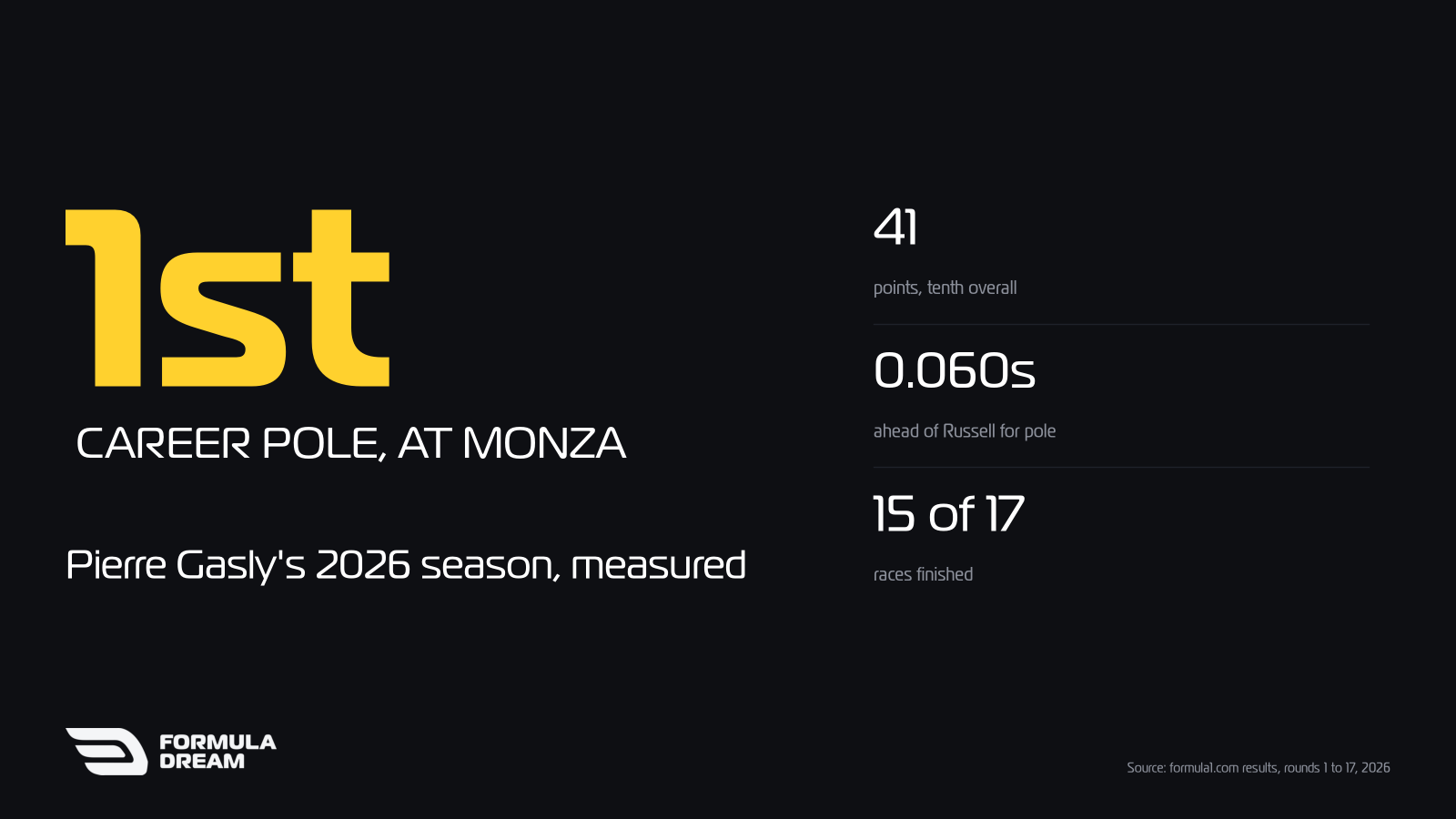
Pierre Gasly's 2026 season, measured: a first pole at Monza, and fifteen finishes from seventeen
Pierre Gasly took the first pole of his career at Monza in 2026, the first of the year not taken by Mercedes or McLaren. He has 41 points, tenth in the championship, and has retired twice in seventeen races. Every race, measured, and the radio from the pole lap.
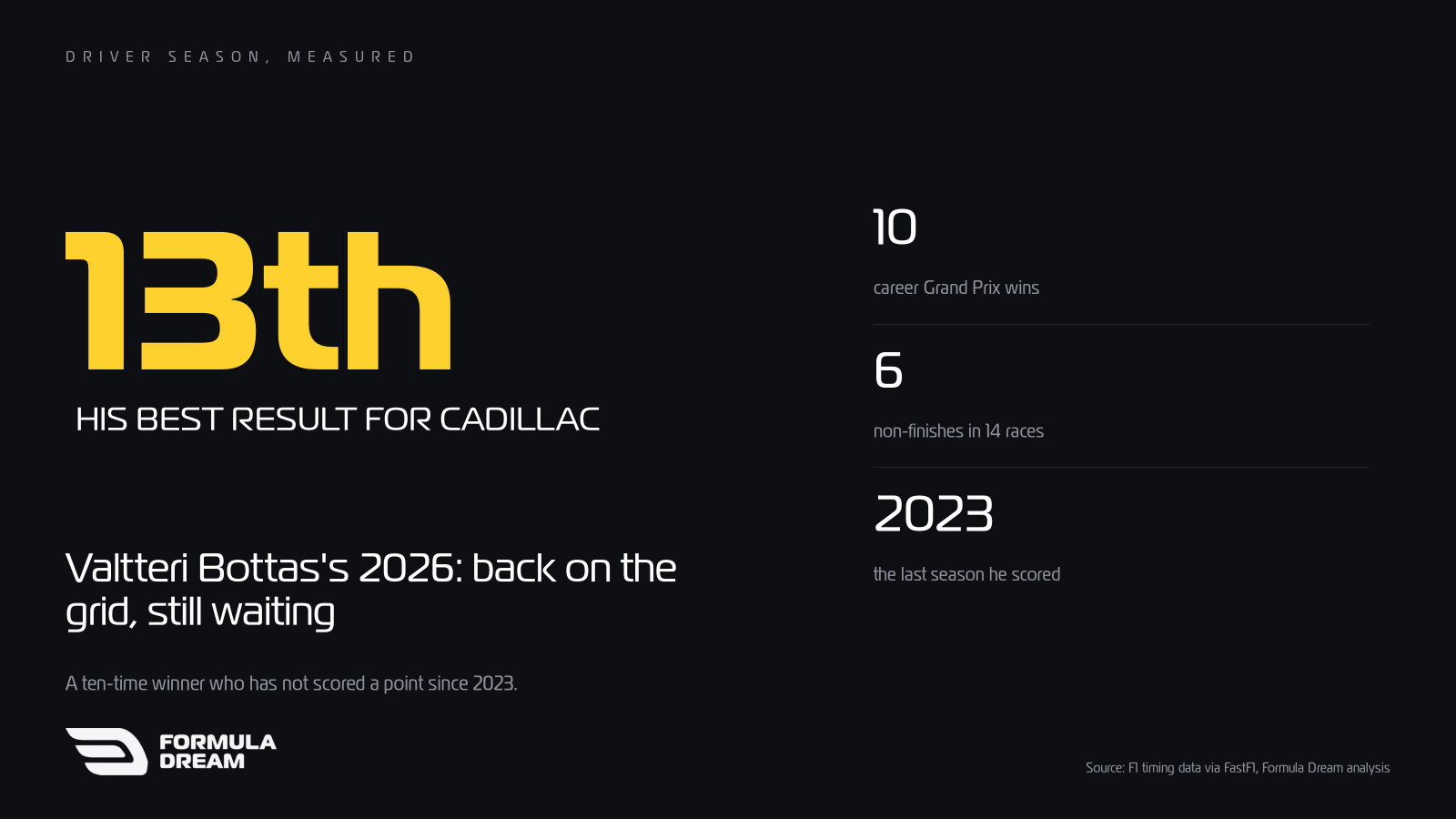
Valtteri Bottas's 2026 season, measured: back on the grid with Cadillac, and still waiting for a point
Valtteri Bottas won ten Grands Prix for Mercedes, went a whole season without a point at Sauber, spent 2025 as a reserve, and returned with Cadillac in 2026. Fourteen races in, his best result is thirteenth. Every race, measured.
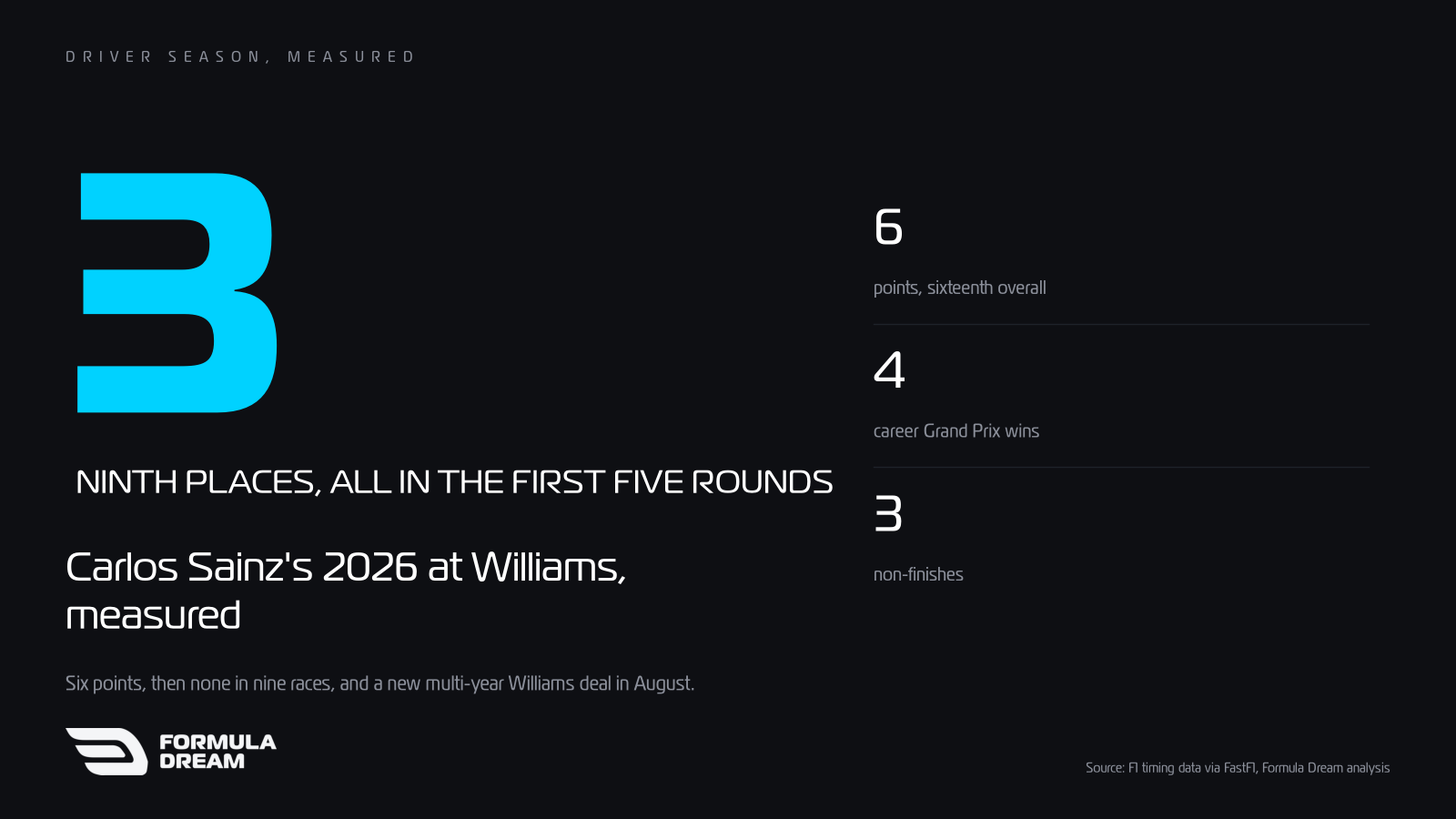
Carlos Sainz's 2026 season, measured: three ninth places, then nine races without a point
Carlos Sainz scored six points in the first five rounds of 2026, ninth three times, and none in the nine races since. In August he signed a new multi-year contract with Williams anyway. Every race, measured, and the radio.
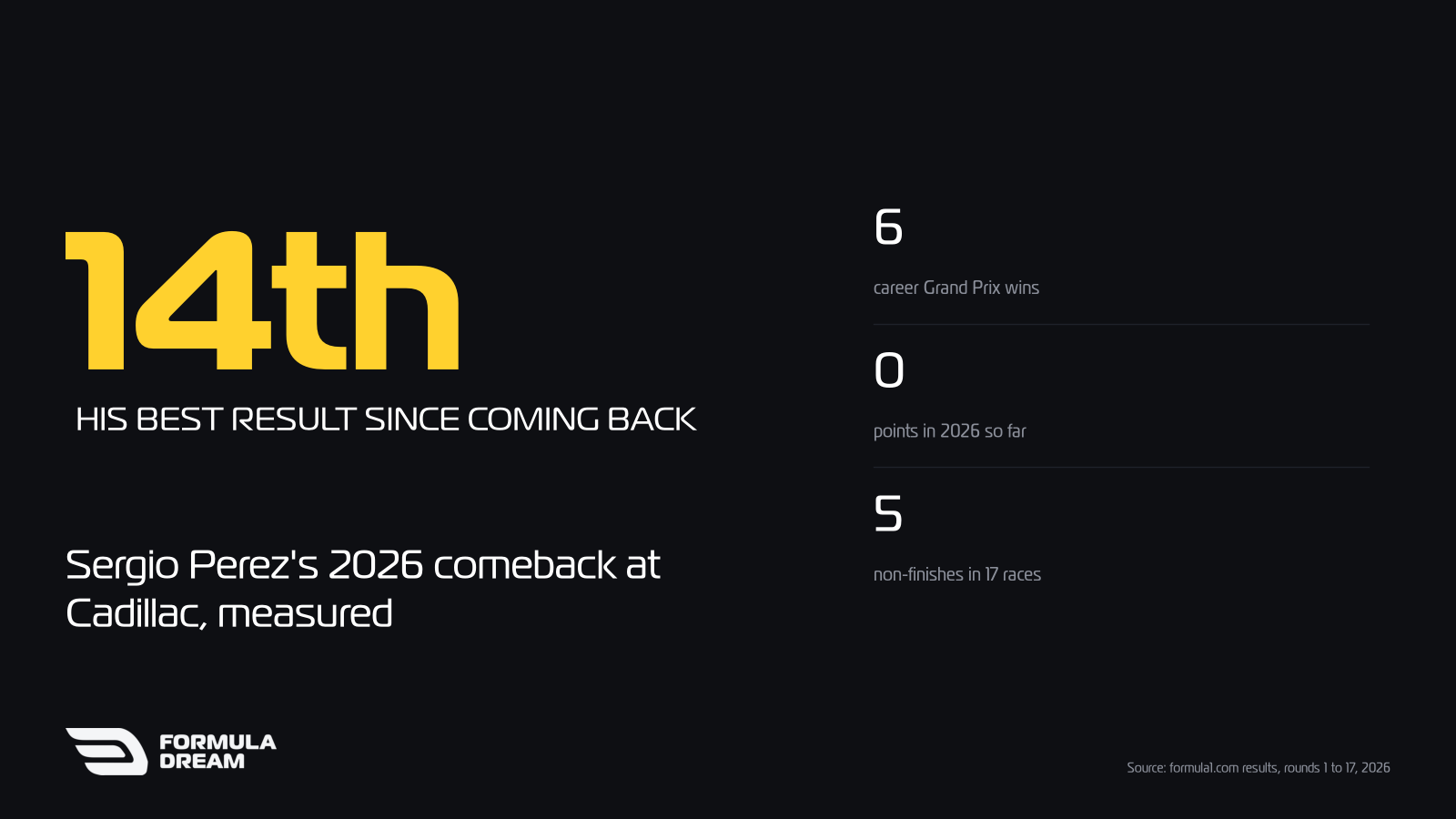
Sergio Perez's 2026 season, measured: the comeback at Cadillac, seventeen races in
Red Bull dropped Sergio Perez after 2024. In 2026 he is back in Formula 1 with Cadillac, the sport's newest team, on a deal that runs to at least the end of 2027. Seventeen races in, his best result is fourteenth. Every race, measured, with his home race in Mexico City on 1 November.
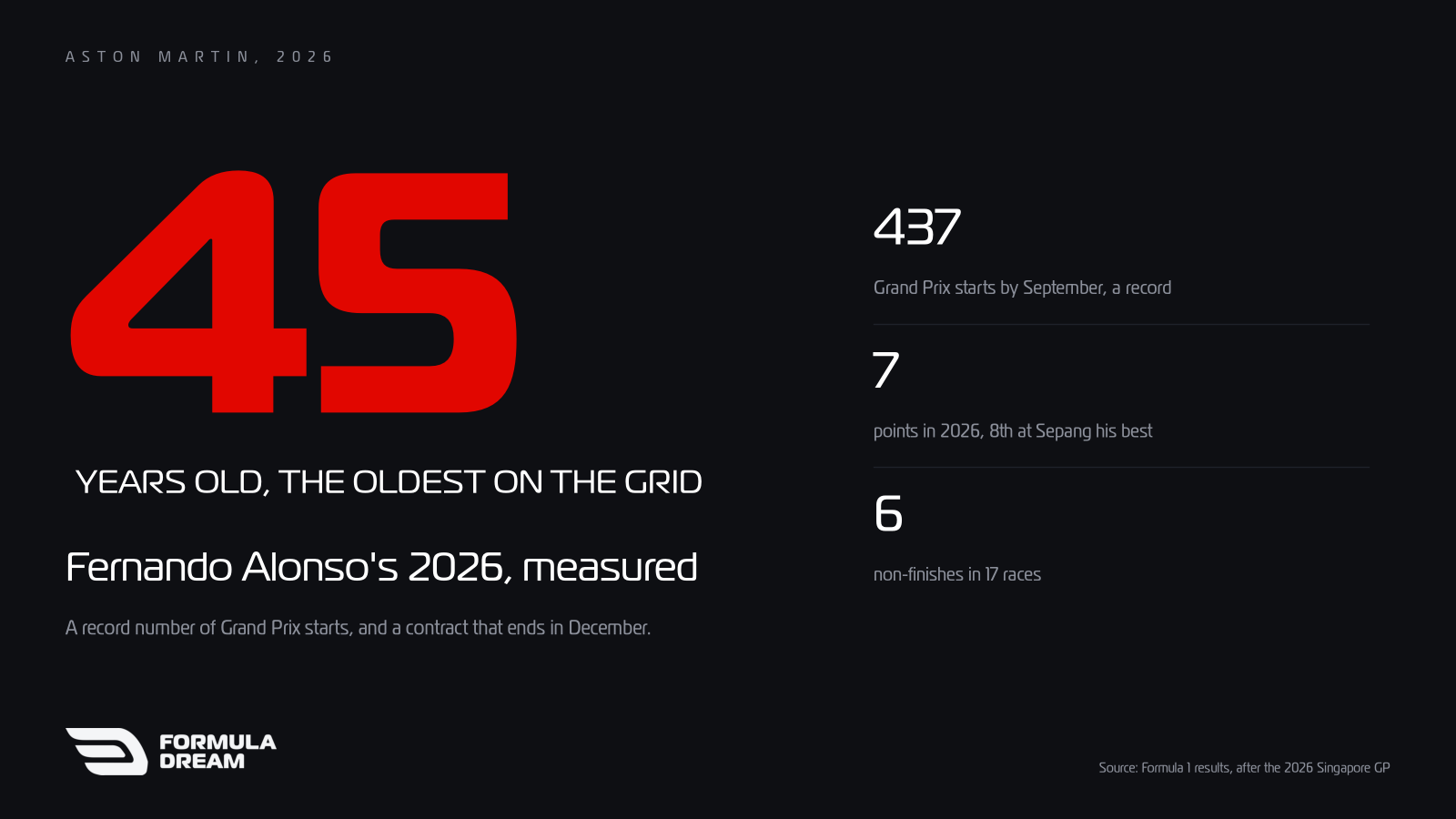
Fernando Alonso's 2026 season, measured: 45 years old, a record 437 starts, and a contract that ends in December
Fernando Alonso is the oldest driver in Formula 1 for more than 50 years and holds the record for Grand Prix starts. In 2026 he has seven points from seventeen races in an Aston Martin shaken by its Honda engine, and his contract ends this year. Every race, and what he has said about his future.
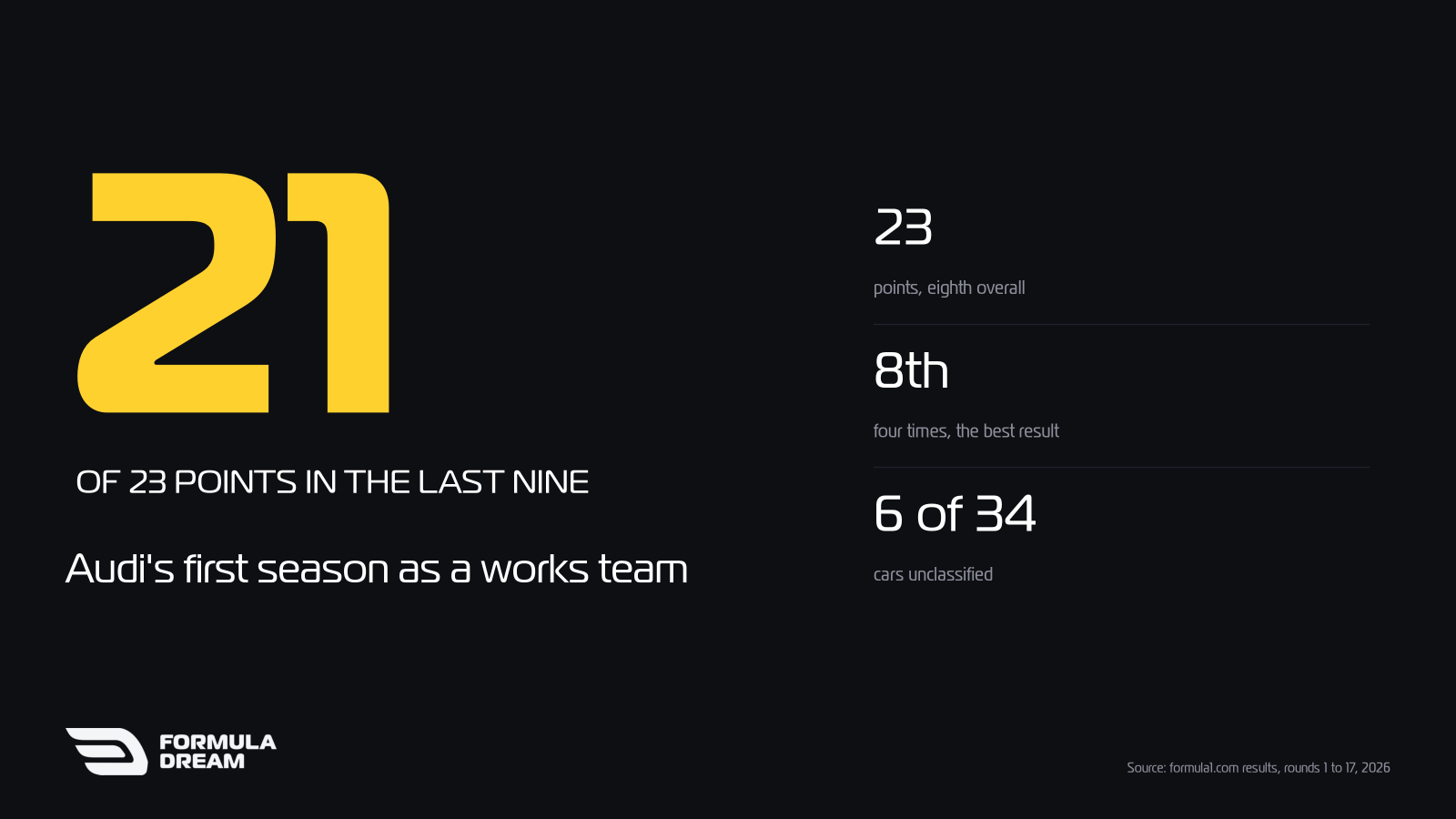
Audi's first Formula 1 season, measured: two points in eight races, twenty-one in the next nine
Audi entered Formula 1 in 2026 as a full works team with its own power unit, taking over Sauber. It scored two points in the first eight races and twenty-one in the nine since. Every race for Gabriel Bortoleto and Nico Hulkenberg, measured.
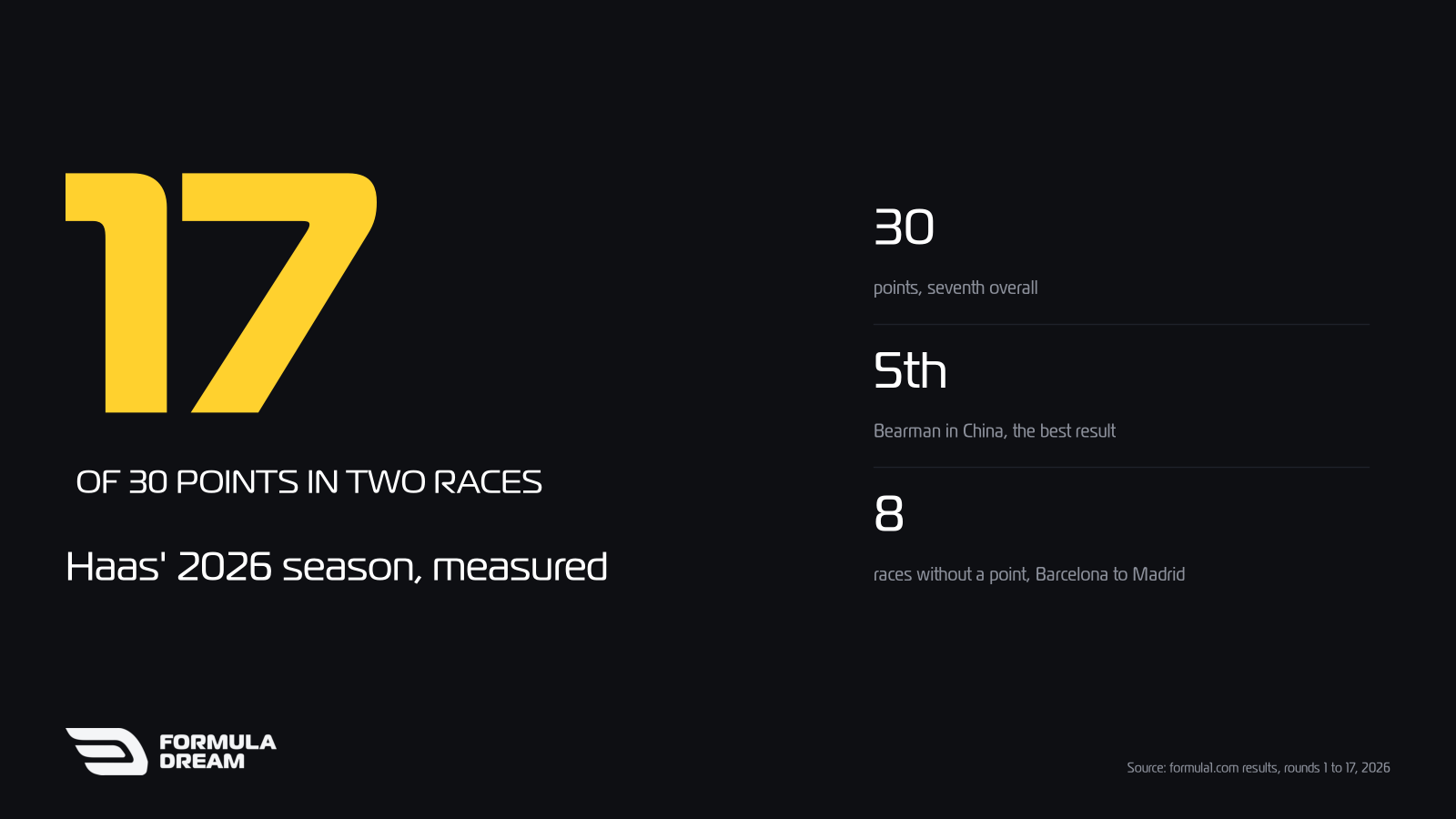
Haas' 2026 season, measured: seventeen points in two races, then thirteen in fifteen
Haas scored 17 of their 30 points in the first two rounds of 2026, when Oliver Bearman finished seventh in Melbourne and fifth in China. Then eight races without a point, before Baku and the Singapore sprint. Every race for Bearman and Esteban Ocon, measured.
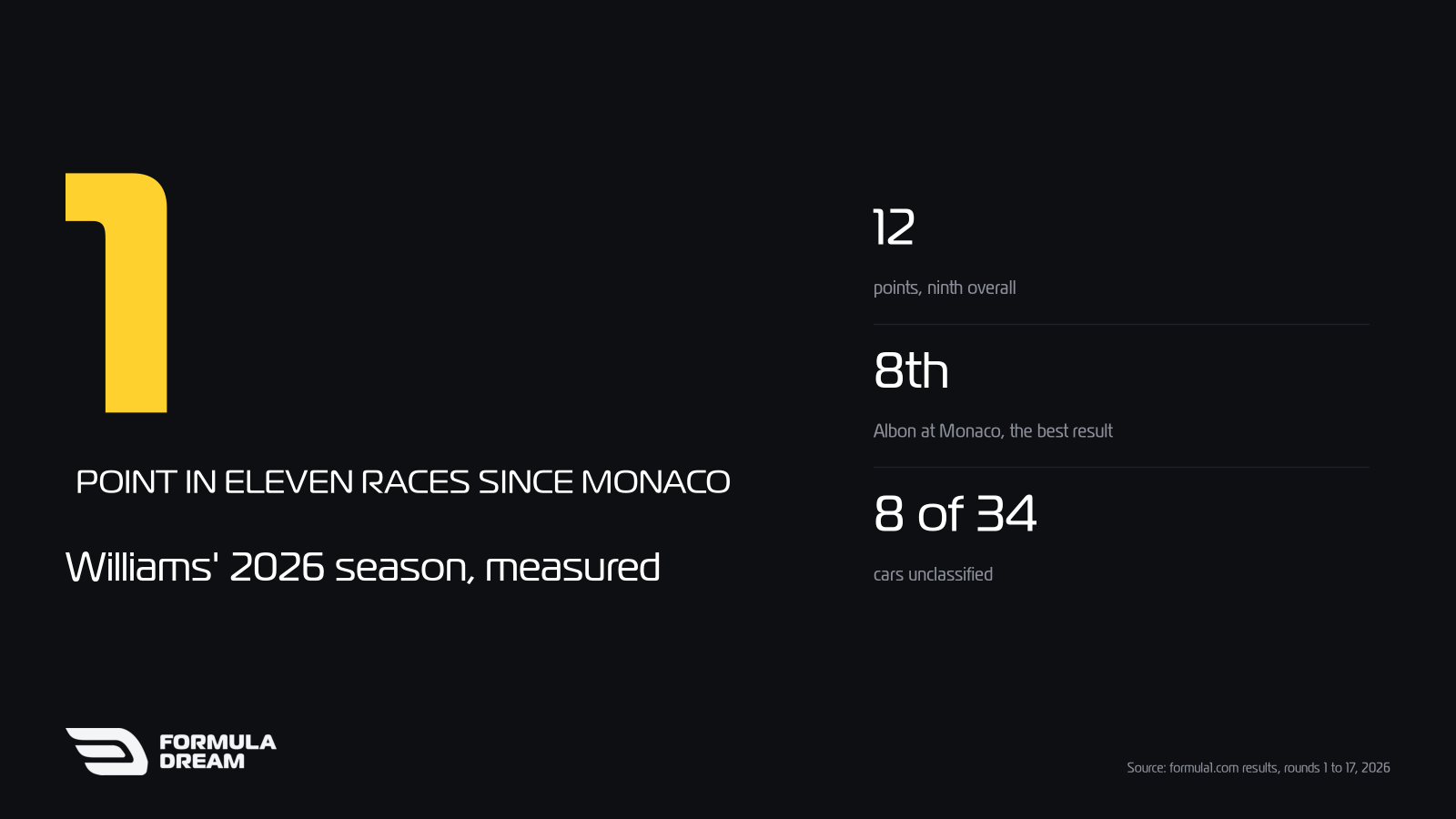
Williams' 2026 season, measured: eleven points in six races, then one in eleven
Williams scored eleven of their twelve 2026 points in the first six rounds, and one in the eleven races since Monaco. Eight of their 34 cars have ended unclassified, the most of any team on a Mercedes engine. Every race for Carlos Sainz and Alexander Albon, measured.
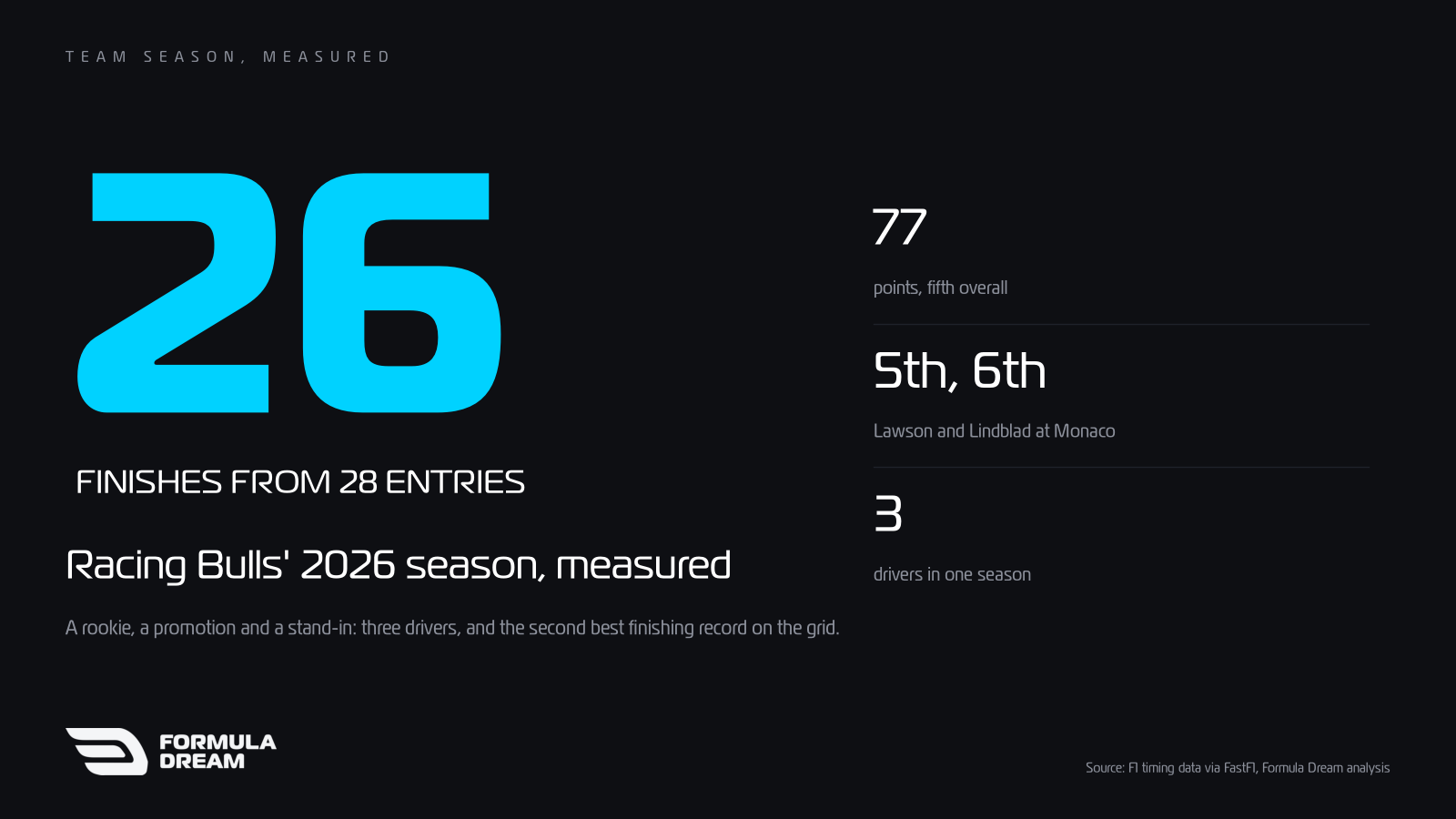
Racing Bulls' 2026 season, measured: a rookie, a promotion and the second best finishing record on the grid
Racing Bulls are fifth in the 2026 constructors' championship on 77 points, with 26 finishes from 28 entries. Liam Lawson moved up to Red Bull mid-season, Yuki Tsunoda came back to cover, and rookie Arvid Lindblad has scored in nine of his thirteen starts. The season race by race.
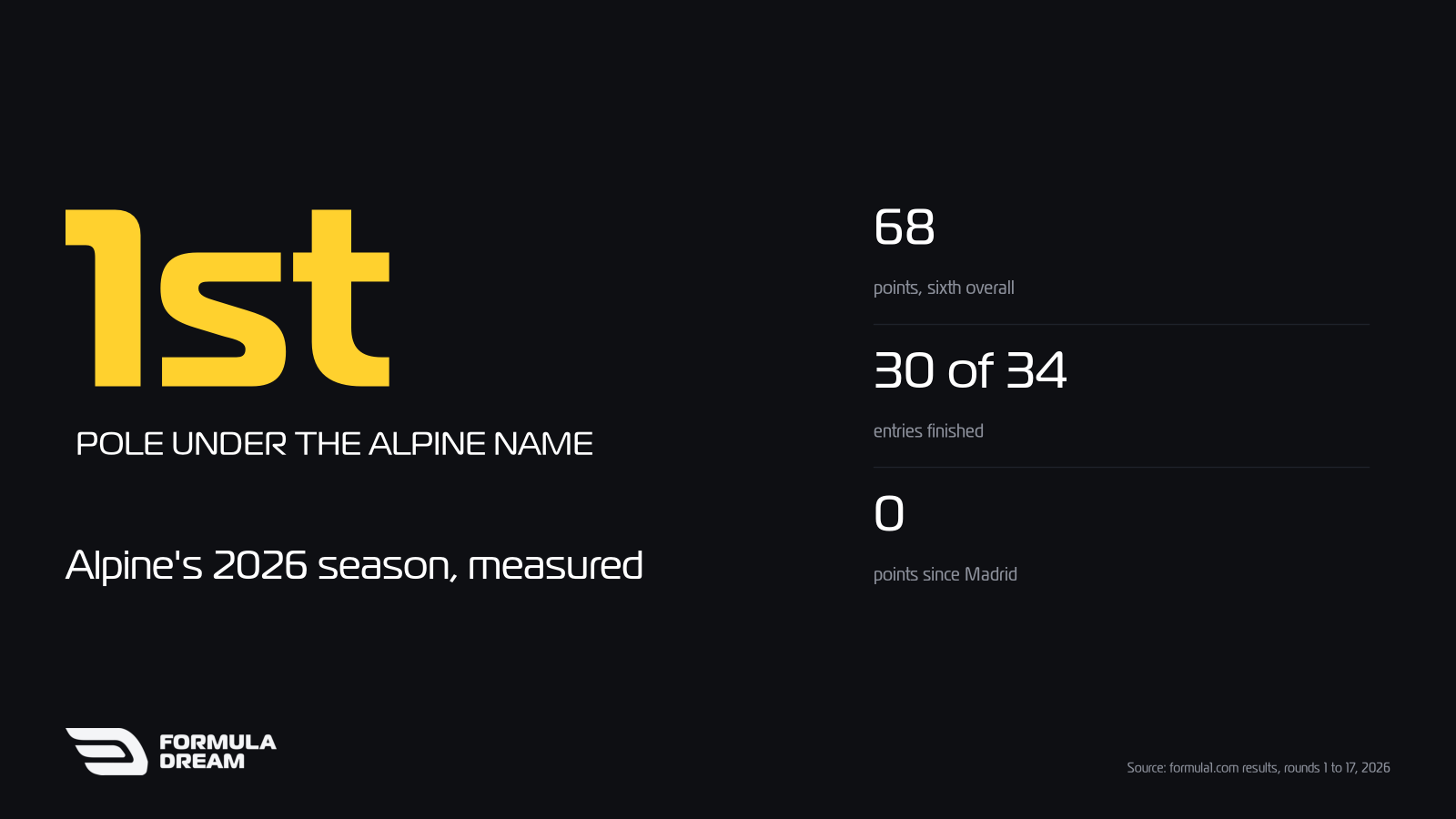
Alpine's 2026 season, measured: a first pole at Monza, and a finishing record that broke in Baku
Alpine finished 27 of their first 28 race entries in 2026, the best record on the grid, and Pierre Gasly took the team's first pole under the Alpine name at Monza. Then three cars went out in three races. The season race by race.
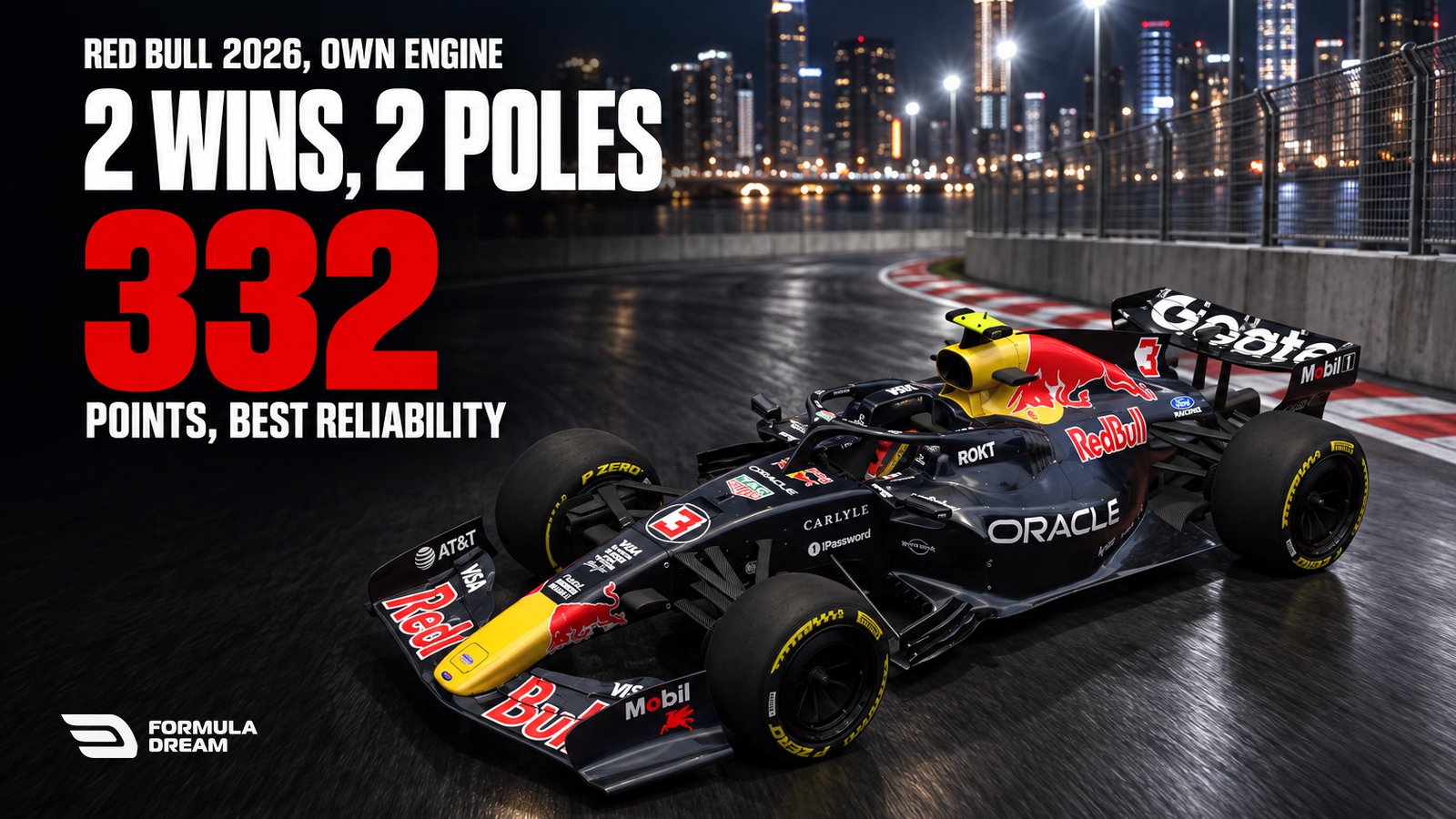
Red Bull's 2026 season, measured: its own engine, two wins in a row, and the best reliability record of any manufacturer
Red Bull build their own power unit for the first time in 2026, with Ford. After fifteen races without a win, Max Verstappen won at Sepang and Singapore, and cars with that engine have the lowest non-finish rate of the five manufacturers. The season race by race, with three drivers.
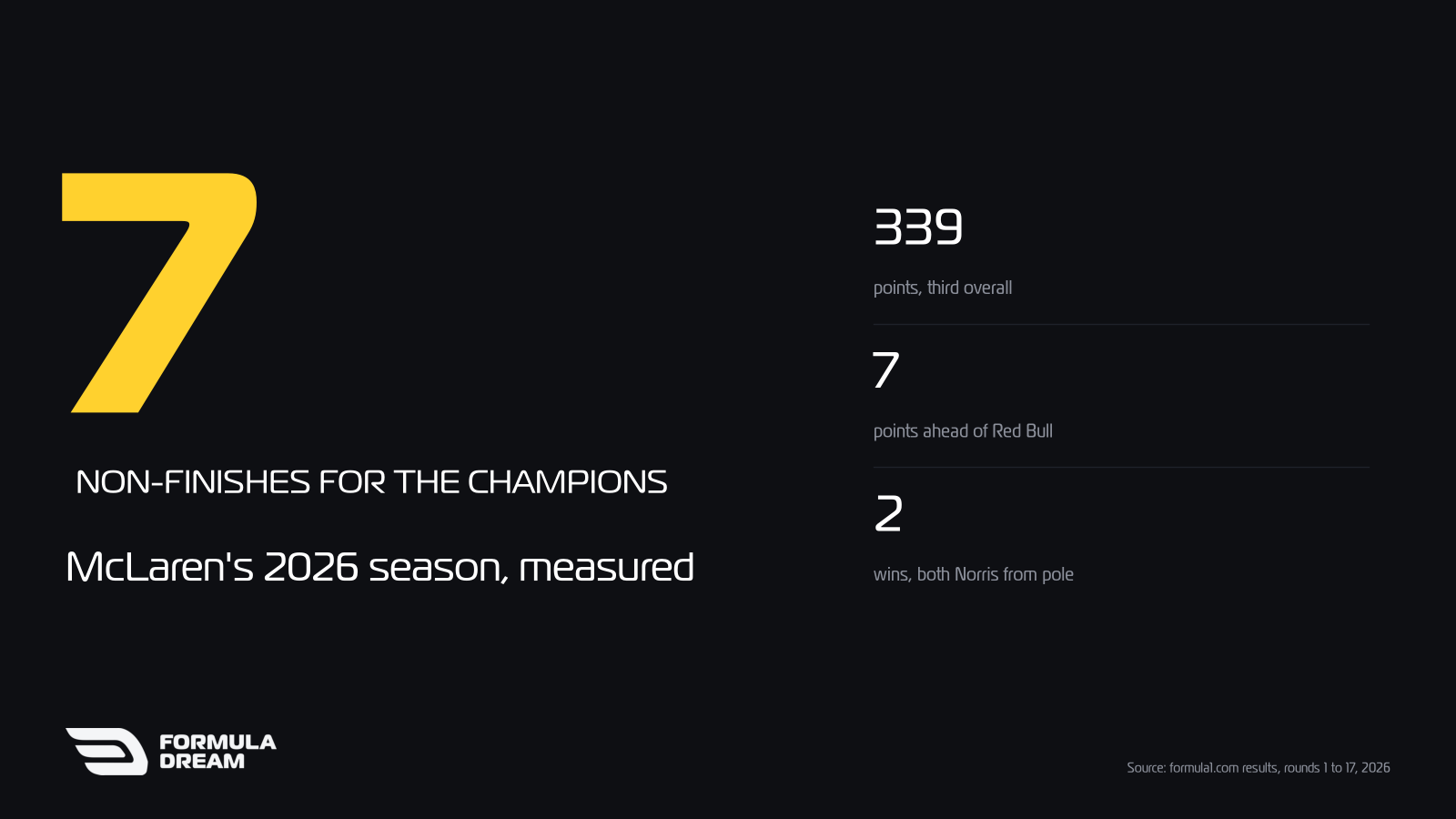
McLaren's 2026 season, measured: the double champions, and seven non-finishes
McLaren started 2026 as both drivers' and constructors' champions. Seventeen races in they are third, seven points clear of Red Bull, with two wins for Lando Norris and seven non-finishes, including both cars failing to start in China. The season race by race.
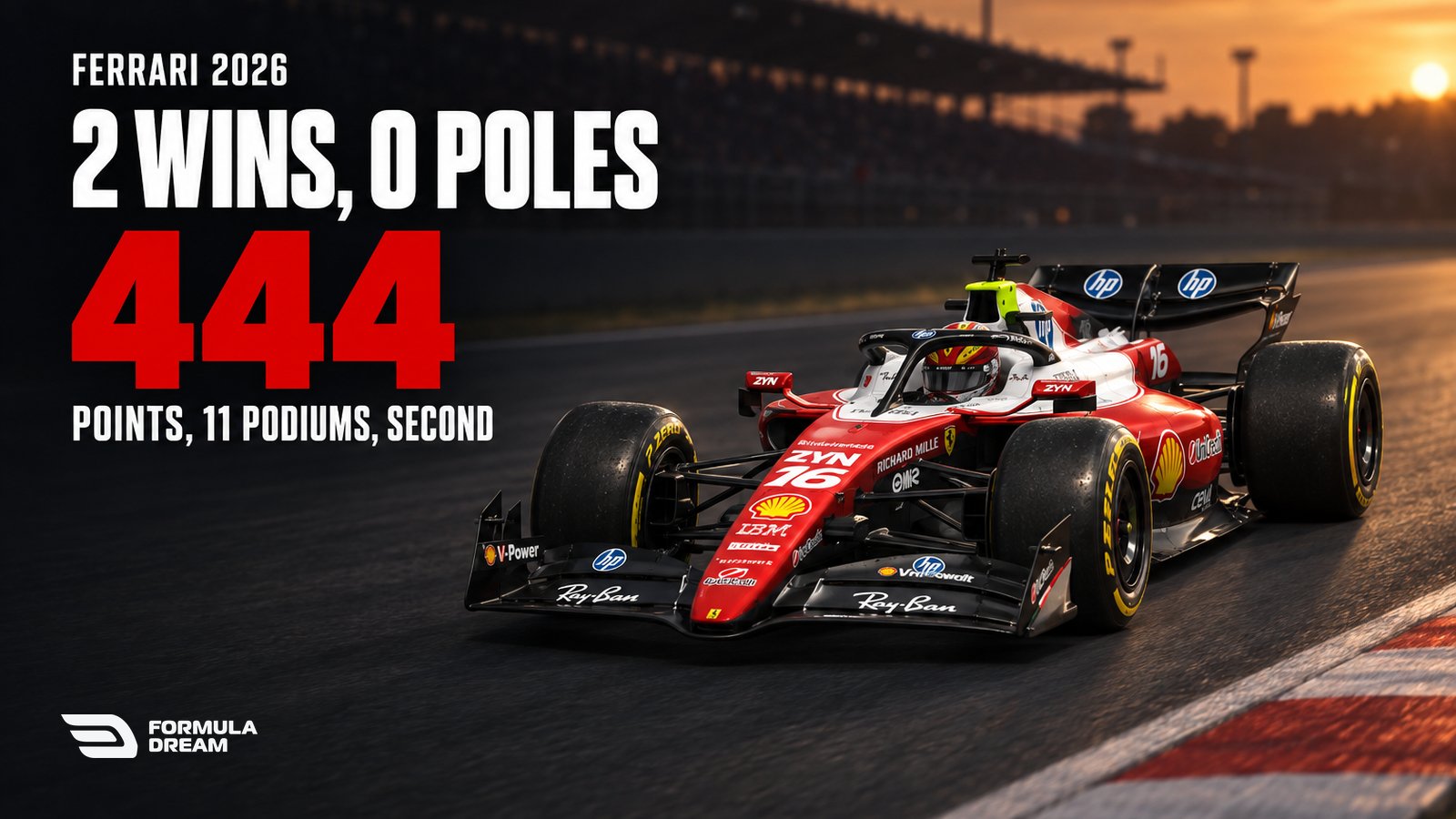
Ferrari's 2026 season, measured: two wins in three weeks, no poles, and a year of what ifs
Ferrari are second in the 2026 constructors' championship on 444 points. Lewis Hamilton won in Barcelona and Charles Leclerc at Silverstone three weeks later, but the team has not taken a pole, and three of Leclerc's races ended off the track. The season race by race.
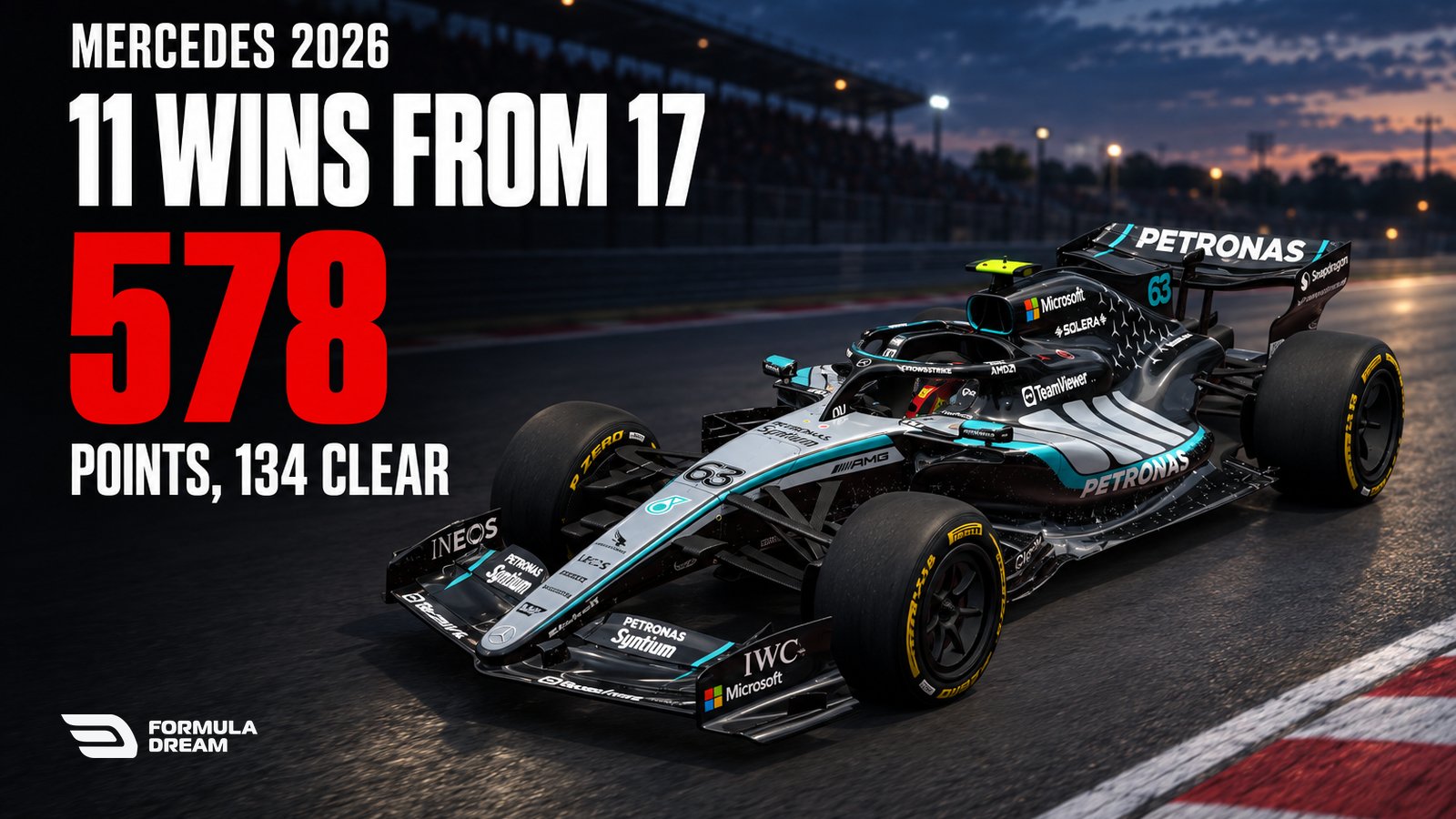
Mercedes' 2026 season, measured: eleven wins, and fifteen straight poles on Mercedes power
Mercedes have won eleven of the seventeen Grands Prix of 2026 and lead the constructors' championship by 134 points. The first fifteen poles all went to cars with a Mercedes power unit, until Red Bull took the last two. The season race by race, and what Toto Wolff says the advantage really is.