Every so often a driver picks up a routine penalty for a routine incident, and the commentary suddenly changes tone. Not because of the penalty. Because of the two points that came with it.
The penalty points system is the only part of Formula 1's disciplinary machinery that accumulates. Everything else is settled on the day. Points follow a driver around for a year, and they are the reason a mid-season ban can arrive with almost no warning to anyone who has not been keeping count.
It is also, once you look at it properly, one of the more elegant pieces of rule-making in the sport, and one of the most misunderstood.
The basic rule
Every Formula 1 driver holds an FIA Super Licence. Stewards can attach penalty points to it when they issue a penalty, typically for driving standards: causing a collision, a dangerous manoeuvre, ignoring flags.
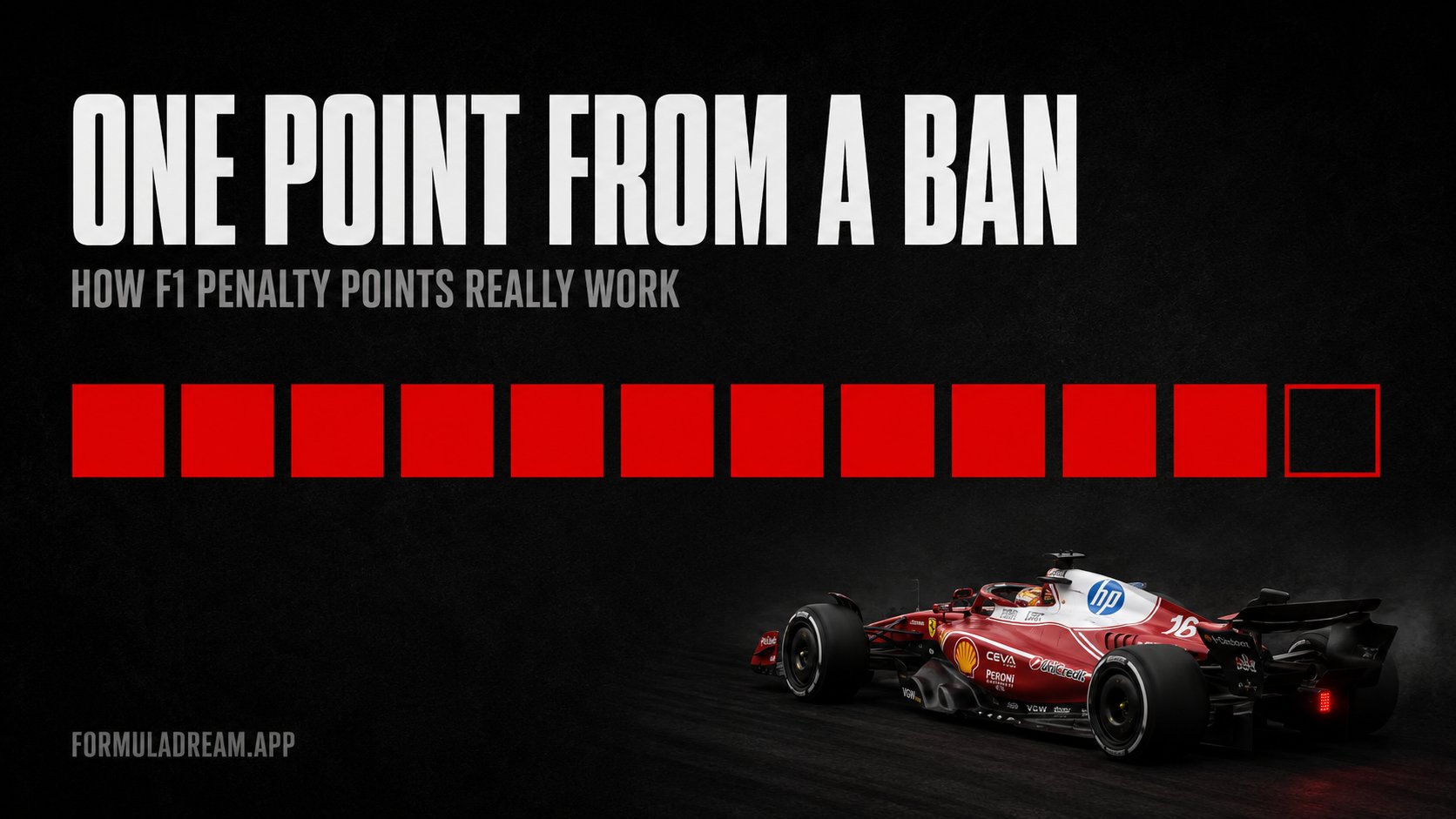
and the licence is suspended for the next event. The driver misses a race.
After serving that suspension, twelve points are removed from the licence.
This is not theoretical. Kevin Magnussen reached twelve points during the 2024 season and sat out the Azerbaijan Grand Prix, watching from the sidelines while Haas ran a replacement. It is the clearest demonstration of the system doing exactly what it was designed to do, and it happened to a driver whose individual offences were mostly minor.
So far, so simple. The part that catches people out is the clock.
Points do not expire in a batch, they expire individually
Penalty points sit on a licence for twelve months from the date they were issued, then drop off.
Individually. Not as a set.
This is the detail that makes the system genuinely hard to follow. A driver's total is not a season tally that resets in January. It is a rolling twelve-month window in which each point has its own expiry date, tied to the incident that produced it.
The practical consequence is that a driver's total goes up and down through a year. Two points earned last April vanish this April, whether or not the driver has done anything since. Somebody can be sitting on ten points, do nothing wrong for two months, and find themselves on six. Somebody else can be on eight, pick up two, and be at ten with four of those due to expire the week after next.
This is why "one point from a ban" is a real and recurring situation, and why it often applies to a driver who has not done anything dramatic recently. They are not being punished for the last incident. They are being caught by the arithmetic of a year's worth of small ones.
Why it was built this way
The alternative designs are both worse, which is worth spelling out because the system takes a lot of criticism.
A season-based tally that resets each year would make offences committed in November nearly free and offences committed in March expensive. It would also produce a scramble of cynical driving in the final rounds by anyone sitting on a safe number.
A cumulative career total would end careers over a decade of minor infringements, and would punish longevity rather than dangerous driving.
The rolling twelve-month window does what a penalty points system on a road licence does: it targets a pattern of behaviour within a defined recent period. One bad afternoon should not end a season. Six bad afternoons in a year probably should cost something.
Reprimands: the other counter
Running alongside points is a quieter mechanism.
A reprimand is a formal warning with no immediate sporting consequence. Drivers collect them for minor procedural things as well as driving ones.
Collect five reprimands in a season, of which at least four are driving-related, and it converts into an automatic ten-place grid penalty.
Two things make this easy to miss. The threshold is a season count rather than a rolling window, so it behaves differently to penalty points. And a reprimand feels like nothing at the moment it is issued, which is exactly why the fourth and fifth arrive as a surprise.
Where the numbers actually live
Here is the thing that makes all of this genuinely awkward to follow: none of it is announced.
Penalty points are attached inside stewards' decision documents. Those documents are published as numbered PDFs, without notification, on a page most fans never visit. Nobody reads out a running total on the broadcast. There is no standings table for it next to the championship table.
So the sport has a disciplinary system with real consequences, which is entirely public, and which is functionally invisible unless you go and count it yourself.
The points are in the documents, so the documents are what you need.
Formula Dream collects every FIA document published across a race weekend, as it is released: the stewards' decisions that carry penalty points, the penalties themselves, the technical delegate's reports, and the power unit allocations that make a grid drop inevitable before anyone announces it.
Alongside that, during a session the app puts every car on the circuit map with a full timing tower carrying gaps, intervals, tyre compound and tyre age, pit stop counts and positions gained or lost, plus alerts for safety cars and yellow and red flags. Driver radio streams live with the transcript running next to the audio. A weekend timeline replays the whole thing in order, which is built for following from a time zone where the session finished overnight.
Free, no subscription, no ads. Independent, and not affiliated with Formula 1.
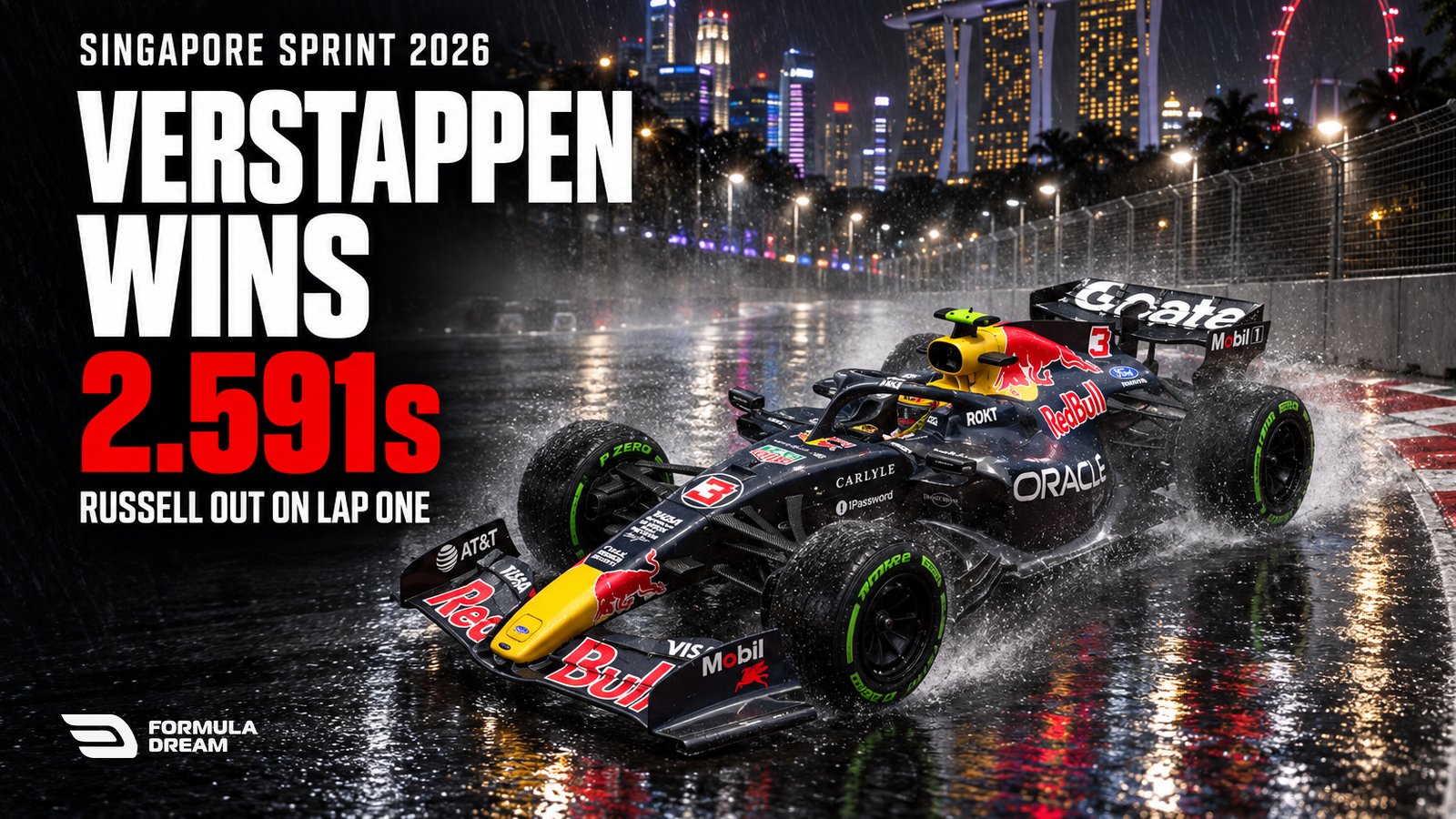
Singapore Sprint 2026 Results: Russell Crashes From the Lead
Russell took the lead at turn one and crashed at the final corner of the same lap. Verstappen won, Hamilton charged to second, and the McLarens hit each other.