We counted every word of F1 radio this season. "Box box" was said five times.
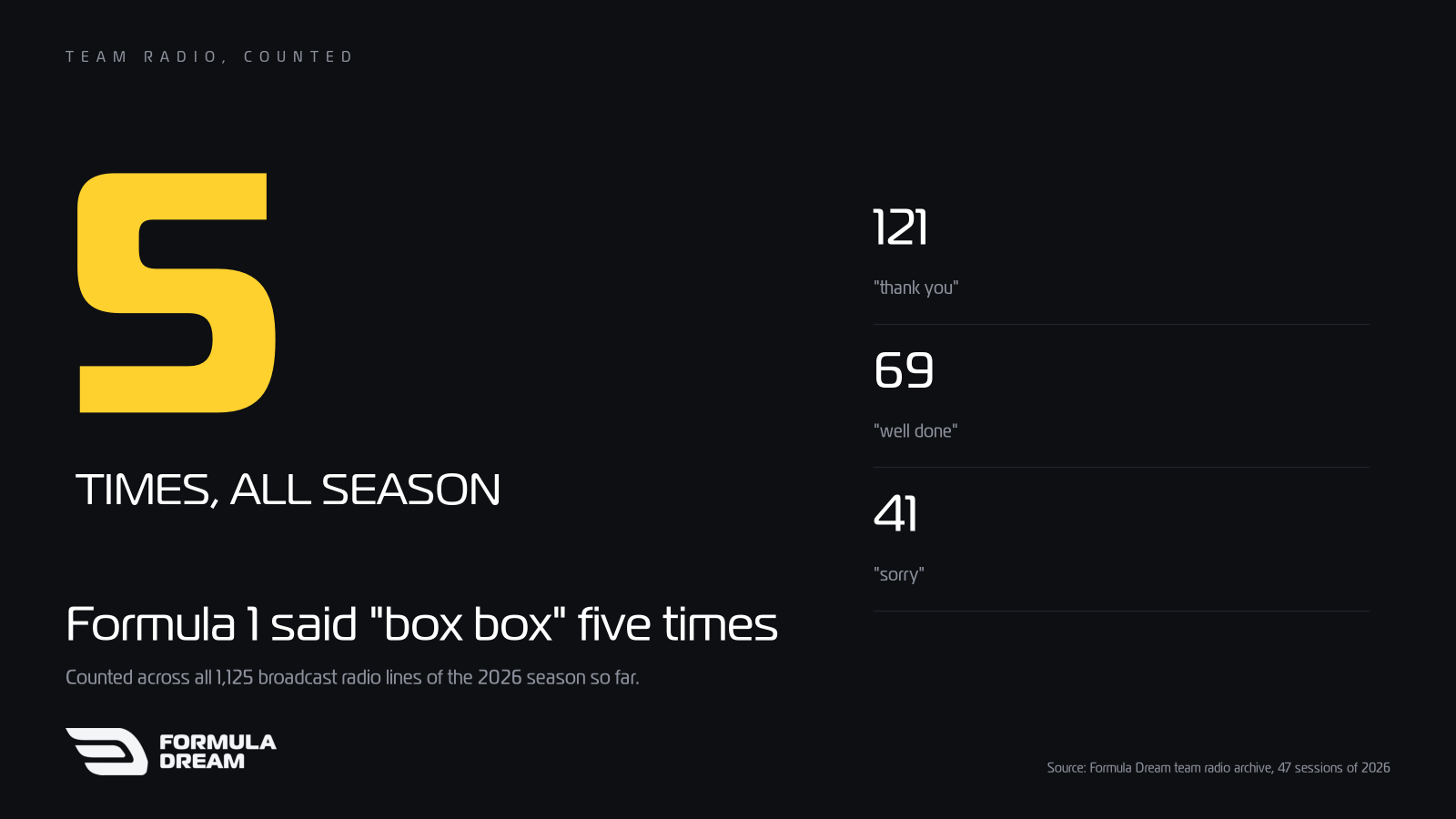
Every broadcast team radio line of 2026, counted. Thank you appears 121 times, well done 69, mate 67. The most famous phrase in Formula 1 radio was said five times all season.
Across the 47 sessions of 2026 we recorded, we hold 1,125 lines of broadcast team radio. "Box box" accounts for five of them.
The phrase everyone can quote, the one printed on T-shirts, turns up roughly once every nine races. Meanwhile some version of "thank you" appears 121 times, and "well done" 69.
These come from our team radio archive, so this is a count rather than an impression: 599 driver lines and 526 engineer lines, each attributed. Our 2026 radio is captured live during each session, and the capture only started working at the Canadian Grand Prix in late May. The Australian, Chinese, Japanese and Miami races were never recorded, so this season's figures cover Canada onward and nothing before it. The races we did record are covered in full apart from the occasional clip, rather than being a partial count that will grow. Ratios between phrases hold regardless, because every phrase is counted over the same sample.
Counted across all 1,125 broadcast radio lines of the 2026 season, driver and engineer combined.
Read that list as a description of the sport and it is not the one the highlights package sells. Formula 1 radio is mostly two people being polite to each other under enormous pressure.
Drivers and engineers say different things
Split the lines by who is speaking and the difference is clear.
Drivers most often say thank you (54 times), then good job (26) and well done (25). After the gratitude comes hedging: "I don't", "I think", "a bit", "I mean". A driver describing a car is rarely definite about it.
Engineers lead with well done (40), then thank you (30) and copy that (13). Their other common openers are instructions in disguise: "we need", "need to", "we can". An engineer almost never tells a driver to do something directly, they tell them what "we" need.
The swearing, since you were wondering
Twenty-six lines this season contain censored language, about one in forty three.
Hamilton appears near the top of both lists, which is its own kind of answer about what twenty years in the sport does to radio manners.
Engineers hand out praise unevenly too. The most "well done" and "good job" messages went to Verstappen with eight and Antonelli with six, which tracks who has been winning.
What this measures, and what it does not
It counts what Formula 1 broadcast, not what was said in the car. Teams talk to drivers continuously and the world feed plays a fraction of it, chosen for drama or clarity. "Box box" is rare on air partly because a pit call is often routine and unexciting to play.
Season totals are more honest than single races. One driver having a bad Sunday can double their apology count in an afternoon.
Attribution comes from the archive's own speaker labels, driver or engineer, and occasionally those labels are wrong upstream. Where a label and the words disagree, we treat the words as the evidence.
Hear the lines yourself
Every message behind these counts is in the archive, with the original audio and a transcript colour-coded by speaker, filed by driver and by session. The season's most heard driver is Antonelli, who we measured taking 13.4% of all broadcast radio in who Formula 1 actually plays.
The next race is Baku on Saturday 26 September, and its messages land in the archive as they are broadcast.
Frequently asked questions
What do F1 drivers actually say on team radio?
Mostly courtesies and hedged descriptions of the car. Across 1,125 broadcast lines in 2026, "thank you" appeared 121 times, "well done" 69 and "mate" 67, against 41 apologies and five instances of "box box".
How often do F1 drivers say "box box"?
Five times across the entire 2026 season in broadcast radio, roughly once every nine races. Most pit calls are never played on the world feed.
How much do F1 drivers swear on the radio?
Twenty-six broadcast lines in 2026 contained censored language, about one line in 43. Verstappen and Antonelli lead with four each.
What is the difference between driver and engineer radio?
Drivers thank, hedge and describe. Engineers praise and instruct, usually in the first person plural: "we need", "we can". Engineers said "well done" 40 times, drivers 25.
Where can I read F1 team radio transcripts?
Our archive holds 39,309 broadcast messages from 2018 to 2026, free and searchable, each with audio and a colour-coded transcript.
Sources
Every count on this page: our own team radio archive, all 47 recorded sessions of 2026, from the Canadian Grand Prix onward, queried 17 September 2026
Speaker attribution: the archive's own per-line driver and engineer labels
Hear the next one live
The interesting radio is rarely the famous kind. It is a driver hedging about the rear end three laps before a pit stop nobody expected.
The Formula Dream app plays live driver radio as it is broadcast, transcript beside the audio, alongside a live timing Dashboard (currently in beta) and every FIA document of the weekend as the stewards publish it.
Free, no subscription, independent. Not affiliated with Formula 1.
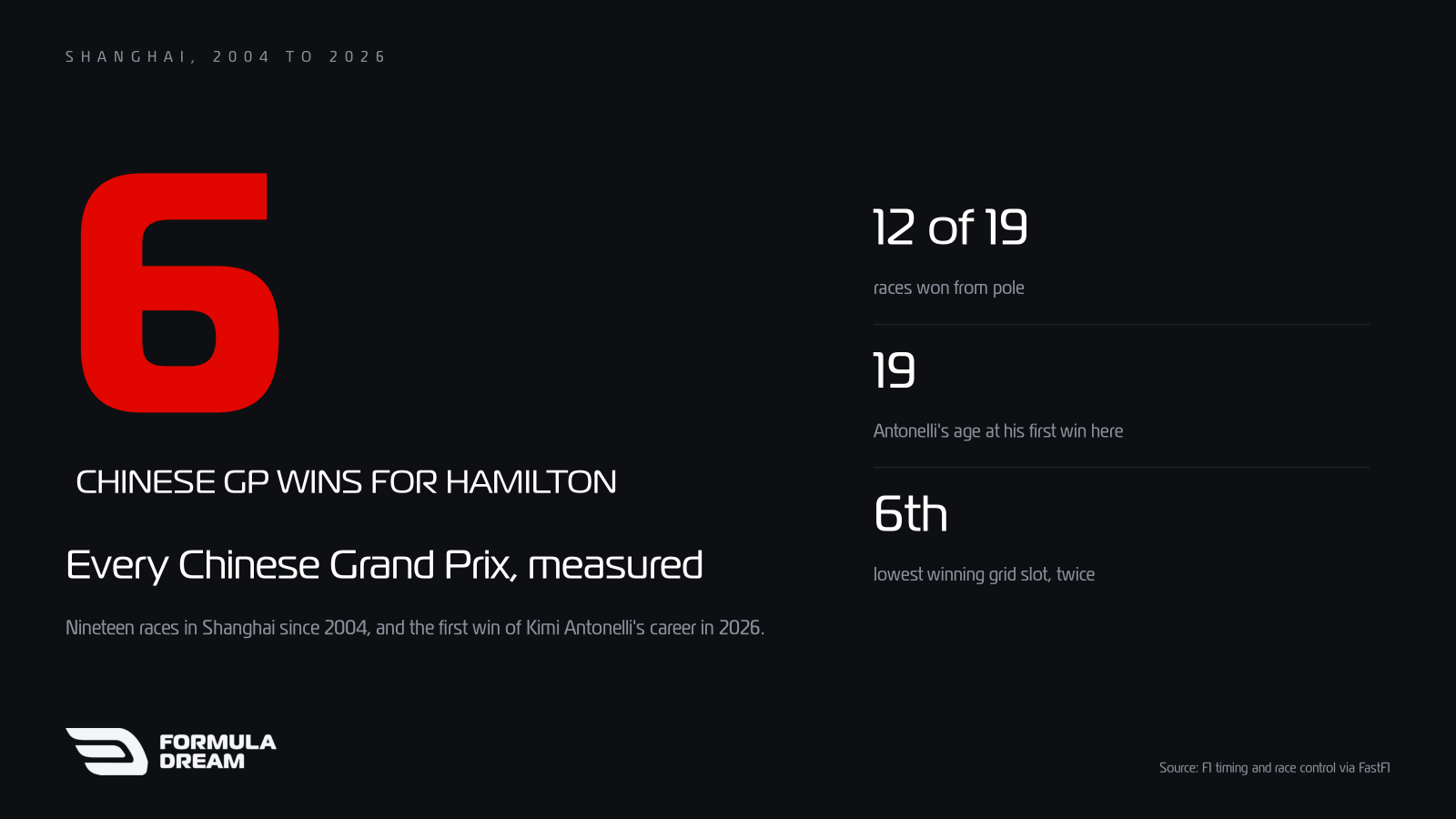
Nineteen Chinese Grands Prix have been held in Shanghai since 2004. Lewis Hamilton won six, pole won twelve, and in 2026 Kimi Antonelli took the first win of his career there, at 19, with Hamilton on the podium for Ferrari for the first time. Every winner, grid slot and safety car, measured.