Azerbaijan GP 2026 Overtakes: All 43 Passes Measured
Guides
Baku 2026 had 43 passes on track, and twelve of them happened in one corner
We counted every on-track pass in the 2026 Azerbaijan Grand Prix from the lap by lap running order. There were 43, but twelve came in a single corner when Oscar Piastri locked up at the restart. Baku ranks seventh of the fifteen races of 2026, which is not what its reputation says.
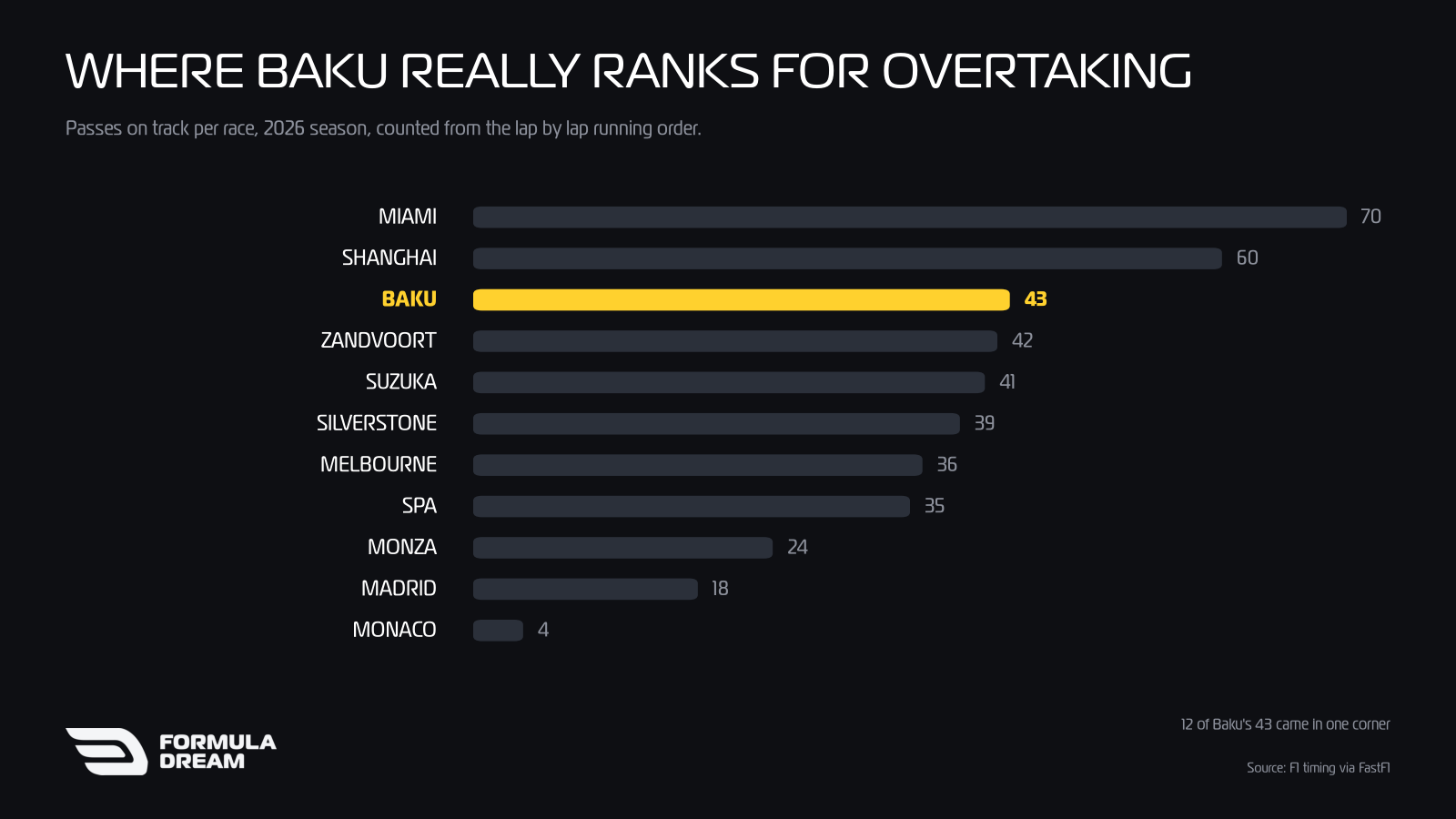
Baku is supposed to be the overtaking race. In 2026 it produced 43 passes on track, which puts it seventh of the fifteen races held so far, behind Miami, Shanghai, Zandvoort and Suzuka.
The number that matters is not 43. It is that twelve of those passes happened at one corner on one lap, when Oscar Piastri locked up at Turn 1 at the restart and was passed by twelve cars before the lap was out.
Take that single mistake away and Baku produced 30 passes in green running across 51 laps. That is an ordinary Sunday, at a circuit with one of the longest flat out runs on the calendar.
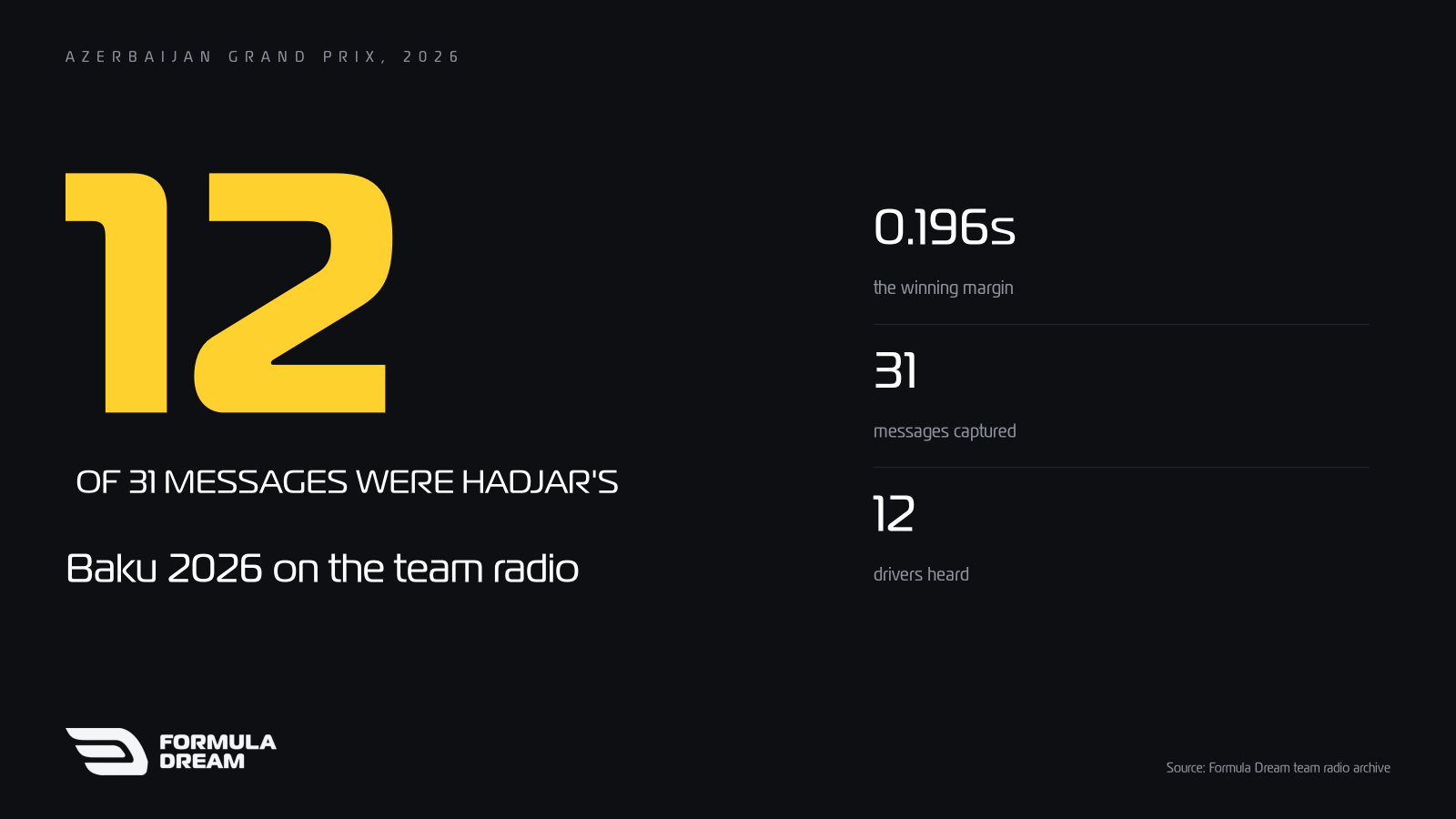
Every radio message from the race, including the drivers reacting to those moves, is in our
A pass, for this count, is one driver ending a lap ahead of a driver he ended the previous lap behind, where neither car was on an in lap or an out lap, and the lap was run under green flags.
That is not Formula 1's official overtake figure and it will not match it. It is a consistent, repeatable count we can run on any race, and the definition is printed here so anyone can disagree with it precisely.
Two things are separated out rather than hidden:
Laps run behind a safety car are excluded, because nothing happens on them.
The lap after a safety car ends is counted separately, because a restart mixes real racing with one car losing ten places in a corner. In Baku that distinction is the whole story.
There is also a guard in the code for a known data fault: FastF1 occasionally merges two laps into one row, which drops a driver down the order and back and invents a dozen passes. Any lap whose duration is outside 0.85 to 1.6 times the race's median green lap is thrown away before counting.
The 2026 season, race by race
Round
Race
Passes on track
4
Miami
70
2
Shanghai
60
15
Azerbaijan
43
12
Zandvoort
42
3
Suzuka
41
9
Silverstone
39
1
Melbourne
36
5
Canada
35
10
Spa
35
11
Hungary
34
The ten highest of the fifteen races run in 2026, counted with the method above.
Below those: Austria 29, Barcelona and Monza 24 each, Madrid 18 and Monaco 4.
Baku's 43 is third on that list, and it is the only race in the top three where nearly a third of the total came from one incident. On green running alone its 30 passes sit between Barcelona and Austria, in the middle of the season.
Lap 40: twelve cars past one McLaren
Piastri qualified third and ran second for 35 laps. The second safety car of the afternoon, for the Turn 1 collision that took out Lando Norris, Pierre Gasly and Franco Colapinto, ended at the start of lap 39. On lap 40 he locked a front wheel at Turn 1 and went straight on.
Twelve drivers were ahead of him by the end of that lap who had not been at the end of lap 39: Kimi Antonelli, Charles Leclerc, Lewis Hamilton, Isack Hadjar, Arvid Lindblad, Esteban Ocon, Oliver Bearman, Carlos Sainz, Nico Hulkenberg, Liam Lawson, Gabriel Bortoleto and Sergio Perez.
He finished thirteenth, and it is the reason McLaren left Baku with nothing. His engineer had already been on at him about front locking earlier in the race, at a different corner:
"turn 15, careful front locking on the pump"
Antonelli passed ten different drivers
The championship leader crashed in qualifying and started sixteenth. He finished fifth.
He passed ten different drivers over the race: Hulkenberg, Sainz, Lindblad, Ocon, Albon, Lawson, Bearman, Colapinto, Piastri and Hamilton. Nine of those ten were in ordinary green running, not on the restart lap, which is what separates his afternoon from a driver who simply inherited places.
His position at the end of each tenth lap tells the same story: seventeenth after lap 1, thirteenth by lap 10, tenth by lap 20, eighth by lap 30, and fifth by lap 45.
The first third of the race carried most of it. Laps 2 to 18 produced 21 of the 30 green running passes, as a grid that had qualified out of position sorted itself out. From lap 19 to lap 30, before the first safety car, there were three.
That is the Baku pattern rather than the Baku legend. A long straight makes a pass possible early, while tyre and fuel differences are still large. Once the order settles, the walls do the rest, and nothing changes until something breaks. Why the circuit behaves that way is in the Baku City Circuit explained.
It also matches what the radio says about this race. Across complete seasons, Baku averages 89 broadcast radio messages a race against 112 across every circuit, fourteenth of sixteen, which we measured in Baku's reputation is chaos, five races of team radio disagree. Two independent measures, passes and radio traffic, both put Baku in the middle rather than at the top. The reputation comes from what happens when it does go wrong.
What this measures, and what it does not
Passes are counted from lap end running order, from official F1 timing via FastF1, using the definition at the top of this article. It is our count, not Formula 1's official overtake statistic.
Position changes caused by pit stops are excluded, because neither car involved is counted on an in lap or an out lap.
A car being passed while it slows with a problem still counts as a pass, which is why the lap by lap breakdown is published rather than only the total.
Our earlier Madrid article counted nine on-track passes, and this one puts Madrid at eighteen. The two are measuring different things on purpose. That count set aside passes on cars that were retiring or off the track, to isolate racing between healthy cars, and seven of Madrid's eighteen came on the lap Lewis Hamilton's brakes were failing. This article applies no such filter, so it is the wider number. Both pages state their method, and the ranking is the same either way: Madrid is the quietest race of 2026 outside Monaco. The detail is in Madrid had 9 overtakes in 57 laps.
Frequently asked questions
How many overtakes were there in the 2026 Azerbaijan Grand Prix?
43 passes on track by our count, of which 13 came on the lap after the second safety car and 12 of those were cars passing Oscar Piastri after he locked up at Turn 1.
Which 2026 race had the most overtaking?
Miami, with 70 passes on track. Monaco had the fewest, with 4.
Who made the most passes in Baku?
Kimi Antonelli, who passed ten different drivers on his way from sixteenth on the grid to fifth.
Sources
Lap times, running order, pit stops and race control messages: official F1 timing via FastF1
Counting method and code: `automation/overtakes.py` in our own toolchain
Radio: our own team radio archive
Watch the next one properly
Passes like Antonelli's are decided in the two seconds before a braking zone, and by the time the broadcast cuts to them they are over.
The Formula Dream app has a live timing Dashboard, currently in beta, with all twenty cars on the circuit map, gaps and intervals, tyre age and race control messages as they are issued. It plays live driver radio as it is broadcast with the transcript beside the audio, and collects every FIA document of the weekend as the stewards publish it.
Free, no subscription, no ads, independent. Not affiliated with Formula 1.
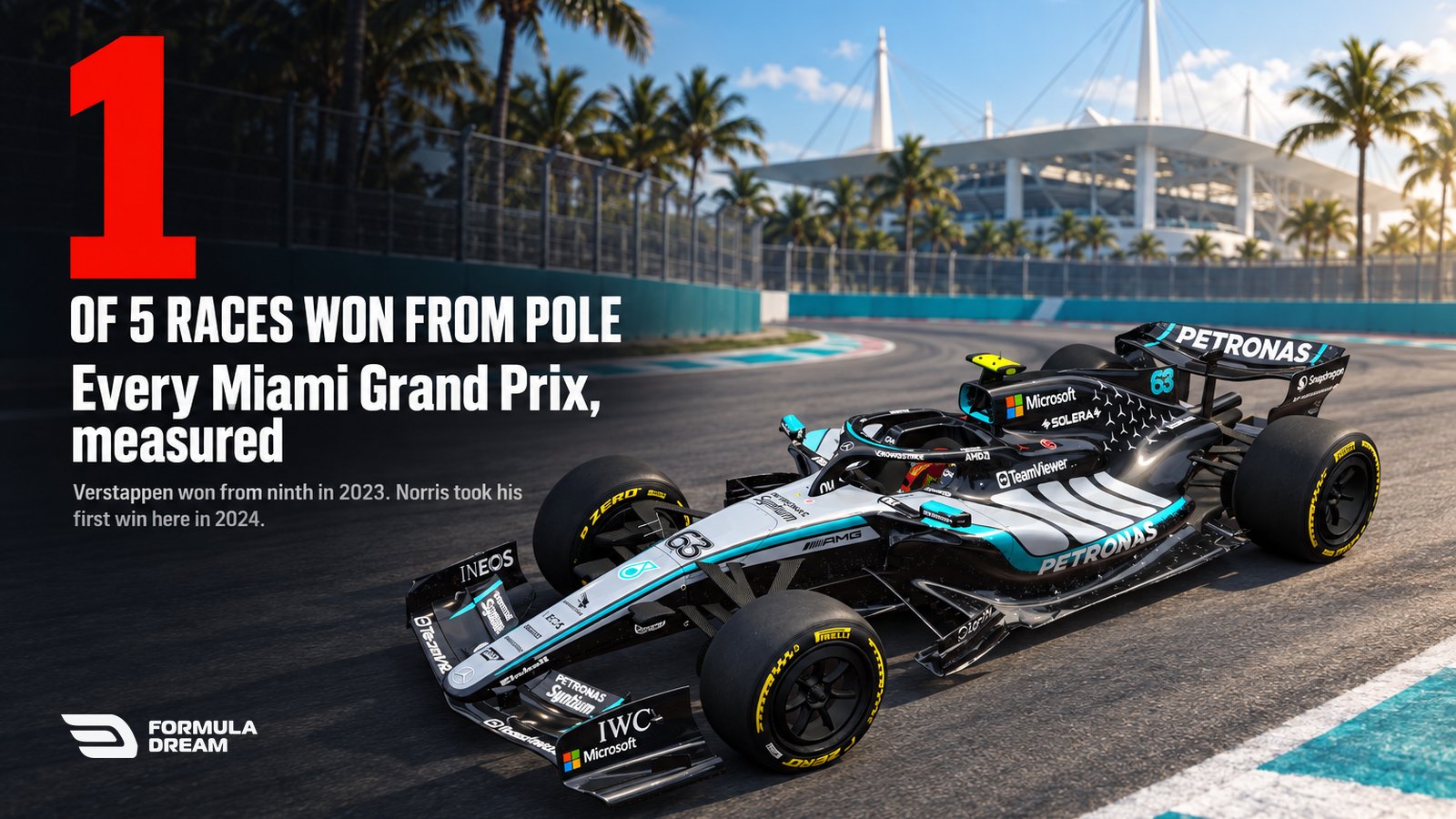
Five Miami Grands Prix have been held since 2022, and only one was won from pole: Kimi Antonelli's in 2026. Max Verstappen won from ninth in 2023, and Lando Norris took his first win there in 2024. Every winner, grid slot and safety car, measured.