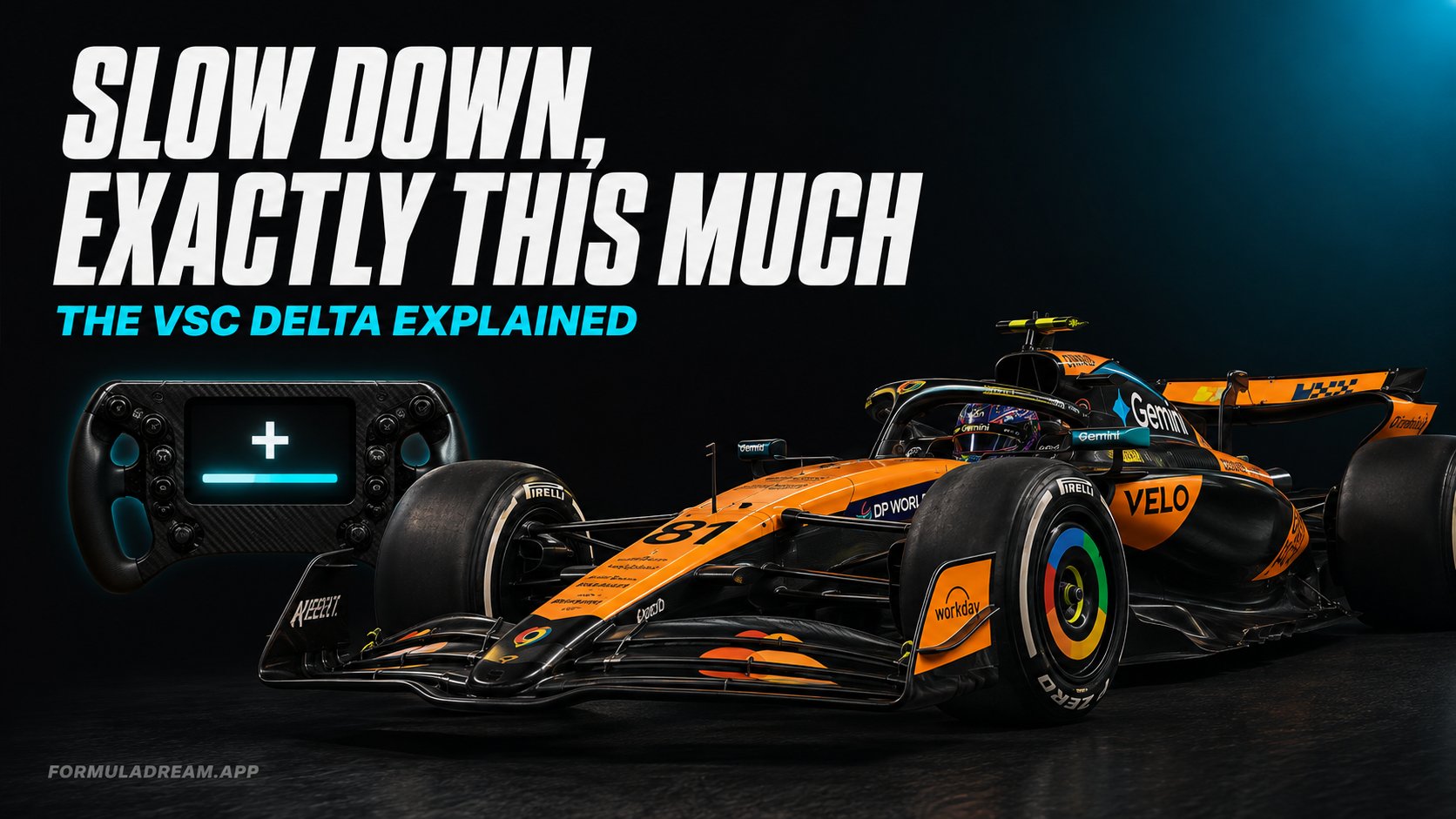
Under a Virtual Safety Car, every driver must stay slower than a minimum time set by the FIA's standard electronics, checked in every marshalling sector of the lap. The team shows the driver a delta on the steering wheel telling them which side of it they are. Stay on the wrong side and you get a penalty.
A VSC is called over the radio before the boards change, and the delta is read out to the driver. Every message from the last race is in our Spanish Grand Prix 2026 race radio archive, audio and transcript together.
It is the most precise piece of speed control in the sport, and it explains something that confuses people every time it happens: why cars under a VSC still look like they are going quickly.
The Virtual Safety Car is a neutralisation without a car. Instead of sending a physical safety car out to bunch the field up, race control imposes a delta lap time on everybody at once.
The delta is measured against a minimum time set by the FIA ECU. Drivers must not go quicker than it. The number on the steering wheel is the driver's margin against that time, so they can see how much they have in hand.
We measured what that means in practice. Across the nine dry races from 2022 to 2025 in which drivers completed whole laps under a VSC, those laps took a median 35% longer than a normal green-flag lap at the same race, an average speed about 26% lower. The range ran from 32% longer at the 2024 Chinese Grand Prix to 46% at the 2024 Australian Grand Prix, because the minimum time is set for each circuit. Overtaking is forbidden, with a few exceptions written into Article B5.12.2: a car entering the pits may pass cars staying out once past the first safety car line, a car leaving the pits may pass before the second safety car line, cars may pass each other within the pit lane, and anyone may pass a car that has slowed with an obvious problem.
The crucial difference from a full safety car: cars do not bunch up. Everybody slows by the same proportion, so the gaps between them are preserved. A driver twelve seconds ahead when the VSC is called is still roughly twelve seconds ahead when it ends.
Why do cars under a VSC still look fast?
Because a reduced F1 car is still very quick, and because there is no speed limit under a VSC. The rule is a minimum time, not a maximum speed.
This is the part almost nobody explains. Drivers are not required to be behind the delta at every instant. Under Article B5.12.2 of the Sporting Regulations, every car must stay above the minimum time at least once in each marshalling sector, the stretch of track between two FIA light panels, and also at both safety car lines and at the moment the light panels turn green.
That means a driver can be quicker than the delta through part of a sector, provided they drop back behind it before that sector ends. Which is why you sometimes see a car apparently carrying real speed under a VSC and no penalty follows. They are managing the number, not holding a constant crawl.
It also explains the odd, lumpy driving you see: cars accelerating, then backing off sharply, then accelerating again. That is a driver banking delta.
None of it is silent, either. The delta is read out to the driver as it changes, and a VSC period on team radio is mostly numbers being called from the pit wall, which is the clearest sign that this is a target being managed rather than a speed being obeyed.
Where the VSC came from
The Virtual Safety Car exists because of Jules Bianchi.
Bianchi's fatal accident at the 2014 Japanese Grand Prix, in which he struck a recovery vehicle attending to another car under double waved yellows, exposed the gap in the system. Yellow flags asked drivers to slow down without defining how much. Different drivers slowed by different amounts. A full safety car was the only tool that guaranteed a slow field, and deploying one for every incident bunches the pack and distorts the race.
The VSC filled that gap: a way to guarantee everybody slows by a specified, enforceable amount, without resetting the race.
That history is the reason the enforcement is precise rather than approximate. The whole point was to remove driver discretion about what "slow down" means.
VSC or full safety car: how race control chooses
The rulebook draws the line in its own words. Under Article B5.12, the VSC is used when double waved yellow flags are needed on a section of track and drivers or officials may be in danger, but not enough to need the Safety Car. In practice that means debris on the verge, a car stopped in a safe place, a barrier needing a quick check.
A full safety car, under Article B5.13, is used only if drivers or officials are in immediate physical danger on or near the track, but not so much that the race has to be stopped. That usually means an obstruction on the racing line, a recovery vehicle that must cross it, or conditions where even a reduced speed is unsafe.
The strategic consequence is significant, and it is why teams care enormously which one is called. Under a full safety car the field bunches, so a pit stop costs far less time relative to the cars ahead. Under a VSC the gaps hold, so a stop still costs real time, though less than under green flag conditions because everyone is circulating slowly. We measured it across the 2025 season: a green-flag stop costs 21.88 seconds, a stop under a VSC 18.13, and a stop behind the Safety Car 14.24. There is one more rule here: under Article B5.12.3 a car may only enter the pits during a VSC to change tyres.
That single difference has decided a lot of races.
What happens if a driver breaks the delta?
It is a sporting offence and it goes to the stewards like any other. Article B5.12.2 lets them give a 5-second or 10-second penalty, a drive-through or a stop-and-go to a driver who fails to stay above the minimum time. The evidence is unusually clean, because the FIA's own electronics record exactly where the car was against the minimum time.
Penalties have ranged from time penalties to, in serious cases involving failure to slow under flags, some of the harshest in-race penalties available. Lando Norris received a ten-second stop-and-go at the 2024 Qatar Grand Prix for failing to slow sufficiently under double waved yellows, which is the same principle applied to a different neutralisation.
Three things become visible once you know the mechanism.
Watch the driving style. The accelerate-and-back-off pattern is delta management, not indecision.
Watch the gaps. If they stay constant, it is a VSC. If the field concertinas, it is a full safety car, and the strategic picture has just changed completely.
Watch the pit lane. A VSC makes a stop cheaper but not free. A safety car makes it cheaper still. Teams have seconds to decide which is happening.
Listen for "VSC ending". Under Article B5.12.4, that message goes to every team, and 10 to 15 seconds later the light panels turn green and racing resumes immediately, wherever the cars are on the lap. Every lap run under a VSC still counts as a race lap.
Following it properly
The delta, the gaps and the flag status are all live data during a session.
Our app puts every car on the circuit map during a session with a full timing tower carrying gaps, intervals, tyre compound and tyre age, pit stop counts and positions gained or lost, plus alerts for safety cars and yellow and red flags as they happen. Driver radio streams live with the transcript running beside the audio, which under a VSC is where you hear the strategy calls being made in real time.
It also collects every FIA document from the weekend, including the decisions that follow a delta breach.
Free, no subscription, no ads. Independent, not affiliated with Formula 1.
A Virtual Safety Car. Instead of sending out a real safety car, race control slows every car at once by setting a minimum time each driver must stay above, and overtaking is not allowed until it ends.
Is there a speed limit under a VSC?
No. The rule is a minimum time set by the FIA's electronics, checked at least once in every marshalling sector, not a maximum speed. That is why cars can briefly look fast under a VSC without being penalised.
What is the maximum delta time in F1?
There is no maximum delta time. The delta on the steering wheel shows how far a driver is from the FIA's minimum time, and the offence is failing to stay above that minimum time at least once in a marshalling sector.
Can you pit under a VSC?
Yes, but only to change tyres. Under the 2026 rules a car may not enter the pits during a VSC for any other reason.
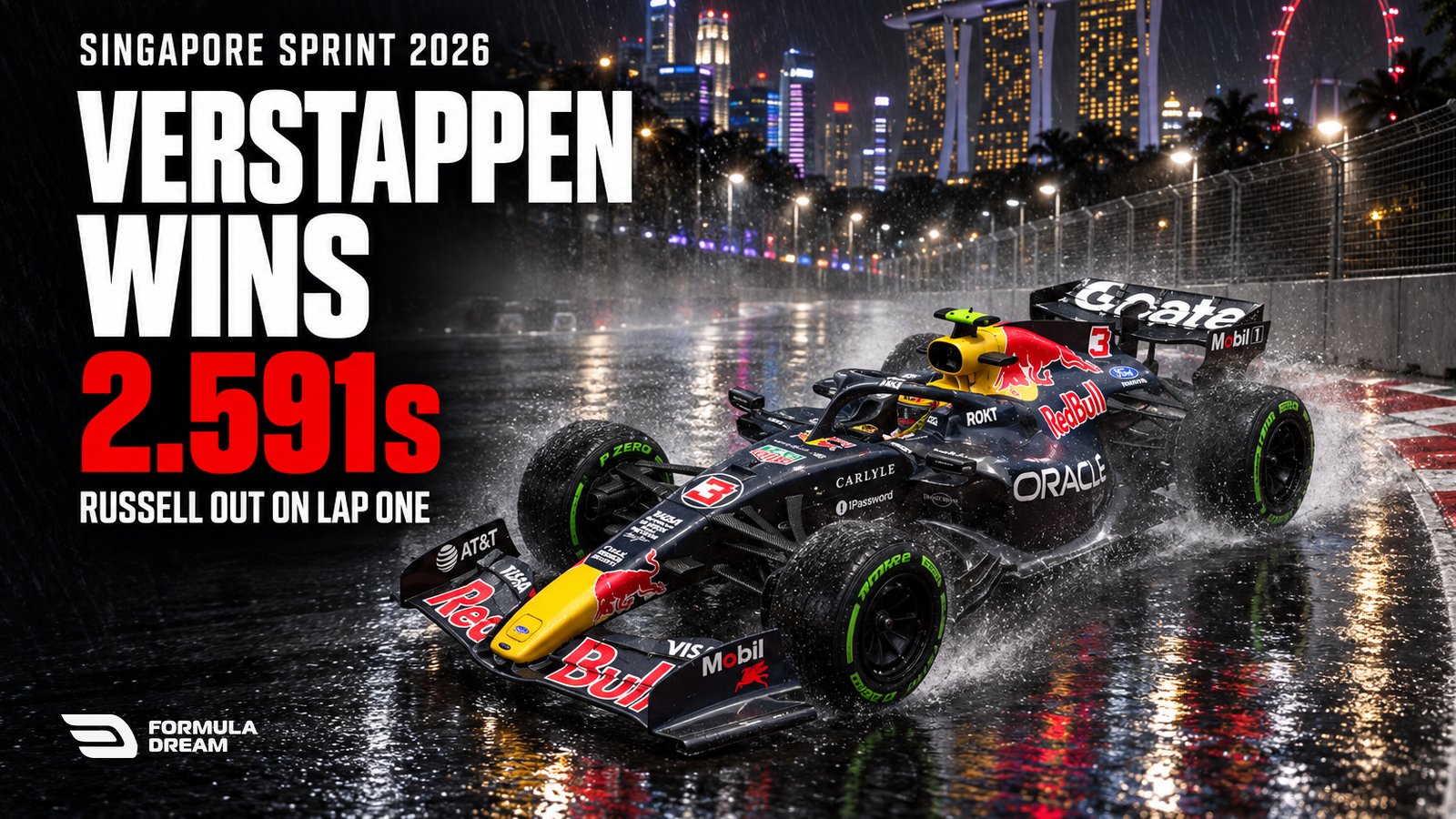
Singapore Sprint 2026 Results: Russell Crashes From the Lead
Russell took the lead at turn one and crashed at the final corner of the same lap. Verstappen won, Hamilton charged to second, and the McLarens hit each other.