You hear that sentence three or four times a race and it is doing a lot of work. It implies a process nobody explains, run by people nobody names, producing outcomes that regularly decide championships.
The process is actually well defined. Here it is.
Who the stewards are
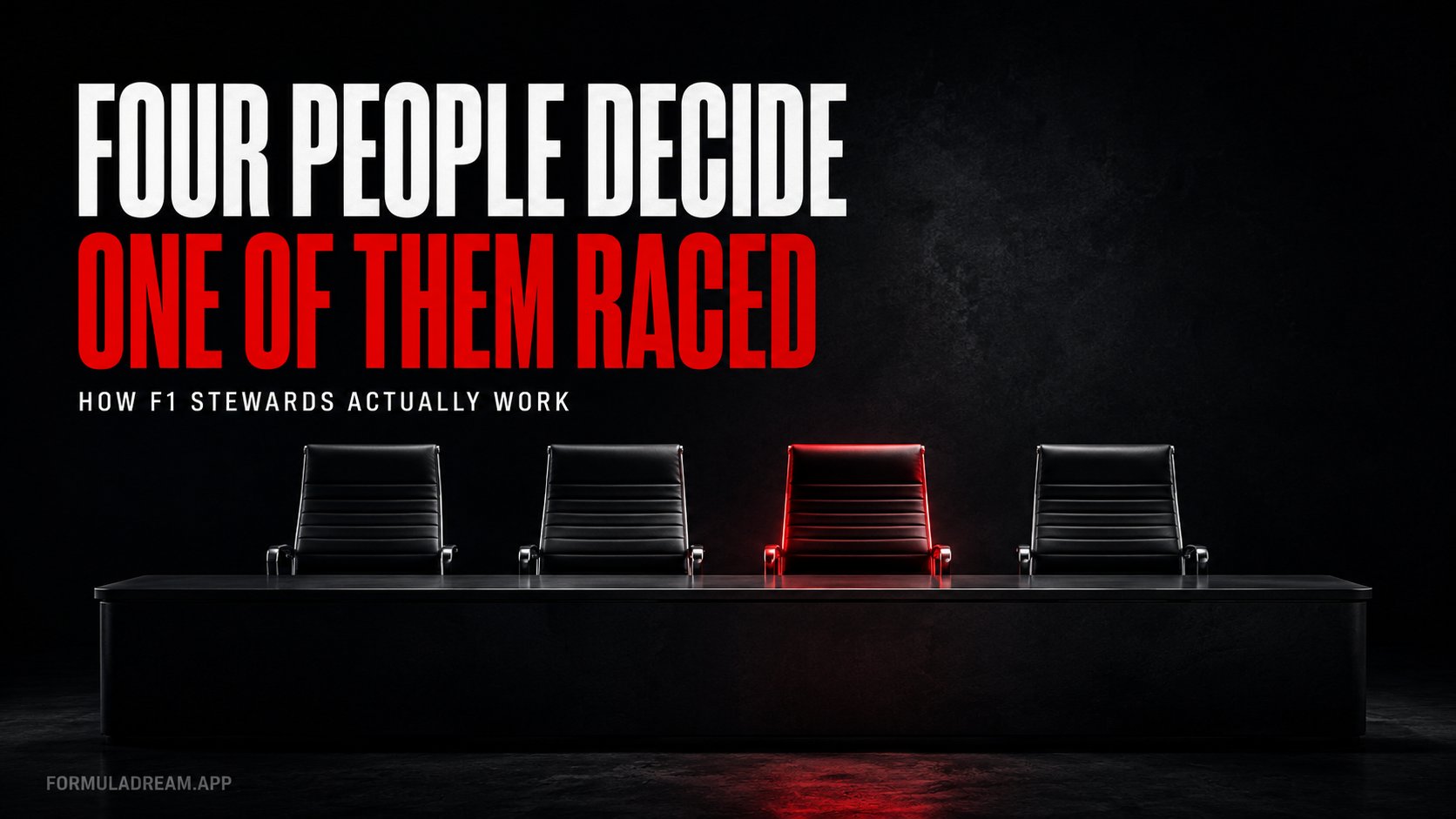
There are four of them, and they are not FIA employees sitting in a permanent office. The panel is assembled for each event.
The Chairman is a senior FIA appointee and runs the panel.
Two regular stewards sit alongside. One is nominated by the FIA, the other by the host country's national motorsport federation. That second appointment is why the panel changes composition from race to race.
is the interesting one. It is always a former Formula 1 driver, and the role rotates through the season. Former drivers who have filled the role include
Derek Warwick, Danny Sullivan and Emanuele Pirro
, and
Vitantonio Liuzzi
sat on the panel at the 2026 Italian Grand Prix.
The reasoning behind the role is straightforward: somebody in the room should know what a car actually does at 280km/h with another car alongside, rather than only what the regulations say. It is also the answer to the complaint that penalties are handed out by people who have never raced. One of the four always has.
Crucially, the stewards are independent of race control. The race director runs the session. The stewards judge it. Those are different jobs held by different people, which is why "race control is investigating" and "the stewards have issued a penalty" are two separate stages and not the same announcement twice.
Step 1: something gets referred
Most incidents are put in front of the stewards, but not all. Under Article B1.9.2 of the Sporting Regulations they can also investigate something they have noted themselves, and it is always their decision whether to investigate at all.
Usually that is a report from the Race Director, who flags an incident from race control. It can also come from a marshal's report, an automated system such as track limits detection, or a formal protest lodged by a team.
At this point the on-screen graphic says "under investigation", and the phrase "noted" means it has been seen but not yet referred. Once an incident is under investigation every team is told which drivers are involved, and if that message comes within 60 minutes of the end of a race, those drivers cannot leave the circuit without the stewards' consent.
Step 2: the evidence
This is where most fan arguments go wrong, because the stewards see considerably more than the broadcast does.
They have every camera angle, including onboards from both cars involved and circuit cameras that never make the world feed. They have telemetry: throttle, brake, steering and speed traces from the cars, which settles questions like whether a driver actually lifted, or braked earlier than usual, or turned in. They have team radio, including messages never broadcast. They have GPS and timing data showing exactly where each car was.
The documents say so plainly. A decision from the 2026 Chinese Grand Prix records that the stewards heard from both drivers and the team representatives and reviewed "video, telemetry, team radio and in-car video evidence".
That combination is why a decision sometimes contradicts what television clearly showed. Television showed one angle. The stewards had the brake trace.
Step 3: the hearing
If the incident needs it, the stewards call the parties in.
These are private, structured sessions. Drivers and team representatives attend, usually with a team manager. Each side presents its account. Drivers can bring their own data and argue from it.
They are not adversarial in the courtroom sense, and they are not public, which is a persistent source of frustration for fans who only ever see the outcome. What does become public is the reasoning, in the decision document.
Step 4: the decision, and the tariff behind it
The first test is blame. Under Article B1.9.3, unless it is clear to the stewards that a driver was wholly or predominantly to blame, no penalty is imposed. That is why so many investigations end with "no further action".
They are not inventing the penalty from scratch. Appendix B to the International Sporting Code sets out the Stewards' Penalty Guidelines, a published tariff of standard penalties for standard offences. It exists so that the same incident produces broadly the same outcome in Bahrain as in Brazil.
But the guidelines explicitly preserve discretion. Stewards are allowed to weigh mitigating and aggravating circumstances, and to consider the nature and location of the event. A first offence and a fourth offence are not the same. An incident at a circuit with a gravel run-off and one with tarmac are not the same.
That discretion is the source of most "inconsistency" complaints, and it is also the reason the written reasoning matters so much: it is where the panel has to justify why this case was not the standard one.
The penalties themselves are fixed by the Sporting Regulations. For an incident in a race or sprint, Article B1.9.5 gives the stewards this list to choose from:
Penalty
What it means
5-second penalty
Five seconds stationary at the next pit stop before the crew can touch the car, or five seconds added if the driver does not stop again
10-second penalty
The same, for ten seconds
Drive-through
A trip down the pit lane without stopping, taken within two laps
Stop-and-go
Ten seconds stationary in the pit box with no work allowed
Time penalty
Time added to the driver's result
Reprimand
Five in a season, at least four for driving, bring a ten-place grid drop
Grid drop
Places lost at the driver's next sprint or race
Disqualification
Removed from the results
Suspension
The driver misses the next event
Penalties for a race or sprint incident, from Article B1.9.5 of the 2026 Sporting Regulations. A drive-through or stop-and-go given in the last three laps becomes 20 or 30 seconds added instead.
Step 5: it becomes a document
The decision is published as a numbered FIA document, and it follows a fixed structure: the car and driver involved, the session, a neutral statement of Fact, the specific regulation breached under Offence, the penalty under Decision, and then Reason, where the stewards explain what evidence they saw and how they weighed it.
At the bottom sits the appeal note, reminding teams that they have the right to appeal certain decisions under Article 15 of the International Sporting Code and Chapter 5 of the FIA Judicial and Disciplinary Rules, within the time limits. The word "certain" matters. Under Article B1.9.7 of the Sporting Regulations, the time penalties, drive-throughs, stop-and-gos, reprimands and grid drops in the table above cannot be appealed at all.
Every decision is published on the FIA's Formula 1 documents page, event by event, alongside the summonses, the technical delegate's reports and the Race Director's notes. Each one carries a document number, a date and a time, so you can see the order things happened in.
A typical example: at the 2026 British Grand Prix, Document 68, issued at 12:18 on race day, recorded that Lance Stroll's car had used additional power unit elements and dropped him ten places on the grid under Article B8.2.8. No hearing was needed, because the facts came straight from the technical delegate's report.
The part that accumulates: penalty points
Alongside whatever penalty is applied on the day, stewards can add penalty points to a driver's Super Licence.
The system runs on a rolling twelve months. Points sit on the licence for twelve months from the date they were issued, then drop off. Reach twelve points in that window and the driver is suspended for the next event, after which twelve points are removed.
This is why a driver can be described as "one point away from a ban" in the middle of a season while apparently not having done anything dramatic recently. The points are cumulative and they expire on individual anniversaries, not all at once, so the total moves up and down through a year in a way that is genuinely hard to follow without tracking it.
Reprimands work similarly. Under Article B1.9.5, five reprimands in a season, of which at least four are for driving, trigger a ten-place grid penalty, served at the next race if the fifth one comes during a race.
Neither of these is announced with any fanfare. Both appear in documents.
Why this is worth understanding
Because the outcome of a Grand Prix is frequently not decided at the flag.
A result stays provisional until post-race scrutineering is complete. Decisions land in the hour after a race and sometimes later. Penalty points accumulate quietly across a season and produce a ban that surprises everybody who was not counting.
All of it is published. Almost none of it is announced.
How we handle it
Formula Dream collects every FIA document published across a race weekend, as it is released: the stewards' decisions, the penalties, the technical delegate's reports, the power unit allocations that make a grid drop inevitable before it is announced.
Alongside it, during a session you get a live dashboard with every car on the circuit map and a timing tower carrying gaps, intervals, tyre compound and tyre age, pit stop counts and positions gained or lost, with alerts for safety cars and yellow and red flags. Driver radio streams live with the transcript running beside the audio. A weekend timeline replays everything in order for anyone catching up across time zones.
Free, with no subscription and no ads. Independent, not affiliated with Formula 1.
Four at each Grand Prix: a chairman, a second FIA steward, a steward from the host country's national federation, and a former Formula 1 driver. At the 2026 Italian Grand Prix the panel was Garry Connelly, Mathieu Remmerie, Iacopo Arcangeli and Vitantonio Liuzzi.
Where can I find F1 stewards' decisions?
On the FIA's Formula 1 documents page, where every decision is published as a numbered document with the facts, the regulation breached, the penalty and the stewards' reasons.
Can F1 penalties be appealed?
Only some. Under Article B1.9.7 of the Sporting Regulations, time penalties, drive-throughs, stop-and-gos, reprimands and grid drops cannot be appealed. Decisions such as a disqualification can be, under Article 15 of the International Sporting Code.
When do the stewards give a penalty?
Only when it is clear to them that a driver was wholly or predominantly to blame. If blame is shared or unclear, the usual outcome is no further action.
Decision documents quoted: FIA Formula 1 documents, 2026 Chinese Grand Prix Document 28, 2026 British Grand Prix Document 68, 2026 Italian Grand Prix Document 43