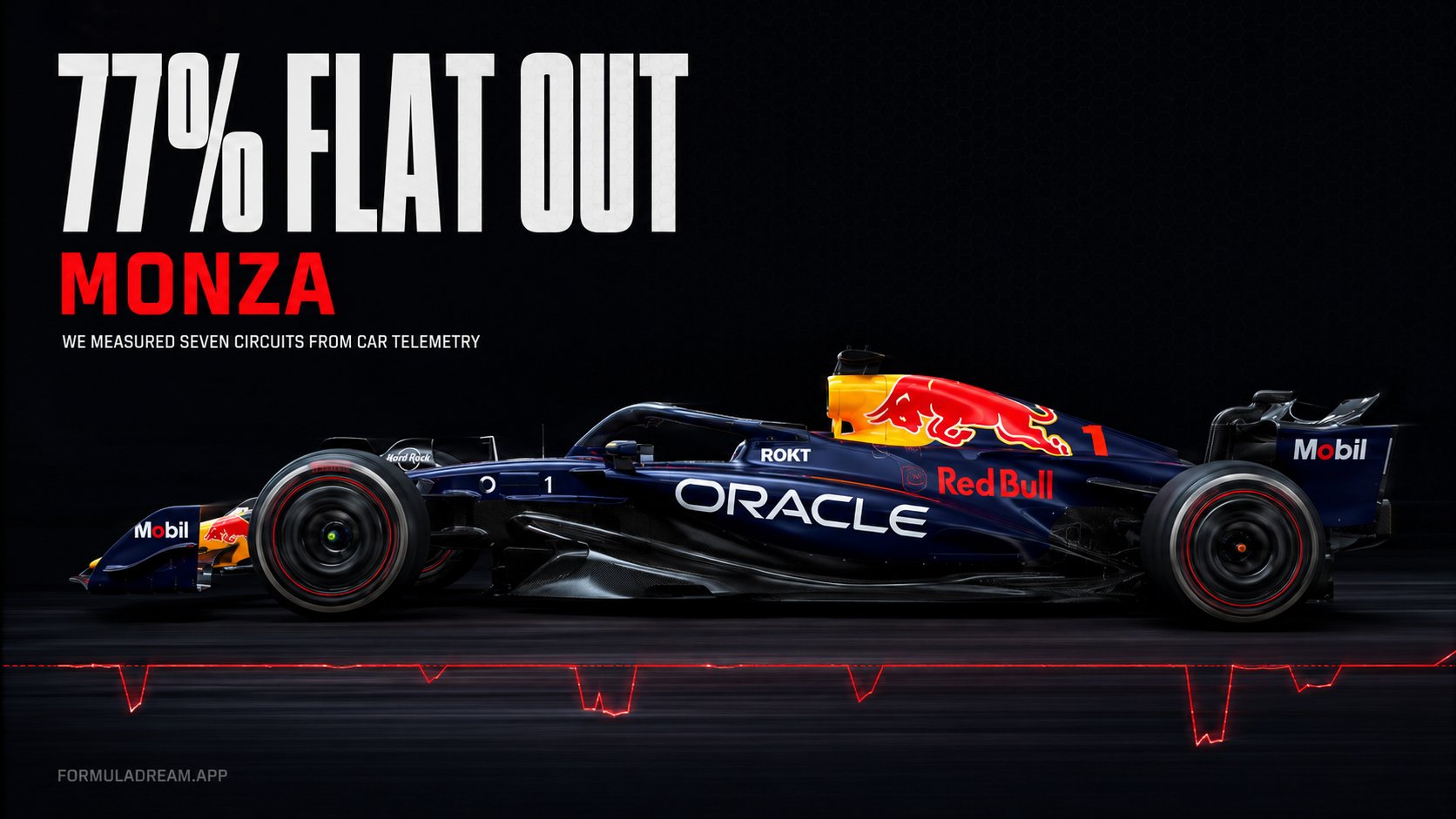
A Formula 1 qualifying lap at Monza is spent at full throttle for 77% of its duration, and 84% of its distance. At Monaco the same measurement gives 44% of the time and 58% of the distance.
Those are two different questions, and almost nobody says which one they are answering. It is the reason you will find Monza quoted as 70%, 75%, 77% and 79% by four different outlets, all of them correct.
We measured seven circuits from the cars' own telemetry to settle it.
Why do published full throttle figures never agree?
Because there are two honest ways to measure the same lap, and they give answers about nine points apart.
Share of lap time asks: for how many seconds of this lap was the throttle on the floor? Share of lap distance asks: over how many metres of this circuit was the throttle on the floor?
They differ because a car at full throttle is going fast, so it covers a lot of ground per second. The slow parts of a lap eat time without eating distance. Weight by distance and the straights dominate. Weight by time and the corners get their due.
Across the seven circuits we measured, distance-weighted figures came out 9.1 points higher than time-weighted ones on average.
The size of that gap is itself a measurement, and a useful one. It was smallest at Jeddah, at 6.2 points, and largest at Monaco, at 13.1. The wider the gap, the more of the lap is being spent going slowly. It is a single number that tells you how much of a circuit is corners.
The numbers, measured both ways
2025 qualifying, fastest lap of each session, read from car telemetry.
Monza: Lap 1:18.792, Full throttle, by time 77.0%, Full throttle, by distance 84.1%, Top speed 348 km/h
Jeddah: Lap 1:27.294, Full throttle, by time 76.2%, Full throttle, by distance 82.4%, Top speed 338 km/h
Silverstone: Lap 1:24.892, Full throttle, by time 68.5%, Full throttle, by distance 77.6%, Top speed 324 km/h
Spa: Lap 1:40.562, Full throttle, by time 65.4%, Full throttle, by distance 73.9%, Top speed 339 km/h
Hungaroring: Lap 1:14.890, Full throttle, by time 54.0%, Full throttle, by distance 62.3%, Top speed 318 km/h
Singapore: Lap 1:29.158, Full throttle, by time 53.0%, Full throttle, by distance 64.7%, Top speed 316 km/h
Monaco: Lap 1:09.954, Full throttle, by time 44.4%, Full throttle, by distance 57.5%, Top speed 289 km/h
Share of the fastest 2025 qualifying lap spent at full throttle, weighted by time and by distance
Everything below uses the time-weighted figure, because "how much of the lap" is a question about the lap as an experience, and a lap is a thing that takes time.
The whole season, ranked
Seven circuits make the point. Here is the entire calendar.
Share of the fastest qualifying lap spent at full throttle, every 2025 Grand Prix
One circuit in that list is worth pausing on. Mexico City records the highest top speed of the entire season at 351 km/h, and sits third from bottom on throttle share at 45.6%.
That combination looks impossible until you remember the altitude. Mexico City sits over 2,200 metres above sea level, where the air is thin enough that drag falls away and cars reach speeds they cannot manage anywhere else. But thin air also means less downforce, so the corners have to be taken slowly. A circuit that is simultaneously the fastest in a straight line and one of the least flat-out is a very specific piece of physics.
We have excluded China from the chart. It computed at 21.3%, so far outside every other circuit that it points to a compromised session rather than a real figure, and publishing it without explanation would have been misleading.
Which F1 circuit is the most full throttle?
Monza, at 77% of lap time, narrowly from Jeddah at 76.2%.
That the two are so close is worth sitting with, because they get there completely differently. Monza is six braking events joined by straights, and needs only 30 gear changes a lap. Jeddah is a 27-corner street circuit that happens to be taken almost flat, and it produces a top speed of 338 km/h between walls.
Monza's reputation as the temple of speed is earned on top speed, at 348 km/h, and on the fact that its lap is structurally simple. Jeddah gets to nearly the same throttle share while asking far more of the driver.
Which is the least?
Monaco, at 44.4%.
Less than half a Monaco lap is spent at full throttle. Put in seconds: about 31 seconds of a 70-second lap.
It is also the only circuit of the seven where the car spends more than a fifth of the lap braking, at 22.7%, and where the slowest point of the lap drops to 46 km/h. The car is almost never settled.
Is the Hungaroring really "Monaco without the walls"?
No, and the data is not close.
Every Hungarian Grand Prix preview repeats that line. Here is what the telemetry says:
Monaco's slowest corner: 46 km/h. The Hungaroring's: 98 km/h. More than twice as fast.
Full throttle: Monaco 44.4%, Hungaroring 54.0%. Ten points apart.
Top speed: Monaco 289 km/h, Hungaroring 318 km/h.
On every measure the Hungaroring sits closer to Singapore than to Monaco. What the two genuinely share is a consequence, not a character: both are hard to overtake at, and both make qualifying decisive. But one is a medium-speed circuit with a real straight, and the other is a slow one hemmed in by barriers. They ask different things of a car.
Which circuit brakes the least?
Spa, at 11.3% of the lap, and this is the number that surprised us most.
Spa is nearly seven kilometres long and reaches 339 km/h, yet it spends less of the lap braking than Monza does. The reason is the shape of the place. Eau Rouge and Raidillon, and Blanchimont near the end, are corners a modern F1 car does not brake for. They are flat.
So you get an enormous lap with very few genuine braking events. It is why brake wear is almost never the story of a Belgian Grand Prix, and why the circuit punishes engines instead.
What about gear changes?
The oddest number in the whole dataset. Singapore needs 53 gear changes a lap. Monza needs 30.
Over a 62-lap Singapore Grand Prix that is more than 3,200 shifts, each a seamless-shift operation completed in hundredths of a second. It is a decent argument for why gearbox reliability is a real engineering problem rather than a footnote, and why the sport regulates gearbox usage at all.
Monaco, despite being the shortest and slowest lap of the seven, needs 41.
What this changes about watching a race
A few broadcast staples read differently once you have these numbers.
When a team runs a low-downforce package at Monza, that is a decision made for 77% of the lap and paid for in the other 23%. When a driver complains about brake temperatures at Singapore or Monaco, the 20%-plus braking share is why that is a real problem there and not at Spa. When engines fail at Monza or Jeddah, the throttle share is the reason.
And when somebody tells you a circuit is "flat out", you can now ask which way they measured it.
The lifts a driver mentions and the ones they do not
A throttle trace records every lift, including the ones a driver would not describe as lifting. What it does not record is which of them the driver noticed, and that turns out to be a much shorter list.
The lifts that get talked about on the radio are the ones that cost something: traffic, a bad exit, a corner they keep getting wrong. The rest happen below the level of comment. If you want the driver's own account of a lap alongside the trace, the team radio archive has the session.
Method
Telemetry retrieved with FastF1, 2025 qualifying sessions, fastest lap of each session. Full throttle defined as throttle position above 98%. Braking share is time or distance with the brake applied.
Telemetry samples are not evenly spaced in time, so both figures are properly weighted rather than counted per sample. Counting samples would have quietly over-represented the straights, where the car covers more ground between readings, and produced a flattering number.
As an integrity check, the lap times returned by the telemetry match the independently published pole times exactly: Spa 1:40.562, Silverstone 1:24.892.
Where this data comes from, live
Every figure here is read from the same telemetry the cars broadcast during every session: throttle, brake, gear, speed and revs, several times a second.
That live feed is what powers the dashboard in our app. During a session it puts every car on the circuit map with a timing tower carrying gaps, intervals, tyre compound and tyre age, pit stop counts and positions gained or lost, plus alerts for safety cars and yellow and red flags. Driver radio streams live with the transcript running beside the audio.
It also collects every FIA document published across a race weekend, the stewards' decisions and penalties that decide results and that most fans never see. We wrote a full guide to what the FIA publishes and how to read it.
Free, no subscription, no ads. Independent, and not affiliated with Formula 1.