The 2026 F1 Regulations Explained: Everything That's New
New power units with a roughly 50/50 split of engine and electric power, active aerodynamics, the end of DRS, smaller and lighter cars, and 100% sustainable fuel. Here is everything that changes in Formula 1 for 2026, explained simply.
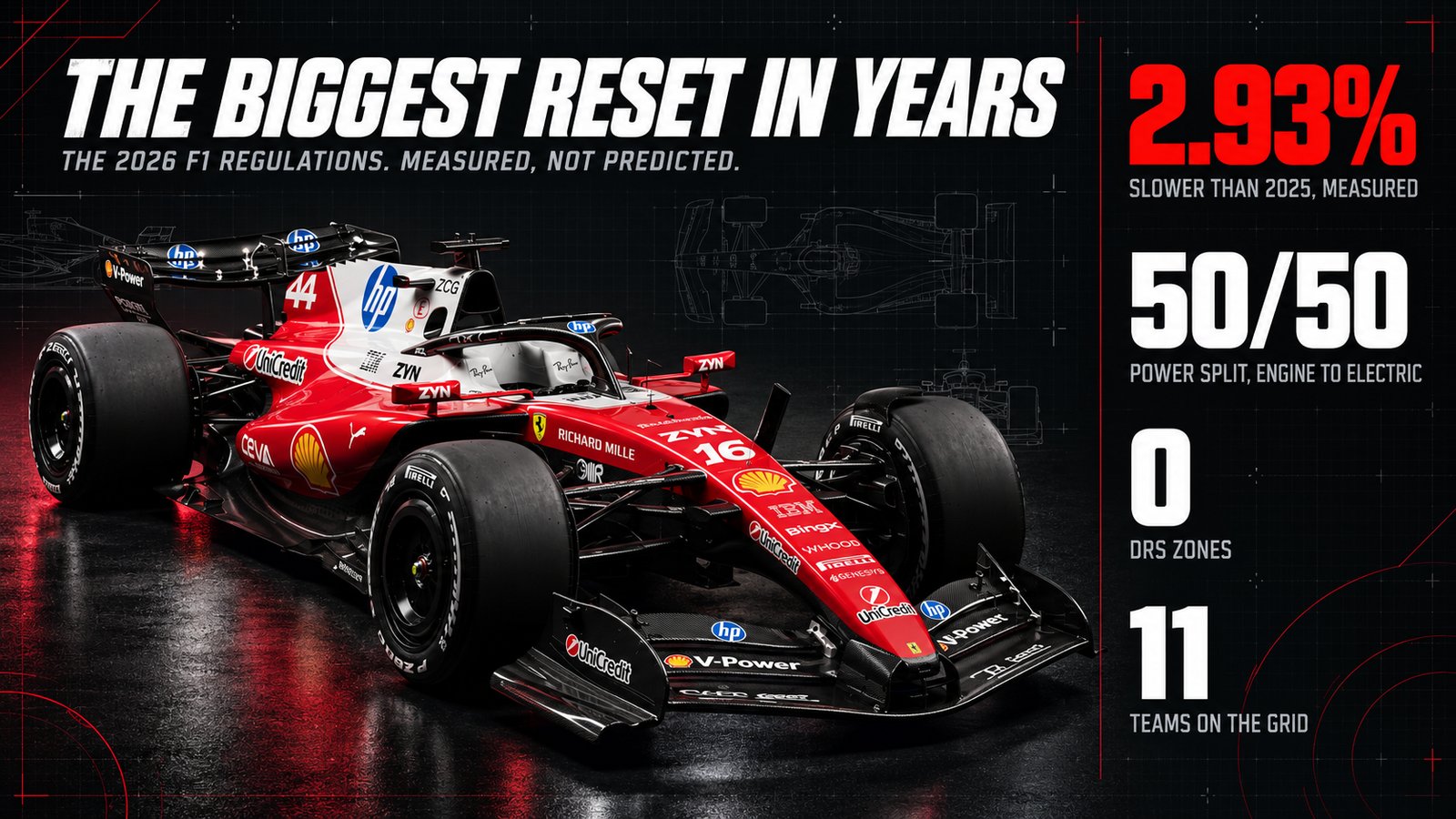
2026 brings Formula 1 its biggest rules reset in years. New hybrid power units move to a roughly 50/50 split between engine and electric power, the cars gain active aerodynamics with wings that change shape, DRS is gone, the cars are smaller and lighter, and everything runs on 100% sustainable fuel. Here is what all of it actually means.
It is a lot to take in, so this guide goes through it one change at a time, in plain language, with the official 2026 terminology
. Prefer to watch first? We break down the whole reset in this video:
The new power units, the headline change
The engines are where 2026 changes most. The new power unit is still a 1.6-litre turbo-hybrid, but the balance between the combustion engine and the electric motor is almost completely rewritten.
Today's cars get roughly 80% of their power from the engine and about 20% from electric. For 2026 that moves to about 50/50. The way it happens is simple to state: the electric side gets much bigger, and the engine side gets smaller. The MGU-K, the motor that recovers and deploys electrical energy, jumps from 120kW to 350kW, nearly three times the electric power. The combustion engine gives up a matching amount, so the two end up roughly equal. Combined peak output still tops 700kW, close to 950 horsepower, so these are not slower cars, just very differently powered ones.
One part of the old system is being dropped entirely: the MGU-H, the unit that recovered heat energy from the turbo. It was clever but complicated and expensive, and no road car uses anything like it. Removing it makes the power unit simpler and cheaper to build, which is a big reason new manufacturers were willing to commit to 2026. The focus shifts to the MGU-K, which is much closer to the hybrid technology in ordinary cars.
100% sustainable fuel
Every car on the 2026 grid runs on 100% advanced sustainable fuel. Rather than being refined from crude oil, the fuel is made from sources like carbon capture, municipal waste, and non-food biomass, and it is designed to slash the lifecycle carbon footprint of a race weekend. Formula 2 and Formula 3 ran the fuel through 2025 as a proving ground, so it arrives in F1 already tested at real racing speeds. The point is that the sport can keep the noise and the performance while cutting the environmental cost of the fuel it burns.
Active aerodynamics, wings that change shape
Here is the change you will see most on track. From 2026 the cars have active aerodynamics: movable front and rear wings that switch between two shapes depending on where the car is on the lap.
The two settings have official names:
Corner Mode is the high-downforce shape. The wings sit in this position by default, giving the car maximum grip through the bends.
Straight Mode is the low-drag shape. On the straights the driver flattens the wings out to cut drag and gain top speed.
The rear wing has three elements and the front wing has two, and both move together between the two modes in the designated high-speed sections of each track. Think of it as the car trimming itself for corners and then for straights, instead of running one compromise wing setting for the whole lap. It is a neat answer to an old problem: cars used to be built either for downforce or for straight-line speed, and now they can have more of both.
Is DRS gone in 2026?
Yes. DRS, the Drag Reduction System that has been part of F1 since 2011, is gone for 2026. (For how the old system worked, see our full guide to DRS in F1.) Its two jobs have been split up and handed to the new systems. The drag-cutting job, opening the rear wing on the straights, is now just part of active aero (Straight Mode). The overtaking job, giving a chasing car a speed advantage, is replaced by a new driver tool called Overtake Mode.
Overtake Mode and Boost, the new push-to-pass
DRS used to give the following car a fixed advantage inside painted zones. 2026 replaces that with electrical energy the driver controls, and it comes in two distinct forms.
Overtake Mode is the direct DRS replacement. When a driver is within one second of the car ahead, they unlock an extra burst of electrical power to help launch a pass. The key difference from DRS is that it is not tied to fixed zones or an automatic flap: the driver chooses when to spend it, all at once or spread across a lap, which makes attacking far more tactical.
Boost is separate. It is a driver-operated deployment of extra energy from the car's recovery system that can be used anywhere on track, to attack or to defend. It hands the driver, rather than a zone on the circuit, the decision about when to use the car's full combined power.
The theme behind both is the same one the FIA has pushed for the whole 2026 package: put the driver back in charge. Less automatic assistance, more decisions in the cockpit.
Smaller, lighter, more agile cars
The 2026 cars are physically smaller than the current generation, which had grown long and heavy. The headline dimensions:
Wheelbase cut by 200mm, down to 3,400mm.
Overall width cut by 100mm, down to 1,900mm.
Floor width reduced by 150mm.
Minimum weight cut by about 30kg, from 800kg down to 768kg.
Tyres narrower too: front tyres 25mm slimmer, rears 30mm slimmer, though the 18-inch wheel diameter stays.
The 2026 car at a glance: lighter, narrower and shorter, with nearly three times the electric power and fully sustainable fuel.
None of these are huge on their own, but together they make a shorter, lighter, more nimble car. The goal is racing you can feel: cars that are easier to place, easier to defend with, and easier to follow closely and overtake. After years of cars getting bigger, 2026 deliberately reverses the trend.
What it means for the racing
Put it all together and the intent is clear. Active aero lets cars carry speed on the straights without throwing away cornering grip. Overtake Mode and Boost hand the driver a strategic energy weapon instead of an automatic zone. Smaller, lighter cars are easier to race wheel to wheel. And the 50/50 power unit keeps the performance while making the technology greener and simpler.
Whether it produces closer racing is the season-long question every fan is watching. What is certain is that the driver has more to manage and more to decide than at any point in the hybrid era, which is exactly what the rules set out to do.
See the 2026 cars
The clearest way to understand a rules reset is to look at what it produced. You can explore every car on the 2026 grid in 3D, spin them around and compare how each team read the same new regulations:
Want to get a proper look at the new machinery? Our 3D Showroom lets you walk around the current F1 cars and see the reshaped bodywork from every angle.
Follow the new rules in practice
The 2026 rules read as a list of changes. They land as lap times, tyre behaviour and penalties.
The Formula Dream app runs a live Dashboard through every session: every car moving on the circuit map, and a timing tower with lap times, gaps and intervals, tyre compound and age, pit counts and positions, plus flag and safety car alerts the moment race control calls them. You also get live driver radio as it is broadcast, and every FIA document of the weekend collected as it is published, which is where the stewards' decisions that change results actually appear.
Free, no subscription, no ads, independent. Not affiliated with Formula 1.
New power units with a roughly 50/50 split between engine and electric power, active aerodynamics with movable wings, the end of DRS (replaced by Overtake Mode), smaller and lighter cars, and 100% sustainable fuel.
Does F1 still have DRS in 2026?
No. DRS is gone. Its drag-cutting role is now part of active aero (Straight Mode), and its overtaking role is replaced by Overtake Mode, an electrical power boost the driver deploys when within one second of the car ahead.
How much of the 2026 power unit is electric?
Roughly half. The electric MGU-K rises from 120kW to 350kW, while the combustion engine's share falls by a matching amount, moving the balance from about 80/20 today to around 50/50.
What fuel do 2026 F1 cars use?
100% advanced sustainable fuel, made from sources like carbon capture, municipal waste, and non-food biomass, and already proven in Formula 2 and Formula 3 during 2025.
Are the 2026 cars smaller?
Yes. The wheelbase is 200mm shorter, the car is 100mm narrower, the tyres are slimmer, and the minimum weight drops from 800kg to 768kg, for a smaller and more agile car.
What is the difference between Overtake Mode and Boost?
Overtake Mode is the DRS replacement, available only when you are within one second of the car ahead. Boost is a separate energy deployment the driver can use anywhere on track, to attack or defend.
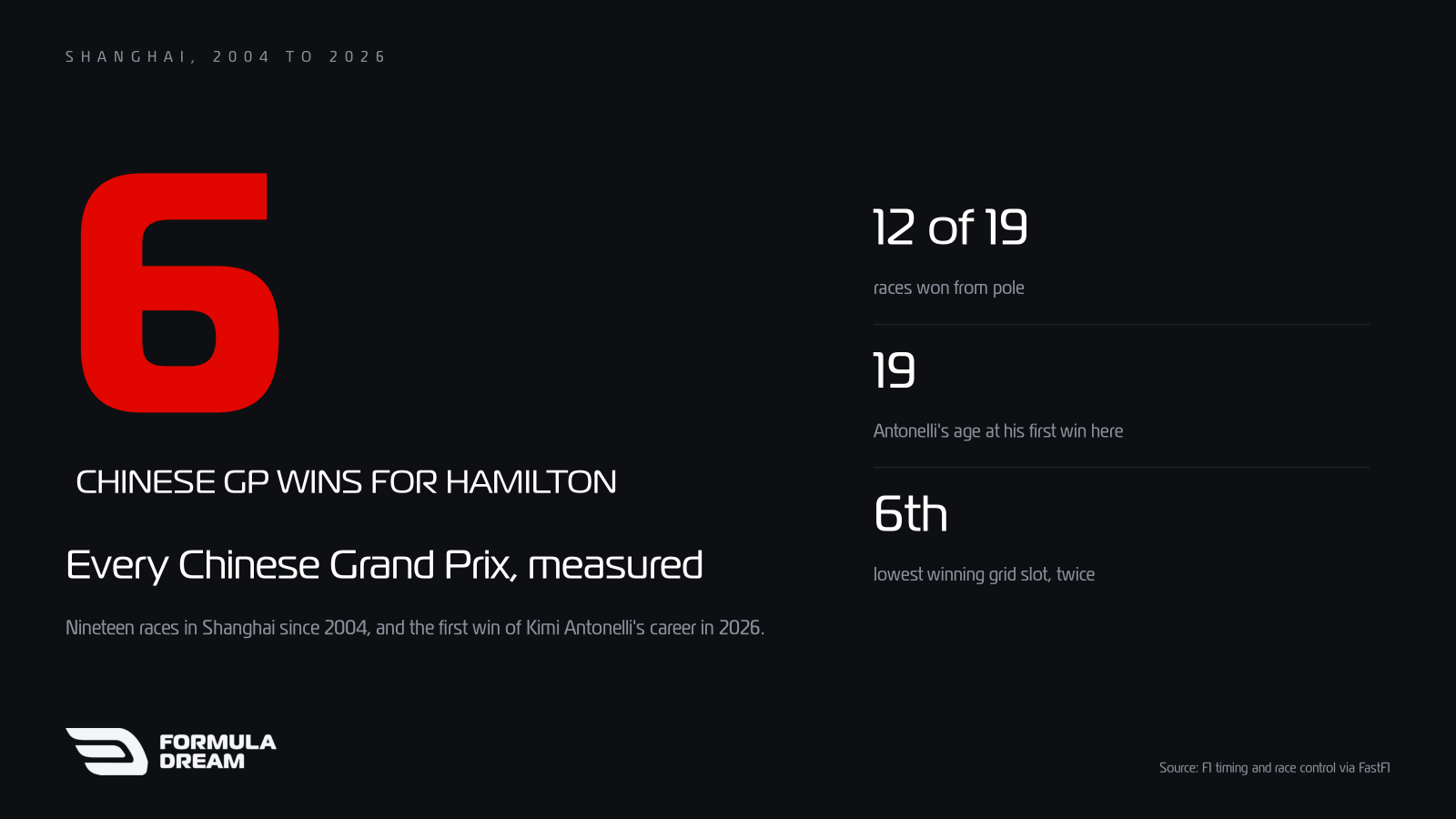
Nineteen Chinese Grands Prix have been held in Shanghai since 2004. Lewis Hamilton won six, pole won twelve, and in 2026 Kimi Antonelli took the first win of his career there, at 19, with Hamilton on the podium for Ferrari for the first time. Every winner, grid slot and safety car, measured.