What Is DRS in F1? (And Why It Ended) | Formula Dream
Guides
What Is DRS in F1? How It Worked, and Why It Ended
DRS, the Drag Reduction System, lets an F1 driver open a flap in the rear wing on designated straights to cut drag and gain speed, making overtaking easier. Here is how it works, the rules, and what changes in 2026.
DRS stands for Drag Reduction System. It was a driver-operated flap in the rear wing that opened on designated straights to cut aerodynamic drag and add straight-line speed, making overtaking easier. A driver could only use it when within one second of the car ahead.
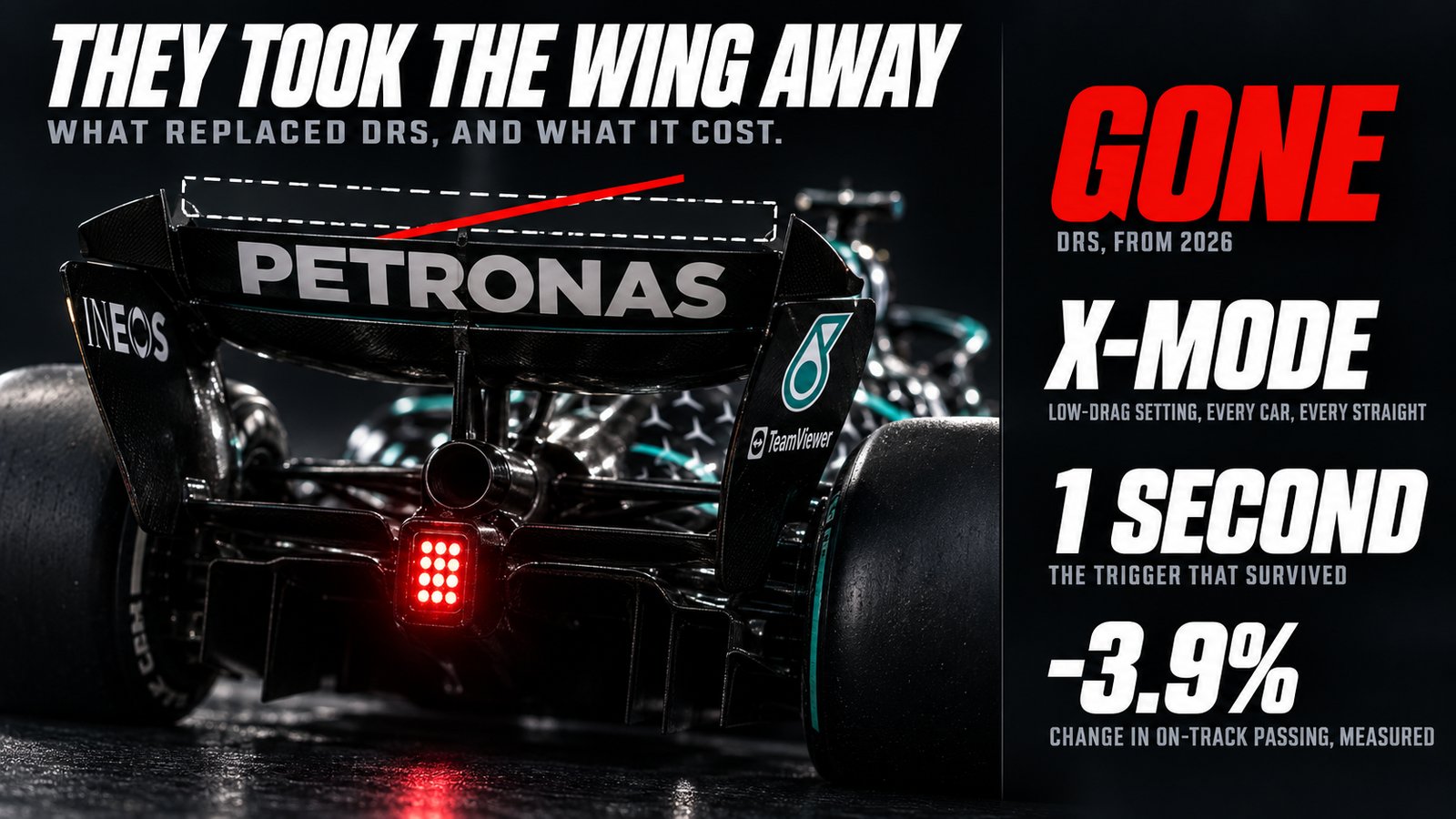
One thing most explanations still get wrong: DRS no longer exists. It ran from 2011 to the end of 2025 and was removed for the 2026 season, replaced by active aerodynamics and a boost called Overtake. If you are watching a race now, there is no DRS in it.
Here is how it worked, why it was introduced, and what took its place.
What does DRS stand for?
DRS stands for Drag Reduction System. It is an overtaking aid, introduced in 2011, and it exists for a specific reason. The year before, Fernando Alonso had lost the 2010 title stuck behind a slower car he could not pass for 40 laps, a symptom of how hard dirty air makes following and overtaking. DRS was F1's answer: give the chasing car a straight-line speed boost to get the job done.
How does DRS work?
A Formula 1 car's rear wing creates downforce, which presses the car onto the track for grip. Downforce comes at a cost: drag, the aerodynamic resistance that holds the car back on the straights. DRS is a clever way to reduce that cost when the driver does not need the downforce.
When a driver activates DRS, a flap in the rear wing flips open. That opening lets air pass through instead of pushing against the wing, so drag drops sharply and the car accelerates harder and reaches a higher top speed down the straight. The moment the driver brakes for the next corner, or lifts off the throttle, the flap snaps shut and full downforce returns for the corner.
Closed, the wing forces air up and over for downforce and drag. Open, a slot lets air through, cutting drag for more straight-line speed.
How much speed did DRS add? We measured it
For every green-flag race lap in 2024 and 2025 without a pit stop, we compared each driver's speed-trap reading with their own clean-air laps, more than three seconds behind anyone, within five laps either side.
Gap to the car ahead
Laps
Speed-trap gain (median)
Under 1 second, DRS allowed
1,564
+10.5 km/h
1 to 1.5 seconds, no DRS
833
+2.5 km/h
1.5 to 2 seconds, no DRS
937
+2.0 km/h
Speed-trap gain from following another car, 2024 and 2025 races, against the same driver's clean-air laps
The tow on its own was worth about 2 to 2.5 km/h. Inside one second, where DRS came into play, the gain jumped to 10.5 km/h, so DRS itself was worth roughly 8 km/h at the speed trap on a typical lap. Where the speed trap sat at the end of a DRS zone it was far more: in 2025 the median gain inside a second was 26 km/h at Bahrain and 22.5 km/h in Spain. The full measurement is in what a tow is worth in F1.
That does not sound like much, but combined with the tow it was often the difference between completing a pass and running out of road.
When can drivers use DRS? The rules
DRS is not a free-for-all. It is tightly controlled so it stays an overtaking aid rather than a permanent speed boost.
The one-second rule and the detection point
Each DRS zone has a detection point earlier on the lap. As a driver crosses that point, the timing system checks the gap to the car ahead. If they are within one second, DRS is enabled for them in the upcoming zone. If the gap is larger, they do not get it. This is why you often hear a driver was "in the DRS window."
DRS zones and activation points
DRS can only be used in designated DRS zones, usually the longest straights, and only after the activation point at the start of that zone. Most circuits have one to three zones. Outside those zones, the wing stays closed.
When DRS is disabled
Race control switches DRS off in several situations for safety:
The first two laps of a race, and the first two laps after a safety car restart.
While the safety car or virtual safety car is deployed.
In wet or dangerous conditions, at race control's discretion.
Through yellow-flag sectors.
Practice and qualifying vs the race
In practice and qualifying, drivers can use DRS freely within the zones, with no one-second rule, because they are chasing a fast lap, not another car. The within-one-second condition only applies in the race.
What is a DRS train?
A DRS train is what happens when a line of cars are all within one second of each other. Every car gets DRS at the same time, so nobody has an advantage over the car directly ahead, and the whole queue is stuck. It is one of the common criticisms of DRS: when everyone has it, it can cancel itself out and freeze the order.
We checked the telemetry. The DRS channel reads zero.
Plenty of articles state that DRS ended. Almost none show it, so here is the evidence.
Formula 1's car telemetry carries a dedicated DRS channel, which recorded when the flap was open on any given lap. We pulled it for the seven fastest drivers at the 2026 Italian Grand Prix at Monza, the circuit where DRS mattered most, and checked every sample around the lap.
The channel reads zero for every driver, on every lap, all the way around. Not intermittent, not low, zero. On a circuit that had two DRS zones as recently as last season.
There is a second piece of evidence in the race control feed, which is worth knowing because it is the replacement showing up in the wild. At 10:51:36 during first practice at Monza, after a red flag period was cleared, race control posted a single line:
"OVERTAKE ENABLED"
That is the 2026 system, not DRS. Where DRS was a flap the driver opened when within a second of a car ahead, the replacement is a driver-triggered energy deployment the FIA calls Overtake, sitting alongside active aerodynamics that move the front and rear wings together between a low-drag and a high-downforce setting. The full rules change is in the 2026 F1 regulations explained, and the Monza telemetry it came from is in the Monza practice data analysis.
So the honest answer to "what is DRS in F1" in 2026 is: it is a system that existed from 2011 to 2025, it no longer exists, and you can prove it from the car data rather than taking anyone's word for it.
The drag-cutting job became part of full active aerodynamics. Both the front and rear wings now move between Corner Mode, the high-downforce setting for braking zones and corners, and Straight Mode, the low-drag setting that opens the wing elements on defined straights. The FIA's early names for them were Z-mode and X-mode. Every driver gets Straight Mode, whether or not anyone is ahead. In effect the whole grid now has something DRS only ever gave to a chasing car.
The overtaking job went to a separate system, Overtake Mode. A driver within one second of the car ahead at the detection point, nominally the final corner, gets an extra 0.5MJ of energy recharge and more electrical power to use on the following lap. So the trigger survived the rule change. The flap did not.
It still shows up at the speed trap. In the first 13 races of 2026, a car inside a second of the one ahead gained a median 8 km/h over the same driver's clean-air laps.
So did losing DRS ruin the racing? We counted the on-track position changes at every 2026 race and compared them with the same circuits in 2025. Overtaking fell by 3.9%. Four of the nine comparable circuits actually produced more passing without DRS than with it. The race-by-race numbers are in what happened to overtaking without DRS.
The one second rule outlived DRS
The one-second window is the part worth remembering, because it did not go away. Overtake uses the same trigger, measured at the same kind of detection point. One second still decides who gets help and who does not.
One second also sounds smaller than it is. At racing speed it is a surprising amount of track, and our Gap Visualizer draws time gaps to scale as real distance so you can see exactly how much ground a driver has to make up before any of it becomes available.
Watch the gaps live
The Formula Dream app runs a live Dashboard through every session: every car on the circuit map, and a timing tower with lap times, gaps and intervals, tyre compound and age, plus flag and safety car alerts the moment race control calls them. That is where you see a driver arrive inside the one second window in real time. You also get live driver radio as it is broadcast, and every FIA document of the weekend as it is published, including the stewards' decisions behind each penalty.
Free, no subscription, no ads, independent. Not affiliated with Formula 1.
It opens a flap in the rear wing on designated straights, which cuts drag and raises the car's straight-line speed so it can close on and pass the car ahead.
When was a driver allowed to use DRS?
Only when within one second of the car ahead at the detection point, only inside a designated DRS zone, and only once race control had enabled it. It was disabled for the first two laps, under safety cars, and in dangerous conditions.
How much faster does DRS make a car?
About 8 km/h at the speed trap on a typical lap, by our measurement of 2024 and 2025 races: drivers inside one second gained a median 10.5 km/h, against about 2 to 2.5 km/h from the tow alone. At some circuits the gain was over 20 km/h.
Does F1 still have DRS?
No. DRS ran from 2011 to the end of 2025 and was removed for 2026. It was replaced by active aerodynamics, where every car's wings switch to a low-drag setting on defined straights, plus Overtake Mode, extra electrical energy for a driver within one second of the car ahead.
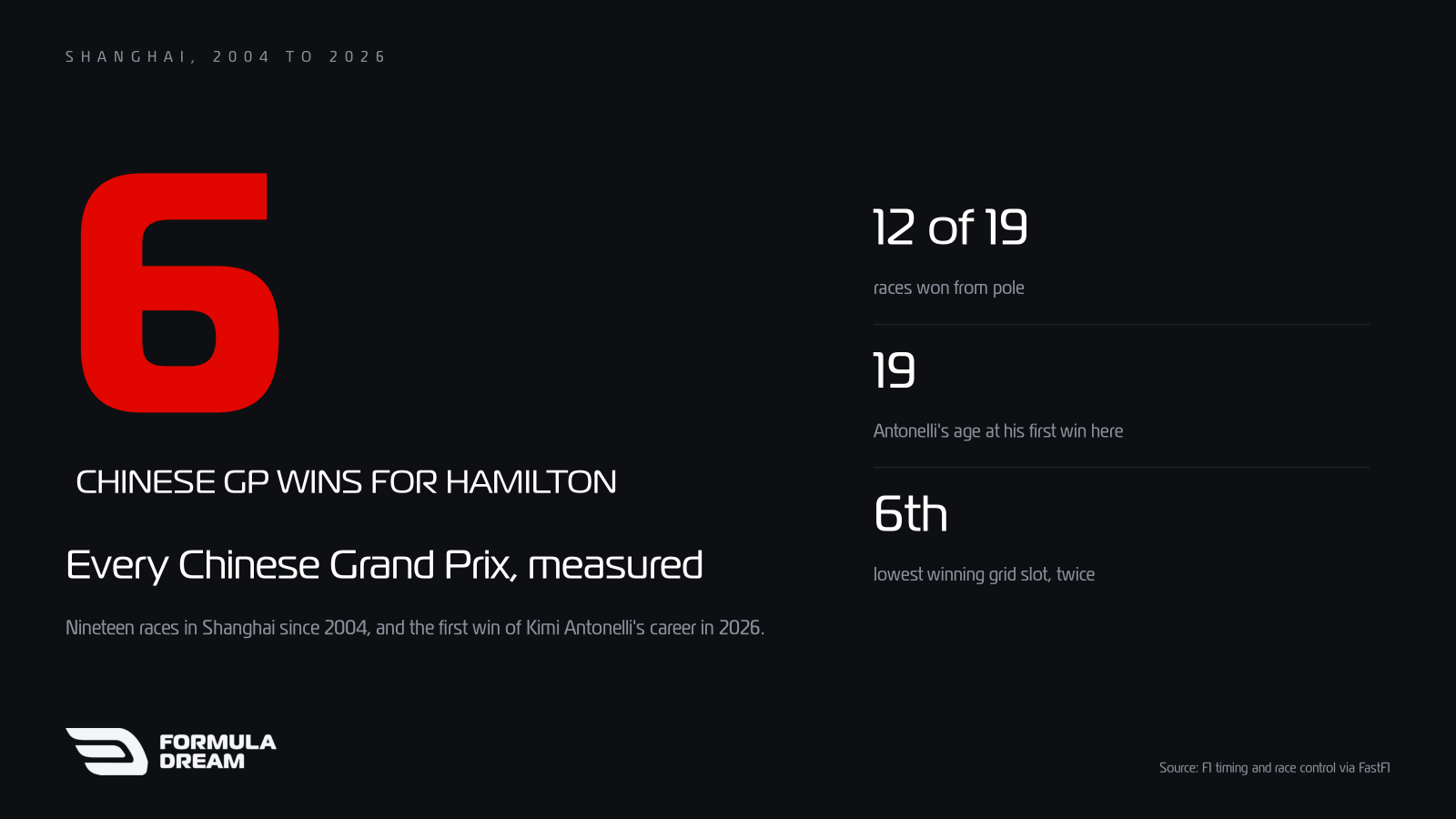
Nineteen Chinese Grands Prix have been held in Shanghai since 2004. Lewis Hamilton won six, pole won twelve, and in 2026 Kimi Antonelli took the first win of his career there, at 19, with Hamilton on the podium for Ferrari for the first time. Every winner, grid slot and safety car, measured.