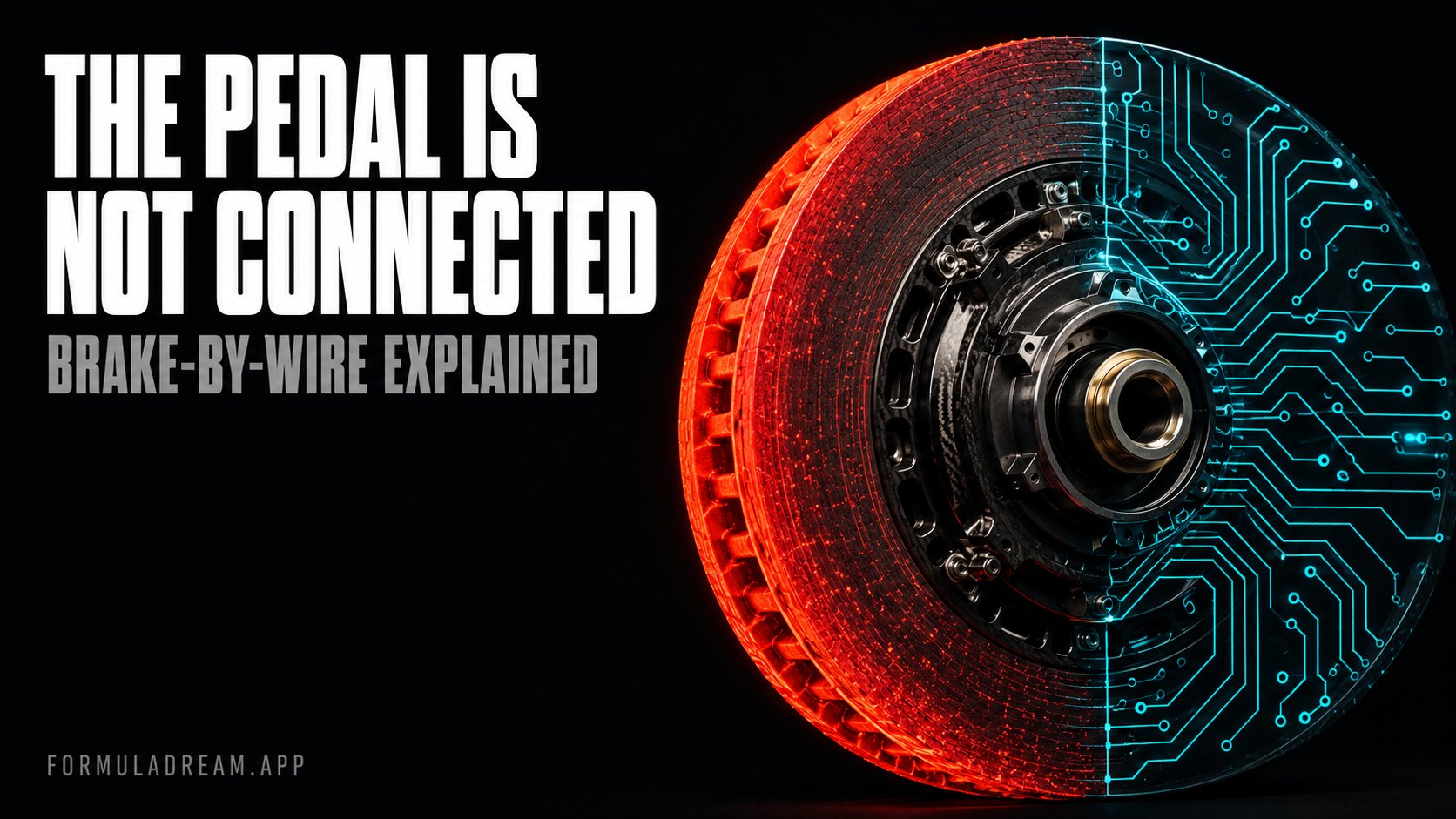
When a Formula 1 driver presses the brake pedal, the front brakes respond hydraulically, exactly as you would expect. The rear brakes do not. A sensor reads how hard the pedal was pressed, sends that number to a computer, and the computer decides how much rear braking to apply.
The pedal is an instruction, not a connection.
This is brake-by-wire, and it is not a gimmick or a driver aid. It exists because without it, a hybrid F1 car would be close to undriveable under braking.
Why does an F1 car need brake-by-wire?
Because there are three separate things slowing the rear wheels, and only one of them is the brakes.
Friction braking, the conventional one: carbon discs squeezed by calipers.
Engine braking, the resistance of an engine being driven by the wheels rather than driving them.
Electrical braking, from the MGU-K. When the hybrid system harvests energy under braking, it does so by putting a load on the rear axle. Generating electricity requires resistance, and that resistance slows the car. Harvesting is braking.
That third one is the problem, because it will not sit still.
The problem brake-by-wire actually solves
The braking effort coming from the MGU-K varies constantly. It depends on the harvesting setting the driver has selected and, crucially, on how full the battery already is.
A nearly empty battery accepts everything the MGU-K can send it, so harvesting is aggressive and the electrical braking contribution is large. A nearly full battery cannot accept much, so harvesting drops away and the electrical braking contribution shrinks or disappears.
Now imagine that without brake-by-wire.
A driver arrives at the same corner on lap 12 and lap 13, presses the pedal by exactly the same amount, and gets a different amount of rear braking each time, because the battery state changed. Sometimes the rear of the car bites hard. Sometimes it does not bite at all. And nothing warns them which it will be.
Inconsistent rear braking is not a minor irritation. It is the difference between the car stopping straight and the car spinning.
How the system works
The driver presses the pedal. Fluid pressure builds in the rear circuit, and an electronic pressure sensor reads it. That reading represents the total rear braking the driver is asking for.
The signal goes to the electronic control unit. The ECU knows how much braking the MGU-K is currently contributing, because it is commanding the harvesting in the first place. It subtracts one from the other and applies exactly enough friction braking to make up the difference.
The result is that total rear braking stays constant for a given pedal input, regardless of how much energy is being harvested at that moment. The blend shifts continuously underneath. The driver feels one consistent thing.
It also lets the car adjust rear pressure in real time to prevent a lock-up, and to maximise recovery without compromising stability.
Is this traction control by another name?
No, and the distinction matters, because this is the most common objection to it.
Brake-by-wire does not decide whether to brake, or how much the car should slow down. The driver decides that with their foot, and that instruction is obeyed. What the system does is manage the split between two sources that together deliver the amount the driver asked for.
The analogy is a mixing desk, not an autopilot. The driver sets the volume. The system decides how much comes from each channel so the output stays the same.
The front brakes, meanwhile, remain purely hydraulic and directly connected. There is no electronic intermediary at the front at all.
Why it started in 2014
Brake-by-wire arrived with the hybrid era. Before 2014 the energy recovery systems were far less powerful and their braking contribution was small enough to live with.
The 2014 power units changed that, and the rules permitted brake-by-wire for the rear brakes specifically because the MGU-K made the old arrangement untenable.
That link matters more now, not less. The 2026 regulations triple the MGU-K's output to 350 kW and remove the MGU-H entirely, which means every joule in the battery has to come from braking. More harvesting means a larger and more variable electrical braking contribution, and a system managing that blend becomes more essential, not less. We wrote about what the 2026 ERS changes mean.
What a driver actually feels
Very little, which is the point.
The system is judged by its invisibility. A driver should be able to brake at the same point, with the same pressure, on lap 1 and lap 50, and get the same response, while underneath the car the balance between friction and harvesting has shifted a hundred times.
When you hear a driver complaining about brake feel or a lack of rear stability on entry, this is often the system being asked to do something at the edge of what it can blend cleanly, usually because the battery is at an awkward state of charge for that corner.
Hearing it happen
Brake balance, harvesting and battery state are constant conversations between driver and engineer during a session, and they happen on the radio.
Our app streams driver radio live with the transcript running beside the audio, so you can follow those conversations as they happen rather than hearing the two clips that make the broadcast. During a session it also puts every car on the circuit map with a timing tower carrying gaps, intervals, tyre compound and tyre age, pit stop counts and positions gained or lost.
Free, no subscription, no ads. Independent, and not affiliated with Formula 1.
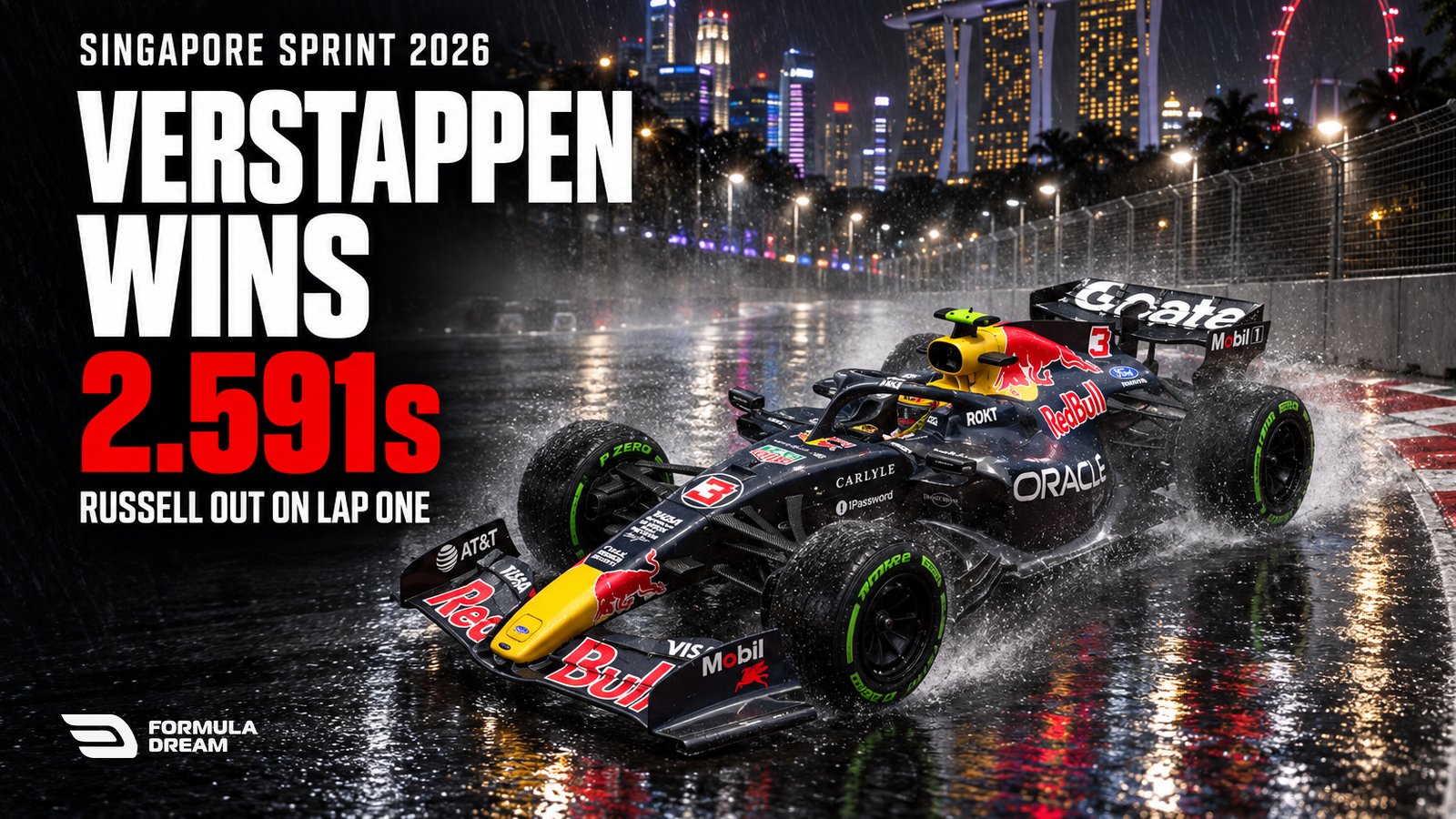
Singapore Sprint 2026 Results: Russell Crashes From the Lead
Russell took the lead at turn one and crashed at the final corner of the same lap. Verstappen won, Hamilton charged to second, and the McLarens hit each other.