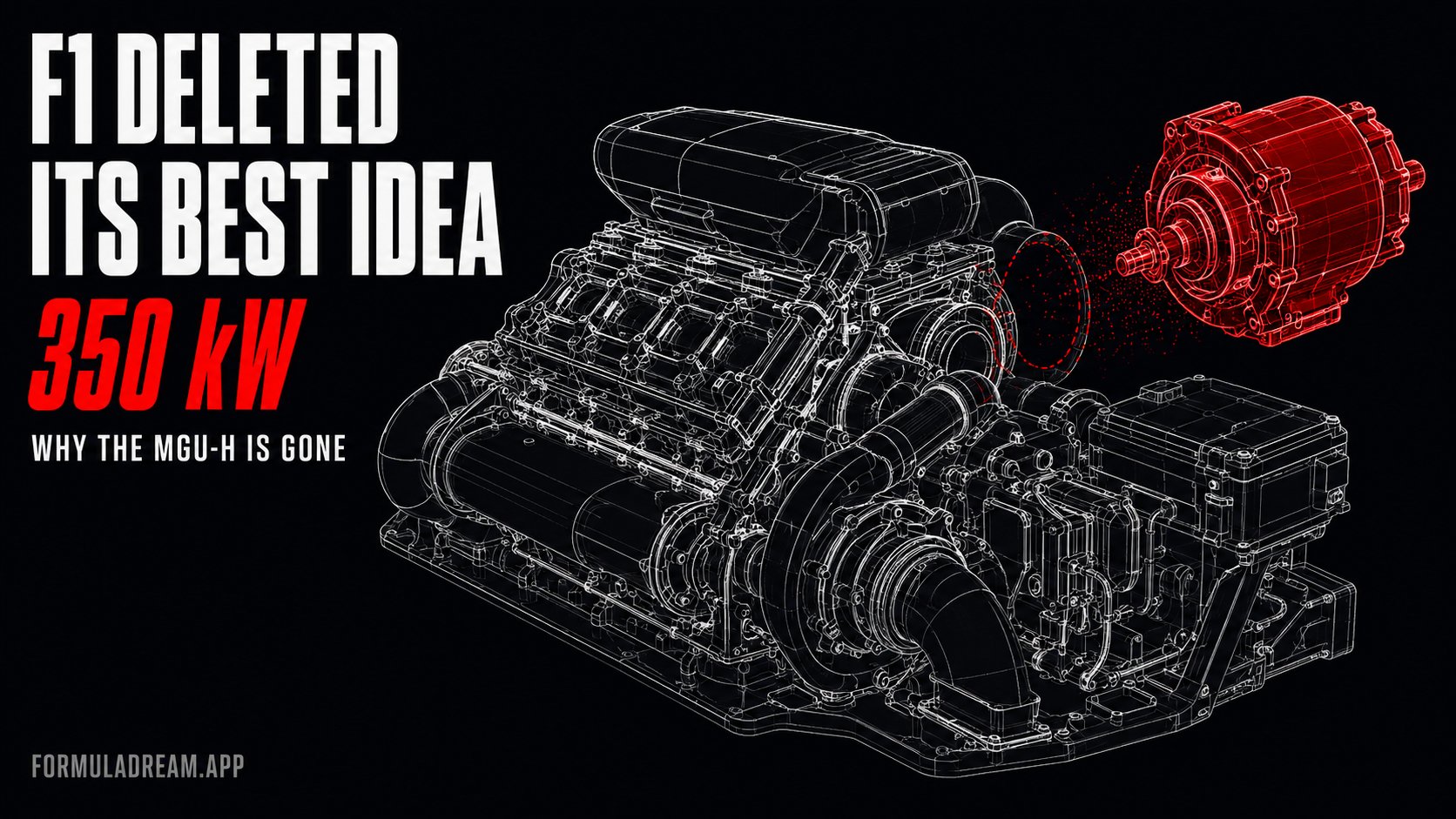
ERS stands for Energy Recovery System, the hybrid half of a Formula 1 power unit. Since 2026 it runs on a single motor generator unit producing up to 350 kilowatts, up from 120. The second unit, the MGU-H, has been deleted entirely, despite being the more ingenious of the two.
That is not an engineering failure. It is one of the more interesting trade-offs the sport has ever made, and it is the reason Audi is on the grid.
What is ERS in F1?
ERS stands for Energy Recovery System. It is the hybrid half of a Formula 1 power unit: it captures energy that would otherwise be thrown away as heat, stores it in a battery, and hands it back to the driver as extra power.
Until 2026 it did this two ways.
The MGU-K, K for kinetic, harvests under braking. A car decelerating from 320 km/h is shedding an enormous amount of kinetic energy, and in an ordinary car all of it becomes heat in the brake discs. The MGU-K intercepts some of it and turns it into electricity.
The MGU-H, H for heat, was the clever one. It sat on the turbocharger shaft and harvested energy from exhaust gas that had already done its job driving the turbo. Waste heat, going out of the back of the car, converted into charge.
Why was the MGU-H so good, and why is it gone?
The MGU-H was extraordinarily effective. Unlike the MGU-K, the amount of energy it could harvest in a lap was not capped, so exhaust heat became a major source of the electricity in a hybrid-era F1 car.
It also solved turbo lag almost completely, because the same unit could spin the turbo up electrically before the exhaust gas arrived.
The problem was everything else about it.
The MGU-H spun at up to 125,000 rpm. Building something that survives that, attached to an exhaust, at F1 temperatures, for a full season, is brutally difficult. It was unreliable, and it was hideously expensive to develop.
That expense became a political problem rather than only a technical one. The MGU-H was the single biggest barrier to a new manufacturer entering Formula 1. Any newcomer faced years and hundreds of millions catching up on a component nobody uses anywhere else in the world.
So the sport made a straight trade: give up the cleverest part of the power unit, and get new manufacturers in return. Audi's entry is the direct consequence.
What the 2026 ERS actually does
With the MGU-H gone, everything is loaded onto a much bigger MGU-K. Here is what the 2026 Technical Regulations actually allow.
Output: 350 kW, up from the 120 kW it produced from 2014 through 2025. Nearly triple. The motor's torque is capped at 500 Nm.
Recovery: up to 8.5 MJ per lap. The FIA can lower that to 7 MJ at circuits where there is not enough braking to harvest more, and to as little as 5 MJ in qualifying at some events. Up to 0.5 MJ extra can be allowed on a lap under conditions the FIA sets for each race.
A 4 MJ battery window. The gap between the battery's fullest and emptiest state may never exceed 4 MJ while the car is on track. The battery is not a tank to be filled at the start and drained by the end. Energy has to be harvested and spent again, lap after lap.
Power that fades with speed. The full 350 kW is only available up to 290 km/h. Above that the limit falls by 5 kW for every km/h, then four times as steeply from 340 km/h, and at 345 km/h the electric motor may not drive the car at all.
Overtake Mode. A driver close enough to the car ahead at the FIA's detection point can use a higher curve, which keeps the full 350 kW to about 337 km/h and only runs out at 355 km/h. DRS is gone, so this is now the main passing aid, explained in how Overtake Mode replaced DRS.
No electric launches. At a standing start the MGU-K may only be used once the car reaches 50 km/h.
Meanwhile the internal combustion engine has been wound back deliberately, from 550 to 560 kW down to about 400 kW.
Put those together and you get the headline: a 2026 F1 power unit is roughly half combustion, half electric. That is a genuine philosophical change, not a tweak.
What that changes about how a car is driven
Three things follow, and they are already visible.
Recovery matters more than it ever has. Without exhaust harvesting, every joule in the battery has to come from braking. That makes braking zones an energy opportunity as well as a lap-time one. It is also why the rules let the FIA cut the recovery limit to 7 MJ a lap at circuits where the braking is not there to harvest more.
Deployment becomes a strategic choice within the lap. With only a 4 MJ window in the battery and electric power fading away at the top end, drivers and engineers decide where the electrical power goes. Which straight, which exit, defending or attacking.
Energy management is now a visible part of racing. When a driver says they are "out of battery" at the end of a straight, that is not a figure of speech. It is a car that has spent its deployment and is running on 400 kW of combustion while the car behind still has charge.
Why the numbers sound smaller than they are
A reasonable objection: if the engine lost 150 kW and the hybrid gained 230 kW, why are the cars not dramatically faster?
Because power is only one input. The 2026 regulations arrived alongside changes to aerodynamics and car dimensions, and the sport was not aiming for a lap-time jump. It was aiming for closer racing, cheaper entry and a power unit that manufacturers actually want to build.
Judging the 2026 rules on top speed alone misses what they were designed to do.
ERS in one paragraph
Energy that would be wasted gets captured, stored and reused. Before 2026, F1 captured it from braking and from exhaust heat, and the heat side did most of the work. From 2026, F1 captures it from braking only, using a much larger motor, and splits the car's power roughly evenly between petrol and electricity. The sport gave up its most sophisticated component to make the sport easier to enter.
Watching it happen
Deployment, recovery and battery state are part of the live data stream during a session, alongside the timing that shows what it produces.
Our app puts every car on the circuit map during a session with a timing tower carrying gaps, intervals, tyre compound and tyre age, pit stop counts and positions gained or lost. Driver radio streams live with the transcript beside the audio, which is where energy management conversations actually happen: engineers telling drivers where to lift, where to deploy, and when they have nothing left.
It also collects every FIA document published across the weekend, including the power unit element allocations that make grid penalties inevitable before anyone announces them. We wrote a guide to what the FIA publishes and how to read it.
Free, no subscription, no ads. Independent, and not affiliated with Formula 1.
ERS stands for Energy Recovery System. It is the hybrid part of a Formula 1 power unit that captures energy which would otherwise be lost, stores it in a battery and uses it to drive the car.
How does ERS work in F1?
Under braking the MGU-K, a motor generator connected to the engine, works as a generator and charges the battery. On acceleration it works as a motor and adds up to 350 kW to the petrol engine's roughly 400 kW. From 2026 it can recover up to 8.5 MJ per lap.
How much power does ERS add in 2026?
Up to 350 kW, about 470 horsepower, nearly triple the 120 kW of the 2014 to 2025 cars. That full figure is only allowed up to 290 km/h, and the electric power reaches zero at 345 km/h unless Overtake Mode is active.
Does F1 still use the MGU-H?
No. The MGU-H, which recovered energy from exhaust heat through the turbocharger, was part of every F1 power unit from 2014 to 2025 and was removed for 2026 to cut cost and complexity.