Formula 1 is run by a contract that almost nobody has read. It decides who makes the rules, who gets paid, and how much. It is signed by the FIA, by the commercial rights holder, and by every team on the grid. Its contents are confidential.
That contract is the Concorde Agreement, and the current one, the ninth, runs until 2030.
What is the Concorde Agreement?
It is the agreement binding the three parties who between them constitute Formula 1:
The FIA, the regulator, which writes and enforces the sporting and technical rules
The commercial rights holder, currently Liberty Media through Formula One Management, which owns and sells the sport commercially
Without it, those three have no defined relationship. The Concorde defines the roles and responsibilities of each, and it defines how the money is divided.
It is not one document. The current version comes in two parts: a Commercial agreement covering entry fees and revenue distribution, and a Governance agreement covering the regulatory framework and how rules get made and changed.
Both are now signed. The Commercial part was agreed by all teams in March 2025. The Governance part followed, signed by the FIA, Formula 1 and all 11 teams. Together they form the ninth Concorde Agreement and run until 2030.
Eleven, not ten, because the grid expanded. That number is itself a Concorde question, since a new entrant changes how the same revenue pot is divided.
What the commercial side actually does
The mechanism is a trade, and it is worth stating plainly because it explains a great deal about how F1 behaves.
Teams grant the commercial rights holder the rights to their image. That is what allows Formula 1 to sell television broadcast rights, to run a streaming service, to license the sport, and to make the commercial decisions it makes.
In exchange, the commercial rights holder pays prize money to the teams, on a sliding scale defined inside the Concorde.
So a team is not simply competing for a trophy. It has sold something, and the payment for it is structured by finishing position. That is why the constructors' championship matters far more than casual coverage suggests: it is a revenue table wearing a sporting title.
Why it is called the Concorde Agreement
Not after the aircraft. After the Place de la Concorde in Paris, where the FIA has its headquarters, and where the first agreement was signed in 1981.
That first agreement ended a genuine war for control of the sport between the governing body and the teams' association. The Concorde exists because Formula 1 once nearly tore itself apart over exactly the questions it now settles: who writes the rules, and who takes the money.
What it means that it is confidential
The Concorde Agreement has never been published in full.
This is the single most important thing to understand about reporting on it, including this article. What is publicly known comes from announcements, leaks, litigation and journalism, not from the text. Specific figures circulate widely and credible sources contradict each other, which tells you those figures are reconstructions rather than quotations.
That confidentiality has real consequences. It means fans cannot check how the sport they follow distributes its money. It means a new team negotiating entry is negotiating against terms it cannot fully see until it is inside. And it means that when a rule change is disputed, the public argument happens without the document that governs it.
None of that is an accusation of wrongdoing. It is a commercial contract between private parties and there is nothing unusual about it being private. But it is worth being honest that F1's constitution is a document the public does not have.
Why the governance half matters more than it sounds
The Commercial agreement gets the headlines because it is about money. The Governance agreement decides something arguably more consequential: how rules get made and changed.
That covers who can propose a regulation change, what majorities are needed to pass one, and how much notice must be given. It is the machinery behind every mid-season technical directive and every rules controversy.
If you have ever wondered why a rule everyone agrees is wrong takes eighteen months to fix, or why a change that suits one team can be blocked by others, the answer is in the governance framework rather than in the rulebook itself.
A Concorde negotiation is the one moment when every team has genuine leverage, because the agreement requires them all.
Historically that has been when teams extract concessions, when threats to leave the sport surface, and when the balance of power between the FIA, the commercial rights holder and the grid gets reset for the next five years.
The ninth agreement running to 2030 means that reset has happened, the terms are fixed for the medium term, and the next real negotiation is some way off. For a sport that spent decades in periodic existential arguments about its own governance, that stability is the actual headline.
Following what it produces
You cannot read the Concorde. You can read everything the system it defines produces: the regulations, the stewards' decisions, the technical directives, the penalties.
Our app collects every FIA document published across a race weekend as it is released, which is the closest thing to watching the governance framework operate in real time. Alongside it, during a session it puts every car on the circuit map with a timing tower carrying gaps, intervals, tyre compound and tyre age, pit stop counts and positions gained or lost, and streams driver radio live with the transcript beside the audio.
Free, no subscription, no ads. Independent, and not affiliated with Formula 1.
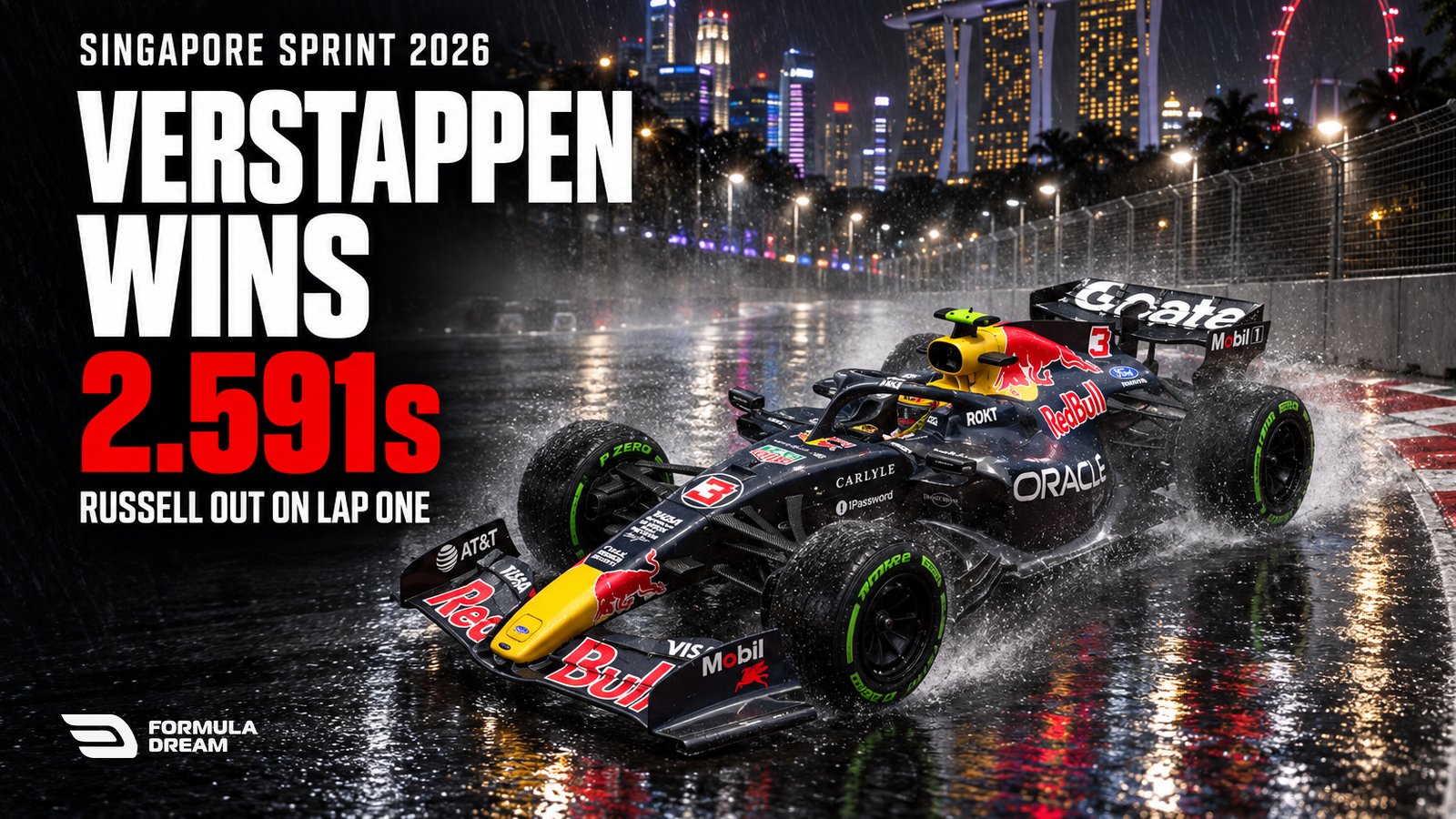
Singapore Sprint 2026 Results: Russell Crashes From the Lead
Russell took the lead at turn one and crashed at the final corner of the same lap. Verstappen won, Hamilton charged to second, and the McLarens hit each other.