Reaching Formula 1 requires three things: lap time, 40 superlicence points, and somebody paying. A driver realistically needs at least two of the three. The ones who arrive with all three are the exceptions everybody remembers.
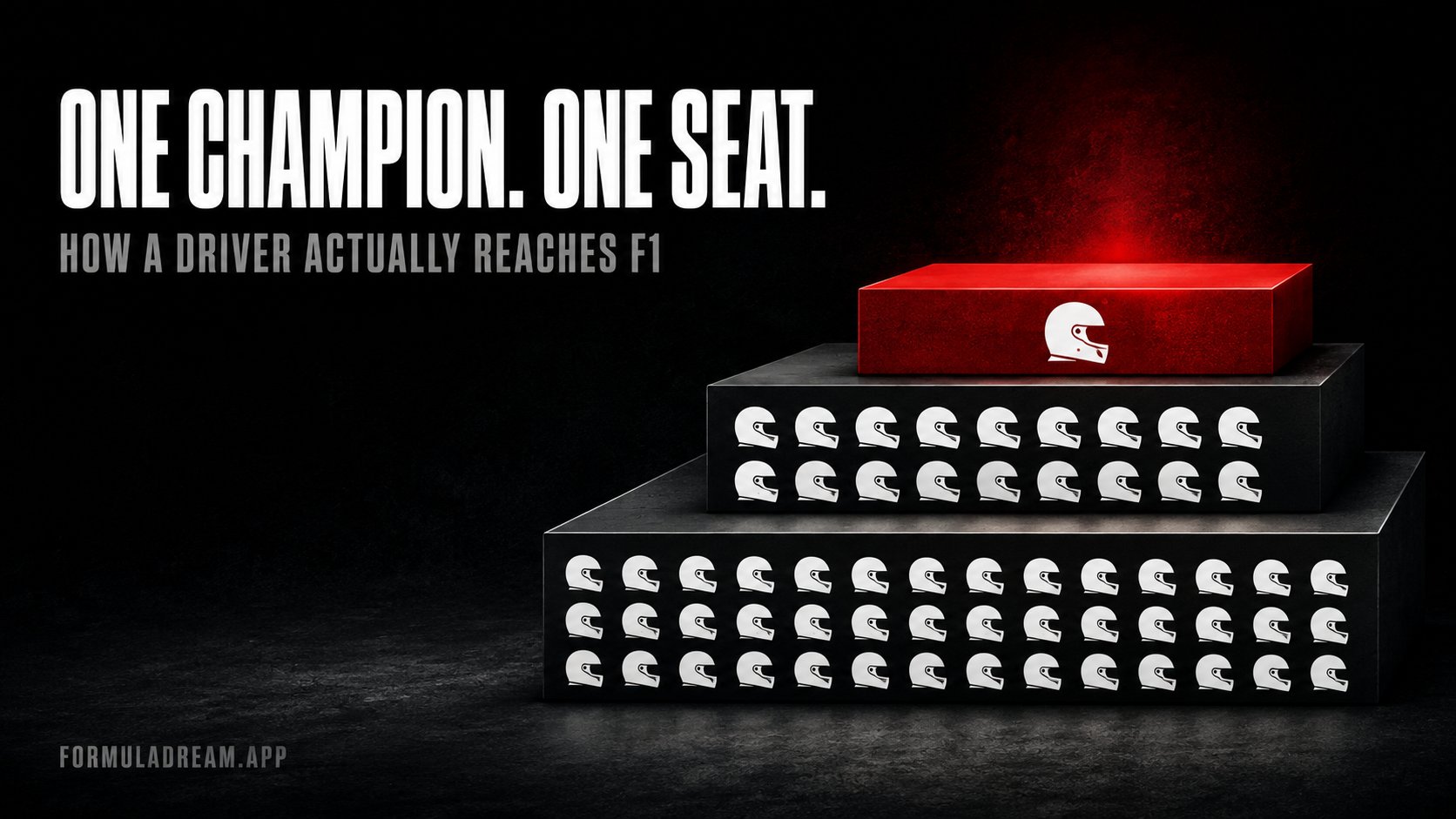
Roughly one Formula 2 champion emerges each year, into roughly one to three genuinely open F1 seats. The arithmetic is brutal and it is the most honest thing about the sport's talent pipeline.
The ladder: F3, then F2, then nothing
FIA Formula 3 and Formula 2 are the official spec-car steps below Formula 1, and their design is deliberate.
They are spec series, meaning every driver has an identical car. That single decision is the ladder's entire purpose: when the machinery is the same, the timing screen measures the driver rather than the budget. In a series where teams build their own cars, a fast driver in a poor car is invisible.
They also share Grand Prix weekends. Junior drivers race on the same circuits, on the same weekend, in front of the same people who decide who gets promoted. Being quick is not enough if nobody with hiring authority is watching, and the calendar removes that excuse.
Below F3 sit regional and karting series that feed into it. Above F2 there is nothing. F2 is the last rung, and the drop from it is long.
Superlicence points: the rule that governs eligibility
You cannot simply be fast and be hired. A driver needs 40 superlicence points to be eligible for a Formula 1 race seat, accumulated over a three-year window, earned mainly by finishing high in recognised championships.
The points are weighted by series, so a strong F2 season is worth far more than dominating a minor category. This is the mechanism that stops a wealthy driver buying their way in from an obscure championship, and it was introduced precisely because that used to be possible.
There is a lesser tier as well. A free-practice-only superlicence requires 25 points over the previous three years, or participation in at least six F2 races. That is how young drivers get FP1 outings before they are eligible to race, which is both genuine experience and a way for a team to evaluate them under real conditions.
The points system also creates strange incentives. A driver can be quick enough for F1 and ineligible for it, which forces another year in the junior categories that is about paperwork as much as development.
The academies: who is actually paying
Behind nearly every ladder career is a patron.
Red Bull's junior programme, and the Ferrari, Mercedes, Alpine and McLaren academies all run the same basic arrangement. The academy pays the bills, provides simulator time, coaching, fitness and media training, and access to the people who matter.
In exchange, it controls the asset. Contracts give the parent team first claim on the driver for years. A driver in an academy is not a free agent who happens to have a sponsor; they are, commercially, part of a team's portfolio.
The support also changes shape as a driver climbs. Early on it is largely funding and coaching. Higher up it becomes simulator work, engineering exposure and placement into the right seat at the right team, which matters enormously because not all F2 seats are equal even in a spec series.
The programmes are also ruthless, and openly so. Red Bull's is the most discussed example, with a long history of promoting quickly and dropping quickly. That is not a criticism so much as a description: an academy exists to find the one driver worth an F1 seat, not to develop everybody in it.
Why most excellent drivers never make it
Because the three currencies are lap time, superlicence points and patronage, and shortages in any of them are fatal.
A driver with lap time and points but no patron cannot fund an F2 season, which can cost more than most people earn in a decade.
A driver with patronage and lap time but not enough points is ineligible, and academies do not wait forever.
And a driver with all three still faces the arithmetic at the top: one champion a year, one to three seats, and those seats also being competed for by existing F1 drivers who have not yet run out of career.
This is why "the best driver does not always make it" is not cynicism. It is the structure working as designed, filtering on three things at once, only one of which is talent.
What changed, and why the system exists at all
The superlicence points system was a response to a real problem. Before it, the route into F1 was less regulated and money could substitute for results more directly.
Making eligibility a function of results in graded championships forced a defined path. It has a cost, which is rigidity: an obviously exceptional driver can be blocked on a technicality. It has a benefit, which is that a seat cannot simply be bought by somebody who has never won anything.
Whether that trade is right is a live argument every time a highly rated junior is held back a year. Both sides of it are reasonable.
Not every driver on a team's books races on Sunday. The role that sits between the academy and a seat is explained in what an F1 reserve driver does.
Watching the next generation
F2 and F3 run on Grand Prix weekends, which means the junior categories are producing results and radio at the same circuits, on the same days, as the main event.
Our app collects every FIA document published across a race weekend, and during a session puts every car on the circuit map with a timing tower carrying gaps, intervals, tyre compound and tyre age, pit stop counts and positions gained or lost. Driver radio streams live with the transcript beside the audio.
If you want to understand how a rookie is actually performing, the timing detail is where it shows up long before the results table does. We wrote about how to read what the FIA publishes across a weekend, which includes the entry lists and the documents that confirm who is driving what.
Free, no subscription, no ads. Independent, and not affiliated with Formula 1.
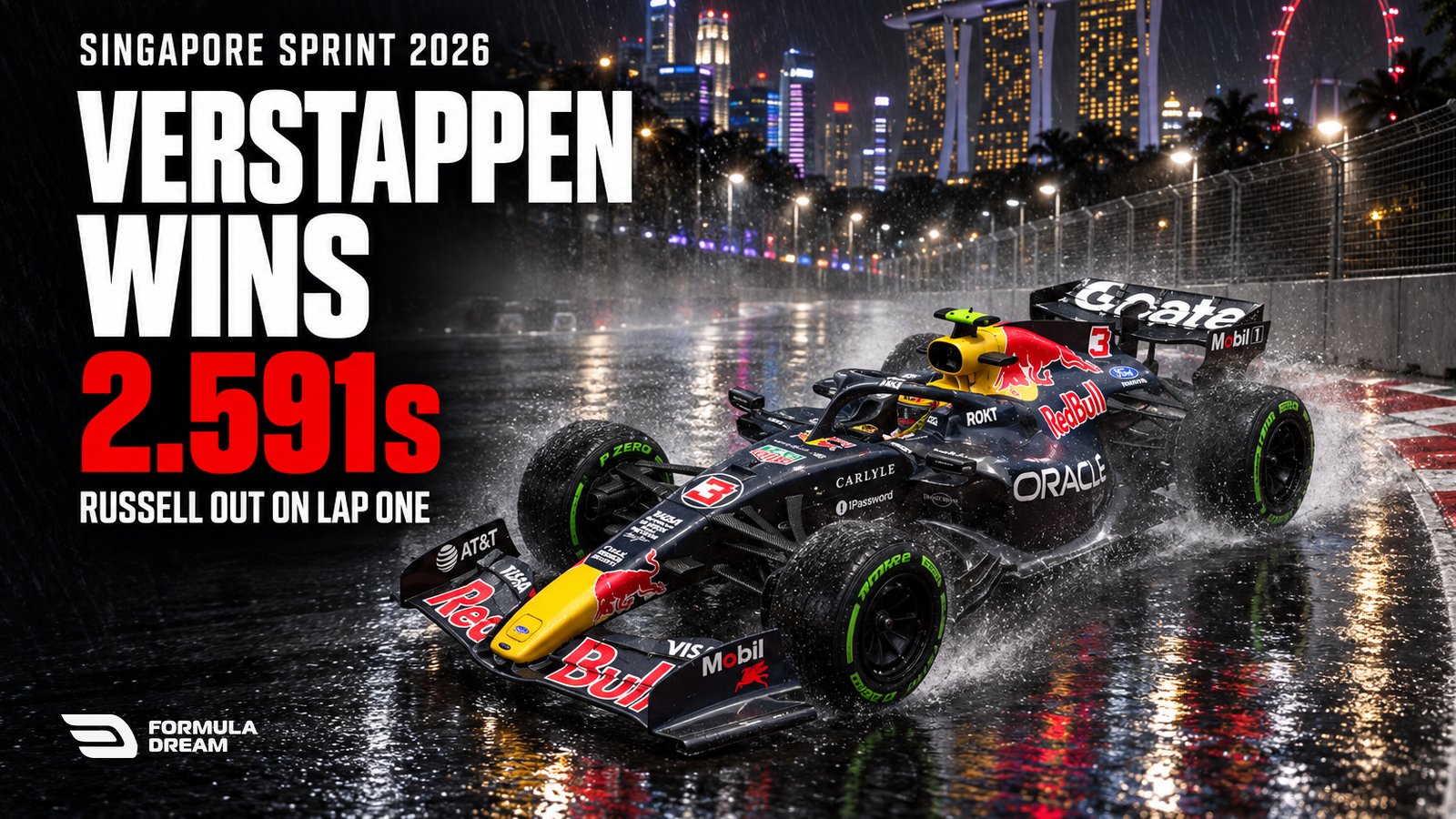
Singapore Sprint 2026 Results: Russell Crashes From the Lead
Russell took the lead at turn one and crashed at the final corner of the same lap. Verstappen won, Hamilton charged to second, and the McLarens hit each other.