A Formula 1 reserve driver spends the weekend fully prepared to race: briefings, track walk, strategy meetings, race suit ready. Then qualifying starts, and the door all but closes. If a race driver falls ill on Sunday morning, the team runs one car unless the stewards accept it as force majeure.
That single rule defines the job, and almost nobody knows it.
What is a reserve driver?
The team's backup. The first name called if a race driver cannot compete through illness, injury or anything unforeseen.
But the role is far larger than the emergency, and the emergency is far more constrained than people assume.
The cut-off nobody mentions
Once qualifying has started, a driver can no longer simply be replaced.
Under Article B1.7.2 of the 2026 Sporting Regulations, a change of driver may be made, with the stewards' consent, at any time before the start of qualifying. On a sprint weekend the deadline for the sprint is the start of sprint qualifying. Anything later is only considered separately, as force majeure.
Practically: a reserve driver's standby duty covers Friday and Saturday. If a race driver takes part in qualifying and then develops a problem before Sunday, the reserve can only step in if the stewards accept a force majeure case. Otherwise the team races with one car.
That inverts how most people picture the job. The image is somebody sitting in the garage on Sunday hoping for a phone call. In reality, by Sunday the phone cannot ring.
The window is Friday through the start of qualifying, and it is genuinely tight. Which is why the preparation has to be complete rather than approximate.
What they actually do on a race weekend
The reserve follows the same schedule as the race drivers. Engineering briefings. Track walk. Strategy meetings. Simulator preparation.
The reason is simple: if the call comes it comes without notice, and there is no time to learn the plan. A reserve who has skipped the briefing is not a usable replacement.
So the weekend job is preparing thoroughly for something that will almost certainly not happen, on a deadline that expires on Saturday.
Where the value actually is: the simulator
This is the part that justifies the salary, and it happens away from the circuit.
Reserve drivers spend long days in the simulator: testing setup configurations, adjusting aerodynamic settings, working through tyre degradation models, and validating upgrades before they reach the track.
That matters enormously under current regulations, because testing is heavily restricted and wind tunnel time is rationed on a sliding scale that penalises the successful. We wrote about that system in how F1 handicaps the team that wins.
When you cannot test freely and you cannot develop freely, simulator work becomes a primary development tool rather than a supplement. A reserve driver who gives precise, repeatable feedback is providing something the team cannot easily buy elsewhere.
They also contribute during pre-season testing, run in Friday practice sessions where the rules allow, and provide feedback across the weekend. The rules create some of those chances: under Article B1.7.3, at two events a season each car must be driven in practice by a driver who has started no more than two Grands Prix.
And there is a commercial half: sponsor events, launches, marketing. A reserve driver is also an available representative of the team on days when the race drivers are not.
The licence question
A reserve driver who might actually race needs a full FIA Super Licence, and the requirements are strict:
A current FIA International Grade A licence
Minimum age 18 at the start of their first F1 competition, with an FIA discretion to permit 17 in exceptional circumstances
At least 80% of each of two full seasons in qualifying championships
40 superlicence points accumulated over the previous three seasons
For drivers qualifying by a route other than the 40 points, 300km in a representative F1 car at racing speeds, over no more than two days and within 180 days of applying
That last requirement is easy to overlook and quietly important. A driver cannot simply be fast in F2 and be dropped into a car. They must have physically driven a Formula 1 car for a meaningful distance first.
There is also a Free Practice Only Super Licence. A first application needs either six Formula 2 events or 25 points, plus the same 300km in a representative car and a question session on the rules. That is what allows academy drivers to run FP1 sessions without being eligible to race, and it is a genuine rung on the ladder rather than a technicality. We covered the full progression in how to actually reach Formula 1.
Why the role is strategically valuable to a team
Three reasons, none of them about emergencies.
Development capacity. Simulator work is regulated far less tightly than track testing, so a good simulator driver effectively extends what a team can learn.
Continuity. A reserve who has been embedded for a season understands the car, the people and the processes. Bringing in an outsider mid-season is a much larger disruption than the lap time difference suggests.
Optionality. A team with a credible reserve has a genuine alternative if a race driver underperforms or leaves. That changes the balance in contract negotiations, quietly.
The uncomfortable truth about the role
For a young driver it is a mixed blessing.
It provides income, an F1 environment, technical education and visibility. It also removes them from competitive racing, and racing is where superlicence points and reputations are built. A season on the sidelines is a season not winning anything.
Drivers and academies weigh this constantly: take the reserve seat and stay close to F1, or take a competitive drive in a junior category and stay sharp. There is no obviously correct answer, and careers have gone both ways on it.
Following who is actually in the car
Entry lists, session participation and any driver changes are published by the FIA as documents across a race weekend, usually with no announcement.
Our app collects every one of them as it is released, so a driver change or an FP1 substitution appears as soon as it is official rather than when somebody notices. During a session it puts every car on the circuit map with a full timing tower carrying gaps, intervals, tyre compound and tyre age, pit stop counts and positions gained or lost, and streams driver radio live with the transcript beside the audio.
Free, no subscription, no ads. Independent, and not affiliated with Formula 1.
Yes. Under Article B1.7.1 of the Sporting Regulations, a team may use up to four drivers in races during a season, and any new driver may score championship points. A reserve who stepped in and won a race would score the full 25 points.
Do F1 reserve drivers go to every race?
Usually, because they have to be ready to step in at short notice, and a driver change is only possible before qualifying starts. Much of their value, though, is in the simulator at the factory.
When can a reserve driver replace a race driver?
Any time before qualifying starts, with the stewards' consent once initial scrutineering is over. On a sprint weekend the deadline for the sprint is the start of sprint qualifying. After that, only a force majeure case considered separately by the stewards allows a change.
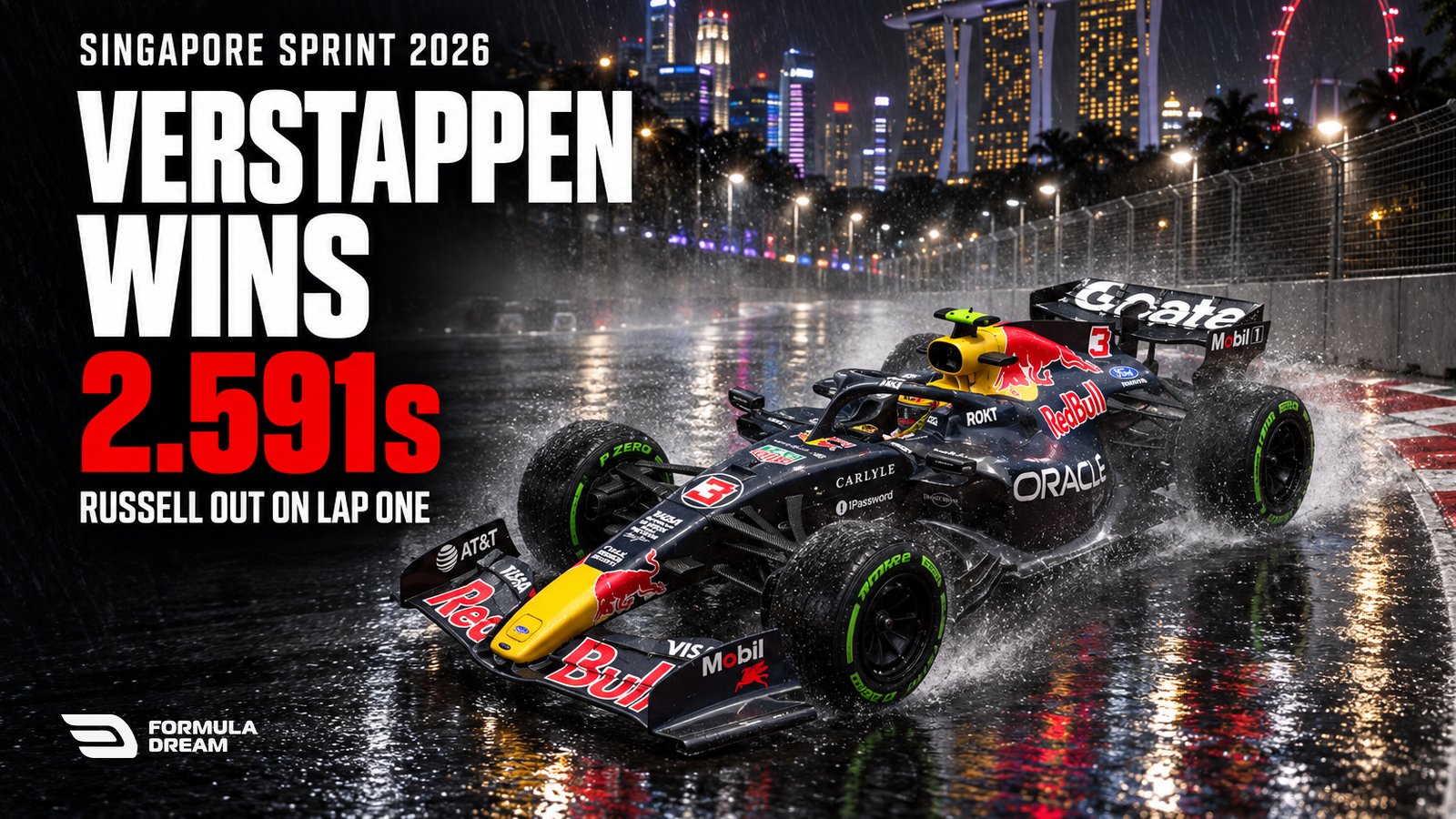
Singapore Sprint 2026 Results: Russell Crashes From the Lead
Russell took the lead at turn one and crashed at the final corner of the same lap. Verstappen won, Hamilton charged to second, and the McLarens hit each other.