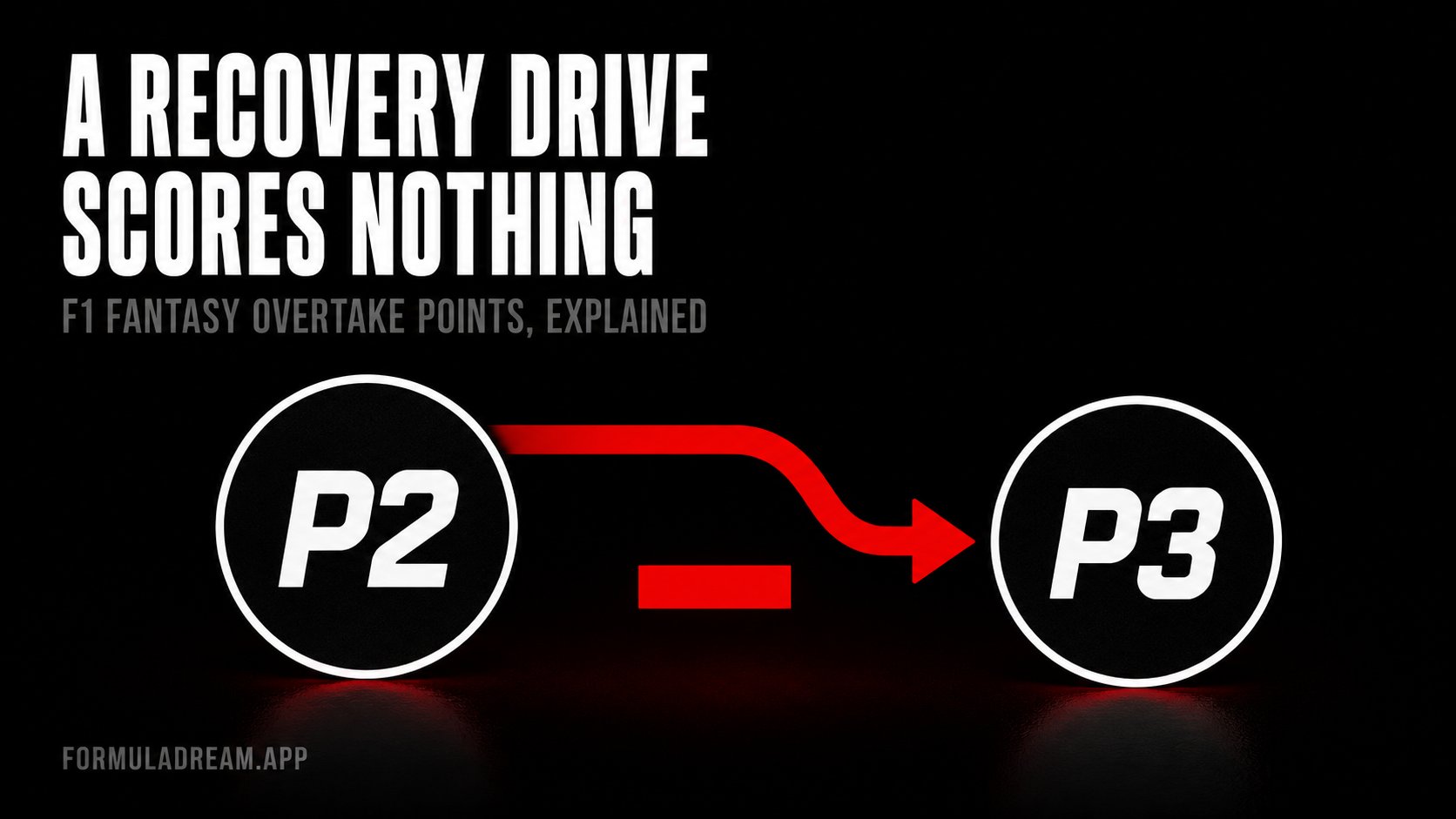
In F1 Fantasy, overtake points are calculated from a driver's qualifying position, not their grid position. So when a driver qualifies second, takes a ten-place engine penalty, and carves back to third on Sunday, they score nothing for it. They finished a place worse than they qualified.
Points come from what happens on track, and the first warning of trouble is usually the radio. Every message from the last race is in our Spanish Grand Prix 2026 race radio archive, free and searchable.
That single rule decides more fantasy leagues than any driver pick, and most people playing do not know it.
You build a team of five drivers and two constructors, within a budget of $100 million. Every driver and constructor has a price, and the total must fit under the cap.
Prices move during the season based on performance and popularity. A driver who overperforms gets more expensive, which means the same team costs more to hold, and a bargain pick stops being a bargain precisely because it worked.
That is the game underneath the game: you are not just picking who will be fast, you are picking who is currently underpriced.
Where the points come from
Several categories, each rewarding something different.
Qualifying position. The higher a driver qualifies, the more points. Crucially, grid penalties do not affect this. A driver who qualifies on pole and starts eleventh still scores as though they qualified on pole.
Race finish. Higher finish, more points. Sprint races score too, on their own scale.
Overtakes. Net positions gained, and here is the trap.
Improvement. Points for finishing above a driver's own rolling eight-race average finishing position. The logic is that a top car finishing near the front is expected, while a slower car doing the same is an achievement, and the scoring should reflect that.
Completion. Awarded in stages as the race progresses, at 25%, 50%, 75% and 90% of scheduled laps. A retirement costs you the remaining stages, which is why reliability matters in fantasy in a way it does not in casual viewing.
The overtake rule, properly
This deserves its own section because it is counterintuitive and expensive.
Overtake points are the net difference between qualifying position and race finish position. Not grid position.
Work through what that does:
A driver qualifies P2, takes a ten-place grid penalty, starts P12, finishes P3. On television that is a superb recovery drive through the field. In fantasy, they went from qualifying second to finishing third. That is minus one. They lose points.
So the drives that look most impressive on Sunday are often the ones that score worst, because the impressive part was recovering from a penalty the scoring system deliberately ignores.
This is not a flaw. It is the system refusing to reward a driver twice: they already scored well for qualifying second, so recovering to third is not an additional achievement. But it means you must know who is carrying a grid penalty before you set your team.
Penalties are predictable if you follow the FIA's published component allocations, which show how many engine parts each driver has used and therefore who is heading for a drop. We wrote about how to read those in F1 engine penalties explained and about the documents themselves in what the FIA publishes across a race weekend.
What this means for strategy
Four things follow directly from the scoring design.
Avoid drivers with known grid penalties, unless they are cheap enough that the qualifying and finishing points alone justify it. The overtake category will work against you.
Value reliability. Completion points accrue in stages, and a DNF at 60% distance forfeits the rest. Two finishes are usually worth more than one podium and one retirement.
Look for underpriced midfield cars. The improvement category rewards finishing above a rolling average, which structurally favours cars that are inconsistent but occasionally quick.
Track price movements, not just form. A driver whose price has climbed after two strong weekends may be a worse pick than the same driver was a fortnight ago, at the same expected performance.
Why the game is harder than it looks
Because the scoring rewards several different things at once, and they conflict.
Qualifying position rewards raw pace. Improvement rewards exceeding your own baseline, which punishes the fastest cars. Overtakes reward starting badly and finishing well, but only if you also qualified badly. Completion rewards simply being there at the end.
A single driver rarely maximises all of them, which is the point. The game is built so that the obvious team of the five fastest drivers does not win, both because of the budget cap and because the categories pull against each other.
Getting the information in time
Fantasy deadlines fall before qualifying, which means the decisions that matter are made on incomplete information. The things that would help most, penalties, practice pace, tyre allocation, are published or observable before the deadline if you know where to look.
Practice radio is the most underused of them. The deadline falls before qualifying, so Friday and Saturday morning are the only sessions inside the window, and that is exactly when drivers say what is actually wrong with the car: a balance they cannot live with, a floor that has taken a kerb, brakes already at the limit. It gets said out loud hours before it shows up in a lap time. Our team radio archive carries every session with the transcript beside the audio, so you can read a practice session in a couple of minutes instead of watching it.
Our app collects every FIA document from a weekend as it is released, including the component allocations that make grid penalties predictable in advance. During a session it also puts every car on the circuit map with a full timing tower carrying gaps, intervals, tyre compound and tyre age, and streams driver radio live with the transcript beside the audio.
It also has its own fantasy game, with a different challenge each weekend, played in private leagues against your friends rather than a global pool.
Free, no subscription, no ads. Independent, and not affiliated with Formula 1.
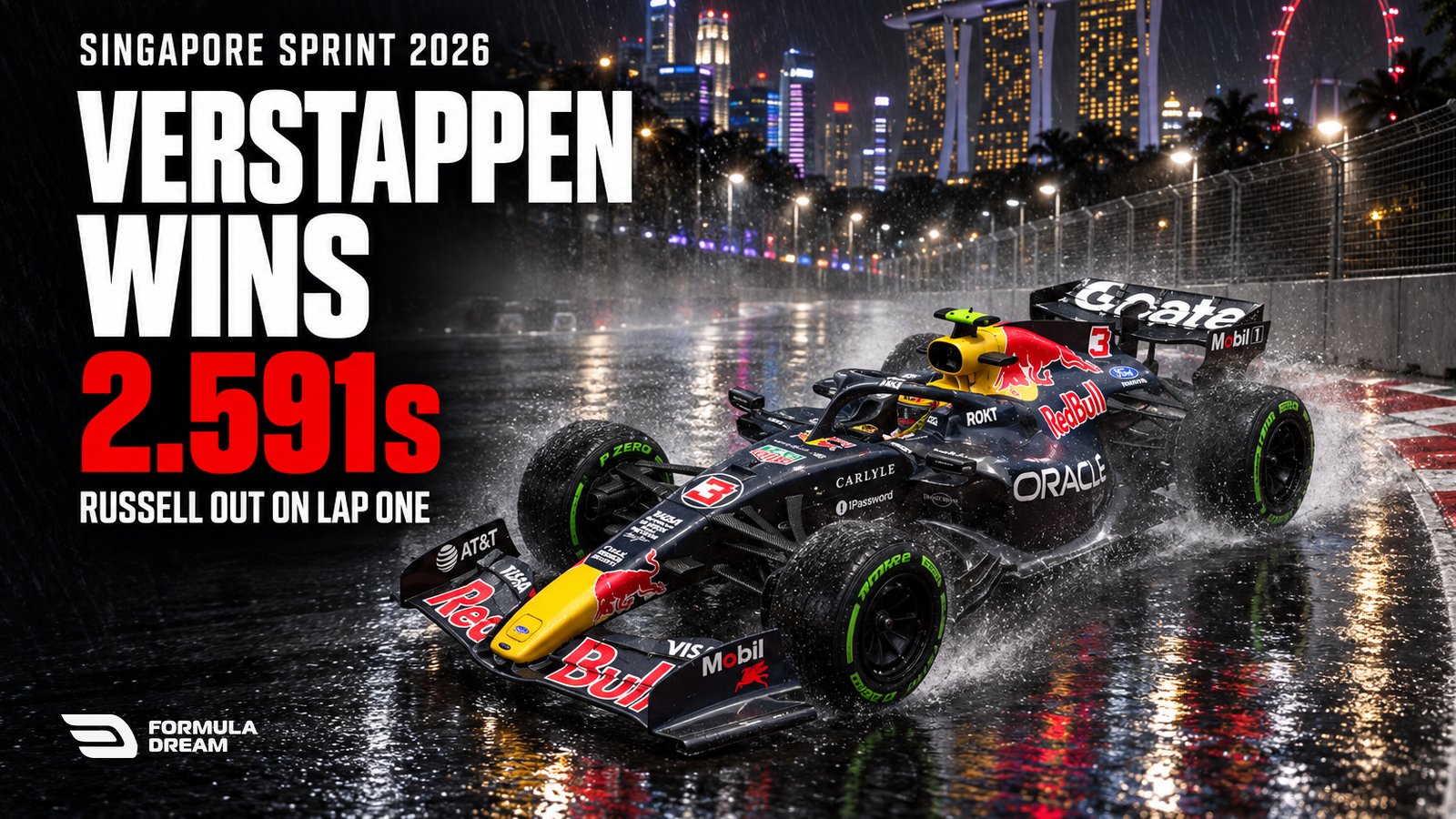
Singapore Sprint 2026 Results: Russell Crashes From the Lead
Russell took the lead at turn one and crashed at the final corner of the same lap. Verstappen won, Hamilton charged to second, and the McLarens hit each other.