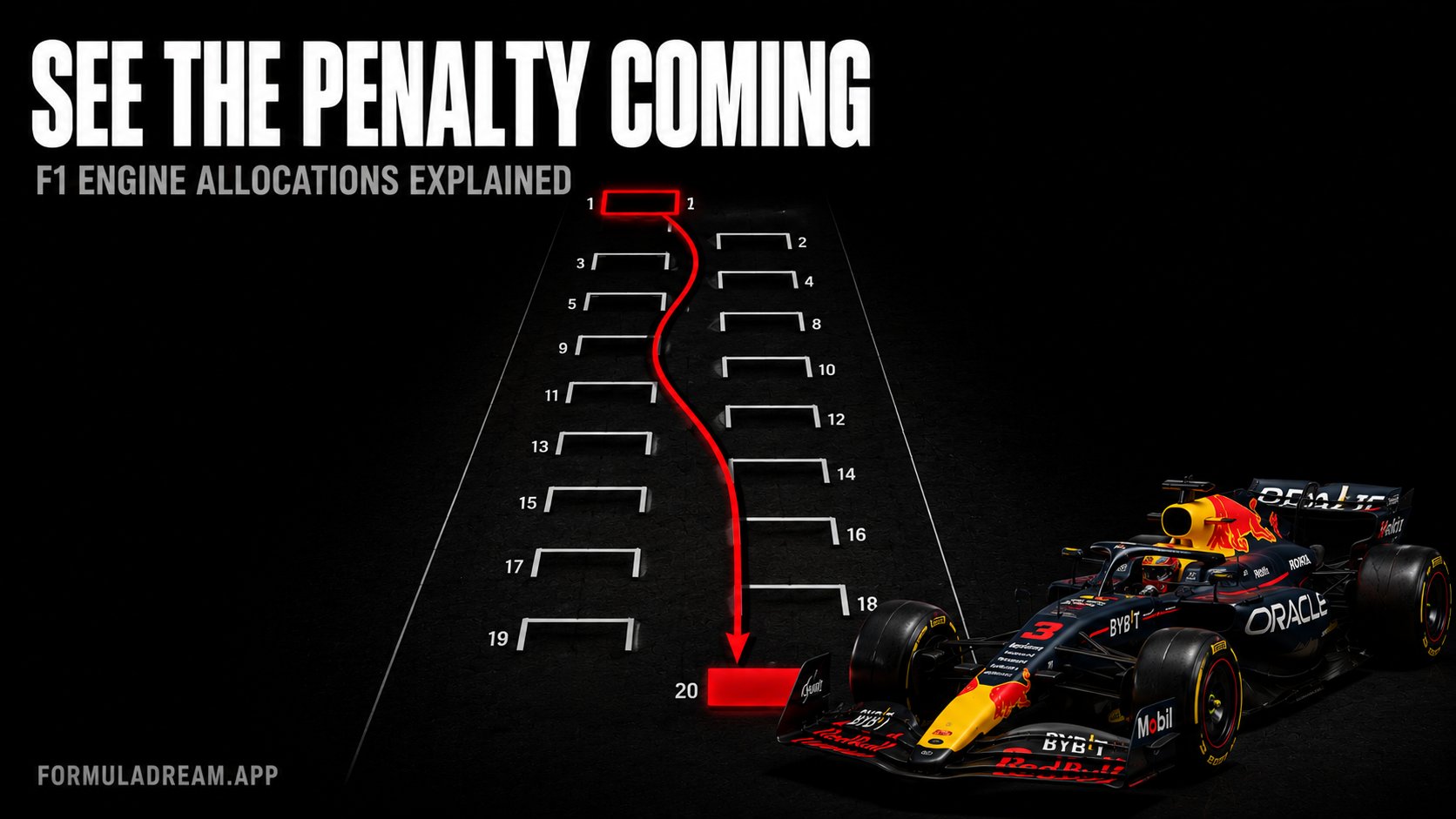
A Formula 1 driver is rationed on engine parts. Six separate components, each with its own season allowance. Use one too many and it is a ten-place grid penalty, and the FIA publishes a running tally of exactly where every driver stands.
MGU-K: the motor generator unit that harvests under braking
ES: the energy store, the battery
CE: control electronics
EX: the exhaust
The MGU-H used to be a seventh. It was removed for 2026, and the reasons why are worth their own read: it was the most effective component on the car and it was deleted anyway, because it was keeping new manufacturers out. We covered that in our piece on ERS.
Because each element is counted on its own, a driver can be perfectly fine on engines and in trouble on control electronics. Penalties often come from the components nobody talks about. The rules also ration a seventh category, the power unit ancillary components listed in the Technical Regulations: five of each per season, plus one extra in 2026.
The 2026 allocation
Across the 2026 season, each driver may use no more than:
4 internal combustion engines
4 turbochargers
4 exhaust sets
3 MGU-Ks
3 energy stores
3 control electronics
There is a deliberate softening in those numbers. Because 2026 introduced an entirely new power unit formula, one of each allocation is effectively a bonus, acknowledging that nobody could reasonably predict reliability on hardware this new.
That grace does not last. From 2027 the allocation tightens to three ICEs, turbochargers and exhausts, two MGU-Ks, energy stores and control electronics, and five of each ancillary component.
Worth sitting with: from next season, a driver gets two batteries and two sets of control electronics for a full championship.
What the penalty actually is
The structure is escalating, and it catches people out.
The first extra of each element type: a 10-place grid penalty. A first extra engine is 10 places, and a first extra turbocharger at the same race is another 10.
Every further extra of that same type: a 5-place grid penalty.
Penalties at the same event are cumulative. Take a new engine and a new turbo at the same race and the drops add together.
And there is a ceiling that functions as a floor. Under Article B2.5.4 of the Sporting Regulations, a driver with more than 15 cumulative unserved grid place penalties starts behind every other classified driver, regardless of the arithmetic, with qualifying deciding the order if several drivers are in that position.
That last rule is the one that shapes team behaviour, and it produces a decision that looks strange until you understand it.
Why teams take enormous penalties on purpose
Once a driver is going to the back anyway, additional penalties cost nothing.
So the smart move is not to spread changes across several weekends, taking a five-place hit each time. It is to take everything at once: new engine, new turbo, new energy store, new control electronics, all at the same race. The driver starts last either way, and emerges with a full complement of fresh components for the rest of the season. There is one catch in the rules: if a driver fits more than one of the same element at a single event, only the last one fitted can be used at later races without a further penalty.
This is why you see a driver suddenly take a vast bundle of new parts and start from the pit lane. It is not a disaster unfolding. It is a planned reset.
The second half of that decision is where to do it. Teams pick circuits where overtaking is realistic and a fast car can recover, which is why Spa and Monza have historically been penalty magnets. Long straights, strong slipstreams, and a genuine chance of climbing back through the field.
How to see a penalty coming
Here is the part almost no fan uses.
The FIA publishes the component tally. Across a race weekend, among the documents that go up without announcement, is a table showing how many of each element every driver has used.
If a driver is on their fourth ICE in August, the arithmetic for the rest of the season is already visible. A penalty is not a surprise announcement; it is a countdown that has been public for weeks.
Formula 1 also publishes a components-used summary during the season, so the information exists in two places and is still largely ignored.
Without an allocation, teams would build engines for maximum performance over minimum distance and replace them constantly. The richest team would run the most aggressive engine at every race. Rationing components forces every manufacturer to build for durability as well as power, and it compresses the advantage money can buy.
It also creates a genuine engineering trade-off that fans can watch play out: turn the engine up and risk a penalty later, or protect it and give up performance now. That decision is being made, quietly, in every session.
Watching the tally
Component allocations, technical reports and stewards' decisions all arrive as published FIA documents during a weekend.
Our app collects every one of them as it is released, which is how you find out a grid drop is coming before it is announced. During a session it also puts every car on the circuit map with a timing tower carrying gaps, intervals, tyre compound and tyre age, pit stop counts and positions gained or lost, and streams driver radio live with the transcript beside the audio.
Free, no subscription, no ads. Independent, and not affiliated with Formula 1.