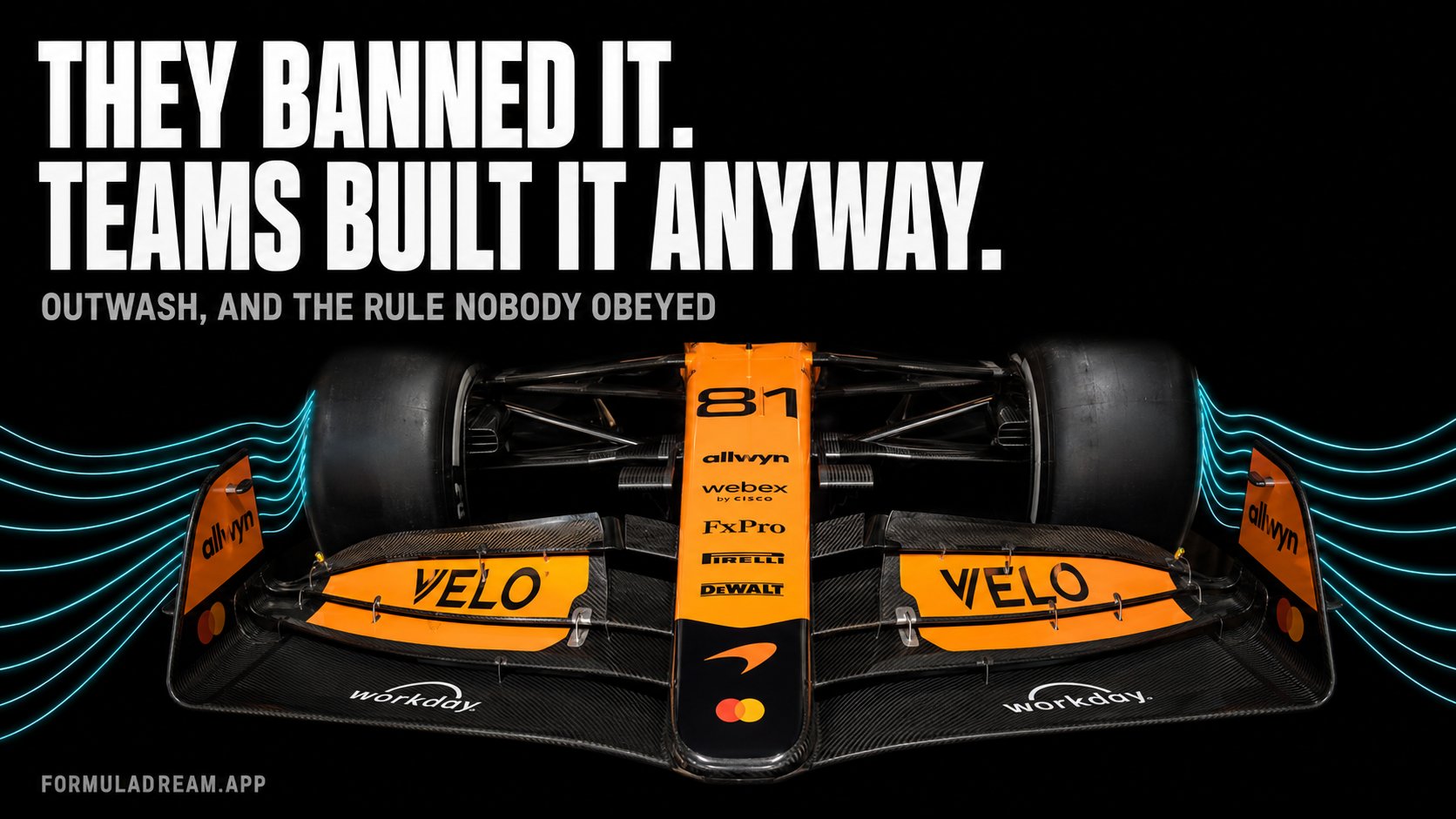
The 2022 front wing was designed to do one thing: stop pushing air around the outside of the front tyres. Within months, teams were finding ways to do it anyway. One Mercedes solution was banned outright.
That fight is the most revealing thing in modern F1 aerodynamics, because it shows what a front wing is really for. It is not mainly about generating downforce. It is about deciding where the messiest air on the car ends up.
What is outwash in F1?
The front tyre is an aerodynamic disaster. It is a wide, spinning, unstreamlined block sitting in clean air at 300 km/h, and it throws out a huge turbulent wake.
That wake has to go somewhere, and where it goes determines how well the rest of the car works.
Outwash is the technique of using the outer section of the front wing to push airflow across and around the outside of the front tyre, steering the tyre's turbulence away from the car. Teams have been doing it since 2009, and by the end of the previous rules era the outer part of a front wing was almost entirely dedicated to it.
For your own car, outwash is excellent. You take the dirtiest air on the car and throw it outboard, keeping the flow to your floor, sidepods and rear wing comparatively clean.
Why F1 tried to ban it
Because that turbulence does not vanish. It goes into the air behind you, and then into the car that is trying to follow.
The turbulent flow around and outside the rear wheels was identified as largely responsible for how much performance a following car lost. Get close to a car in a corner, drive into its wake, lose downforce, lose grip, back off. Racing became difficult by design.
The 2022 regulations attacked this directly. Article 3.2 of the technical regulations stated as an explicit objective that cars should be able to race closely, with the aerodynamic performance loss of a following car kept to a minimum.
The intended mechanism: an anti-outwash front wing. Instead of throwing disturbed air outboard, the 2022 car was supposed to channel almost all the air that passes through the front wing and around the front tyres inboard of the rear tyres, so it exits in a tidier, more predictable wake.
Combined with the tunnelled floor taking over downforce generation, the goal was cars that could follow each other.
Why teams engineered it back in
Because a rule can state an objective, but a car is judged on lap time.
Teams have no obligation to pursue the regulations' intent, only to comply with their text. And outwash still works. A car that gets its turbulence outboard is faster than one that does not, whatever the aim of the rules.
So teams built designs that generated outwash by other means. The approach that emerged was to create high-pressure regions that naturally force the air coming off the front wing and front wheel to travel outboard, achieving the old effect without the old geometry.
Most teams settled on a hybrid, and the balance between outwash and downwash became one of the defining differences between car concepts. When people talk about teams having different "philosophies", this is a large part of what they mean.
The Mercedes wing that got banned
The clearest example of how far this went.
At the Miami Grand Prix, Mercedes ran a front wing where the flap and endplate connections were mounted much further forward than anyone else on the grid, with the flaps angled steeply back so that the lower rearmost section of the endplate was left exposed to the airflow.
That exposed section gave more outwash potential than rival solutions. It complied with the text. It defeated the purpose.
The FIA banned the design from 2023 onwards.
That sequence, an objective written into the regulations, a compliant design that undermines it, and a subsequent ban, is the normal rhythm of Formula 1 rulemaking. It is not cheating and it is not a failure of the rules. It is what happens when you write an objective in prose and then invite eleven engineering organisations to find the edges of the words.
Did the 2022 rules work?
Partly, and honestly the answer should be partly.
Following did improve. Cars could run closer through corners than in the previous era, and the floor doing most of the downforce work is the main reason. That part of the plan held.
But the aerodynamic advantage of getting turbulence outboard never went away, so teams kept chasing it, and each step in that direction eroded a little of the benefit the rules were built to deliver.
The front wing tells you which way a team leaned. That is why photographers shoot them obsessively and why a new front wing is treated as a significant upgrade even when it looks like a minor change to the untrained eye.
What to look at
Next time you see a front wing close up, look at the outer third, where the flaps meet the endplate. That region is where the outwash argument is being had.
Then look at where the team has put its performance elsewhere. A car leaning hard on outwash usually pairs it with particular sidepod and floor-edge treatments, because it is trying to keep a specific flow structure alive all the way down the car. It is a whole concept, not a part.
Aerodynamic concepts show up as lap time and as the ability to follow, both of which are visible live.
Our app puts every car on the circuit map during a session with a timing tower carrying gaps, intervals, tyre compound and tyre age, and positions gained or lost, so you can watch how close a car can actually run to the one ahead through a corner sequence. Driver radio streams live with the transcript beside it, which is where drivers report what the car is doing in traffic in their own words.
It also collects every FIA document from the weekend, including the technical delegate's reports that record front wing flap and deflection tests on named cars.
Free, no subscription, no ads. Independent, and not affiliated with Formula 1.
Singapore Sprint 2026 Results: Russell Crashes From the Lead
Russell took the lead at turn one and crashed at the final corner of the same lap. Verstappen won, Hamilton charged to second, and the McLarens hit each other.