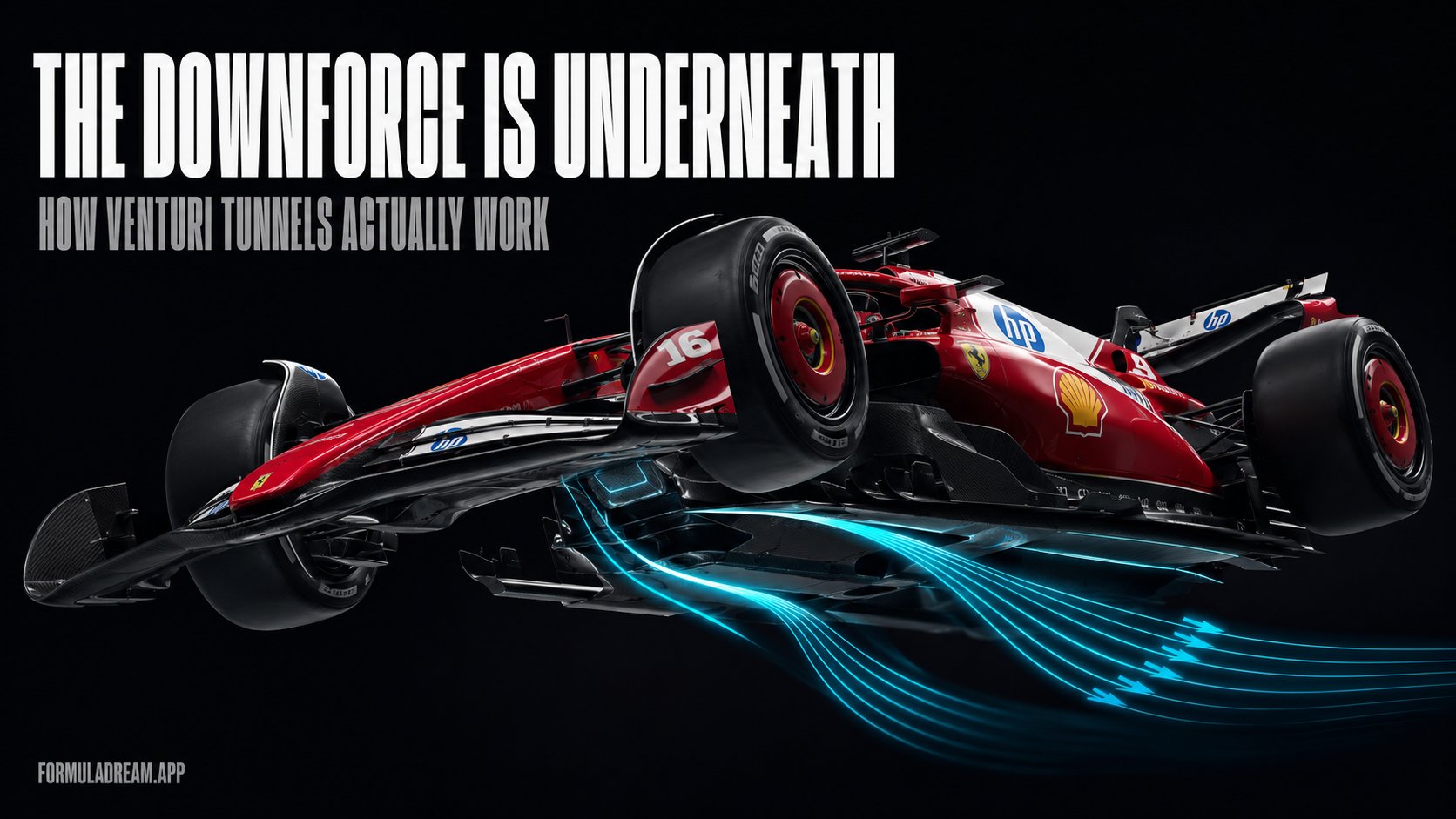
Look at a Formula 1 car and you will see two enormous wings. Most of the downforce is not coming from them. It is coming from the part you cannot see: the floor.
From 2022 to 2025, the underside of an F1 car was shaped into a pair of tunnels that accelerate air beneath the car and pull it towards the ground. For 2026 the floor was partly flattened and the effect dialled back, but the principle is the same. The wings still matter. The floor matters more.
This is the single biggest thing to understand about how a current F1 car works, and it explains everything from why the cars bounced to why teams obsess over ride height.
The tunnels under the floor are shaped like a venturi: a wide inlet, a narrowing constriction in the middle, and a wide outlet at the back. The ground forms the bottom surface of that shape.
Air entering the tunnel has to get through the constriction. Squeezing the same volume of air through a smaller gap means it must move faster. Faster-moving air has lower pressure.
So you end up with low pressure under the car and ordinary atmospheric pressure above it, and the difference pushes the car down. Not a wing deflecting air. A pressure difference sucking the whole car into the track.
The expanding section at the rear does the heavy lifting. By opening back out, it pulls air through the constriction harder than it would otherwise flow, which deepens the low-pressure region. The faster the air moves underneath, the harder the car is sucked down.
Why is floor downforce better than wing downforce?
Because of what it does to the car behind.
A wing generates downforce by throwing air upwards and backwards, leaving a churned, turbulent wake. A following car drives into that wake, its own wings receive disturbed air, and it loses grip precisely when it needs grip most, in the corner where it is trying to follow.
That is dirty air, and it is why the previous generation of cars were so difficult to race closely.
Floor-generated downforce is far less dependent on clean air arriving at the front of the car. A car making most of its grip underneath is less damaged by following. That was the entire logic of the 2022 regulations: push teams to generate downforce from the floor instead of the wings, and cars would be able to race each other again.
The idea itself is not new. Ground effect appeared in F1 in the late 1970s, was restricted, and was deliberately brought back for 2022.
What is porpoising and why did it happen?
The problem with the floor is that it works better the closer it gets to the ground, right up until it does not work at all.
At speed, the low pressure under the car pulls it downwards. As it drops, the floor gets closer to the track, the constriction gets tighter, the air accelerates more, the pressure drops further, and the car is pulled down harder still. It is a feedback loop.
Then the floor gets close enough that the airflow stalls or the plank touches down. The low-pressure region collapses almost instantly, the downforce vanishes, and the car springs back up on its suspension.
Now it is high again. The airflow reattaches. The downforce returns. The car is sucked back down.
Repeat several times a second and you have porpoising: the violent vertical bouncing that defined the 2022 season and left drivers with back pain. It is not a suspension problem in origin. It is aerodynamics, with the suspension along for the ride.
Why teams obsess over ride height
Once you understand the feedback loop, the entire setup philosophy of a modern F1 car follows.
The floor rewards running as low and as stiff as possible. Low, because the effect strengthens as the gap closes. Stiff, because a floor that moves is a floor whose downforce is changing constantly, and unpredictable downforce is worse than slightly less of it.
That is also why these cars are so unforgiving over kerbs and bumps, and why some circuits suit them far better than others. A smooth, fast circuit lets a team run the car where the floor wants to be. A bumpy street circuit does not, and the compromise costs real lap time.
It is also why the current cars are, at some circuits, slower over one lap than the cars that preceded them. At the Hungaroring, Lewis Hamilton's 1:13.447 from qualifying in 2020 has still not been beaten: the closest since was Lando Norris's 1:14.890 in 2025, and the 2026 pole was a 1:17.207, because a tight, slow, technical circuit is close to the worst possible environment for a floor that wants to be pressed to the ground at speed.
What actually changed on the car in 2022
Three things, all serving the same goal.
The floor became tunnelled rather than flat, with proper venturi shaping underneath.
The wings got simpler. Fewer of the small winglets and flow-conditioning devices whose job was to manage the wake, because the wake mattered less.
The wheels gained covers and the bodywork was reshaped to control the turbulence coming off the tyres, which is one of the messiest airflow sources on the car.
Floors became more important than wings for total downforce, and stayed that way through the 2022 to 2025 generation.
What changed for 2026
The floor described above defined the 2022 to 2025 cars. The 2026 regulations deliberately turned it down.
Formula 1's own description of the new car is that it has a "partially flat floor and a lower-powered diffuser, which should reduce the ground effect." The tunnels were not abolished, and the car still generates downforce underneath rather than purely from its wings. The effect was simply dialled back.
The headline numbers for 2026 are a 30% reduction in downforce and a 55% reduction in drag, alongside active aerodynamics replacing DRS. That combination is the reason the cars behave the way they do this season: markedly quicker in a straight line, because there is far less drag, and slower everywhere else, because there is far less grip.
We measured the net effect on lap time. Comparing pole laps at the ten circuits raced in both seasons, 2026 is a median of 3.05% slower than 2025, 2.93% on average, with every single circuit slower and no exceptions. The floor is a large part of why, and the full comparison is in are F1 cars getting faster.
There may be an unintended benefit. A less aggressive underfloor moves less water, and testing during the spray guard trials found that a great deal of the spray blinding drivers in the wet comes off the diffuser rather than the tyres. A lower-powered diffuser could quietly improve wet racing, which is covered in what happens when it rains in F1.
Watching the floor do its work
You cannot see the floor, but you can see its effects: a car that suddenly loses grip over a kerb, a driver complaining about bouncing on a specific straight, a team changing ride height between sessions and finding half a second.
Our app shows every car on the circuit map during a session with a timing tower carrying gaps, intervals, tyre compound and tyre age, and positions gained or lost, so you can see setup changes appear as lap time. Driver radio streams live with the transcript beside it, which is where bouncing and ride-height complaints actually get reported, in the driver's own words, mid-session.
It also collects every FIA document from the weekend, including the technical delegate's reports that record floor deflection tests on named cars.
Free, no subscription, no ads. Independent, and not affiliated with Formula 1.
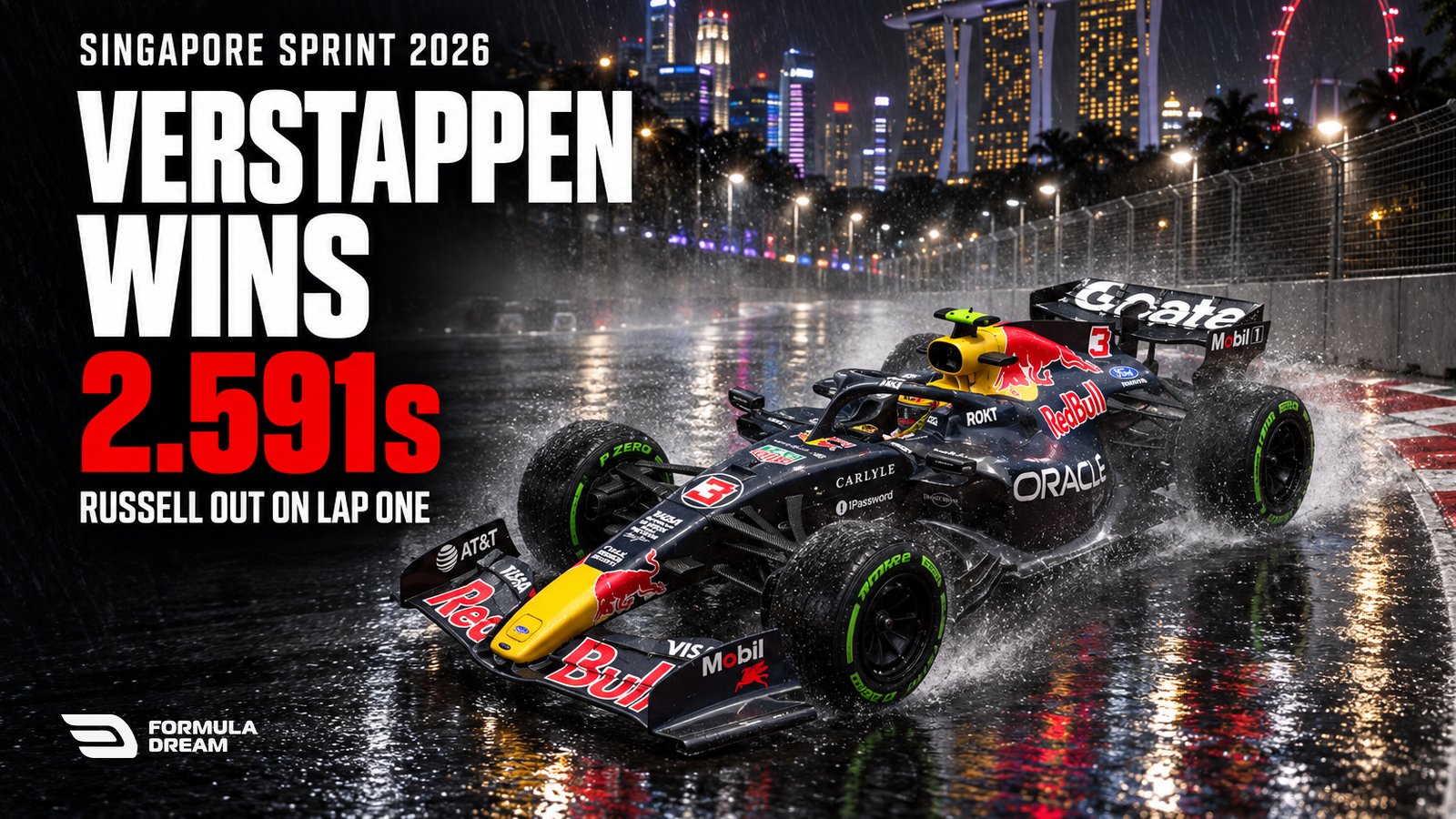
Singapore Sprint 2026 Results: Russell Crashes From the Lead
Russell took the lead at turn one and crashed at the final corner of the same lap. Verstappen won, Hamilton charged to second, and the McLarens hit each other.