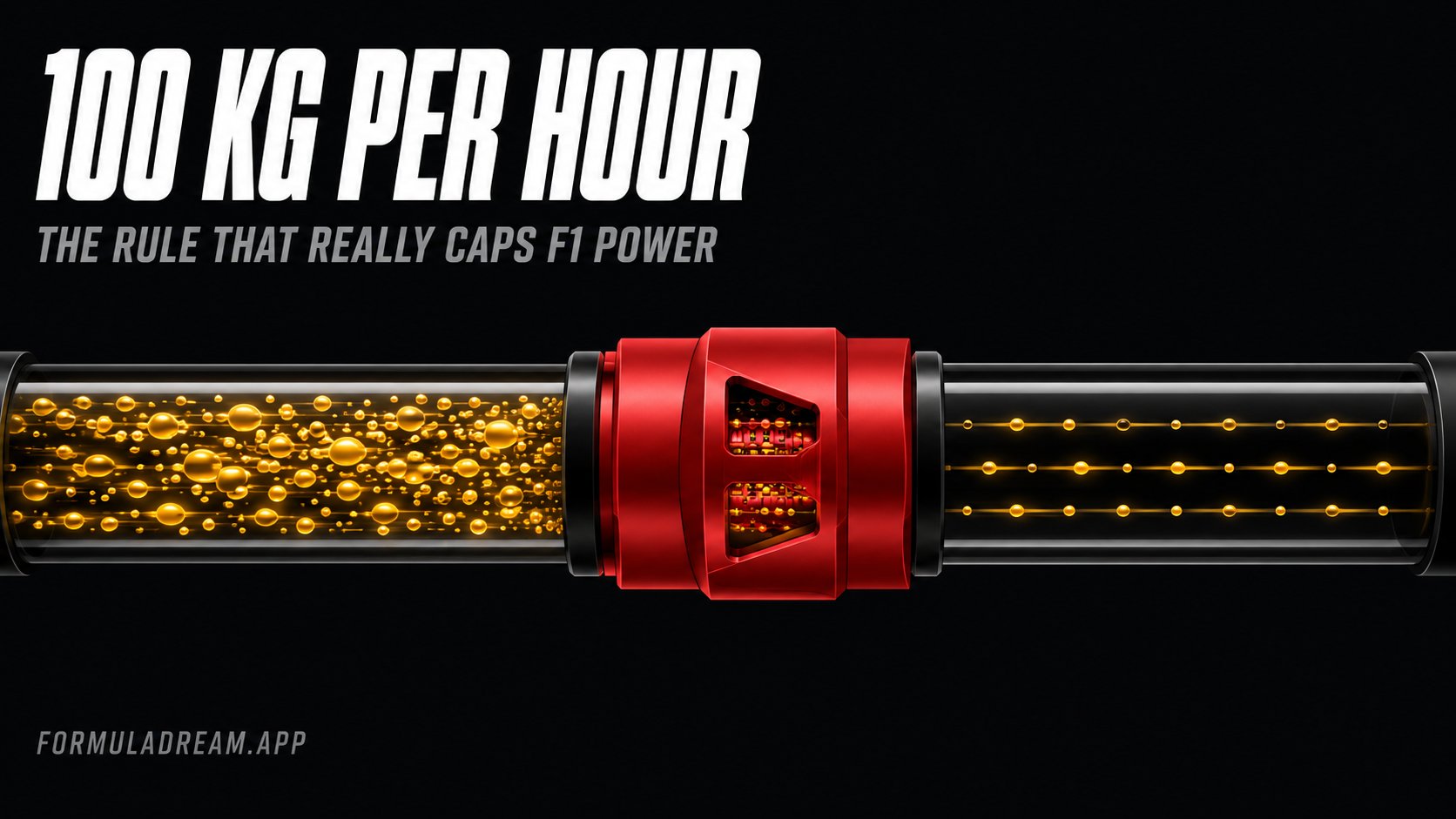
Formula 1 does not put a limit on engine power. It puts a limit on how quickly fuel can get into the engine: a maximum of 100 kilograms per hour, measured continuously.
Power is what comes out. Fuel flow is what goes in. Cap the input and you have capped the output without ever writing a horsepower number into the regulations.
It is one of the more elegant pieces of rule-writing in the sport, and in its first season it got a driver disqualified from a podium.
Why does F1 limit fuel flow instead of power?
Because a race fuel limit on its own does not do the job.
Since 2014 there have been two separate fuel restrictions: a total allowance for the race, and an instantaneous flow limit of 100kg per hour.
Without the flow limit, a team could hold back fuel through the parts of a lap where power matters less, then dump it in enormous quantities where it matters most. Same total consumption across the race, far more power exactly where it counts. The race allowance would be respected and completely defeated at the same time.
The flow limit closes that door. It does not care about your total, it cares about your rate, right now, at this instant.
It also delivers the efficiency goal the 2014 rules were built around. Before then, teams could effectively burn as much as they liked, and races were frequently won by whoever could burn the most. That is a difficult thing for a sport to defend.
How the limit actually works
The full 100kg per hour is available at 10,500 rpm, and a formula based on engine speed governs the permitted flow below that.
That detail matters more than it sounds. The rule does not simply say "never exceed 100kg/h". It ties the ceiling to rpm, which means the regulation is shaping how the engine is allowed to make power across its whole range, not just at the top.
Compliance is measured by an FIA-supplied fuel flow meter fitted to every car. It is the FIA's sensor, not the team's, and its reading is the one that counts.
The Ricciardo disqualification
The rule's first season produced the argument that defines it.
At the 2014 Australian Grand Prix, the season opener, Daniel Ricciardo finished second and was disqualified for exceeding the permitted fuel flow.
What makes the case interesting is that Red Bull were warned during the race that the car was over the limit. They believed the FIA sensor was faulty, and chose to ignore the warning and run the engine to their own fuel flow readings instead.
They were not alone in distrusting the hardware. Inconsistencies with the FIA meters were reported up and down the pit lane that weekend, and sensor reliability became a running dispute through the season. Red Bull appealed. The disqualification stood.
The principle established there is the one that still governs: the FIA's measurement is the measurement. A team that believes the official sensor is wrong must raise it and comply, not substitute its own numbers and race on. Whether the sensor was accurate that day is almost beside the point. A championship cannot function if each team decides which instruments it accepts.
Why this rule shaped the hybrid era
The fuel flow limit is the reason the 2014 engines became so obsessive about efficiency.
If you cannot get more fuel in, the only route to more power is extracting more energy from the fuel you are allowed. That single constraint pushed teams towards extreme combustion technologies, and it is why F1's V6 hybrids reached thermal efficiency figures well beyond anything in a road car.
It is also why the hybrid system mattered so much. With the combustion side capped at the input, electrical energy became the way to add power without adding fuel. That logic carries directly into the current rules, where the 2026 power units run roughly half combustion and half electric and the MGU-H has been dropped entirely. We wrote about what the 2026 ERS changes actually do.
What to listen for
Fuel is a constant subject on team radio, and now you know why the two numbers are different things.
"Fuel saving" or "lift and coast" is about the race total: the driver is being asked to use less overall, usually by lifting off earlier before braking.
Anything about flow, mixture or engine modes is about the instantaneous limit and how the engine is being allowed to make power right now.
They sound similar on the broadcast and they are separate problems.
Following the argument live
Fuel warnings, mixture calls and mode changes happen on the radio, usually long before they show up in a result.
Our app streams driver radio live with the transcript running beside the audio, which is where you hear fuel management being negotiated in real time. During a session it also puts every car on the circuit map with a timing tower carrying gaps, intervals, tyre compound and tyre age, pit stop counts and positions gained or lost.
It collects every FIA document from the weekend too, including the technical delegate's reports and the stewards' decisions where fuel irregularities are recorded. We wrote a guide to reading those documents.
Free, no subscription, no ads. Independent, and not affiliated with Formula 1.
Singapore Sprint 2026 Results: Russell Crashes From the Lead
Russell took the lead at turn one and crashed at the final corner of the same lap. Verstappen won, Hamilton charged to second, and the McLarens hit each other.