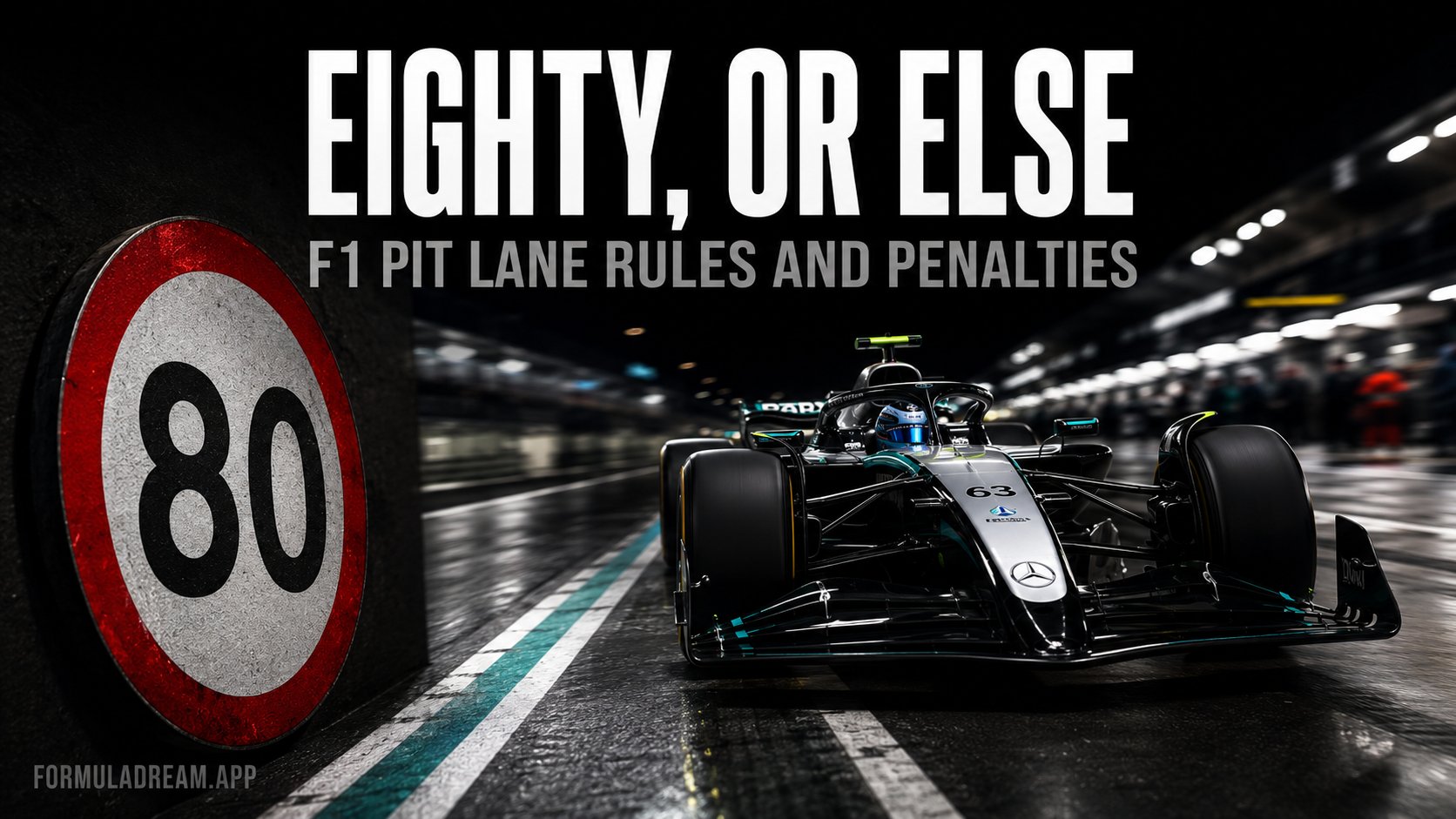
The Formula 1 pit lane speed limit is 80km/h, and the Race Director can lower it where the pit lane is tight, which in 2026 means 60km/h at Monaco. Break it in practice and the team is fined. Break it in the race and the driver gets a time penalty, normally five seconds.
80km/h is the standard, written into Article B1.6.3 of the Sporting Regulations, which also lets the Race Director change it. Where a pit lane is narrower or more congested it drops to 60km/h, and Monaco is the clearest case. Melbourne was expected to join it in 2026, because an eleventh team made its pit lane more crowded, but the FIA kept it at 80km/h.
The reason is straightforward: the pit lane is the only place on a circuit where cars travelling at speed share space with people on foot. Pit crews, mechanics, team personnel and officials are all in a confined corridor. Everything about the limit is about that.
Drivers do not hold the speed manually. Each car has a pit limiter button on the steering wheel that caps the car's speed electronically. Pressing it late, or releasing it early, is how speeding offences actually happen. It is rarely carelessness with the throttle.
What speeding costs
The penalty depends on the session, which is a distinction most people miss.
In practice, qualifying and sprint qualifying: a fine for the team of €100 for every km/h over the limit, up to €1,000. Financial, not sporting, although the stewards can add a penalty if they think a driver was speeding to gain an advantage.
In the race or sprint: the rules let the stewards choose a five or ten-second penalty, a drive-through or a stop-and-go. In practice speeding is normally punished with five seconds, served at the next pit stop or added to the race time. Sporting, and often decisive.
The logic is that in practice, speeding gains you nothing worth having, so the deterrent can be a fine. In a race, time in the pit lane is time in the race, so the penalty has to be time as well.
Unsafe release, and the two versions of it
This is the offence that produces the most argument, and there are genuinely two different things being penalised.
Both are in Article B1.6.2 of the 2026 Sporting Regulations.
Releasing a car in a way that could endanger people or another car, typically into the path of a car already coming down the pit lane. A car rejoining the lane in front of a rival at the limit is a collision at closing speed in a corridor full of people. The regulations leave the penalty for this one to the stewards.
Releasing a car in an unsafe condition, for example with a wheel not properly attached. Here the rules are specific. In the race or sprint the driver gets a stop-and-go penalty, and if they have to retire because of it the team can be fined as well. In practice or qualifying the stewards can instead drop the driver down the grid by as many places as they see fit.
On top of either, a driver who carries on knowing the car was released unsafely faces an additional penalty.
The penalty lands on the driver, but the decision to release is made by the crew. The driver holds a stationary car and goes when the release signal says go.
Why the pit stop clock is not the pit stop cost
The number quoted on broadcasts is the stationary time: the moment the car stops to the moment it moves. The record is 1.80 seconds, by McLaren for Lando Norris at the 2023 Qatar Grand Prix.
That number is close to meaningless for strategy.
The real cost of a pit stop includes braking for the pit entry, the entire journey down a speed-limited lane, the stop itself, the launch, and the acceleration back to racing speed at pit exit. We measured it across every race of the 2025 season: a green-flag stop costs 21.88 seconds on average. It varies enormously by venue, from 17.85 seconds at Monaco to 27.52 at Imola, because pit lanes differ in length and speed limit. Full method and per-circuit figures here: we measured every pit stop of the 2025 season.
This is why a two-second stop at one circuit and a two-second stop at another have very different strategic consequences, and why teams model pit loss per circuit rather than using a single figure. It is also why the undercut works at some tracks and not others.
Pit exit has its own rules. Under Appendix L of the FIA International Sporting Code, no part of a tyre may cross the painted line that separates cars leaving the pit lane from cars on the track, unless the Race Director allows it. The line exists because a car rejoining at low speed alongside cars at racing speed is a genuine hazard.
Pit entry too. The same rule applies on the way in: no part of a tyre of a car entering the pit lane may cross the painted line separating it from the cars on track, in either direction.
During a red flag, the pit lane rules change entirely: cars are stopped, work is permitted, and tyre changes are allowed and count as the mandatory stop. We covered that in F1 red flag rules.
The pit entry can be closed. In exceptional circumstances the Race Director can close it for safety reasons. A car may then only come in for essential and obvious repairs, and entering for any other reason during the race brings a stop-and-go penalty.
Why the pit lane is where races are decided
Because it is the only place a driver can gain or lose enormous time without touching another car.
A slow stop costs positions that took a hundred laps to earn. A five-second penalty for a pit lane offence is applied at the next stop or added at the end, and at a circuit where overtaking is hard it is effectively unrecoverable. An unsafe release can end two races at once.
All of which happens in a corridor most viewers only see when something goes wrong.
Watching it properly
Pit stops, penalties and the decisions behind them all show up in the timing and the radio before they show up in the commentary.
Our app puts every car on the circuit map during a session with a full timing tower carrying gaps, intervals, tyre compound and tyre age, and pit stop counts, so you can see a stop coming from the lap times rather than from the pictures. Driver radio streams live with the transcript beside the audio, which is where the release calls and the penalty notifications actually happen.
It also collects every FIA document from the weekend, including the stewards' decisions that record each pit lane offence, the article breached and the reasoning.
Free, no subscription, no ads. Independent, and not affiliated with Formula 1.
Singapore Sprint 2026 Results: Russell Crashes From the Lead
Russell took the lead at turn one and crashed at the final corner of the same lap. Verstappen won, Hamilton charged to second, and the McLarens hit each other.