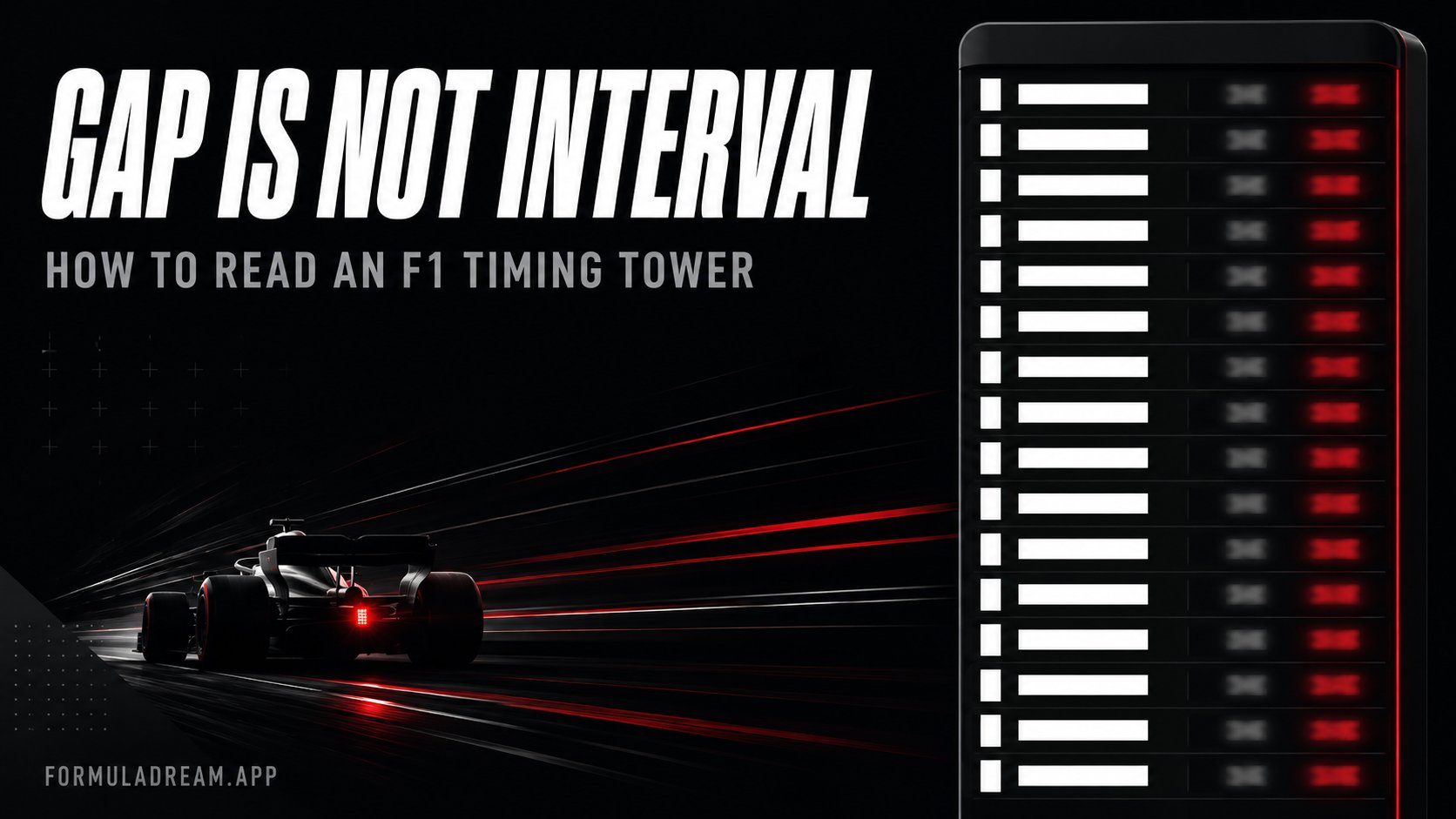
GAP is the time to the race leader. INTERVAL is the time to the car directly ahead. They are different numbers, they mean different things, and only the driver running second ever sees them match.
Get those two the wrong way round and the entire race looks different to what is actually happening. That is the single most common mistake fans make with live timing, and it takes about thirty seconds to fix permanently.
Tyre compound currently fitted, usually as a coloured letter or band
Tyre age, the number of laps completed on that set
Last lap time
GAP: time to the leader
INTERVAL: time to the car directly ahead
Overtake mode indicator, showing when a driver is within range of the following car's power boost
Pit stop count
Broadcasts show subsets of this. A proper timing screen shows all of it at once, which is why people who follow F1 seriously watch the timing alongside the pictures rather than instead of them.
GAP versus INTERVAL, properly
Take a driver running sixth.
Their GAP is the accumulated time behind the leader. It is built from five cars' worth of time and it can be enormous even when the driver is in a close fight.
Their INTERVAL is the time to fifth place only. That is the number that tells you whether a battle is happening.
A driver can be 40 seconds off the lead and 0.3 seconds behind the car in front. The GAP says the race is over for them. The INTERVAL says they are about to try something. Watch the wrong column and you will miss the entire race.
The only driver for whom the two numbers are identical is whoever is running second, because for them the car ahead is the leader.
The moment the timing screen lies to you
This one catches nearly everybody, and it is worth knowing before you next argue about a strategy call.
When a car pits, the INTERVAL for the car behind it recalculates against a completely different rival.
Say you are watching a tight battle for fourth, INTERVAL of half a second. The car in fourth pits. Now the car that was fifth is fourth, and its INTERVAL no longer measures the fight you were watching. It measures the distance to whoever is now ahead on track, which might be twenty seconds up the road.
The screen suddenly shows +20s and it looks like the battle collapsed. Nothing happened. The number is measuring something else.
The rule: after any pit stop cycle, give the timing two or three laps before you trust INTERVAL to tell you about battles. Until the stops have shaken out, you are reading gaps between cars that are not racing each other.
Why the interval number is so precise
Intervals are measured to extraordinary resolution, far finer than the two decimal places you normally see displayed.
That precision is not decoration. It drives real decisions:
Overtake eligibility. A chasing driver must be within one second of the car ahead to unlock the extra electrical power that helps them attack on the straight. Not approximately one second. One second. The interval at that specific point on the track decides whether an overtake is possible.
This is the part that changed for 2026. DRS is gone. For fourteen seasons the reward for getting within a second was a rear wing that opened to shed drag. From 2026 the wings move under an active aerodynamic system that drivers can switch between low-drag and high-downforce modes without being close to anybody, and the proximity reward is instead Overtake Mode: a burst of additional MGU-K power, available only to a car within a second of the one ahead.
The one-second threshold survived the rule change. What you get for crossing it did not.
Pit stop timing. Teams need to know whether releasing a car into traffic will cost more than staying out, and that is an interval calculation against cars the driver cannot see.
Undercut decisions. Whether to pit a lap earlier than a rival depends on the interval, the pit loss and the out-lap pace, computed in seconds and fractions.
We wrote about what those gaps mean in physical terms in how much of an F1 lap is spent full throttle, where a tenth of a second works out to roughly ten metres at racing speed.
If any of the abbreviations on that screen are unfamiliar, our F1 glossary covers the vocabulary broadcasts assume you already know.
Reading tyre information
The tyre columns are where strategy becomes visible before it is announced.
Compound tells you what a driver is on. Tyre age tells you how long they have been on it, and that is the number that matters. A driver on twenty-lap-old softs and a driver on twenty-lap-old hards are in completely different situations.
Watch for a driver whose lap times are stable while their tyre age climbs. That is a car managing a stint successfully. Watch for lap times drifting while everyone around them holds steady, and you are watching a pit stop become necessary several laps before the team calls it.
Everything on the screen is provisional
During a live session, every column is moving and none of it is final.
Sector times update as cars cross timing loops, not continuously. GAP and INTERVAL recalculate as each car crosses the line, so two drivers' numbers are refreshed at different moments. The running order can reshuffle mid-lap as cars complete laps at different times.
And the classification itself stays provisional after the flag until post-race checks are complete, which is why results occasionally change afterwards. The documents that change them are published by the FIA, usually without announcement, and we wrote a guide to reading those.
What to actually watch
Three habits that change how much you get out of a race.
Watch INTERVAL, not GAP, unless you specifically care about the championship-level picture.
Watch tyre age against lap time. Strategy is visible here before it is visible anywhere else.
Watch the interval cross one second. That is the moment a chasing driver unlocks their power boost and a fight becomes possible, and it usually happens a lap before the overtake.
Where to get the full tower
Broadcasts show a simplified version, usually a handful of positions at a time, chosen by a director following the story they have decided to tell.
Our app shows every car at once on the circuit map with the full timing tower: gaps, intervals, tyre compound and tyre age, pit stop counts and positions gained or lost, plus alerts for safety cars and yellow and red flags as they happen. Driver radio streams live with the transcript running beside the audio, so you can hear the decisions being made against the numbers you are watching.
It also collects every FIA document published across the weekend.
Free, no subscription, no ads. Independent, and not affiliated with Formula 1.
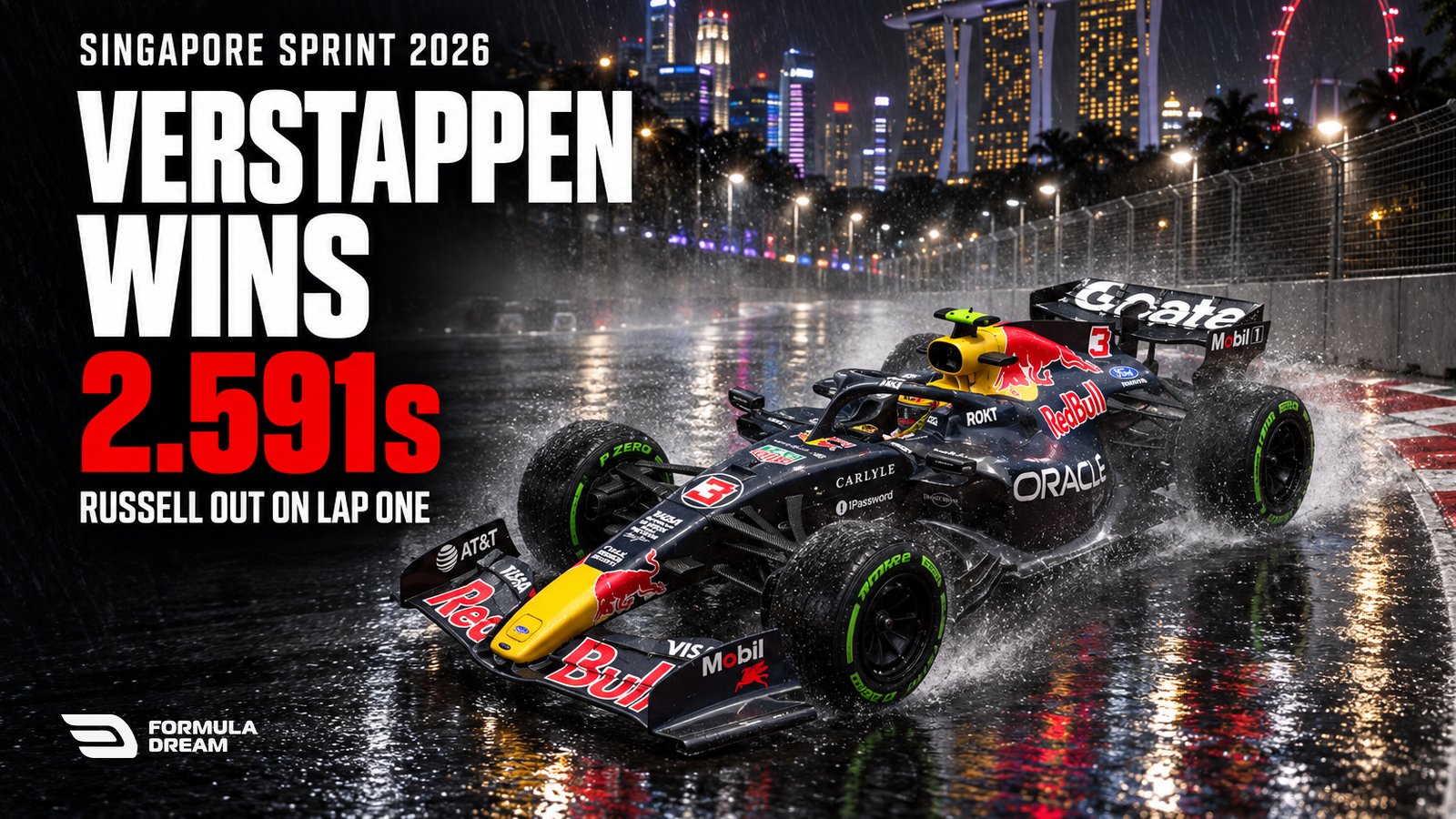
Singapore Sprint 2026 Results: Russell Crashes From the Lead
Russell took the lead at turn one and crashed at the final corner of the same lap. Verstappen won, Hamilton charged to second, and the McLarens hit each other.