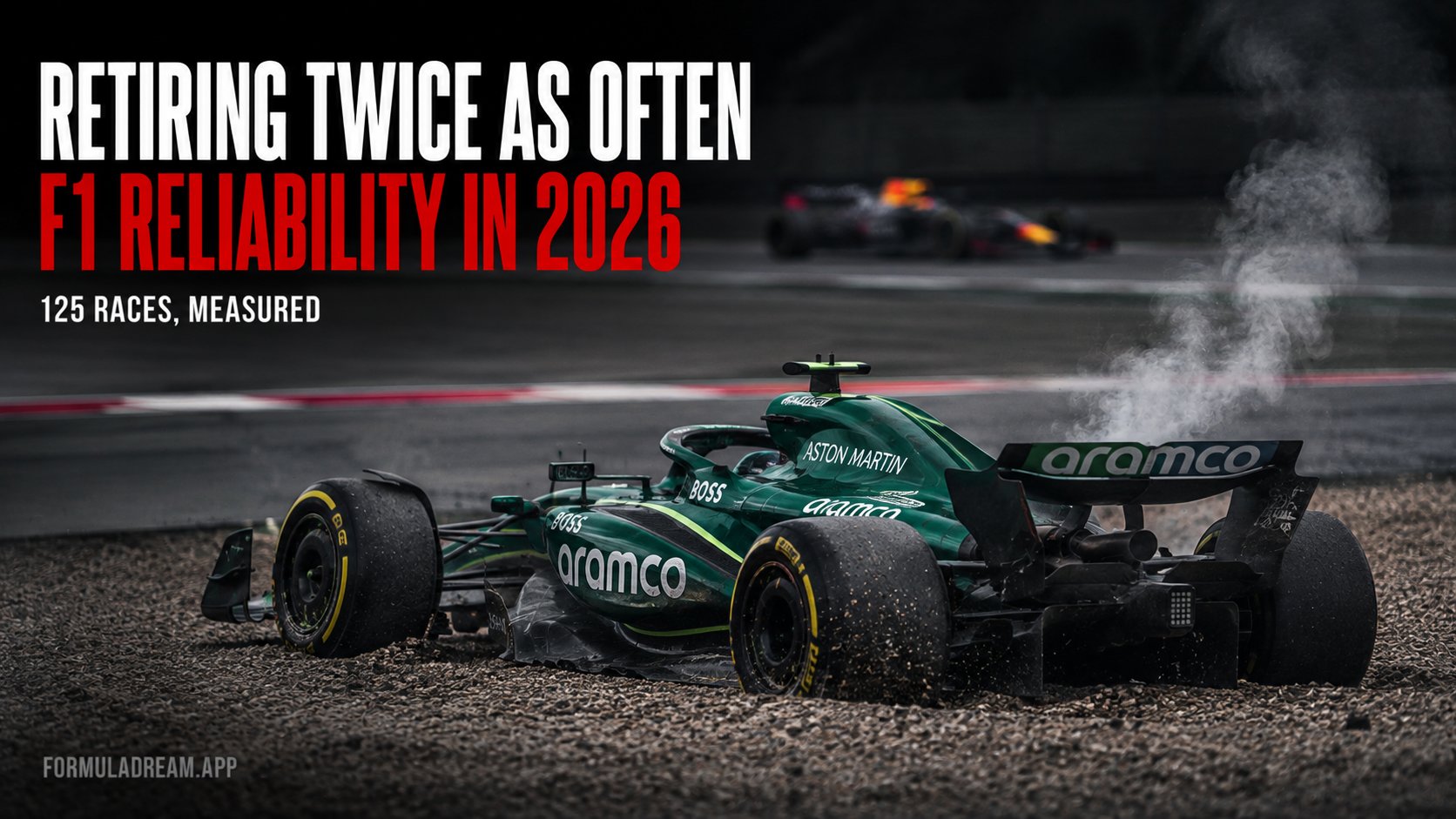
In 2025, 10.7% of race starts ended in retirement. In 2026 so far it is 18.7%. That is four cars per race instead of two.
The reliability story of the season has been about Mercedes power units. Mercedes are retiring from 13.6% of their starts, which is below the field average.
Every race classification from 2021 to 2026, counting how many starts ended in retirement as a share of all starts. Drivers who never started are excluded from both sides.
2021: 12.6%, 2.45 retirements per race
2022: 16.8%, 3.27
2023: 13.6%, 2.68
2024: 10.3%, 2.04
2025: 10.7%, 2.12
2026: 18.7%, 4.00
2026 is the least reliable season in this window by a clear margin, and the jump from 2025 is a 75% increase in the rate.
A new rulebook breaks cars
This has happened before, inside the same dataset.
Retirement rate across the 2022 and 2026 regulation changes
2022 was the first year of the last big aerodynamic reset, and the retirement rate jumped from 12.6% to 16.8%. It then fell for three straight years as teams matured those designs, bottoming out at 10.3% in 2024.
2026 is a far larger reset than 2022 was. It changed the aerodynamics and the power unit, moving to a roughly even split between internal combustion and electrical power with an entirely new battery and deployment architecture. A bigger change has produced a bigger spike: 18.7%, higher than 2022 managed.
The pattern is the useful part. Reliability in Formula 1 is not a fixed property of the sport. It is a function of how long teams have had to debug what they are running, and every reset restarts that clock.
If 2022 is the guide, this improves from here.
The coverage has the wrong culprit
Read the 2026 season through the headlines and it is a Mercedes story. George Russell losing power while leading in Montreal. Kimi Antonelli's electrical failure in Barcelona. Toto Wolff calling the reliability "not good enough". James Allison eventually identifying a battery issue. McLaren, as a Mercedes customer, failing to start in China with twin battery problems.
All of that happened. But it is not where the retirements are.
Retirement rate by team across the 2026 season to date
Aston Martin: 45.5% (10 of 22)
Cadillac: 40.9% (9 of 22)
Red Bull: 22.7% (5 of 22)
Williams: 19.0% (4 of 21)
McLaren: 15.8% (3 of 19)
Audi: 15.0% (3 of 20)
Mercedes: 13.6% (3 of 22)
Haas: 13.6% (3 of 22)
Ferrari: 9.1% (2 of 22)
Racing Bulls: 4.8% (1 of 21)
Alpine: 4.5% (1 of 22)
Aston Martin have retired from nearly half their starts. Cadillac, in their first season in the sport, are barely better. Between them those two teams account for 19 of the 44 retirements in the entire field.
Mercedes sit seventh of eleven, below the field average.
So why is everyone talking about Mercedes?
Because retirements are not equally expensive.
A retirement from the lead costs 25 points. A retirement from fourteenth costs nothing. Russell was running at the front in Montreal when his car shut down. That single failure was worth more in championship terms than several of Cadillac's put together.
The coverage is not wrong about the impact. It is just measuring something different from what it sounds like it is measuring. Mercedes have a points problem caused by reliability. Aston Martin and Cadillac have a reliability problem.
This is worth holding onto whenever you see a reliability discussion. "Most affected" almost always means most points lost, and that is dominated by where a car was running, not how often it broke.
What this changes about watching a race
Expect a car to go out. Four per race is the 2026 rate, against two last year.
A first-year team breaking down is normal. Cadillac at 40.9% is what a brand new operation looks like, and it is not a verdict on them.
Expect this to improve. The last reset spiked and then fell for three years. The mechanism is teams learning what they built.
Be careful with "worst reliability". Ask whether you are being told about failure frequency or points lost. They point at completely different teams this season.
A retirement is any start not classified as finished, lapped or disqualified. Entries recorded as "did not start" are excluded from both the numerator and the denominator, so a car that never left the grid does not count as a retirement.
2026 covers 11 races, the season being incomplete at the time of writing. It is the smallest sample here and the figure will move.
Important limitation: this does not separate mechanical failures from accidents. For 2021 and 2022 the data records specific causes such as engine, gearbox or collision. From 2023 onwards it records only "Retired". A crashed car and a broken car are counted identically throughout, so "reliability" here means "did not reach the end", not "the car failed".
That limitation cuts both ways for the team table. Some of Aston Martin's and Cadillac's retirements will be accidents rather than failures, and we cannot say what share.
The 2026 grid is 22 cars and 11 teams following Cadillac's entry, so per-team starts are out of 22 rather than 24 races.
Team assignments come from the same classifications.
Retirements are announced in race control messages and confirmed in documents.
The Formula Dream app collects every FIA document of the weekend as it is released, which is where the decision behind a penalty actually appears, usually before the commentary catches up. It also runs a live Dashboard through every session with all the cars on the circuit map, a timing tower carrying lap times, gaps, intervals, tyre compound and age, flag and safety car alerts the moment race control calls them, and live driver radio as it is broadcast.
Free, no subscription, no ads, independent. Not affiliated with Formula 1.
Singapore Sprint 2026 Results: Russell Crashes From the Lead
Russell took the lead at turn one and crashed at the final corner of the same lap. Verstappen won, Hamilton charged to second, and the McLarens hit each other.