Every other driver comparison is contaminated. Race results depend on strategy, safety cars, reliability and traffic. Points depend on the car. Even the overtaking counts we published reward a driver who happens to be out of position.
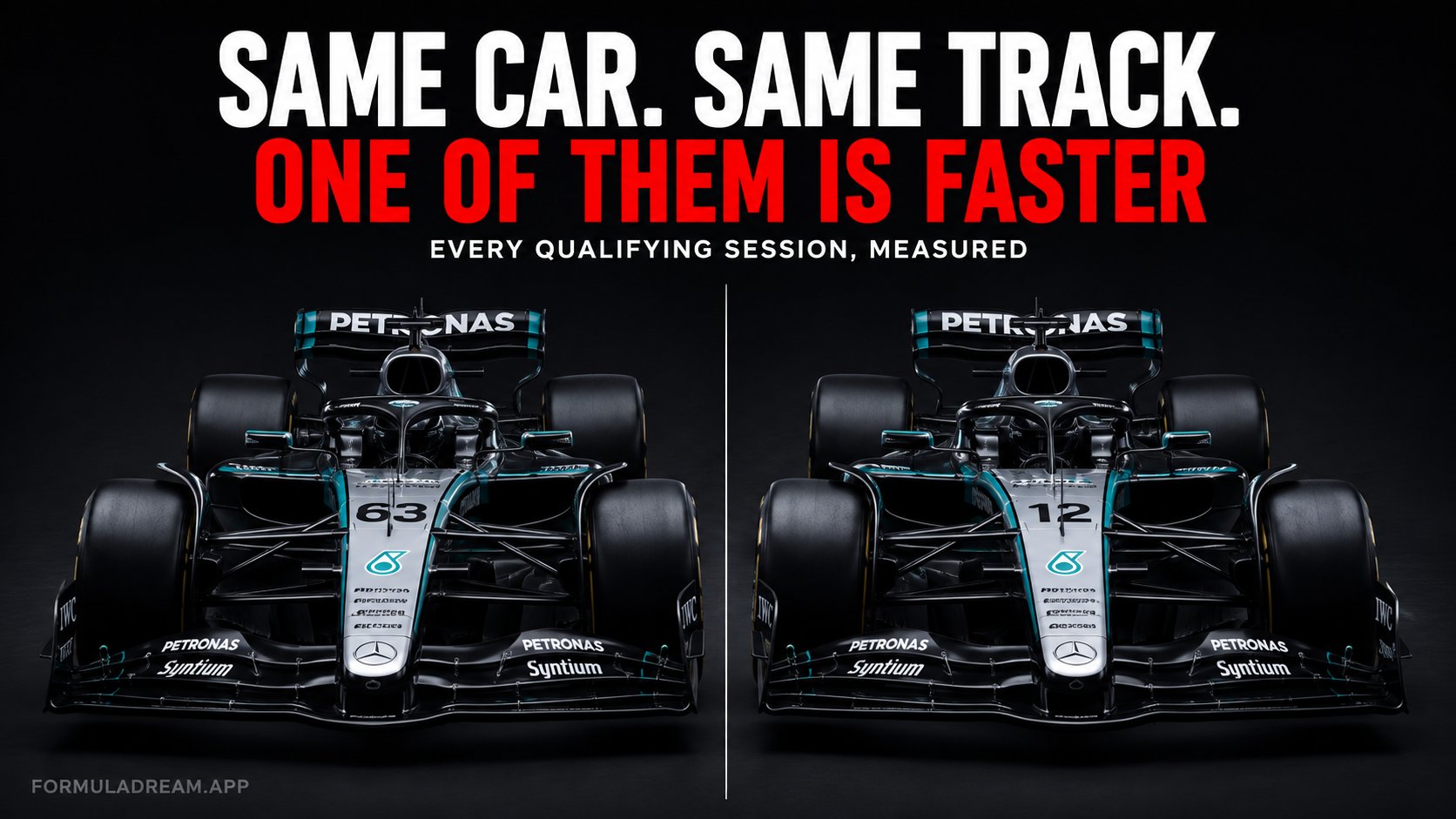
Qualifying has none of that. Same car, same track, same twenty minutes, low fuel, both drivers pushing as hard as they can for one lap. If you want to know which of two drivers is faster, this is the measurement.
The trap nearly everyone falls into
There is a catch, and it changes the answer.
The obvious approach is to compare each driver's fastest lap of the session. That is biased, and predictably so. A driver knocked out in Q1 sets their best time on a green, slow, unrubbered track. A driver who reaches Q3 sets theirs at the very end of the session, on the fastest the circuit gets all day, on a fresh set of softs.
Comparing those two directly flatters whoever went further, which is precisely the driver you were trying to evaluate. The measurement rewards the outcome it is supposed to be testing.
So we compared drivers only within the last segment they both reached. If both got to Q3, we compare Q3. If one was knocked out in Q2, we compare Q2. If one went out in Q1, we compare Q1. Same track state, same moment, genuinely like for like.
Across the two seasons that meant comparing in Q3 111 times, Q2 95 times and Q1 134 times.
The correction is real and measurable. The naive session-best method gives an average team-mate gap of 0.295%. Segment matching gives 0.242%. About a fifth of the apparent gap between team-mates is an artefact of comparing different track conditions.
We also ran an accounting check on every pairing: wins plus losses plus dead heats must equal the number of comparable events. It passed on all 21 pairings.
2025: two clean sweeps
Red Bull: Verstappen beat Tsunoda 20-0, by 0.681%
Aston Martin: Alonso beat Stroll 22-0, by 0.412%
Mercedes: Russell beat Antonelli 21-2, by 0.404%
Alpine: Gasly beat Colapinto 13-5, by 0.381%
Ferrari: Leclerc beat Hamilton 18-5, by 0.277%
Haas: Bearman beat Ocon 13-8, by 0.224%
Racing Bulls: Hadjar beat Lawson 15-5, by 0.157%
Williams: Sainz beat Albon 13-9, by 0.083%
McLaren: Norris beat Piastri 13-10, by 0.035%
Kick Sauber: Bortoleto and Hulkenberg split it 11-11, by 0.020%
Verstappen's 0.681% is the largest gap on the grid by a distance. On a 90 second lap that is more than six tenths, every Saturday, against a driver who was good enough to be in the car.
At the other end, McLaren and Kick Sauber were effectively dead heats. Norris edged Piastri by 0.035%, which on a 90 second lap is three hundredths of a second. Bortoleto, a rookie, and Hulkenberg, one of the most experienced drivers in the sport's history, finished 11-11 and 0.020% apart.
2026: the front has closed up
Median team-mate qualifying gaps across the 2026 season to date
Aston Martin: Alonso over Stroll, 8-2, by 0.449%
Williams: Sainz over Albon, 9-1, by 0.398%
Mercedes: Antonelli over Russell, 7-4, by 0.336%
Alpine: Gasly over Colapinto, 8-3, by 0.315%
Audi: Hulkenberg over Bortoleto, 6-5, by 0.250%
Haas: Bearman over Ocon, 8-3, by 0.229%
Red Bull: Verstappen over Hadjar, 7-2, by 0.128%
Cadillac: Perez over Bottas, 6-5, by 0.123%
Ferrari: Leclerc over Hamilton, 7-4, by 0.089%
McLaren: Norris over Piastri, 7-4, by 0.071%
Racing Bulls: Lawson over Lindblad, 6-5, by 0.020%
Verstappen still beats his team-mate, but by 0.128% rather than 0.681%. Whether that is Hadjar being closer to him than Tsunoda was, or the new cars changing what a qualifying lap rewards, this data cannot say. It can say the gap is a fifth of what it was.
The biggest swing on the grid
Eight pairings stayed together across both seasons, which lets us measure movement rather than just standing.
Change in team-mate qualifying gap from 2025 to 2026 for the eight pairings that stayed together
Antonelli against Russell: +0.740 points, from 0.404% behind to 0.336% ahead
Hamilton against Leclerc: +0.188, from 0.277% behind to 0.089% behind
Colapinto against Gasly: +0.066
Bearman against Ocon: +0.005, essentially unchanged
Bortoleto against Hulkenberg: minus 0.270
Albon against Sainz: minus 0.315, from 0.083% behind to 0.398% behind
Antonelli's swing is by far the largest, and it is a genuine reversal rather than a narrowing. A rookie who was beaten 21-2 is now beating the same driver in the same car 7-4. Whatever else is true about Mercedes' season, their teenager has taken the step.
Hamilton has closed on Leclerc but not caught him. The gap has more than halved, from 0.277% to 0.089%, and the head-to-head has gone from 18-5 to 7-4. On a 90 second lap, 0.089% is eight hundredths.
Albon has gone the other way. A near-even 2025 against Sainz has become 9-1 and nearly four tenths.
What this changes about watching qualifying
A tenth between team-mates is a big gap, not a small one. Most pairings on this grid are separated by less than three tenths, and several by less than a twentieth of a second.
Be careful with head-to-head records quoted without a gap. Bortoleto and Hulkenberg finished 11-11 in 2025 and were 0.020% apart, which agrees. But a 13-10 record and a 0.035% gap, as at McLaren, describes two drivers who are for practical purposes identical over one lap.
Rookie seasons are not verdicts. Antonelli's first year looks like a thrashing. His second says something completely different about the same driver.
Watch which segment a comparison uses. A "he out-qualified him" claim built on session-best times carries about a fifth more gap than really exists.
Method
Data: FastF1 qualifying classifications, the 2025 season and the 2026 season to date, 722 driver records.
Drivers are compared only in the last qualifying segment both reached: Q3 if both progressed, otherwise Q2, otherwise Q1. Segment used: Q3 111 times, Q2 95, Q1 134.
21 events could not be segment matched because the segment times were unavailable in the source data, including Miami 2025. Those events are excluded rather than fudged.
Gaps are reported as a percentage of lap time, so Monaco and Spa can be compared, and as the median across events, so one disastrous session cannot swing a pairing.
Accounting check: wins plus losses plus dead heats equals comparable events, verified on all 21 pairings.
A pairing needs at least 8 comparable events to be reported.
This measures one lap on low fuel and nothing else. It is not a ranking of drivers. Race craft, tyre management, consistency and starts are all absent, and we have measured several of those separately.
2026 covers 11 races, so those figures rest on 9 to 11 comparisons per pairing and will move.
Team-mate qualifying is the cleanest comparison in the sport, and it happens in about an hour.
The Formula Dream app runs a live Dashboard through every session: every car moving on the circuit map, and a timing tower with lap times, gaps and intervals, tyre compound and age, pit counts and positions gained or lost. It is the same information these measurements come from, arriving live. You also get live driver radio as it is broadcast, and every FIA document of the weekend as it is published.
Free, no subscription, no ads, independent. Not affiliated with Formula 1.
Singapore Sprint 2026 Results: Russell Crashes From the Lead
Russell took the lead at turn one and crashed at the final corner of the same lap. Verstappen won, Hamilton charged to second, and the McLarens hit each other.