A technical directive does not change the Formula 1 regulations. It states how the FIA intends to interpret them. That distinction sounds academic until you realise a team can build a fully legal car and be told, mid-season, that it is no longer legal.
Technical directives are the most powerful tool the FIA has for managing competitive balance without a formal rule change, and they are barely understood outside the paddock.
What is a technical directive?
A clarification, issued by the FIA to the teams, explaining how a given part of the technical regulations will be interpreted and enforced.
The regulations are a written document. Written documents contain ambiguity. Entire engineering departments spend their careers finding the places where the text permits something the authors did not intend, and building it.
A technical directive closes one of those gaps. It says: we have seen what you are doing, here is how we read the rule, and this is how it will be policed from now on.
Are they legally binding?
This is the question people argue about, and the honest answer is that the distinction matters less in practice than it does in theory.
A TD is not a regulation. It does not go through the formal rule-change process, which requires consultation with teams and can take months. It is guidance on interpretation.
But it is guidance on interpretation from the body that enforces the rules. A team that ignores a technical directive is telling the FIA it disagrees with how the FIA reads its own regulations, and finding out at scrutineering. In practice, a TD determines what happens if you are brought before the stewards, which makes it functionally binding whatever its formal status.
The polite fiction that a TD only clarifies rather than changes is exactly that. If a car was fast on Saturday and must be modified by the next race, something changed.
Why the FIA uses them
Speed. A formal regulation change is slow by design, because it requires agreement. A loophole exploited in March cannot wait for a rulebook update that arrives in December, by which point the championship is decided.
Precision. A TD can address one specific interpretation without reopening an entire article of the regulations and inviting fifty new arguments.
As a stopgap. Frequently a TD is a temporary measure, holding the line until a proper rule change can be drafted and ratified into the rulebook.
Together, these let the FIA respond to innovation in weeks rather than seasons.
The obvious objection
If the governing body can reinterpret the rules mid-season, and a reinterpretation can cost a team the development direction it has spent a year and a substantial share of a capped budget pursuing, then technical directives are a genuine competitive weapon.
That is why every TD is followed by an argument about who lobbied for it. Teams complain to the FIA about rivals' designs, the FIA investigates, and a directive appears. Whether that constitutes proper policing or successful lobbying depends almost entirely on which team you support.
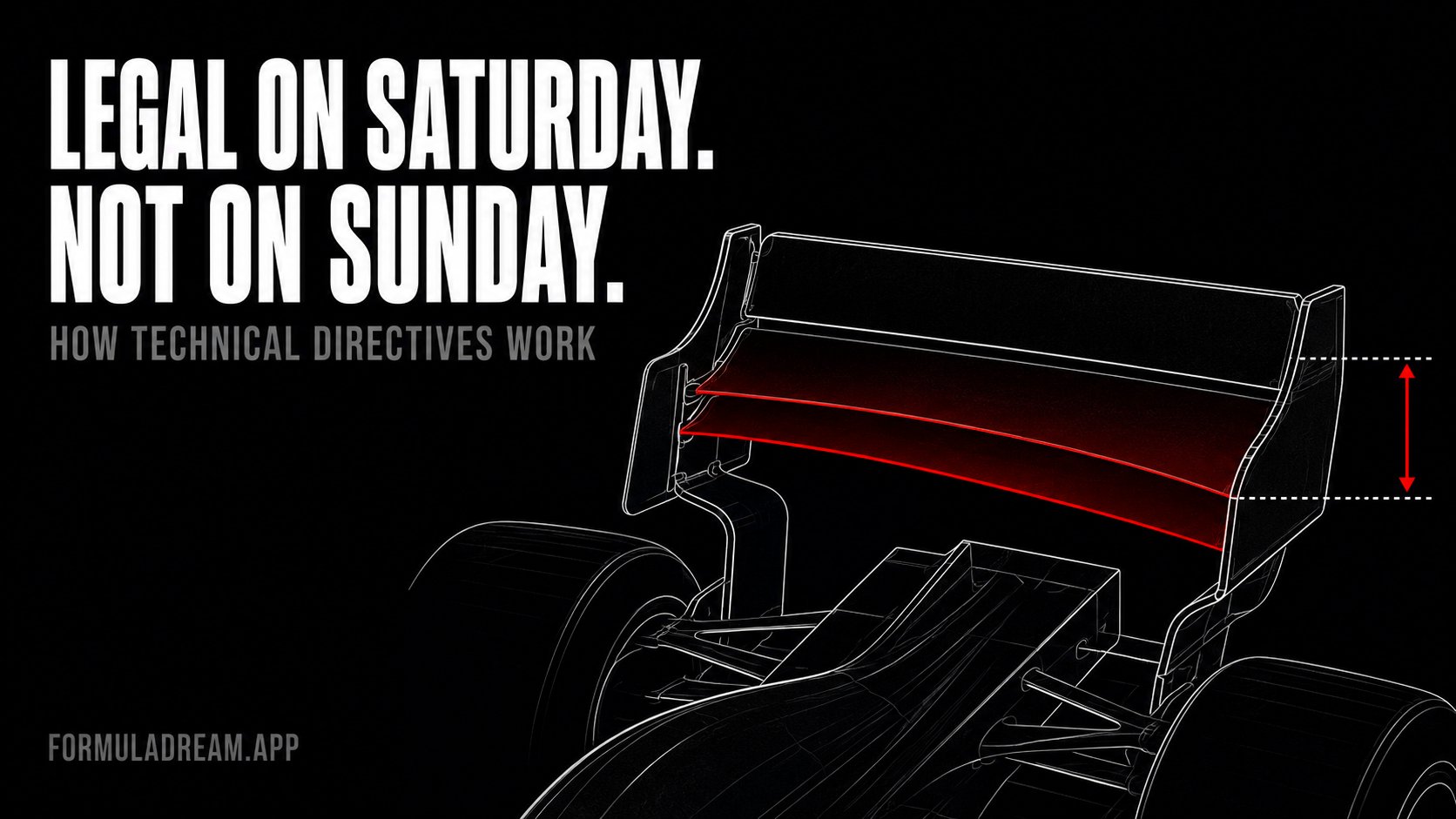
The most famous example is the flexi-wing directives of 2021, where Red Bull and others complained that Mercedes' rear wing flexed beyond the legal limit under aerodynamic load, gaining an advantage on the straights. The dispute ran for months and produced new deflection tests.
That case shows both readings at once. Either the FIA closed a loophole, or a complaint by rivals forced a change to a legal design. Both descriptions fit the same facts.
Why flexing is such a recurring subject
Because it exploits the difference between a static test and a moving car.
The regulations set limits, and compliance is verified by applying a defined load to a component and measuring how far it moves. A design that passes that test at rest can still deform under aerodynamic load at 300km/h, in ways the test never simulates.
That is not necessarily cheating. Every component flexes; the question is how much, and under what conditions, and whether the test reflects reality. Which is precisely the kind of grey area a technical directive exists to resolve, usually by introducing a stricter test rather than a new rule.
This connects directly to the technical delegate's reports published across a race weekend, which record the actual deflection tests carried out on named cars. We wrote about those documents in what the FIA publishes across a race weekend.
How this fits the wider governance picture
Technical directives sit alongside the other levers: the sporting regulations, the technical regulations, the financial regulations, and the governance framework that decides how any of them can be changed.
That framework is defined by the Concorde Agreement, which sets out who can propose a rule change and what majorities are needed. TDs matter precisely because they route around that machinery. We covered it in the Concorde Agreement, the secret contract that runs Formula 1.
What to watch for
A sudden loss of form with no obvious cause. A team that was quick and is suddenly not, without a crash or a failure, has often had something clarified.
Talk of "new tests" rather than new rules. That is the signature of a TD: the rule is unchanged, the measurement is stricter.
Complaints from rivals that go quiet. When a team stops complaining about a rival's part, it usually means a directive has been issued rather than that they changed their mind.
Following the paperwork
Technical directives themselves are not routinely published, which is part of the problem. What is published is everything downstream: the technical delegate's scrutineering reports, the tests carried out, and the stewards' decisions when a car is found non-compliant.
Our app collects every FIA document from a race weekend as it is released, which is the closest a fan can get to watching this process operate. During a session it also puts every car on the circuit map with a full timing tower carrying gaps, intervals, tyre compound and tyre age, and streams driver radio live with the transcript beside the audio.
Free, no subscription, no ads. Independent, and not affiliated with Formula 1.
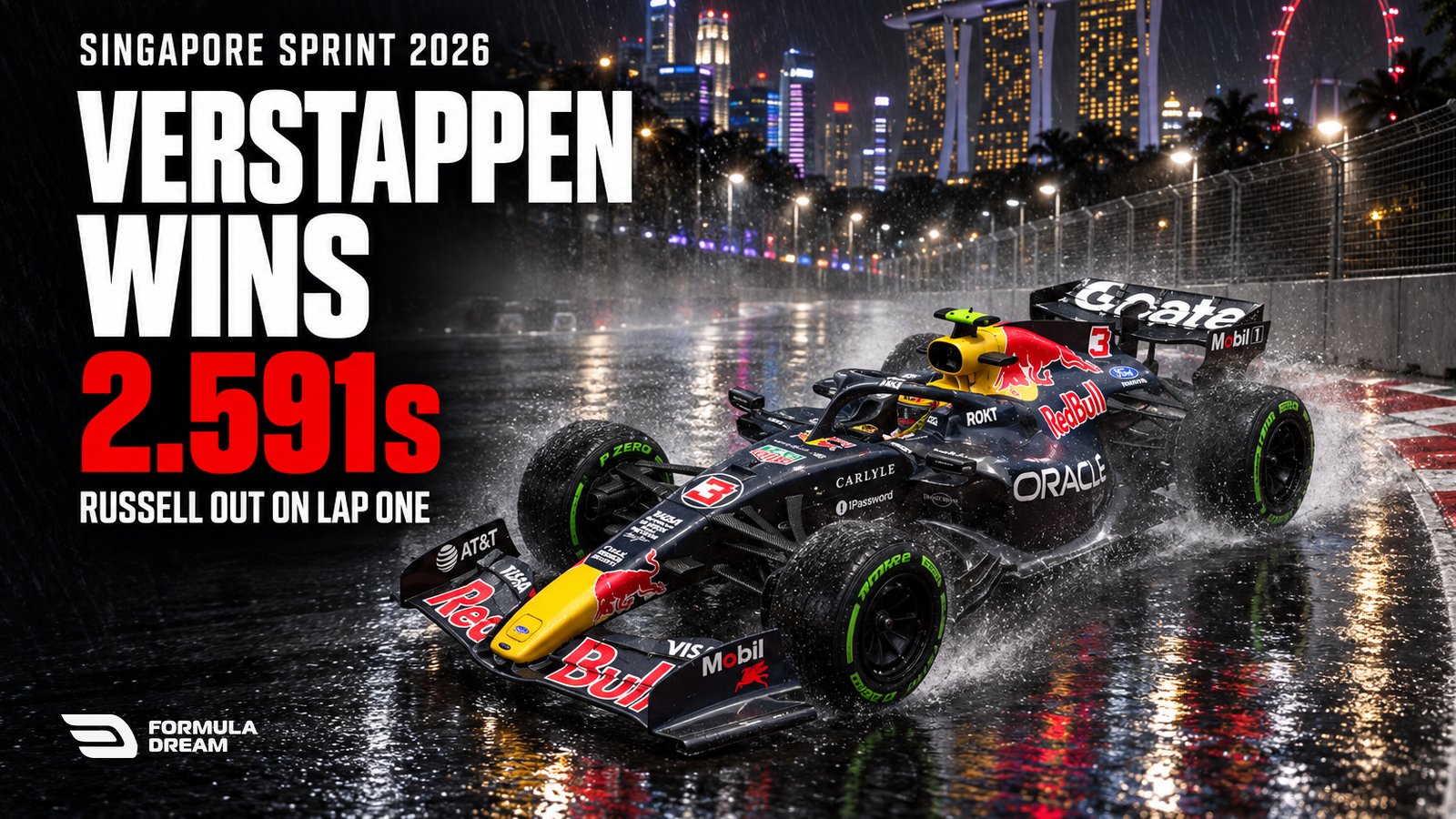
Singapore Sprint 2026 Results: Russell Crashes From the Lead
Russell took the lead at turn one and crashed at the final corner of the same lap. Verstappen won, Hamilton charged to second, and the McLarens hit each other.