How We Turned F1 Time Gaps Into Metres of Racetrack
A gap like +0.012s is impossible to picture. We converted every 2026 qualifying gap into real distance, and one second turns out to mean 66 metres at Spa and 45 at Monaco.
Time deltas are one of the least intuitive things you can put in front of a fan.
If we tell you a driver qualified +0.175s ahead, that is precise and completely unfeelable. Almost nobody has an internal sense of a tenth of a second. It just stays a number.
So we tried a different way to show it: turn the time gap into physical distance on the track, and draw it to scale.
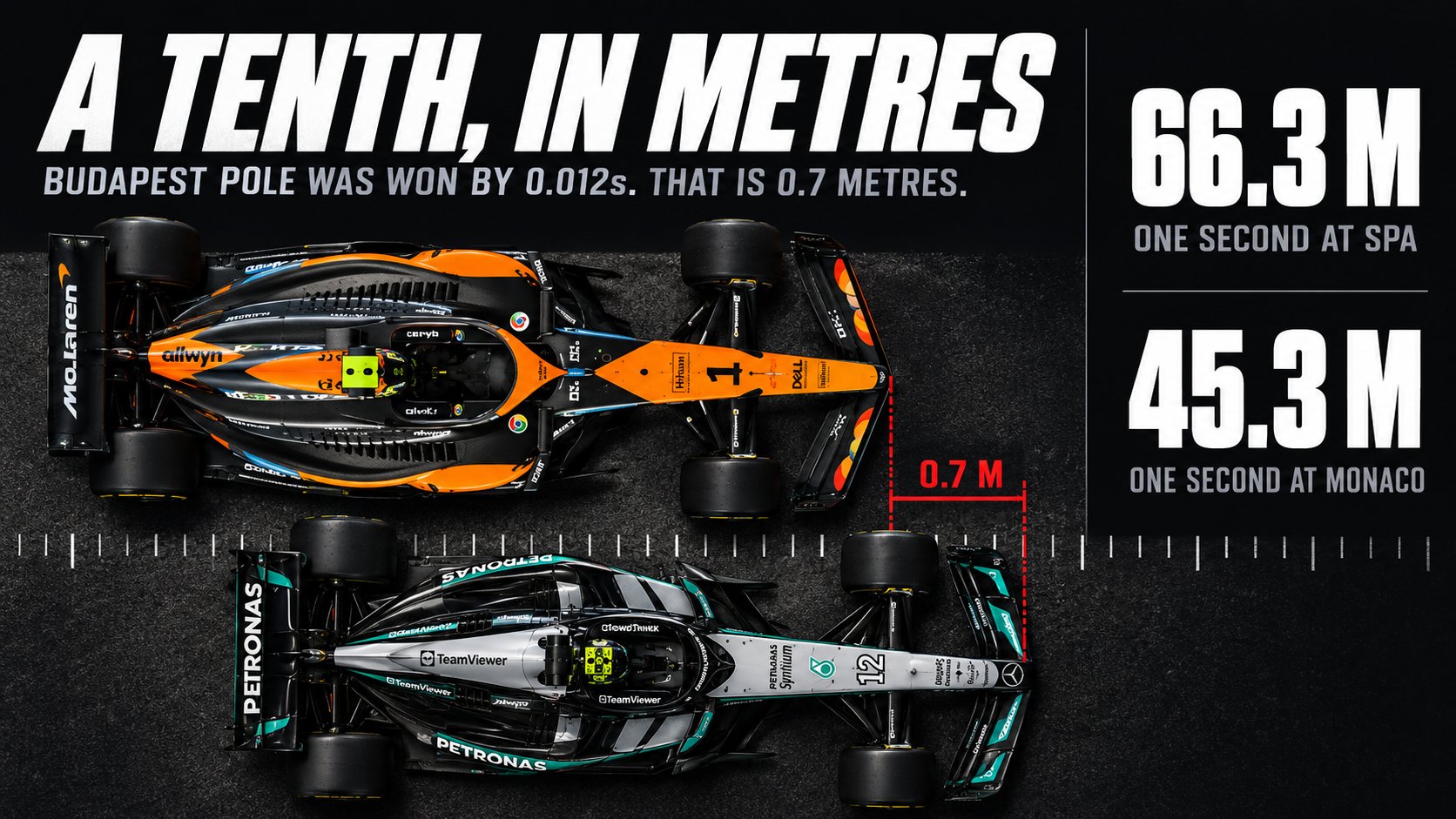
A tenth of a second, in metres
The idea is simple. A gap in time becomes a gap in space once you know the speed.
At the sort of pace an F1 car carries across the line, roughly 300 km/h, that works out to about 83 metres every second. So a tenth of a second is around 8 metres of track. A gap of +0.175s becomes about 14 metres, roughly three car lengths.
Each car sits back from the line by its own gap turned into metres, so a whole grid's spread turns into a visible length of tarmac you can pace out. The cars are nudged slightly sideways only so none hides behind the one ahead; that sideways offset carries no data, only the distance back along the straight means anything.
Every 2026 qualifying session, converted
The example above is one session. So we did the whole season.
For each round we took the fastest legal qualifying lap from every driver, excluding deleted laps, and converted the gaps into distance using that circuit's own measured average lap speed, taken from the pole lap telemetry rather than assumed.
Grand Prix
One second, in metres
Pole to 2nd
Pole to 10th
Spa
66.3 m
0.317s, 21.0 m
1.462s, 97.0 m
Melbourne
66.1 m
0.293s, 19.4 m
1.703s, 112.6 m
Silverstone
66.0 m
0.175s, 11.5 m
1.194s, 78.8 m
Spielberg
64.8 m
0.236s, 15.3 m
0.894s, 57.9 m
Miami
60.8 m
0.166s, 10.1 m
1.012s, 61.5 m
Suzuka
60.6 m
0.298s, 18.1 m
1.331s, 80.6 m
Zandvoort
59.5 m
0.102s, 6.1 m
1.022s, 60.8 m
Montreal
59.4 m
0.068s, 4.0 m
1.119s, 66.5 m
Shanghai
58.6 m
0.222s, 13.0 m
1.133s, 66.4 m
Budapest
56.1 m
0.012s, 0.7 m
1.432s, 80.3 m
Monaco
45.3 m
0.043s, 1.9 m
1.361s, 61.6 m
2026 qualifying gaps converted to distance at each circuit's measured average lap speed. Deleted laps excluded.
Two things fall out of that table that are hard to see in a timing screen.
One second is not one second
A second is worth 66.3 metres of Spa and 45.3 metres of Monaco. The same interval, the same rule, and nearly half as much track again at one circuit as at the other.
That is not a curiosity. One second is the threshold that has decided who gets an overtaking aid in Formula 1 for over a decade, and it survived the 2026 rule change: DRS is gone, but the Overtake deployment that replaced it is still gated by the same one-second condition at a detection point. So the rule is written in time and paid in distance, and the distance changes by circuit.
A driver at Monaco needs to close to within 45 metres. At Spa they can be 66 metres back and still qualify for help. We measured what that regime change did to actual passing in what happened to overtaking without DRS, where the answer turned out to be a fall of only 3.9%.
Pole was decided by less than a car length
The 2026 Hungarian Grand Prix pole margin was 0.012 seconds. Converted, that is 0.7 metres.
An F1 car is a little over five metres long. So pole in Hungary was decided by roughly one seventh of a car. On the timing screen it is twelve thousandths, which reads as a rounding error. Drawn as distance, it is a gap you could step over.
It was not the only one. Montreal was settled by 4.0 metres and Monaco by 1.9. Three of eleven poles this season were decided by less than the length of the car that won them.
At the other end, pole to tenth is a genuinely large distance almost everywhere: 112.6 metres at Melbourne, 97.0 at Spa. The top ten in Formula 1 qualifying are covered by about the length of a football pitch, and the fight for pole inside it is decided by a wheel.
Where the model is honest, and where it simplifies
This is worth being upfront about, because a naive version would mislead.
Speed is not constant. A car is doing over 320 km/h on a straight and under 100 km/h in a slow corner, so the same gap covers a different distance depending on where on the lap it opens up.
There are two defensible ways to convert, and they answer different questions.
Using speed across the line, around 300 km/h, tells you how far apart two cars physically are at the moment they cross it. That is the right number for picturing two cars on track, and it is what the visualiser above uses.
Using the circuit's average lap speed tells you how much of a lap's worth of track the gap represents. That is the right number for comparing circuits, and it is what the table above uses. It is also the smaller number, which is why the Silverstone gap of +0.175s reads as 11.5 metres there and about 14 at the line.
Neither is wrong. They are different questions, and quoting one while implying the other is the mistake to avoid.
A few hundredths in the midfield, the difference between Q2 and going home, is often less than a single car length.
One session is missing from the table, and the reason is worth stating rather than hiding: the Australian Grand Prix produced a last-place gap of 23.507 seconds, which is not a qualifying gap but a driver who never set a representative lap. We have kept its pole to second and pole to tenth figures, which are sound, and dropped the full-grid spread.
Why it works
The point is not the arithmetic. It is the swap of unit.
People are bad at abstract quantities and good at physical ones: distance, size, how long it takes to walk somewhere. Translate an abstract unit into a physical one and the reader's body does the understanding for you.
Time to distance is just one instance of that. You could do the same with a currency figure or a network speed. Find the physical analogue and the number stops being a number.
Turning a gap into metres makes it feel real. Watching that number change lap by lap is what makes a race readable.
The Formula Dream app runs a live Dashboard through every session: every car moving on the circuit map, and a timing tower with lap times, gaps and intervals, tyre compound and age, pit counts and positions, plus flag and safety car alerts the moment race control calls them. You also get live driver radio as it is broadcast, and every FIA document of the weekend collected as it is published, which is where the stewards' decisions that change results actually appear.
Free, no subscription, no ads, independent. Not affiliated with Formula 1.
About 8 metres at the speed a car crosses the line, roughly 300 km/h. Measured against a circuit's average lap speed it is smaller: around 6.6 metres at Spa and 4.5 at Monaco.
How far apart is one second in Formula 1?
It depends on the circuit. We measured it at 66.3 metres at Spa, 66.0 at Silverstone and just 45.3 at Monaco, using each circuit's own average lap speed from the 2026 pole lap.
What was the closest F1 qualifying of 2026?
Budapest. Pole was taken by 0.012 seconds, which converts to about 0.7 metres, roughly one seventh of a car length. Montreal was settled by 0.068s and Monaco by 0.043s.
Why does one second matter in F1?
Because it is the threshold for an overtaking aid. Under DRS a driver had to be within one second at a detection point, and after DRS was removed for 2026 the Overtake deployment that replaced it kept the same one-second condition.
How do you convert an F1 time gap into distance?
Multiply the gap in seconds by the car's speed in metres per second. The choice of speed is what matters: speed across the line tells you how far apart two cars are at that moment, while average lap speed tells you what share of a lap the gap represents.
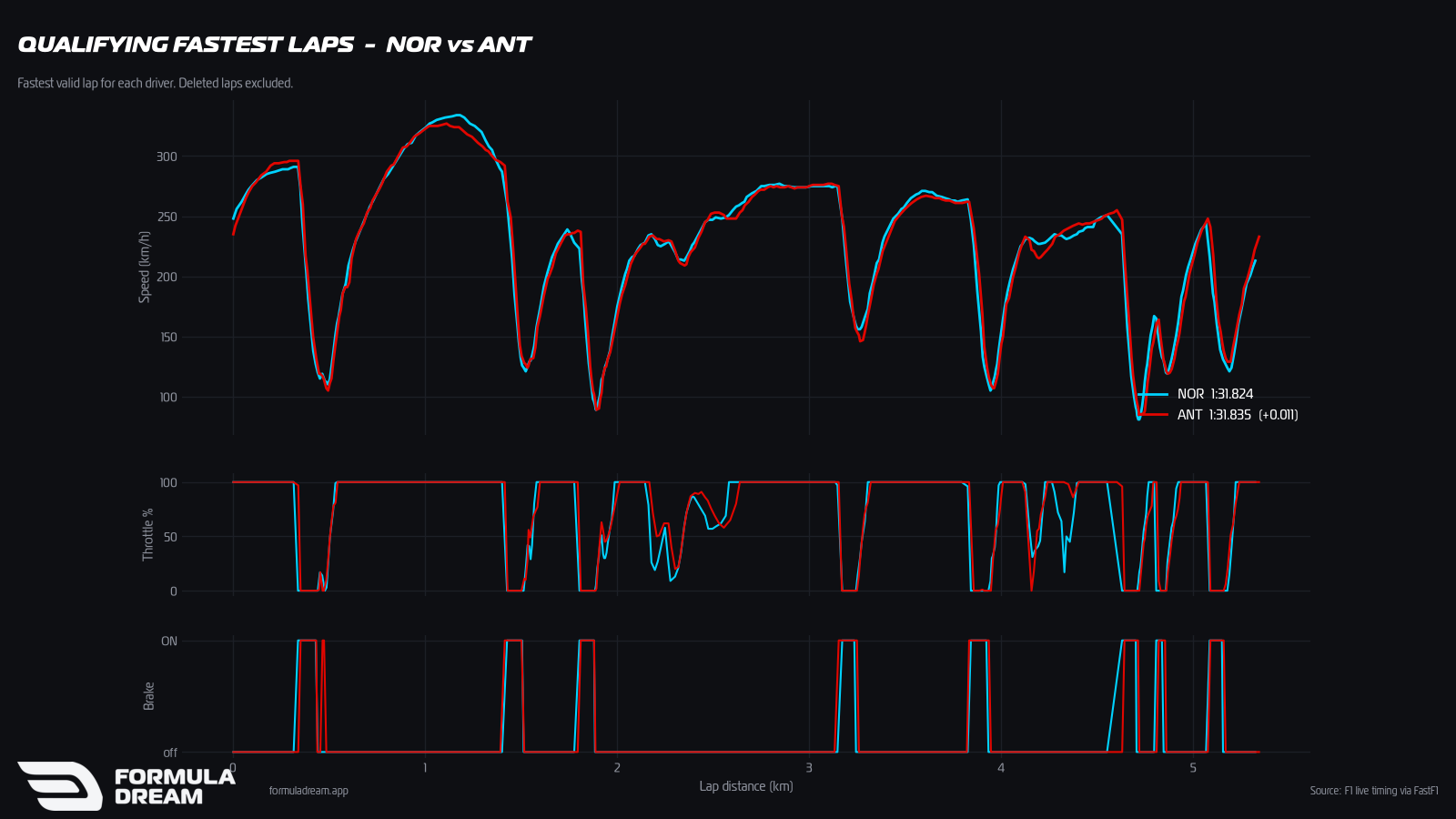
Spanish GP Qualifying: Norris Takes the First Madring Pole by 0.011s
Norris beat Antonelli to the first Madring pole by 11 thousandths. We predicted the pole time from Friday practice and missed by 0.014 seconds. Full results, grid penalty and the radio.