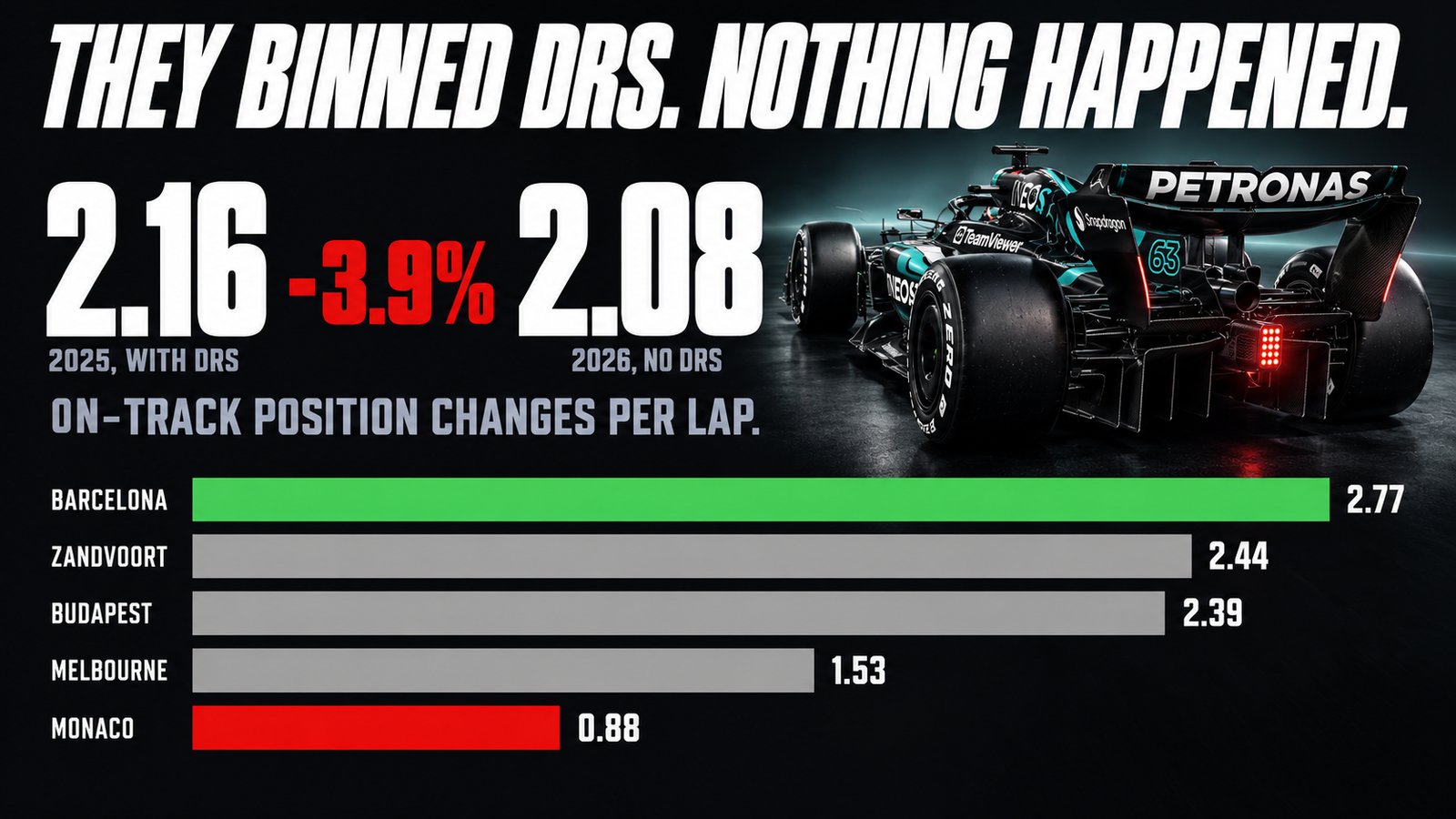
Formula 1 got rid of DRS for 2026. The widespread prediction was that overtaking would collapse. We counted the position changes at every race this season and compared them with the same circuits last year. Overtaking fell by 3.9%.
Not a collapse. Barely a change at all.
How we counted, and what the number is not
This needs stating plainly before the results, because "overtakes" is a slippery statistic that different sources count differently.
For every pair of consecutive race laps we counted how many drivers improved position. We excluded any driver who entered or left the pit lane on either lap, so pit cycles do not register as passes. We excluded the opening lap, because the start is not overtaking.
What that measures is on-track position changes. It includes a car recovering after an incident and a car passing a rival who is on a different strategy or nursing a problem. It is not a hand-verified count of wheel-to-wheel passes, and it will read slightly higher than one.
What matters is that the identical method is applied to every race in both seasons, so the comparison between them is sound even though the absolute number is a proxy. Where we could not compare fairly, we say so and drop the race.
Every 2026 race, ranked
Circuit
Position changes per lap
On-track passes
Race laps
Barcelona
2.77
24
66
Monza
2.45
60
53
Zandvoort
2.44
39
72
Spa
2.39
30
44
Budapest
2.39
32
70
Shanghai
2.34
38
56
Miami
2.16
34
57
Silverstone
2.10
25
52
Spielberg
2.04
28
71
Suzuka
1.91
41
53
Montreal
1.75
28
68
Melbourne
1.53
37
58
Madrid
1.40
9
57
Monaco
0.88
3
78
Every 2026 Grand Prix to date, measured from official timing. Position changes count every place gained on track; on-track passes count matched pairs of cars, which is the stricter measure. Pit cycles, safety car laps and the opening lap are excluded from both.
The season mean is 2.04 position changes per racing lap, across all fourteen races run so far. The average race produced 31 matched on-track passes.
Barcelona tops the list, which is not where most people would put it. The Circuit de Barcelona-Catalunya has spent two decades as the standard example of a track where nobody can follow anybody, largely because it was the venue for winter testing and everyone had seen enough of it. This season it produced more position changes per lap than any other circuit.
Monaco is last at 0.88, less than a third of Barcelona, on the longest race of the year by lap count. That is the expected result and it is the only one on the list that matches its reputation exactly.
Madrid is the outlier of the season. The first Grand Prix at the Madring produced nine on-track passes in 57 laps, and four of those were on cars with a problem or a driver who had run off the track. Every one is broken down in Madrid had 9 overtakes. We checked every one. We also applied this count to the ten circuits chosen for 2027's sprint weekends in F1's 2027 calendar has 10 sprints.
The DRS comparison
Nine of these circuits were also raced in 2025, in dry conditions in both years. Three had to be dropped: Silverstone, Melbourne and Spa all had a wet race in 2025, and rain changes overtaking far more than any regulation does.
Circuit
2026, no DRS
2025, with DRS
Change
Barcelona
2.77
2.89
-0.12
Zandvoort
2.44
1.96
+0.48
Budapest
2.39
2.41
-0.02
Shanghai
2.34
2.73
-0.39
Miami
2.16
1.30
+0.86
Spielberg
2.04
2.20
-0.16
Suzuka
1.91
2.17
-0.26
Montreal
1.75
2.63
-0.88
Monaco
0.88
1.15
-0.27
Like-for-like comparison, dry races only, same nine circuits in both seasons.
2026 average: 2.08 per lap. 2025 average: 2.16 per lap. A fall of 3.9%.
Two circuits went up and seven went down, so the direction is clear: most circuits lost a little overtaking without DRS. What is small is the size of it. Five of the seven falls were under 0.3 position changes per lap, and the average fell only 3.9%. Whatever replaced DRS is doing most of the same job, and the difference between circuits, from 0.88 per lap at Monaco to 2.77 in Barcelona, is far bigger than the difference between the two rule sets.
Why the collapse did not happen
DRS was not removed and replaced with nothing.
The 2026 cars run active aerodynamics, with front and rear wings that move between a high-downforce mode for corners and a low-drag mode for straights, plus a driver-deployed burst of electrical energy the FIA calls Overtake. We confirmed both from the car data, where the old DRS channel now reads zero all race.
The functional difference is subtler than "DRS is gone" suggests, and it cuts the other way from what you might expect.
The one second trigger survived. Overtake is still gated by the same condition at the same kind of detection point, so the rule about who qualifies for help did not change. What changed is the drag reduction. Under DRS, opening the rear wing was the chasing car's exclusive advantage. Under active aerodynamics, every car switches between a low-drag straight-line mode and a high-downforce cornering mode, everywhere, all the time.
So the chasing car lost the one thing it used to have that the car ahead did not. On its own that should have made passing harder, not easier. The full breakdown is in what is DRS in F1, which is now a history of the system rather than a description of a current one.
That it cost only 3.9% is the interesting part. Something offset it, and the most likely candidate is the second change below.
The circuit-level pattern supports that reading. Montreal, which had two of the most productive DRS zones on the calendar and therefore the most to lose, fell the furthest at -0.88 per lap. Zandvoort and Miami, where DRS was never decisive, both went up.
The bigger change was not DRS
There is a second thing going on this season, and it is worth naming because it complicates the reading.
The 2026 cars carry roughly 30% less downforce than the 2025 generation, which we measured in are F1 cars getting faster. Less downforce means less wake, which should make following easier, and it also means less grip, which makes cars harder to place precisely.
So the 3.9% figure is not a clean measurement of DRS alone. It is the net effect of losing DRS, gaining active aero and Overtake, and losing a third of the downforce, all at once. Nobody can separate those with public data, and we are not going to pretend otherwise.
What can be said is the thing people actually wanted to know: the racing did not get worse in any way this measurement can detect.
Which circuits actually produce racing
Strip the regulation question out and the table above is still useful, because it settles some arguments.
The three best circuits of 2026 for position changes are Barcelona, Zandvoort and Budapest. Zandvoort and Budapest both have reputations as processional, narrow tracks where the race is decided in qualifying. On this measure they are near the top.
Meanwhile Melbourne at 1.53 and Montreal at 1.75 sit low, and both are circuits usually described as good for racing.
The pattern that does hold is the extreme: Monaco really is different, and no amount of regulation change has moved it. At 0.88 per lap it produced 69 position changes across 78 laps, against Barcelona's 183 across 66. We measured why in the fastest street circuit in F1: Monaco's fastest lap is at full throttle for just 37% of its duration, against 68% at Spa, and a lap with no straights has nowhere to complete a pass.
What this does not tell you
Three honest limits.
One season is not a trend. Twelve races with a brand new set of regulations, at circuits where teams are still learning the cars. Ask again at the end of the year.
Safety cars distort individual races. A safety car bunches the field and then freezes it, and both effects land in this measure. Silverstone had two, Monaco had two.
Position changes are not quality. This measurement cannot tell you whether a pass was a fair fight into a braking zone or a car cruising past a rival with a puncture. It counts events, not entertainment.
Watch the passes as they happen
The interesting part of a race is the two seconds before a pass, not the replay afterwards.
The Formula Dream app runs a live Dashboard through every session: every car on the circuit map, and a timing tower with lap times, gaps and intervals, tyre compound and age, plus flag and safety car alerts as race control calls them. The column that predicts an overtake is the interval, because you can watch a gap close over three laps before anything happens on the broadcast. You also get live driver radio as it is broadcast, which is where a driver tells the pit wall they are ready to go, and every FIA document of the weekend as it is published.
Free, no subscription, no ads, independent. Not affiliated with Formula 1.
No. DRS was removed for the 2026 regulations and replaced by active aerodynamics, where the bodywork switches between low-drag and high-downforce configurations, plus a driver-triggered deployment the FIA calls Overtake.
Has overtaking got worse without DRS?
Barely. Across nine circuits raced dry in both 2025 and 2026, on-track position changes fell from 2.16 per lap to 2.08, a drop of 3.9%. Two of the nine, Zandvoort and Miami, produced more overtaking in 2026 than in 2025, and seven produced less.
Which F1 circuit has the most overtaking?
Of the 2026 races measured, Barcelona, at 2.77 on-track position changes per racing lap. Zandvoort and Budapest follow at 2.44 and 2.39.
Which F1 circuit has the least overtaking?
Monaco, at 0.88 position changes per lap, less than a third of Barcelona's rate and the lowest of any race we measured in either season.
How was this measured?
From Formula 1's own timing data. For each pair of consecutive laps we counted drivers who improved position, excluding anyone who entered or left the pits on either lap, and excluding the opening lap. It is a proxy for overtaking rather than a hand-verified pass count, applied identically to every race so the seasons can be compared.
Why were some races excluded from the comparison?
Because they were wet in one of the two years. Silverstone, Melbourne and Spa all had significant wet running in 2025, and rain affects overtaking far more than any rule change, so comparing a wet race with a dry one would have produced a meaningless number.
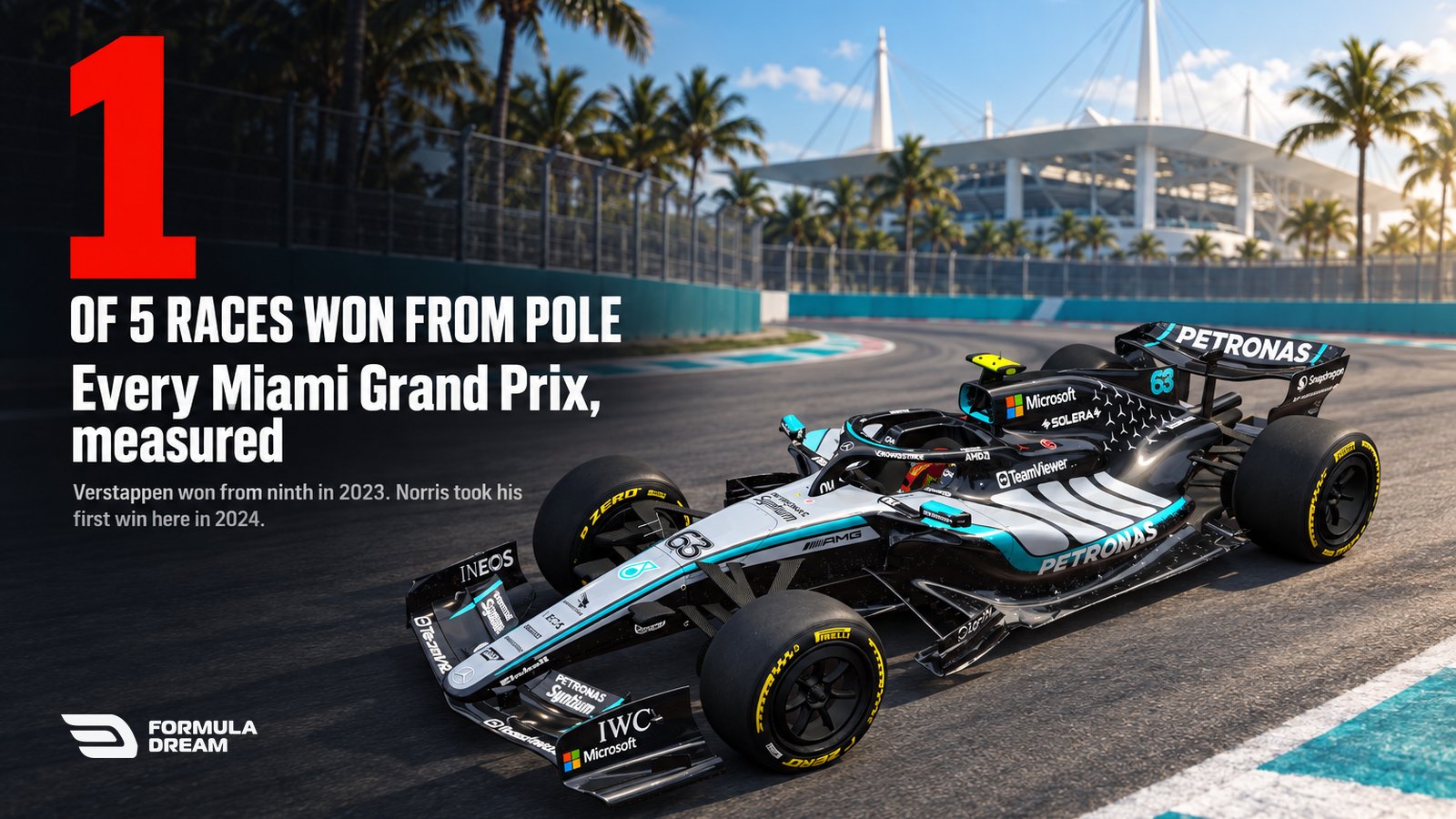
Every Miami Grand Prix winner, measured: five races, and pole has won only one of them
Five Miami Grands Prix have been held since 2022, and only one was won from pole: Kimi Antonelli's in 2026. Max Verstappen won from ninth in 2023, and Lando Norris took his first win there in 2024. Every winner, grid slot and safety car, measured.