Hungarian GP Hungaroring Track Analysis 2026 | FormulaDream
Race Analysis
Hungarian Grand Prix: Nine Braking Zones and One Place to Pass
The Hungaroring packs 14 corners into 4.4 kilometres and gives a driver one real overtaking opportunity. Here is the whole lap from real telemetry, and why Leclerc's pole did not win the race.
Spa asks a driver to hold their nerve. The Hungaroring asks them to never stop working. Fourteen corners are packed into 4.4 kilometres, and across that lap a driver touches the brake pedal nine times. There is almost nowhere to rest, and, more importantly, almost nowhere to pass.
Every figure below comes from real session telemetry. The layout is unchanged for 2026, so the numbers hold.
Split the lap into the places a driver is actually on the brakes and you get nine marks. On a circuit two thirds the length of Spa, that is half again as many braking events.
Nine braking zones in 4.4 kilometres.
The heaviest by a distance is Turn 1, where the car goes from 313 km/h to 95 km/h in 110 metres. That is the biggest speed drop on the lap and, not coincidentally, the only genuine overtaking opportunity.
One straight that matters
Full throttle is not rare here, but long full throttle is. The lap's longest unbroken run is the main straight into Turn 1: 735 metres, 9.6 seconds, topping out at 315 km/h.
The main straight is the only long run on the lap.
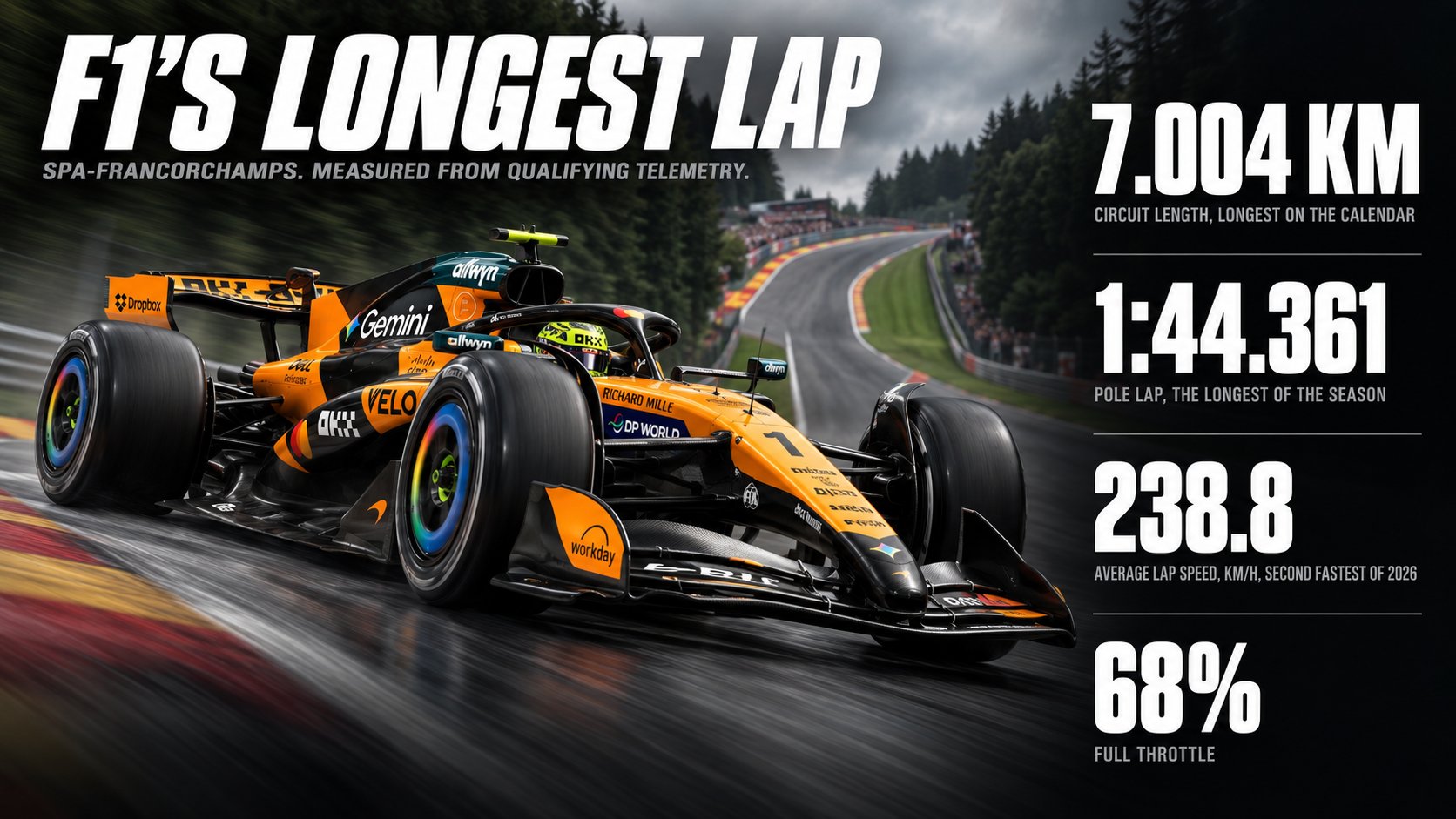
Compare that to Spa, where the run from La Source to Les Combes lasts 1,818 metres and 21.8 seconds. The Hungaroring gives you barely half the distance, once.
For 2026 there is no DRS anywhere in Formula 1. In its place the FIA has designated four Straight Mode zones at the Hungaroring, where cars flatten their wings for less drag: the main straight, plus the runs between Turns 1 and 2, Turns 3 and 4, and Turns 11 and 12. The overtake boost, which arms when a driver is within a second at a detection point, is detected on the exit of Turn 13 and activates at Turn 14 onto the main straight.
Full throttle 63 percent of the time
Here is the number that surprises people: despite the reputation, drivers are at full throttle for 63 percent of a Hungaroring lap.
Busy, but rarely fast: only 5 percent of the lap sits above 300 km/h.
The catch is where that throttle goes. Only 5 percent of the lap is spent above 300 km/h. At Spa that figure is 35 percent. The Hungaroring keeps the pedal down but never lets the car breathe, which is why teams arrive with maximum downforce and the lowest top speeds of the European season.
Turn 1: the whole race in one corner
313 down to 95 km/h. The heaviest braking zone, and the only real passing place.
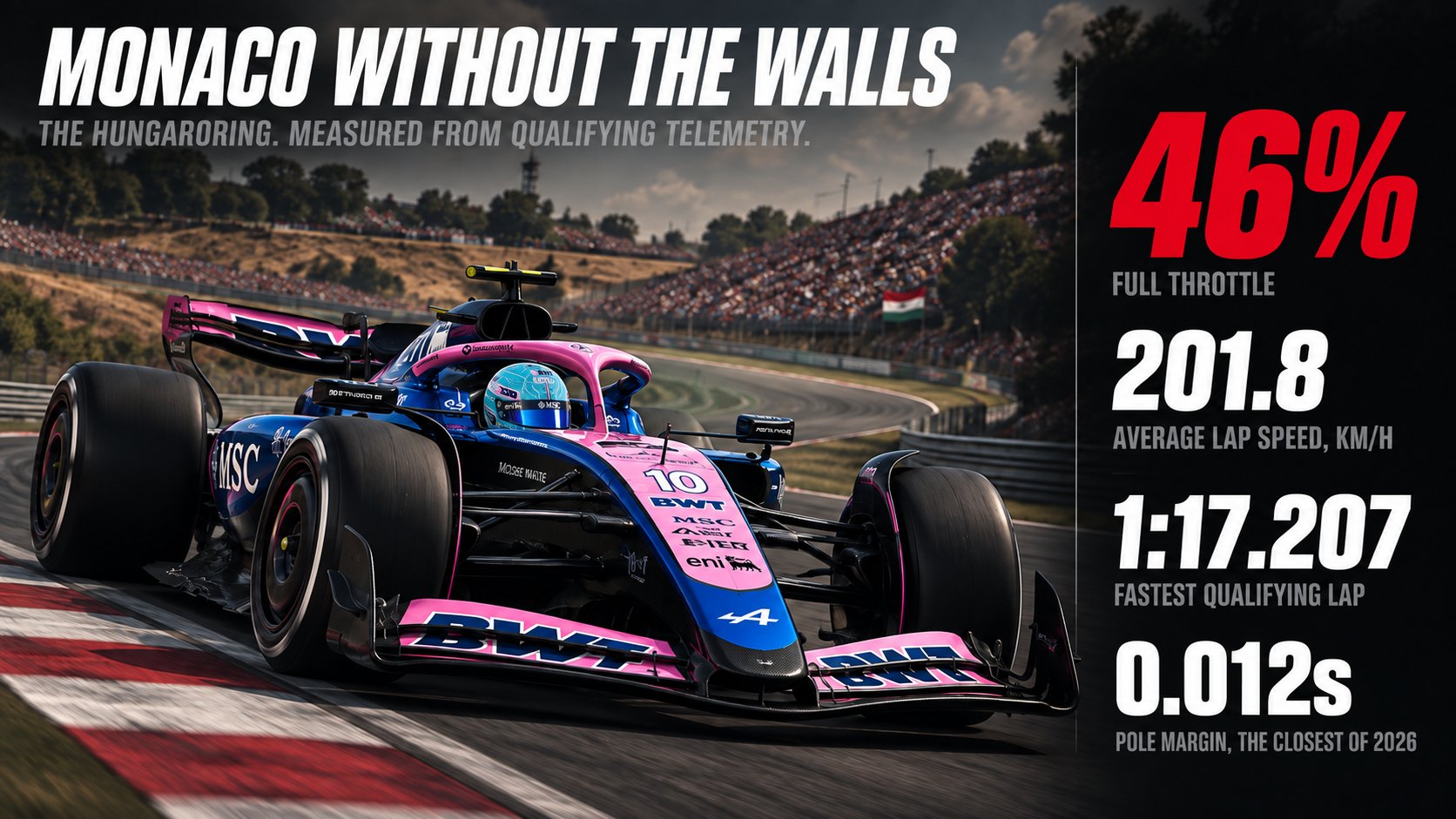
Everything about the Hungaroring funnels into Turn 1. It is the slowest corner on the lap at 95 km/h, the heaviest braking zone, and the end of the only straight long enough to launch a move. Get it wrong and there is no second chance for another 4.4 kilometres.
The fastest corner, for contrast, is Turn 4 at 256 km/h, a flowing left commonly called Mansell after Nigel Mansell lost a wheel there in 1987.
Where the lap was won
Colour the racing line by whoever was quickest through each minisector in qualifying and one car owns it. Charles Leclerc was fastest across 60 percent of the lap.
Leclerc was fastest over most of the lap, and this time he converted it to pole.
Unlike Spa, where Leclerc owned the lap and lost pole anyway, here he converted. His 1:15.372 beat Oscar Piastri by twenty-six thousandths of a second, with Lando Norris a further fifteen thousandths back. Three cars covered by four hundredths.
Nobody brakes differently here
If Leclerc owned two thirds of the lap, why could nobody do anything about it on Sunday? Look at where the three fastest cars actually hit the brakes.
The biggest brake-point spread on the entire lap is 21 metres.
Across all nine braking zones, the largest gap between the earliest and the latest braker is 21 metres, at Turn 14. For comparison, the equivalent figure at Spa is 44 metres, and Spa has a corner, Pouhon, that one driver brakes for and the other two take flat.
The Hungaroring has no such corner. All three brake in every zone, and they do it in almost exactly the same place. Individual laps vary slightly in how often a driver touches the pedal, between eight and ten times around a lap with nine genuine braking zones, but the braking points themselves are near-identical.
That is the circuit's problem in a single figure. When nobody can out-brake anybody, and there is only one straight long enough to attempt a move, the race stops being about pace.
And why pole did not win it
One stop, mediums to hards, and the race changed hands in the pit lane.
Norris started third, dropped to fifth on lap 1, and won anyway. McLaren committed to a one-stop, ran the medium long, and switched to hards on lap 32. Leclerc and Piastri two-stopped. On a circuit where a pit stop costs about 21 seconds and passing is close to impossible, track position gained in the pit lane is track position kept.
Piastri closed to within DRS range in the final laps and still could not find a way through. That is the Hungaroring in one sentence.
The 2026 preview
The nine braking zones, the single straight, the traction demands out of the slow corners: all of it carries into 2026 unchanged. What changes is the aero. No DRS, four Straight Mode zones, and an overtake boost armed at Turn 13. On a circuit where overtaking was already the hardest problem on the calendar, four zones instead of two DRS zones is a bigger change than it sounds.
The the Hungaroring circuit hub pulls together everything we hold for this venue in one place: every qualifying gap drawn as real distance, the track domination maps where we have them, and the team radio from previous races here.
What the drivers said here
The radio is the part of a weekend that does not make the highlights. We hold every message Formula 1 broadcast from the Hungaroring in 2026, 82 of them across the whole weekend, transcribed with the original audio and the driver and engineer colour coded, on the the Hungaroring 2026 team radio page.
It is worth a scroll before a race here, because the complaints repeat. Drivers tend to raise the same two or three things about a circuit every year, and reading last season back is the quickest way to know what to listen for in this one.
The Hungaroring is the slowest permanent circuit of the 2026 season by average lap speed, and the only one under 210 km/h apart from Monaco. The measured ranking is in the fastest F1 circuits of 2026.
Follow the weekend live
Telemetry explains the Hungaroring after the fact. Watching the gaps refuse to close is a different thing entirely.
The Formula Dream app runs a live Dashboard through every session: every car moving on the circuit map, and a timing tower with lap times, gaps and intervals, tyre compound and age, pit counts and positions gained or lost. It is the same information these measurements come from, arriving live. You also get live driver radio as it is broadcast, and every FIA document of the weekend as it is published.
Free, no subscription, no ads, independent. Not affiliated with Formula 1.
When Can Antonelli Win the 2026 Title? Every Round, Every Rival
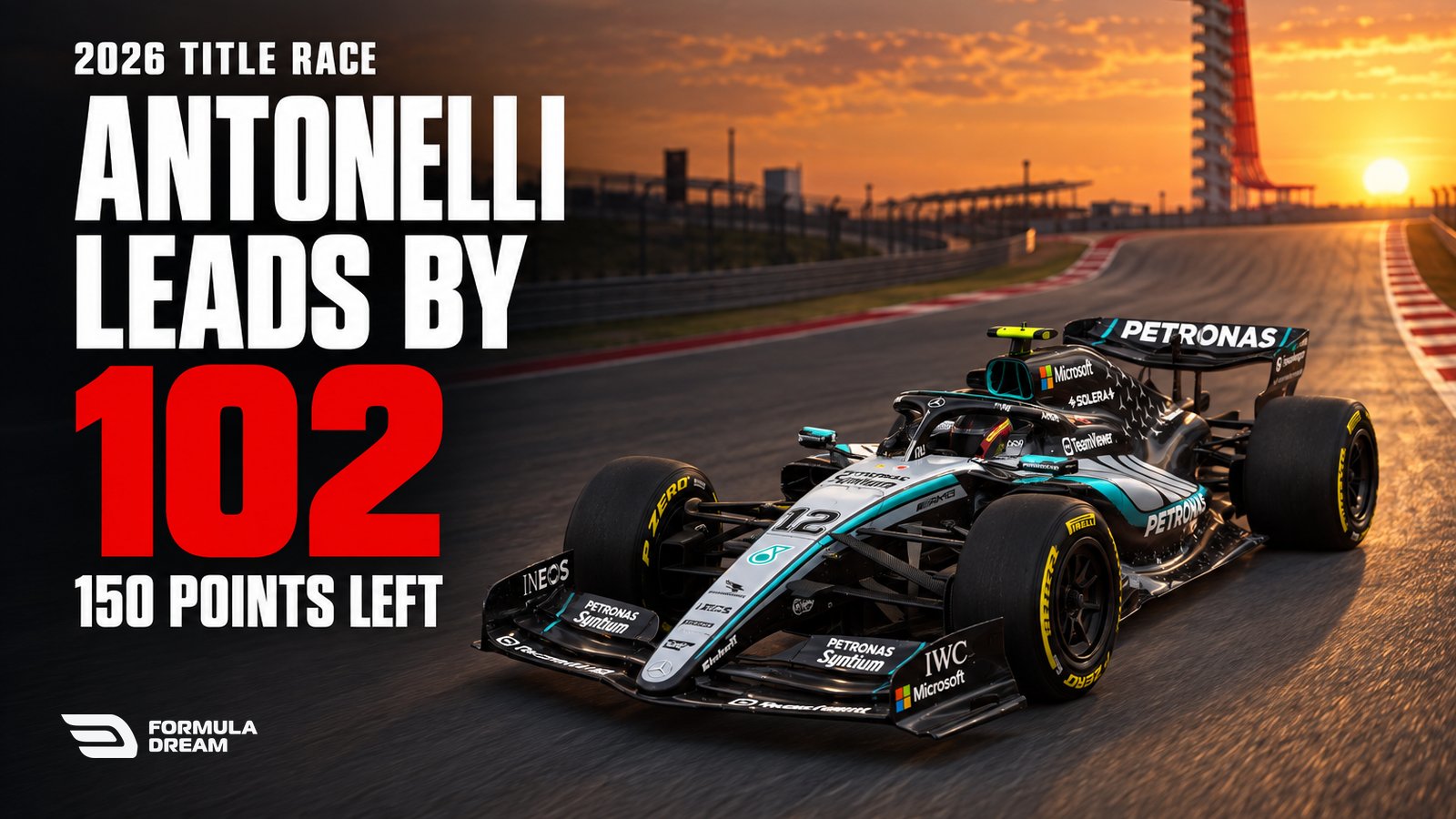
Antonelli leads by 102 points with 150 left. Here is how many points he can lose to Russell, Hamilton, Verstappen, Leclerc and Norris at each round and still clinch.