Fastest F1 Track: Every Circuit Ranked | Formula Dream
Guides
The Fastest F1 Circuits, Ranked by Average Lap Speed
Every 2026 F1 circuit ranked by measured average lap speed, the fastest lap in Formula 1 history, and why the track with the highest top speed is not the fastest track.
Monza is the fastest circuit in Formula 1. Its 2026 pole lap averaged 253.6 km/h across the whole lap, corners included, the quickest of any circuit this season. On the previous generation of car it was faster still: Max Verstappen's 2025 pole at Monza averaged 264.682 km/h, the fastest lap in Formula 1 history.
But "fastest" hides a trap that catches almost everyone. A circuit can have the highest top speed on the calendar and still not be the fastest track, because top speed is one number at one point and average lap speed is the whole lap. Las Vegas is the clearest example: enormous top speed, and it still is not in the top three.
Here is the ranking, both ways.
We measured the 2026 season. The record books no longer describe it.
Almost every ranking of "fastest circuit" quotes historical averages set by earlier generations of car. The 2026 regulations changed that, and not by a rounding error: these cars carry roughly 30% less downforce and are measurably slower.
So we measured this season directly, taking the fastest legal qualifying lap at every round raced so far, dividing the real telemetry distance by the real lap time.
Circuit
Average lap speed
Fastest lap
Full throttle, by distance
Monza
253.6 km/h
1:21.786
81%
Spa-Francorchamps
238.8 km/h
1:44.361
80%
Melbourne
238.1 km/h
1:18.518
73%
Silverstone
237.5 km/h
1:28.111
77%
Spielberg
233.1 km/h
1:06.113
69%
Barcelona
222.6 km/h
1:14.679
68%
Miami
218.8 km/h
1:27.798
68%
Suzuka
218.1 km/h
1:28.778
72%
Zandvoort
214.1 km/h
1:11.163
63%
Montreal
213.8 km/h
1:12.578
73%
Shanghai
211.1 km/h
1:32.064
70%
Budapest
201.8 km/h
1:17.207
54%
Monaco
163.0 km/h
1:12.051
51%
Average lap speed at each 2026 round raced so far, measured from qualifying telemetry. Full throttle is the share of the lap DISTANCE held at full throttle, not the share of lap time.
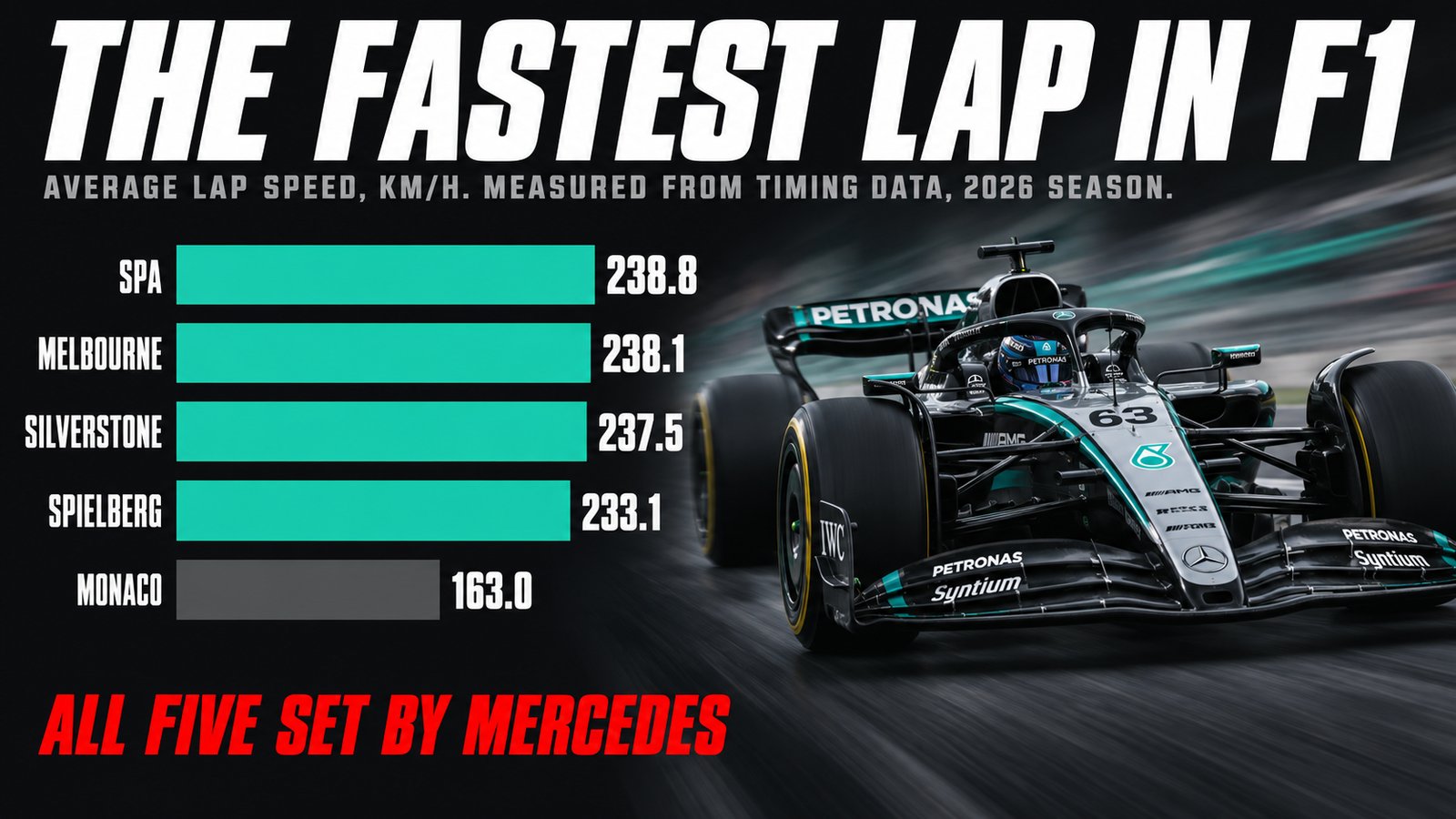
Monza is the fastest circuit of the 2026 season at 253.6 km/h, with Spa next at 238.8, with Melbourne and Silverstone within 1.3 km/h of it. Monaco sits 90.6 km/h adrift of the top, which is a larger gap than exists between any other two circuits on the calendar.
We have measured several of these circuits corner by corner, and a few that this season has not reached yet: Spa, the longest lap on the calendar; the Hungaroring, the slowest of the thirteen above; Monza, the fastest; and, still to come this year, the Circuit of the Americas, Mexico City and Yas Marina.
Monza has now been added, and it goes straight to the top. Qualifying on 5 September produced a pole of 1:21.786 from Pierre Gasly, which works out at 253.6 km/h on the racing line: 14.8 km/h clear of Spa and the fastest lap of the 2026 season by a distance. Gasly's pole lap has a 4.7 second gap in its car telemetry, which inflates the distance measured from it, so its average speed uses the racing line distance from George Russell's clean lap in the same session, 5.762 km. Measured straight from Gasly's own telemetry it would have read 257.2 km/h, a figure this page briefly carried. The session is in the Italian GP qualifying results.
Two things about Monza are worth pulling out. Russell's clean lap was run at 81% full throttle, the highest share of any 2026 circuit, and it needed only six braking events in 5.8 km.
It also fits the pattern of the season. The 2026 cars have been running 2.93% slower than the 2025 generation at circuits raced in both years, and at Monza the drop from 2024's 260.2 km/h is 2.5%, a little less than average. We had first measured it as only 1.15%, but that came from the gap in the pole lap's telemetry, not from the cars.
The other number worth reading is the full-throttle column, because it explains the ranking better than the speeds do. Monza holds the throttle open for 81% of the lap and Spa for 80%. Monaco manages 51%. A fast circuit is not one with a high top speed, it is one where the driver is able to stay on the throttle.
One note on that column, because it is easy to get wrong and we corrected it here. Telemetry is sampled at a fixed rate in time, so slow corners produce more readings per metre than straights do. Counting samples therefore understates how much of a lap is spent at full throttle, by between 5 and 14 points depending on the circuit. These figures are the share of lap distance at full throttle, which is what the phrase should mean.
The circuits 2026 has not reached yet
Six rounds of the season are still to come, so six circuits are missing from the table above. The temptation is to fill the gaps with laps from earlier years, and that is exactly how speed rankings go wrong: a 2024 car and a 2026 car are not the same machine, and the 2026 regulations cost roughly 3% of lap time.
The honest way to place those circuits is to compare them with each other on the same generation of car. Measured on dry 2024 qualifying laps:
Monza 260.2 km/h
Jeddah 251.0
Melbourne 247.4
Silverstone 244.1
Las Vegas 239.4
Read that against the 2026 column and the ordering holds even though the absolute numbers do not. Melbourne and Silverstone sit near the top in both. Las Vegas, the one genuinely new entry, lands fifth, which is fast but short of its reputation: it has the peak speed of Monza at 347 km/h and the highest full-throttle share of any street circuit at 81.3%, on the coldest track surface of the season. We broke it down in the Las Vegas circuit guide.
A warning that applies to anyone repeating this exercise. Both Spa and Las Vegas had a fully wet qualifying session in one of the years we looked at, and using those laps would have put Spa at 221.2 km/h and Las Vegas at 204.9, wrongly, in both cases near the bottom. Check the tyre compounds before comparing two seasons.
The fastest lap in Formula 1 history
The all-time record for average lap speed belongs to Monza and to 2025. Max Verstappen took pole for the 2025 Italian Grand Prix with a 1:18.792, an average of 264.682 km/h. It beat Lewis Hamilton's 2020 Monza pole of 1:18.887, which averaged 264.362 km/h.
That record will not fall in 2026. This season's cars are around 3% slower, and Monza's 2026 pole averaged 253.6 km/h. Record-book tables that list circuits by their fastest-ever laps therefore mix generations of car, which is why every ranking on this page is measured within a single season.
Monza: the Temple of Speed
There is a clear number one, and it is not close. Monza, home of the Italian Grand Prix, has been the fastest track in F1 for decades, earning it the nickname the "Temple of Speed". It is a low-downforce blast of long straights linked by a handful of chicanes and fast corners, and in 2025 Max Verstappen took pole with an average lap speed of 264.682 km/h (164.5 mph), the fastest lap in the sport's history. On its straights the cars top 350 km/h.
Because Monza is so dependent on straight-line speed, teams run their skinniest, lowest-drag wings of the year, and the slipstream becomes king, which is why it has produced some of the closest, most frantic racing in F1 history.
Jeddah: Monza pace between the walls
The Jeddah Corniche Circuit in Saudi Arabia is the proof that a street circuit does not have to be slow. It has 27 corners, and yet Verstappen's 2025 pole lap there averaged 251.6 km/h with 82.4% of the lap distance at full throttle, because almost every one of those corners is a flat-out or near-flat kink.
It is not on the 2026 calendar. The Saudi Arabian Grand Prix, scheduled for April, was cancelled along with the Bahrain Grand Prix.
We ranked every street circuit on the same generation of car, Jeddah, Las Vegas, Melbourne, Baku, Singapore and Monaco included, in the fastest street circuit in F1, measured.
Spa and Silverstone: fast where it is hardest
Two of the sport's most beloved circuits are also among its fastest, but for a different reason: their fast corners.
Spa-Francorchamps in Belgium is long, sweeping and set across dramatic elevation, home to the Eau Rouge-Raidillon complex. Silverstone, the birthplace of F1, has Copse and the Maggotts-Becketts-Chapel sequence, threaded at close to 300 km/h and pulling over 5g of lateral force.
These are not fast in a straight line. They are fast where it is hardest, in the corners, which is why they out-average circuits with far bigger top speeds.
The track with the highest top speed is not Monza
Here is where the two measures come apart properly, and it is something we found in our own data rather than a spec sheet.
We measured every speed trap across a full season. The highest trap speeds do not come at Monza. They come at Mexico City, where the circuit sits 2,240 metres above sea level and the thin air cuts drag so much that cars go faster there than at the Temple of Speed, despite Mexico being a much slower track overall.
The same data turned up something else worth knowing: across a whole season the fastest team through the speed trap was only 3.75 km/h quicker than the slowest, and five of the ten teams were identical to the nearest km/h. Over the same season those teams were separated by 1.6 seconds of lap time. Top speed is where F1 cars are most alike. The full breakdown is in what the speed traps actually show.
So if someone asks which F1 track is fastest, the honest answer needs a second question: fastest by lap, or fastest at one point on the straight? Monza wins the first. Altitude wins the second.
What makes a track fast?
A track is fast for one of two reasons: long straights where the cars reach maximum speed, or flowing high-speed corners that can be taken without lifting.
Either way, teams respond by running low-downforce setups, trimming the wings to cut drag so the cars fly on the straights, accepting less grip in the slow corners as a worthwhile trade. It is the opposite approach to a tight circuit like Monaco, where teams bolt on maximum downforce and top speed barely matters.
One thing has changed the picture for 2026. The new rules cut downforce sharply and replaced DRS with active aerodynamics, so cars are quicker in a straight line and slower through corners than they were. That flatters the straight-line circuits and hurts the corner-speed ones, which means the gap between Monza and Silverstone is not a fixed thing. Our measurements of whether F1 cars are getting faster show every circuit raced in both seasons got slower, but not by the same amount.
You can see where a given car wins and loses on any lap with our Track Domination map, which splits a lap into micro-sectors and colour-codes who is quickest through each one.
Every circuit sounds different too
Speed is not the only thing that separates these circuits. We counted the distinctive words on team radio across 34 of them and found each one has a vocabulary of its own: Monaco says "tunnel" 22.3 times more often than the rest of Formula 1, Shanghai says "holes", and Mexico City's are "lift" and "coast", which is altitude and cooling rather than anything about the corners.
Those words track what a circuit actually does to a car, which is the same thing the speed numbers measure from the other direction. The full count is in the vocabulary each circuit has of its own, and the sessions themselves are in the team radio archive.
Watch it happen live
The Formula Dream app runs a live Dashboard through every session: all the cars moving on the circuit map, a timing tower with lap times, gaps, intervals, tyre compound and age, and flag or safety car alerts the moment race control calls them. You also get live driver radio as it is broadcast, and every FIA document of the weekend as it is published, which is where the stewards' decisions that actually change results appear.
Free, no subscription, no ads, independent. Not affiliated with Formula 1.
Monza, by average lap speed. The 2026 pole lap averaged 253.6 km/h across the full lap, corners included, and the record, from 2025, is 264.682 km/h.
What is the fastest lap in F1 history?
Max Verstappen's pole lap at the 2025 Italian Grand Prix, a 1:18.792 at Monza averaging 264.682 km/h. It beat Lewis Hamilton's 2020 Monza pole, which averaged 264.362 km/h.
Why is Monza so fast?
It is mostly long straights joined by a few chicanes, so teams run their lowest-drag wings of the season. Little of the lap is spent slowing down, which lifts the average speed above every other circuit.
Which F1 track has the highest top speed?
Not Monza. Mexico City produces the highest speed-trap figures, because the circuit sits 2,240 metres above sea level and the thin air dramatically reduces drag, even though it is a slower track overall.
What makes an F1 track fast?
Either long straights, or fast corners that can be taken without lifting. Silverstone and Spa rank near the top on corner speed alone, and both average more than Las Vegas despite its much longer full-throttle run.
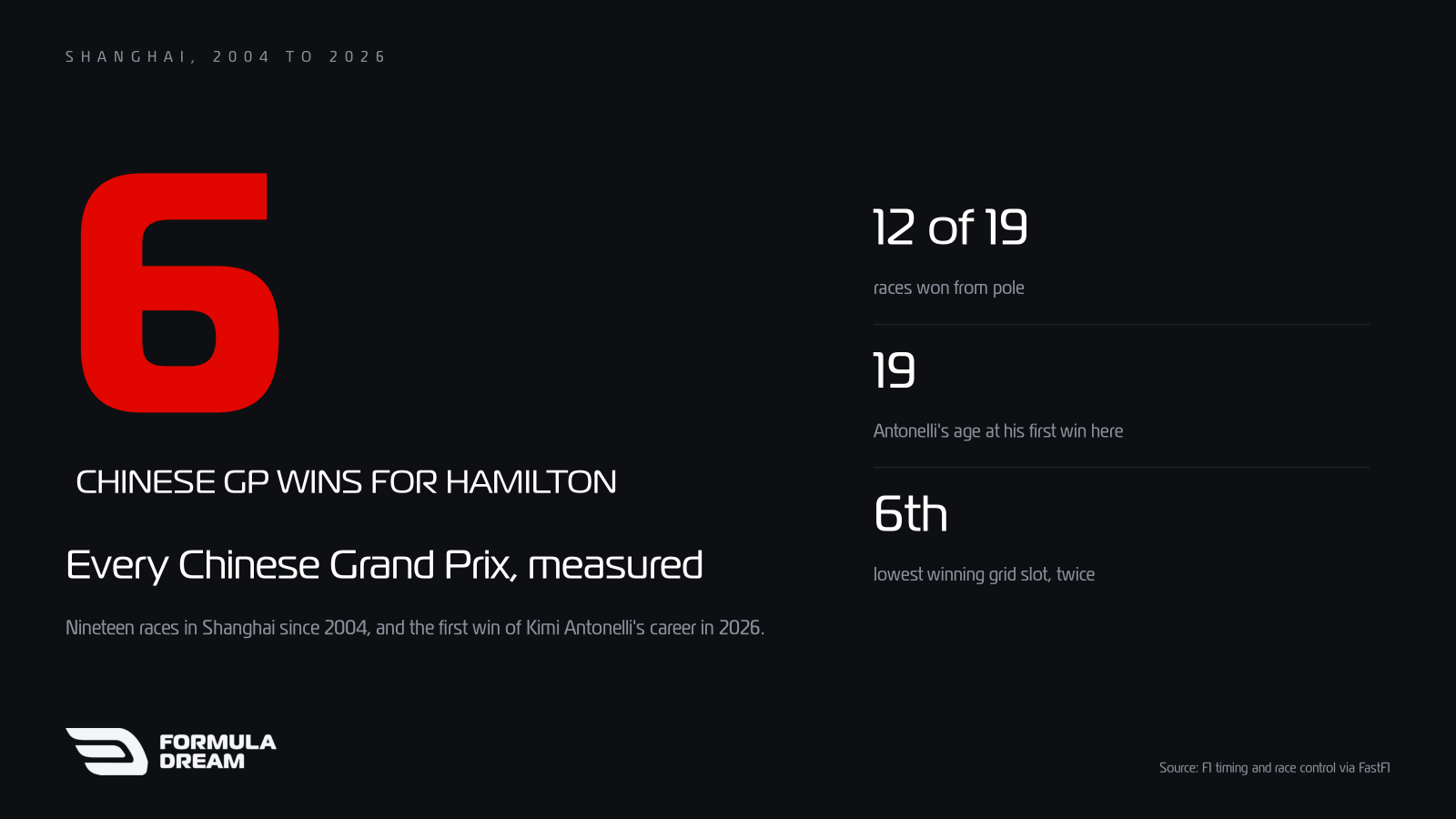
Nineteen Chinese Grands Prix have been held in Shanghai since 2004. Lewis Hamilton won six, pole won twelve, and in 2026 Kimi Antonelli took the first win of his career there, at 19, with Hamilton on the podium for Ferrari for the first time. Every winner, grid slot and safety car, measured.