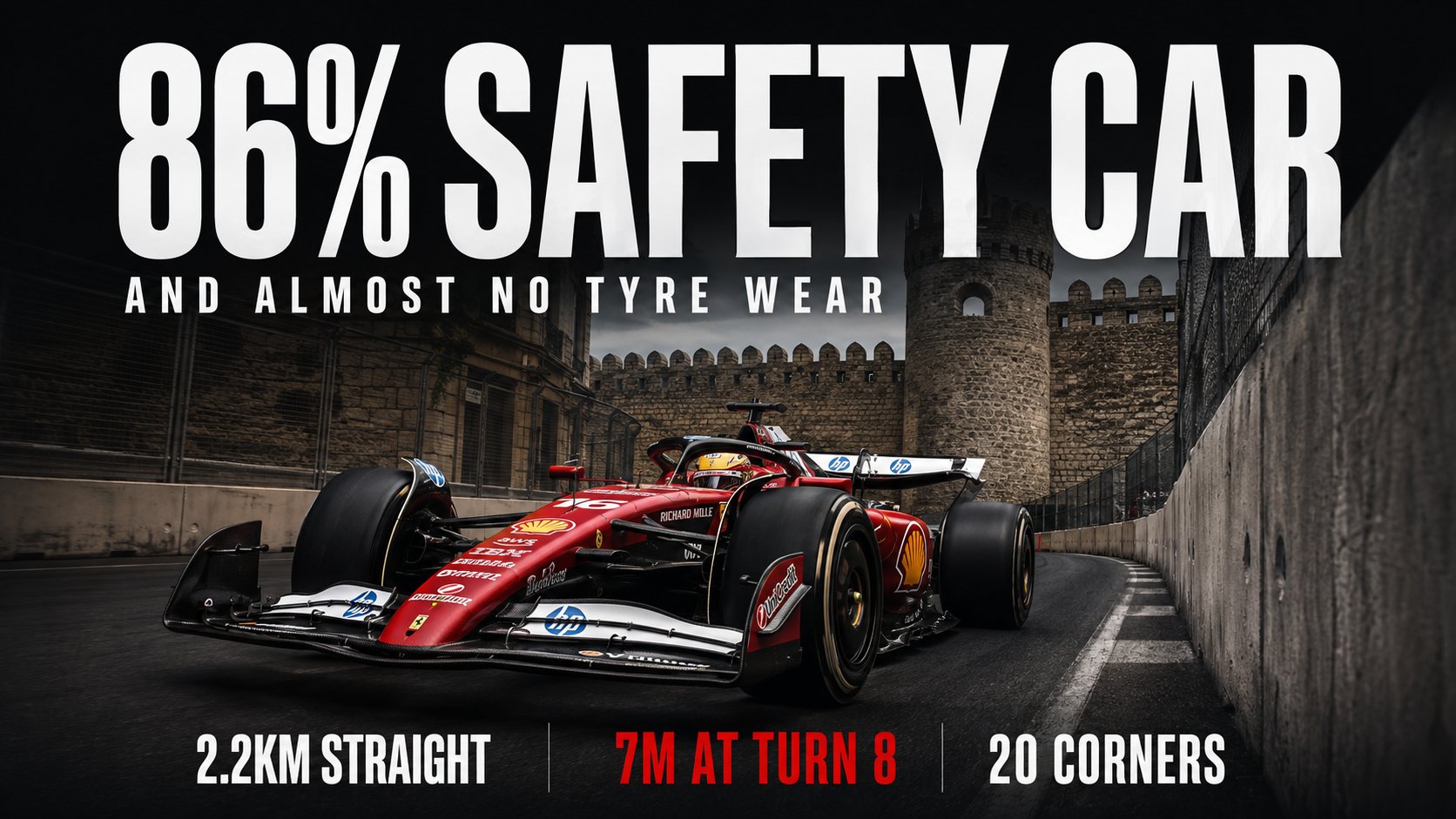
A 2.2km straight, a seven metre gap between walls, near-zero tyre wear and an 86% safety car rate. Baku's chaos is not luck, it is the direct product of four things.
The Azerbaijan Grand Prix has a reputation for producing races that make no sense. It is not luck, and it is not the drivers.
Baku is the only circuit on the calendar that combines four specific things: the longest straight of the season, a section where the walls are seven metres apart, almost no tyre degradation, and a safety car rate reported at around 86%.
Put those together and you get a circuit where the normal levers of strategy do not work, and where the one thing that decides the race is an event nobody controls.
Racing at Baku in 2026? The race is on Saturday 26 September for the first time, and we forecast pole between 1:43.9 and 1:44.5, slower than the 2019 lap record. Session times and the full forecast are in our Azerbaijan GP 2026 preview.
The layout
The Baku City Circuit is 6.003km with 20 corners, many of them at ninety degrees, threaded through the old town and the modern city.
Baku, drawn from the car rather than traced: the path of Verstappen's 2025 pole lap, 339 km/h at its fastest and 72 km/h at its slowest. The 2026 cars have not raced here yet.
What the drivers say about those walls is in our Azerbaijan Grand Prix 2025 race radio, every broadcast message with the audio and a transcript coloured by who is speaking.
Two parts define it.
The 2.2km straight, the longest Formula 1 runs all year. It is also unusually wide, with room for three cars abreast, which is why passes at the end of it are so often three-way rather than two.
The castle section, Turns 8, 9 and 10, running between the walls of the old town. Turn 8 is the narrowest point of the season at seven metres wide. For context, a Formula 1 car is around two metres across. There is no run-off, no margin and no version of a mistake that ends anywhere other than a wall.
A lap that contains both is a genuine contradiction. The straight rewards a low-drag setup, and the castle section demands precision that low downforce makes harder.
The tyre problem: there isn't one
Here is the thing that makes Baku strategically strange, and we measured it rather than assuming it.
Across a full season of race stints, Azerbaijan produced tyre degradation close to zero, and in some readings very slightly negative. It sits in the same group as Las Vegas, Qatar and Monza. The full method is in how fast F1 tyres degrade.
Degradation is the engine of strategy. It is the reason fresh tyres give back time, the reason an undercut works, and the reason a team accepts the cost of a stop at all. At most circuits the soft loses around 0.048 seconds per lap of tyre age. At Baku, effectively nothing.
So the usual calculation collapses. A pit stop costs about 21.88 seconds under green flags, and the tyres are giving you almost nothing back for it. The rational strategy is to stop once, because the rules force it, and otherwise to stay out.
Which means track position is close to everything, and everyone is on the same plan.
Then the safety car arrives
Baku's safety car rate is reported at around 86%. Our own count from race control: a safety car or virtual safety car in 8 of the 9 races held there, and a full safety car in 5. The reason is structural rather than bad luck. Seven metres of width, walls instead of run-off, and a circuit where a small error has nowhere to go.
Now recall what a safety car does, which we also measured:
It cuts the spread from leader to last runner from about 75 seconds to 22, deleting roughly 71% of the field advantage.
It drops the cost of a pit stop from 21.88 seconds to 14.24.
At a circuit where nobody wants to stop and everybody is running a similar plan, a caution arriving at the right moment hands one group of cars a nearly free pit stop and destroys the gap the other group spent thirty laps building. The measurements are in what a safety car does to the field.
That is the whole of Baku strategy. Not tyre management, not an undercut battle. A coin flip on timing, weighted 86% towards it happening at all.
Why the racing is genuinely good
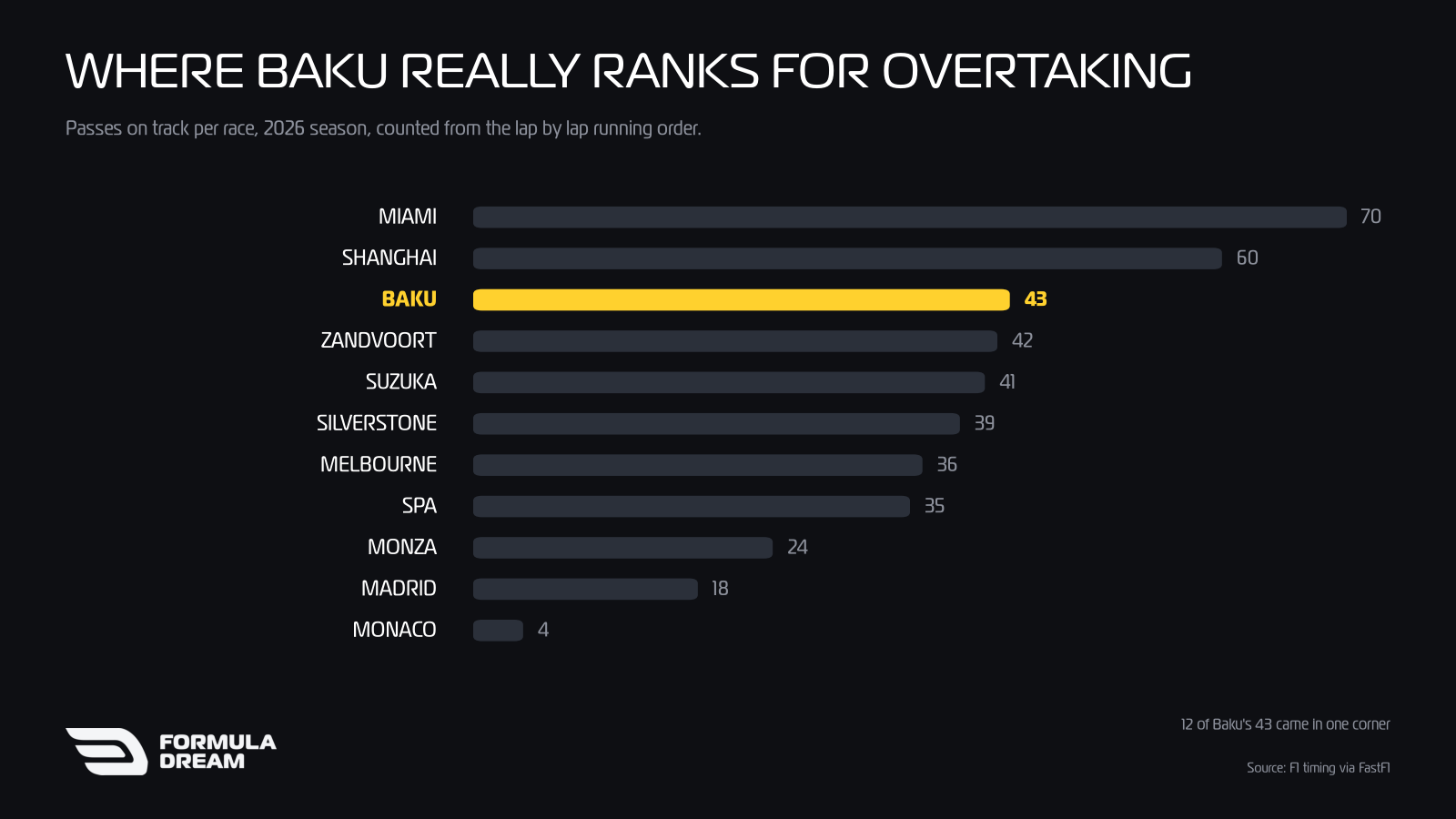
Two features make Baku produce passes rather than processions.
The straight is long enough to overcome dirty air. Running within a second of another car costs about 0.49 seconds a lap in lost downforce, which at most circuits is enough to stall an attack before it starts. A 2.2km straight gives a chasing car enough distance for a slipstream to overcome that deficit. The cost of following is in what dirty air actually costs.
Low downforce setups make cars unstable in the castle section. Teams trim wing for the straight, which makes the car harder to place in the narrow, slow corners, which produces mistakes, which produces safety cars, which resets the race. The circuit's two halves actively fight each other, and the setup compromise is genuinely unresolvable.
We measured the lap
Everyone describes Baku the same way: a huge straight bolted onto a castle section. Here is the lap in
numbers, taken from qualifying telemetry.
2025
2024
Fastest qualifying lap
1:41.117, Verstappen
1:41.365, Leclerc
Lap distance recorded
5.934 km
5.935 km
Average lap speed
211.3 km/h
210.8 km/h
Highest speed on the lap
339 km/h
339 km/h
Full throttle
73.9%
73.8%
Baku City Circuit, fastest qualifying lap measured from car telemetry.
The longest continuous full-throttle run is 1.849 km. That is the defining number of the circuit
and it is the longest uninterrupted flat-out stretch anywhere on the calendar, running from the castle
exit all the way to Turn 1.
And yet the car is at full throttle for only 73.9% of the lap, and the average speed is
211.3 km/h. For comparison, we measured Spa at 238.8 km/h and Melbourne at 238.1 in 2026. Baku,
despite that enormous straight, is a mid-table circuit for speed.
The reason is the other end of the lap. The fastest lap contains ten separate braking events (nine in 2024), and
the slowest point is 72 km/h, identical to the Rettifilo chicane at Monza. The straight gives the
lap its character and the castle section takes the time back.
That combination is exactly why Baku produces the racing it does: a long enough run to close up and
attempt a pass, followed by a section narrow enough that a mistake ends your race against a wall.
The speed
Baku is also one of the fastest places in Formula 1 in a straight line.
The unofficial highest speed ever recorded at a race weekend, 378 km/h, was set by Valtteri Bottas in qualifying at Baku in 2016. The official race record of 372.5 km/h belongs to Mexico City, where altitude does the work, but Baku achieves comparable numbers at sea level through sheer straight length and minimal wing.
The rest of the speed picture, including why top speed is a poor way to judge a circuit, is in the fastest F1 circuits.
What to watch for
Qualifying matters more than usual, and is harder than usual. Track position is king because nobody can overtake through the castle section, and the walls punish the exact aggression a pole lap requires.
Watch tyre age, not tyre choice. With degradation near zero, the interesting question is not who is on what compound but who has already stopped when a caution appears.
The first safety car changes everything. Watch who is within the pit window when it comes out. That single moment usually decides the podium.
The Baku circuit hub pulls together everything we hold for this venue in one place: every qualifying gap drawn as real distance, the track domination maps where we have them, and the team radio from previous races here.
What the drivers said here
The radio is the part of a weekend that does not make the highlights. We hold every message Formula 1 broadcast from Baku in 2025, 69 of them across the whole weekend, transcribed with the original audio and the driver and engineer colour coded, on the Baku 2025 team radio page.
It is worth a scroll before a race here, because the complaints repeat. Drivers tend to raise the same two or three things about a circuit every year, and reading last season back is the quickest way to know what to listen for in this one.
Follow the weekend live
Baku is a circuit where the race turns on one unpredictable moment, and knowing who is exposed when it happens is the whole game.
The Formula Dream app runs a live Dashboard through every session: every car on the circuit map, and a timing tower with lap times, gaps and intervals, tyre compound and age, pit counts and positions, plus flag and safety car alerts the moment race control calls them. At Baku that alert is the most valuable information on the screen. You also get live driver radio as it is broadcast, and every FIA document of the weekend as it is published.
Free, no subscription, no ads, independent. Not affiliated with Formula 1.
6.003km with 20 corners, many of them ninety degree turns, running through Baku's old town and modern city.
How long is the straight at Baku?
2.2km, the longest straight Formula 1 races on all season. It is also wide enough for three cars side by side, which is why overtakes into the braking zone are often three-way.
Why are there so many safety cars at Baku?
Eight of the nine races held at Baku have had a safety car or a virtual safety car, and five a full safety car. The circuit has walls instead of run-off and a castle section where the track narrows to seven metres, so a small mistake has nowhere to go.
Why is Baku strategy so unpredictable?
Because tyre degradation there is close to zero, so there is no natural reason to stop beyond the mandatory one. Everyone runs a similar plan and the race is then decided by when a safety car appears, which drops the cost of a pit stop from about 21.88 seconds to 14.24.
What is the fastest speed recorded at Baku?
378 km/h, set by Valtteri Bottas in qualifying in 2016. It is the highest speed recorded at a race weekend, though the official race record of 372.5 km/h was set in Mexico.
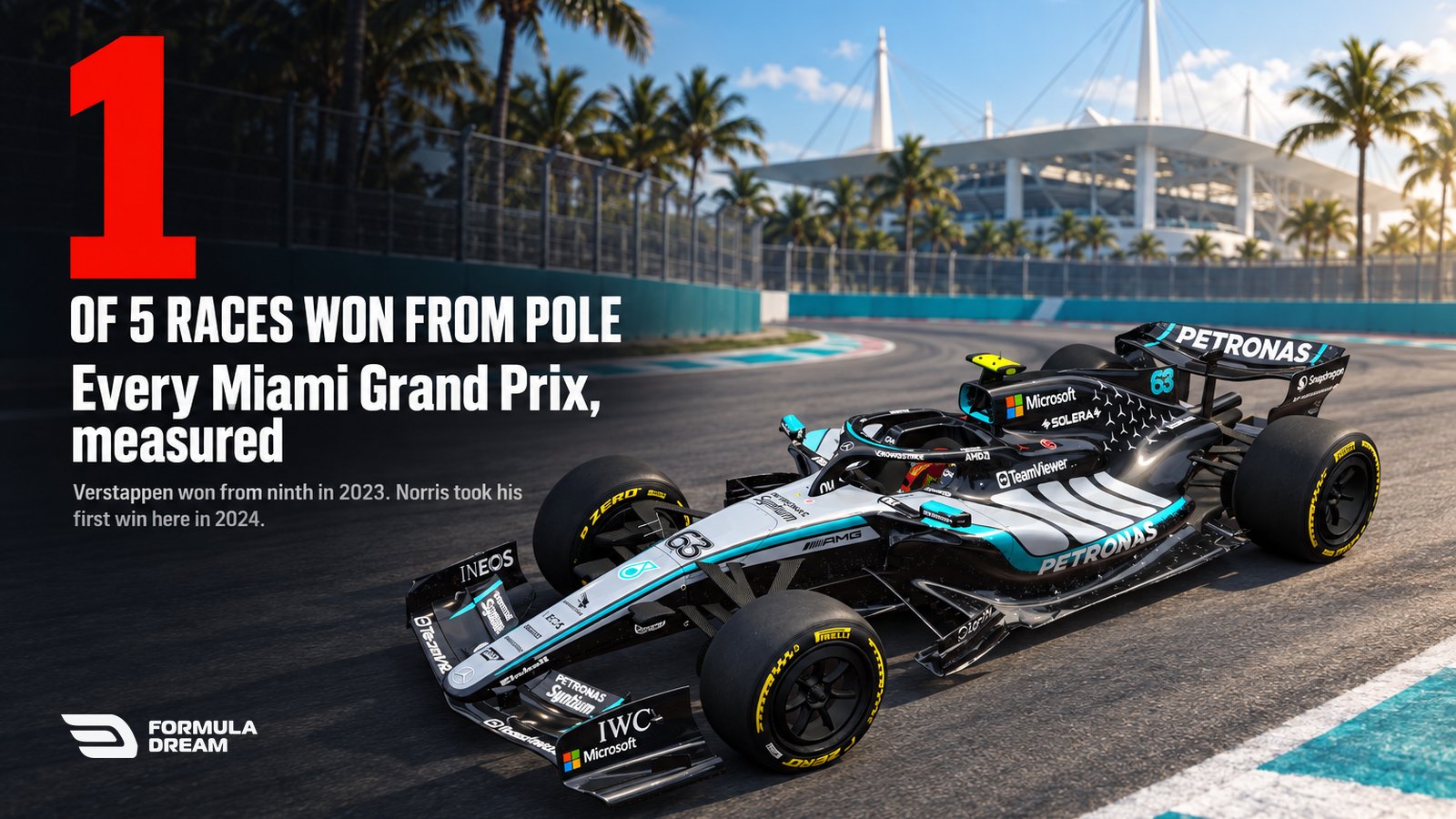
Every Miami Grand Prix winner, measured: five races, and pole has won only one of them
Five Miami Grands Prix have been held since 2022, and only one was won from pole: Kimi Antonelli's in 2026. Max Verstappen won from ninth in 2023, and Lando Norris took his first win there in 2024. Every winner, grid slot and safety car, measured.