Spanish GP 2026 Overtakes: Every Madrid Pass, Measured
Guides
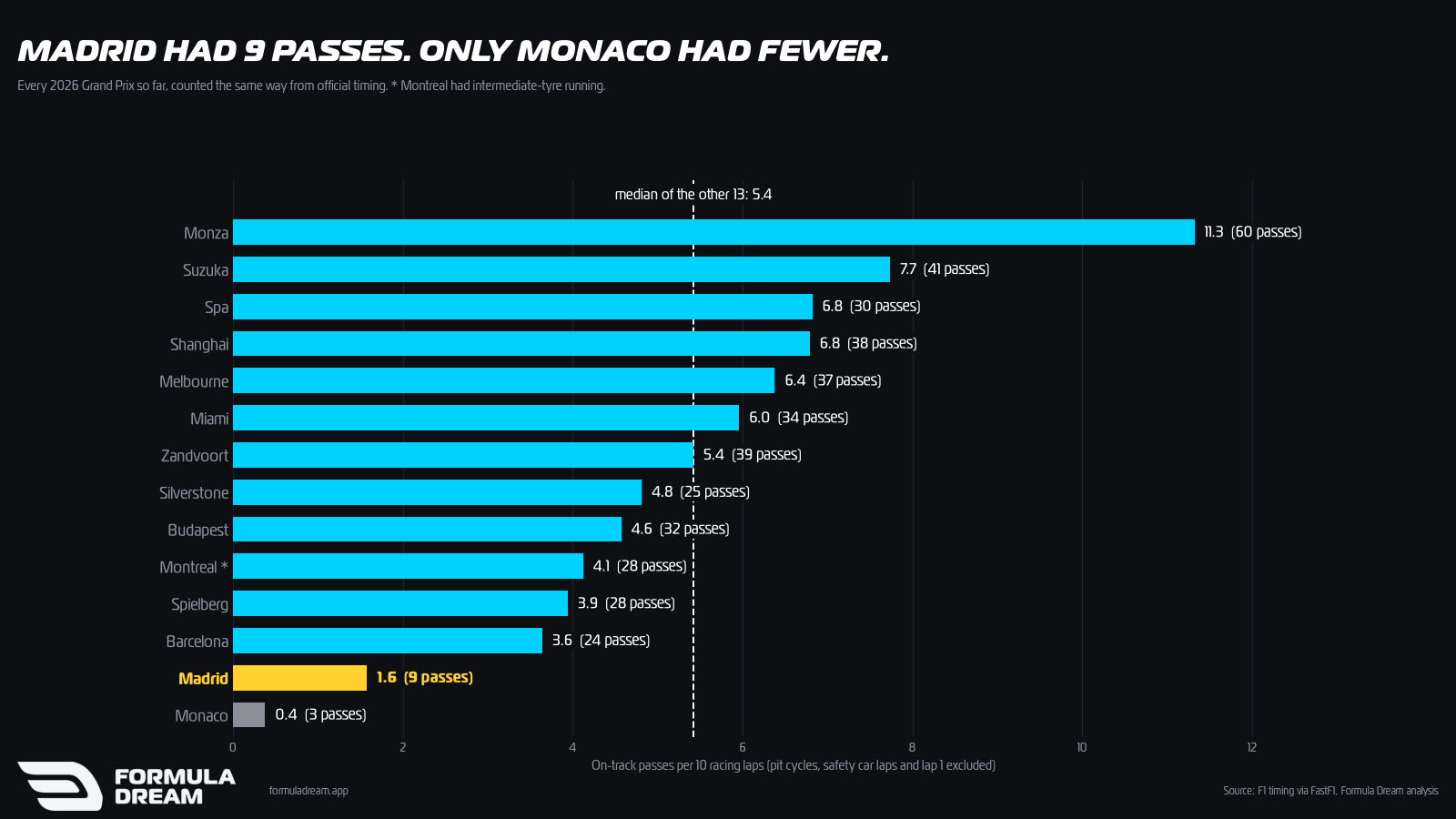
Madrid had 9 overtakes in 57 laps. We checked every one.
The first Madring race produced 9 on-track passes, the fewest of 2026 outside Monaco. Two came from Verstappen running off, three were on cars that retired soon afterwards. Every pass explained, the trains that never broke, and what changes for 2027.
The first Spanish Grand Prix at the Madring produced nine on-track passes in 57 laps. Only Monaco has produced fewer in 2026.
That is our count from Formula 1's own timing data, with pit stops, safety car laps and the start taken out. Look at the nine one by one and the number gets worse. Two happened because Max Verstappen ran off the track at Turn 1. Three were on cars that retired soon afterwards: Stroll twice, Perez once. That leaves four passes between two cars running normally, which is the same figure fans arrived at by counting the broadcast.
Drivers said it before the race and said it louder after it. Gabriel Bortoleto, told that journalists had almost fallen asleep, answered: "I almost fell asleep as well!" Here is what the timing data says went wrong, and what the organisers have already promised to change.
The drivers' frustration is on the radio too. Every message from the race is in our Spanish Grand Prix 2026 race radio archive, with the audio and a colour-coded transcript.
How we counted
A pass counts when one driver is behind another at the end of a lap and ahead at the end of the next, and all of these are true:
Neither driver pitted on either lap, so pit stop cycles do not count.
Both laps were green, so the Virtual Safety Car period does not count.
It was not lap 1, because the start is not overtaking.
It is the same method we used for every overtake of the 2025 season, where it put Monaco last with three passes. Applied to every 2026 race so far, it again puts Monaco last, with three.
Madrid against the rest of 2026
Measure
Madrid
Median of the other 13 races
Madrid's rank of 14
On-track passes
9
32
13th
Passes per 10 racing laps
1.58
5.42
13th
Position changes per lap
1.40
2.16
13th
Passes per 100 laps within a second of the car ahead
7.0
22.1
13th
Pit stops per driver
1.27
1.71
12th
Caption: Every 2026 Grand Prix from Melbourne to Madrid, measured the same way from official timing via FastF1.
The position-change figure is the looser measure from our 2026 overtaking without DRS analysis. It counts every place gained on track rather than matched pairs of cars, and it agrees: Madrid is second from bottom on both.
For context, the last Spanish Grand Prix in Barcelona, in 2025, produced 33 passes by the same count. The Barcelona Grand Prix this season produced 24.
All nine passes
Lap
Pass
Tyres
What it was
3
Alonso on Stroll
Both hard, 3 laps old
Stroll stopped with brake trouble ten laps later
4
Antonelli on Verstappen
Medium 4 laps, soft 7 laps
Verstappen ran off at Turn 1
4
Hamilton on Verstappen
Soft 4 laps, soft 7 laps
Same moment. Hamilton retired after lap 6 with brake problems
8
Bearman on Stroll
Both hard, 8 laps old
Stroll again, five laps before stopping
10
Lawson on Colapinto
Hard 10 laps, medium 10 laps
A pass between two healthy cars
24
Alonso on Bottas
Soft 10 laps, hard 24 laps
14 laps fresher
30
Alonso on Perez
Soft 16 laps, hard 16 laps
Perez retired a lap later
35
Russell on Lawson
Hard 7 laps, hard 35 laps
28 laps fresher
54
Lawson on Gasly
Medium 10 laps, hard 54 laps
44 laps fresher
Caption: Every on-track pass in the 2026 Spanish Grand Prix, with tyre compound and age from official timing. Race control noted Verstappen for leaving the track at Turn 1 on lap 4 and took no further action.
Two things stand out.
Among the cars that finished in the top five, there was one pass on the track all afternoon, and it came when Verstappen went off. Every other change of position at the front happened in the pit lane, most of it under the Virtual Safety Car on laps 14 and 15. How that decided the win is in our Spanish GP race report.
Three of the four clean passes needed a big tyre advantage. Alonso had tyres 14 laps fresher than Bottas, Russell 28 laps fresher than Lawson, and Lawson 44 laps fresher than Gasly. Only Lawson's pass on Colapinto on lap 10 came between two cars on tyres of the same age.
They could follow. They could not finish the move.
The complaint was not that cars could not get close. They could.
Across the race, drivers spent 129 laps within a second of the car in front. That is fewer than the median race, but not far off Barcelona (120) or Silverstone (105). The difference is what happened next. At a typical 2026 race, about 22 passes come for every 100 laps a driver spends within a second of someone. In Madrid it was 7.
How often a lap within a second of the car ahead became a pass, every 2026 race so far. Only Monaco converted less.
The longest queues show it clearly:
Norris behind Verstappen, 12 laps. Lando Norris ran within a second of Verstappen on every lap from lap 42 to lap 53, 0.80 seconds behind on average and 0.574 at his closest, on hard tyres one lap younger than Verstappen's. He finished 0.738 seconds behind him.
Colapinto behind Bortoleto, 9 laps. Franco Colapinto sat within a second of Gabriel Bortoleto from lap 38 to lap 46, as close as 0.369, on hard tyres 14 laps fresher, and never passed him on track.
Piastri behind Colapinto. Nico Rosberg picked this one out: "Piastri had fresh tyres, he could not get past." The timing agrees. After his stop Oscar Piastri was within 0.3 to 0.8 seconds of Colapinto on laps 43 to 46, on medium tyres 28 laps younger than Colapinto's hards. He dropped back, and finished eighth, 1.558 seconds behind.
Four laps inside a second on tyres 28 laps younger, and no pass. That is the Madring.
Why the Madring does not produce passes
The drivers' explanations are consistent, and they point at the layout rather than the cars.
The braking zones do not allow two cars side by side. Kimi Antonelli, who won the race, said the circuit "definitely doesn't create overtaking opportunities" and that trying a move at the second chicane would most likely end in contact. Oliver Bearman said the combined corner entries and exits make it easy to defend and hard to attack, as Motorsport.com reported. The Turn 5 and 6 chicane's curved entry and kerbing stop two cars running cleanly side by side, according to The Race.
There is no single big overtaking spot. Carlos Sainz, the event's ambassador: "Good street tracks like Baku, Macau tend to have one single overtaking spot with a very long straight." Before the race, the circuit was designed with four overtaking zones, at Turns 1, 5, 11 and 17, as our Madring circuit guide recorded.
Almost nobody was on a different strategy. Madrid averaged 1.27 pit stops per driver against a 2026 median of 1.71, and the Virtual Safety Car on lap 14 put most of the leaders onto hard tyres for a long final stint. Overtaking needs a pace difference, and the biggest source of one is a tyre offset. Drivers also pointed to the long pit lane, which makes an extra stop expensive, according to Autosport.
That last point matters because it is the one thing that can change without new asphalt. When the few passes that did happen needed 14 to 44 laps of tyre advantage, a race where nobody takes a second stop is a race without passes.
What changes for 2027
The organisers have already said the circuit will change. The track has to be rebuilt each year anyway, and the northern half was built on empty land, so there is room to do it.
"Being honest with you, the FIA defined clearly which is the way to improve the track layout, and we will be open because we will have to reinstall the track for the next year," said Luis Garcia Abad, the event's managing director. "We have the space, we have a venue, we have the facilities, we have the capacity to do it."
Turns 5 and 6: a wider chicane with a different approach, so two cars can contest it.
Turn 13: the left-hander after La Monumental made tighter, to give a following car a braking zone to attack into.
Turn 20: a wider entry and realigned barriers, so a move there does not risk the wall.
Lando Norris wants more than that: "a straight line from Turn 17 straight to Turn 20, to have a much wider entry like Austin Turn 1 or Turn 10, a big hairpin." The contract runs to 2035, so there will be time to see which of them was right.
Hear it from the drivers
Norris's frustration with Verstappen on lap 56, "He went off defending against me, he cut a chicane... pretty obvious", and the rest of the race told through the radio, is in our Spanish GP team radio article. The race messages in order:
Method and limits
Data: official Formula 1 timing via FastF1, all 14 Grands Prix of 2026 up to and including Madrid.
Order on track comes from each car's end-of-lap time, so a lapped car cannot register as a pass.
Guard against bad timing rows: a lap is rejected if its duration is outside 0.85 to 1.6 times the race's median lap, because the timing feed occasionally merges two laps into one. No Madrid laps were rejected. Monza (70), Zandvoort (67) and Monaco (47) had many, so their counts carry more uncertainty than Madrid's.
What it is not: a hand-checked count of wheel-to-wheel moves. A pass on a car with a problem still counts, which is why the table above explains each one.
Where passes happened: Formula 1 has not published corner position data for the new circuit, so we have not placed each pass corner by corner.
Frequently asked questions
How many overtakes were there at the 2026 Spanish Grand Prix?
Nine on-track passes by our count from official timing, excluding pit stops, the Virtual Safety Car and lap 1. Four of them were between two cars running normally; the others came from Verstappen running off at Turn 1 or were on cars that retired shortly afterwards.
Why was there so little overtaking in Madrid?
Drivers blamed the layout: braking zones that do not let two cars run side by side, no single long straight into a heavy stop, and a long pit lane that discouraged extra stops. With most of the field on one stop, there were few tyre advantages to use, and the passes that did happen needed tyres 14 to 44 laps fresher.
Will the Madring change for 2027?
Yes. The organisers say the FIA has recommended changes, and three are planned: a wider Turn 5 and 6 chicane, a tighter Turn 13 and a wider entry to Turn 20.
Which 2026 race had the fewest overtakes?
Monaco, with three on-track passes in 78 laps. Madrid is second from bottom with nine in 57.
Which 2026 race had the most overtakes?
By our count, the Italian Grand Prix at Monza, with 60 on-track passes in 53 laps.
Sources
Laps, positions, tyres, pit stops and race control messages: official F1 timing via FastF1
Fan count of four overtakes after lap 1: MotorBiscuit
Watch the gap close before the pass
A pass at a circuit like this is decided in the three laps before it, when the gap either comes down or does not. The Formula Dream app shows that live: a timing Dashboard (currently in beta) with gaps and intervals, tyre compound and tyre age for every car, so a 28-lap tyre advantage is on screen before anyone tries a move. It also plays live driver radio as it is broadcast, and carries every FIA document of the weekend, including every stewards' decision on who left the track and gained an advantage.
Free, no subscription, independent. Not affiliated with Formula 1.
Bahrain GP at Sepang preview: session times and a pole forecast from 2017
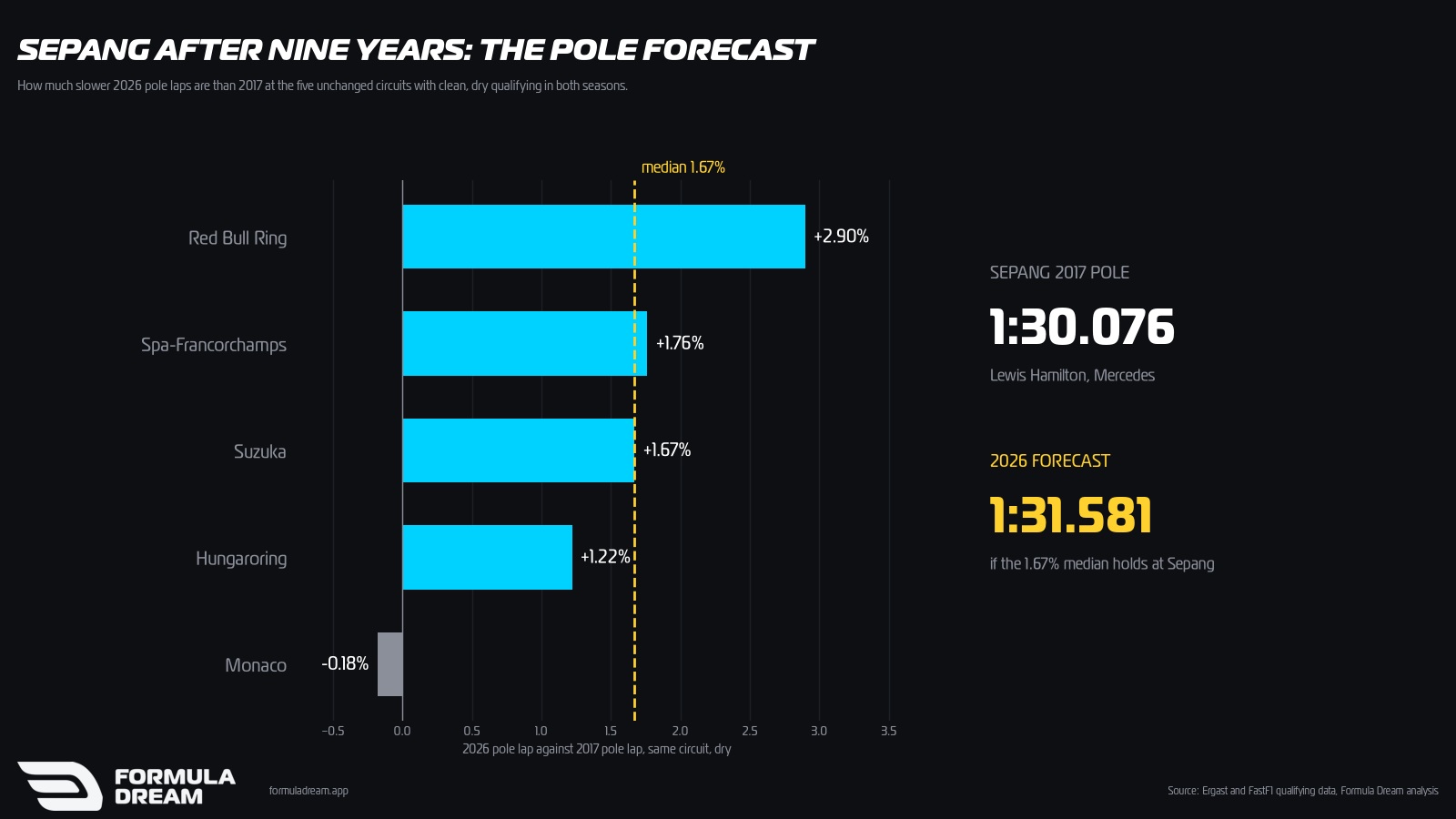
The 2026 Bahrain Grand Prix runs at Sepang in Malaysia on 4 October, as a day race. Session times in Malaysian time, and our forecast of a 1:31.6 pole from how 2026 cars compare with 2017 at unchanged circuits.