F1 Banked Corners: What Banking Actually Does, Measured
What banking actually does to an F1 corner, measured
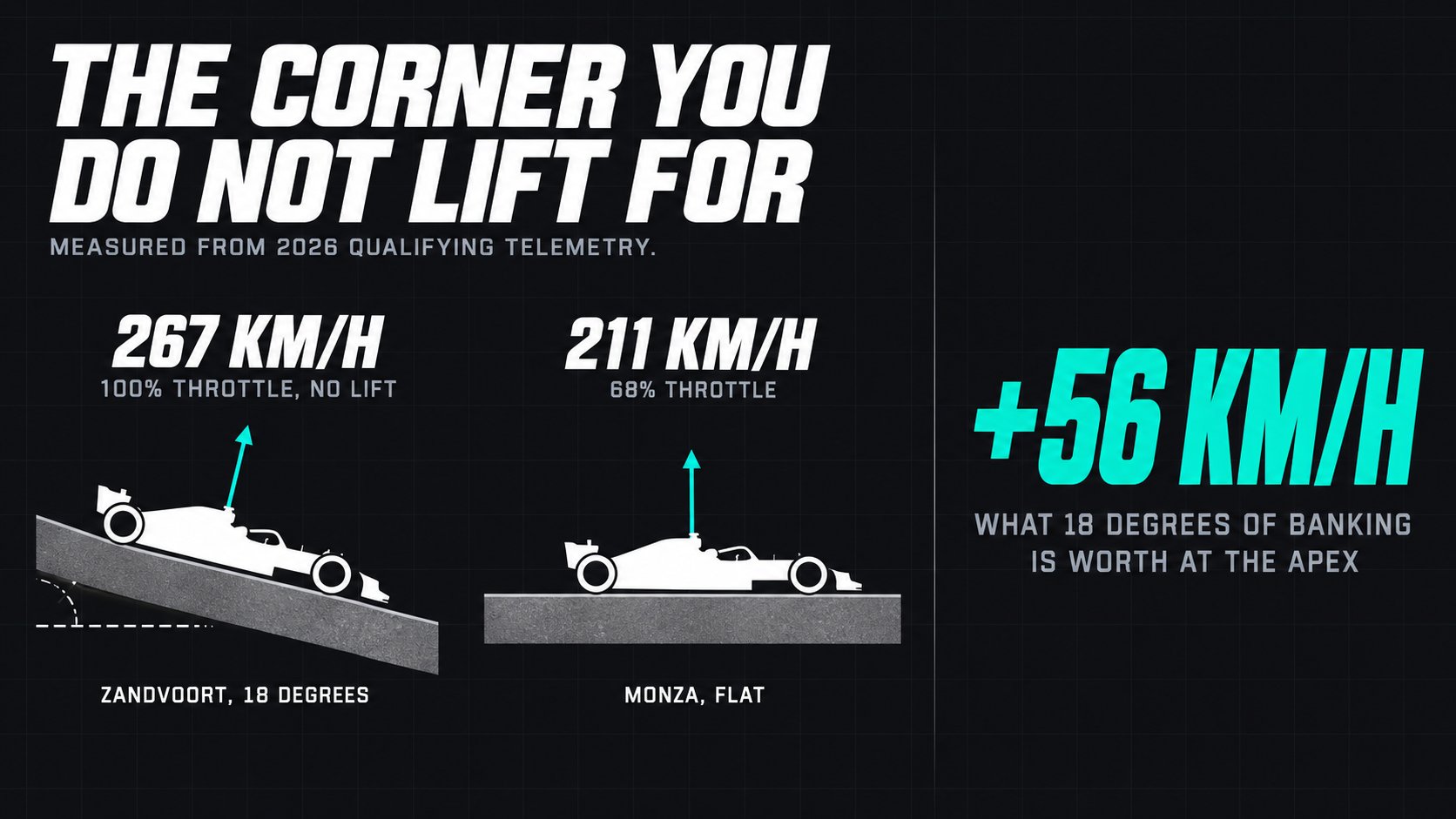
At Zandvoort's final corner an F1 car never lifts. At Monza's Parabolica, on identical machinery, the driver backs off to 68% throttle. The difference is 18 degrees of banking.
Through the last corner at Zandvoort, an F1 car does not lift. Throttle stays at 100% the whole way round, there is no braking, and the slowest the car gets is 267 km/h.
Drivers talk about how a corner like this feels while they are still in the car. The last race, message by message, is in our Spanish Grand Prix 2026 race radio archive.
Through the last corner at Monza, on the same 2026 cars, the driver backs off to 68% throttle and the car drops to 211 km/h.
Both are fast, sweeping final corners that feed a long straight. One is banked and one is not. We measured both from qualifying telemetry, and the gap is larger than we expected.
The measurement
Pole lap, 2026 season, both corners taken as the final section of the lap:
Zandvoort, Arie Luyendijkbocht
Monza, Parabolica
Banking
18 degrees
Flat
Minimum speed
267 km/h
211 km/h
Minimum throttle
100%
68%
Braking
None
None
Speed at the line
307 km/h
288 km/h
Pole lap
1:11.163 (Norris)
1:21.786 (Gasly)
Measured from 2026 qualifying telemetry. Same regulations, same tyres, same season.
56 km/h more at the apex, and no lift at all.
The same-season part matters. 2026 cars are roughly 3% slower than the 2024 generation, so comparing a 2025 Zandvoort lap with a 2026 Monza lap would have flattered the banked corner by a margin that has nothing to do with banking. We ran both on 2026 machinery for that reason.
Why banking does this
A car cornering on a flat track asks one thing of the tyre: generate a sideways force while carrying the car's weight. Grip is finite, and once the sideways demand exceeds it the car slides.
Bank the track and the geometry changes. Part of the cornering load is taken by the road pushing the car towards the inside of the turn rather than by the tyre gripping sideways. The car is effectively pressed into the surface, so the tyre has more capacity left for turning. The steeper the banking and the faster the car, the more of the work the road does.
That is why the throttle trace matters more than the speed. 267 km/h against 211 km/h is the headline, but 100% throttle against 68% is the actual finding, because it means the car was never at the limit of what the tyre could do. The driver was not managing grip through that corner. He was just accelerating.
Banking does not make everything flat out
Zandvoort has two banked corners, and the other one behaves nothing like the final turn.
The Hugenholtzbocht, Turn 3, is banked as well, and on the same pole lap it requires braking, drops the car to 150 km/h, and takes the throttle all the way to zero.
The difference is entry speed and radius. Arie Luyendijk is a long, open turn approached at close to 300 km/h, where banking has a lot of load to work with. Hugenholtz is a tight, slow hairpin. Banking a slow corner helps far less, because the forces it redirects scale with speed. Bank a car park and it is still a car park.
So the useful statement is narrower than "banking makes corners faster". Banking makes fast corners faster, and it does most for the ones that were already near flat out.
What this means for Madrid's La Monumental
Formula 1 arrives at the Madring for the first time on 13 September, and its headline feature is a banked corner called La Monumental. Most of the coverage has compared it to Zandvoort. The comparison is worth making carefully, because the two are less alike than they sound.
Zandvoort, Arie Luyendijk
Madring, La Monumental
Banking
18 degrees
24% gradient, about 13.5 degrees
Length
A single turn
550 metres
Arc
Roughly 180 degrees
More than 270 degrees
Height
Modest
10 metres
Madrid's banking is shallower than Zandvoort's and far longer.
Madrid is not more steeply banked than Zandvoort. It is less. 24% sounds larger than 18 until you notice the units: 24% gradient works out at about 13.5 degrees, against Zandvoort's 18. What makes La Monumental different is length. It runs for 550 metres through more than 270 degrees of arc, which is a corner drivers will be inside for several seconds rather than a moment.
Estimates from the circuit's designers put entry at 180 to 200 km/h with the cars accelerating throughout. Our Zandvoort numbers suggest that is plausible: at 18 degrees a car can hold 267 km/h at full throttle, so 13.5 degrees supporting continuous acceleration from 200 km/h is not a stretch.
What we cannot tell you is the exit speed, the line, or whether it produces overtaking, because nobody has driven it. There is no telemetry for a circuit that has never held a session. Anyone publishing a lap time prediction for Madrid this week is guessing, and so would we be.
The full circuit is in our Madring guide, including the 57-lap race distance and the parts of the layout that are genuinely unusual.
Where else F1 has banking
Very little of the modern calendar is banked, which is why Zandvoort and now Madrid stand out. Banking was common in the sport's early decades at circuits like Monza's old oval and AVUS, and it disappeared for the same reason the ovals did: sustained high loads on cars and structures that were not built for them, and the safety record that followed.
The modern versions are deliberately mild by comparison. Zandvoort's 18 degrees is a fraction of what a US oval runs, and Madrid's 13.5 is less again, because the FIA caps banking at 24% gradient for a Formula 1 circuit. Both are designed to add a sensation and an overtaking line rather than to turn the circuit into a speedway.
Compare the corners yourself
Every qualifying gap on our Zandvoort 2025 session pages is drawn as real distance on track rather than as a time, which is a more honest way to see what a corner like this is worth. And every message the drivers said about the place is on the Dutch Grand Prix team radio page.
See the trace during the session
Corner speed is one of the few things that is far more interesting live than afterwards.
The Formula Dream app runs a live Dashboard through every session, currently in beta, with every car on the circuit map and a timing tower carrying lap times, gaps and intervals, tyre compound and age, and race control's flags as they are called. There is a lap scrubber, so you can rewind inside a session and watch a specific lap build. It also carries live driver radio as it is broadcast with a transcript alongside it, which at a new circuit is where you will hear what the corner is actually like before anyone writes about it.
Free, no subscription, no ads, independent. Not affiliated with Formula 1.
Zandvoort, with two, and from 2026 the Madring in Madrid. Zandvoort's Arie Luyendijkbocht is banked at 18 degrees and its Hugenholtzbocht at Turn 3 is banked as well. Madrid's La Monumental runs at a 24% gradient, about 13.5 degrees, for 550 metres.
How much faster is a banked corner in F1?
At Zandvoort's final corner an F1 car holds a minimum of 267 km/h at full throttle. At Monza's Parabolica, an unbanked fast final corner on the same 2026 cars, the minimum is 211 km/h and the driver lifts to 68% throttle. That is 56 km/h and the difference between lifting and not lifting.
Is Madrid's banking steeper than Zandvoort's?
No. Madrid's La Monumental is a 24% gradient, which is about 13.5 degrees, against 18 degrees at Zandvoort. Madrid's corner is longer, not steeper: 550 metres through more than 270 degrees of arc.
Why does banking make a corner faster?
Because part of the cornering load is carried by the road surface pushing the car inwards rather than by the tyre gripping sideways. That leaves the tyre more capacity for turning. The effect scales with speed, which is why banking transforms a fast corner and does very little for a slow one.
Does banking help at slow corners?
Barely. Zandvoort's banked Turn 3 still requires braking and drops the car to 150 km/h with the throttle fully closed, because the forces banking redirects grow with speed and there is not much to redirect at a hairpin.
All telemetry in this article was measured from official 2026 qualifying session data.
Singapore Sprint 2026 Results: Russell Crashes From the Lead
Russell took the lead at turn one and crashed at the final corner of the same lap. Verstappen won, Hamilton charged to second, and the McLarens hit each other.