Which F1 driver swears the most on team radio? We counted 37,359 messages
One broadcast radio message in 53 contains something the transcript has to censor. Three in four of them come from the driver, and the sweariest session is not the race.
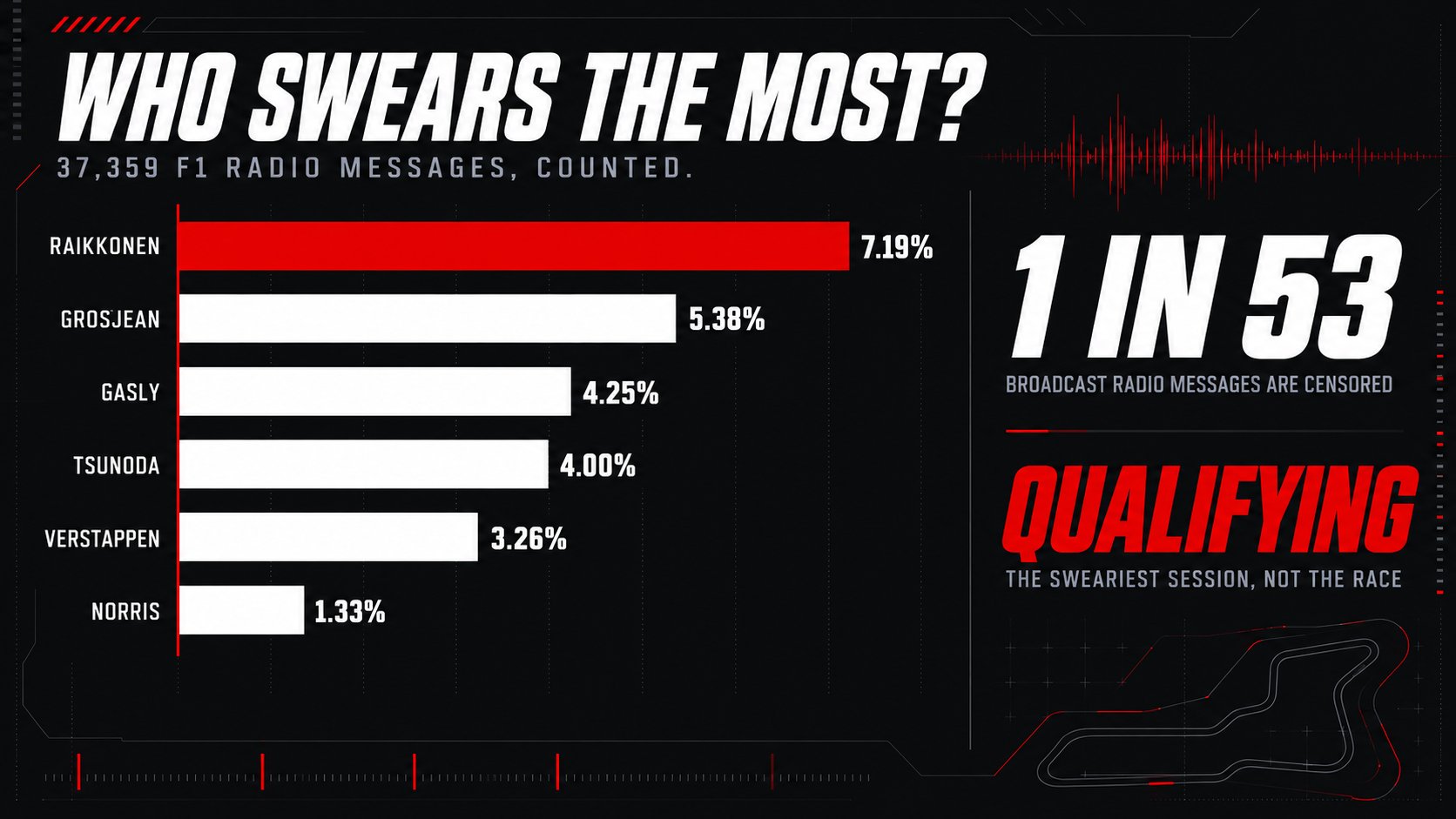
One F1 radio message in every 53 contains a word the transcript has to censor. For Kimi Raikkonen it is one in 14.
We counted every instance across 37,359 broadcast messages in our team radio archive, covering 2018 to 2026. The leaderboard is the fun part. The genuinely surprising result is which session it happens in.
What this actually measures
Worth two sentences before any table, because it changes how you should read them.
Our transcripts censor profanity where it appears, so a message renders as "what the f*
is he doing". We counted messages containing that censored pattern. That means this measures
language in radio that Formula 1 chose to broadcast**, not language on the radio. Broadcasters select clips, and a clip full of swearing is both more likely to be interesting and, at times, less likely to be aired. Both pressures exist and we cannot separate them.
So read every number below as a rate within broadcast radio. It is a real and consistent measure across drivers and sessions, because they are all subject to the same selection. It is not a measure of how much anybody swears in a car.
699 of 37,359 messages, 1.87%, roughly one in 53.
The leaderboard
Drivers with at least 400 messages in the archive, ranked by the share of their broadcast messages containing censored language.
Driver
Flagged
Messages
Rate
Kimi Raikkonen
58
807
7.19%
Romain Grosjean
30
558
5.38%
Pierre Gasly
80
1,882
4.25%
Yuki Tsunoda
36
900
4.00%
Max Verstappen
108
3,308
3.26%
Zhou Guanyu
15
554
2.71%
Daniel Ricciardo
33
1,571
2.10%
Sergio Perez
33
1,683
1.96%
Charles Leclerc
37
2,084
1.78%
Lando Norris
30
2,252
1.33%
Caption: Share of a driver's broadcast radio messages containing censored language, 2018 to 2026.
Raikkonen at 7.19% is more than five times Norris at 1.33%, which is a wider spread than we expected from a sample this size.
There is a nice contradiction in it too. We measured separately that Raikkonen speaks 39.2% of the words on his own channel, more than Verstappen or Hamilton, which already undermines his reputation for saying nothing. He does not say little. He says a lot, and a disproportionate amount of it needs asterisks. The full breakdown is in who actually talks on F1 team radio.
Three in four come from the driver
Of the flagged lines, 593 were spoken by the driver and 188 by the engineer. So about a quarter of it is the pit wall, which is higher than most people would guess. Engineers are not neutral commentators; they are watching the same race, usually with more information and less to do about it.
The most human example in the archive is a Verstappen clip from Bahrain in 2018 where the swearing is the engineer's, and it is not anger:
"F*, f, f**. Are you alright, Max?"
That is a race engineer watching a crash on a monitor.
The sweariest session is qualifying
This is the finding we did not expect.
Session
Flagged
Messages
Rate
Qualifying
202
6,747
2.99%
Race
287
14,769
1.94%
Practice and other
210
15,843
1.33%
Caption: Qualifying produces censored language at more than twice the rate of practice, and half again the rate of a Grand Prix.
A Grand Prix is two hours long, contains every wheel-to-wheel fight of the weekend, and produces the crashes. Qualifying is under an hour and produces more of it per message.
The reason is not complicated once you see the number. A race gives you laps to recover. Qualifying gives you one lap, and the single most common way to lose it is something entirely outside your control: another car in the wrong place. George Russell in Q2 at Imola in 2020 is the whole thing in one line, and it is not even a complaint:
"Need more tracks like this in F1, because this is f***ing awesome."
Raikkonen at Monaco in 2018, blocked on his lap, is the other half:
"Yeah, the Mercedes blocked me completely, completely. F*** my life."
Both are qualifying. One is joy and one is despair, which is roughly what a single flying lap does to people.
Some garages are ten times louder than others
Team
Flagged
Messages
Rate
AlphaTauri
108
1,689
6.39%
Alfa Romeo
61
1,360
4.49%
Red Bull
152
5,791
2.62%
Haas
69
2,698
2.56%
Ferrari
59
4,290
1.38%
Williams
30
2,550
1.18%
Alpine
25
2,198
1.14%
McLaren
51
4,952
1.03%
Mercedes
34
5,691
0.60%
Caption: AlphaTauri's radio is censored ten times as often as Mercedes', per message broadcast.
Treat this one with more caution than the others, because a team's rate is mostly its drivers' rate. AlphaTauri at the top is Gasly and Tsunoda. Alfa Romeo is Raikkonen and Zhou. Mercedes at the bottom is a Hamilton, Bottas and Russell line-up over eight seasons.
What is left after you account for that is a real thing, though: Mercedes at 0.60% against Red Bull at 2.62% is a four-fold difference between two teams that have both been at the front throughout, with drivers who are not obviously different in temperament. Some of that is house style, and some of it is which clips a broadcaster reaches for.
Two things we could not measure, and why
We are publishing these because the absence is more useful than a guess.
Whether the FIA crackdown worked. The FIA tightened its rules on driver conduct and language for 2025, which makes the obvious question whether the broadcast rate fell. Our archive holds 1,373 messages from 2025 and 400 from 2026, against 7,752 from 2024. Those recent seasons are still being added, and a sample that small will swing on a handful of clips. The rates we get for 2025 and 2026 are actually higher than 2024, and we do not believe them, because the sample cannot carry the claim. We will revisit when the recent seasons are complete.
What they swear about. We tried to classify the subject of every flagged driver line: traffic, another driver, the car, tyres, strategy, celebration. 75.7% of them did not fall cleanly into any category, so the classification failed and we are not reporting the 24% that did. The samples we read by eye looked heavily weighted towards traffic and being held up, and we are telling you that as an impression rather than a finding, because reading a dozen quotes and calling it a pattern is how you publish something that is not true.
Read it yourself
Every message counted here is in the team radio archive, searchable by driver and session, with the original audio and a transcript that colours itself by who is speaking. The individual channels for the drivers in the table above are the fastest way in: Raikkonen, Grosjean, Gasly, Tsunoda and Verstappen.
Broadcast radio reaches television with a delay and a selection. During a session, the Formula Dream app carries live driver radio as it is broadcast, with the transcript running alongside it and the driver and engineer colour coded, so you get the clip and the words at the same moment rather than reading about it afterwards.
It also runs a live Dashboard through every session, currently in beta, with every car on the circuit map and a timing tower showing lap times, gaps, intervals, tyre compound and age, plus every FIA document of the weekend as the stewards publish it.
Free, no subscription, no ads, independent. Not affiliated with Formula 1.
Kimi Raikkonen, by a clear margin. 7.19% of his broadcast radio messages contain censored language, one in every 14, against a grid-wide rate of 1.87%. Romain Grosjean is second at 5.38% and Pierre Gasly third at 4.25%.
How often do F1 drivers swear on the radio?
In broadcast radio, 699 of 37,359 messages contain censored language, which is 1.87% or about one message in 53. That is a rate within the clips Formula 1 chooses to air, not a measure of everything said in the car.
Do F1 engineers swear on the radio too?
Yes, and more than people expect. About a quarter of flagged lines come from the pit wall rather than the driver, 188 out of 781.
Is swearing on F1 radio against the rules?
Drivers can be penalised for misconduct, and the FIA tightened its guidance on language for 2025. Our archive does not yet hold enough messages from 2025 and 2026 to say whether the broadcast rate changed.
Which session has the most swearing?
Qualifying, at 2.99% of messages, ahead of the race at 1.94% and practice at 1.33%. One flying lap with no second chance produces more of it per message than a two-hour Grand Prix.
All counts were measured from our own archive of 37,359 transcribed broadcast messages covering the 2018 to 2026 seasons. Coverage is not even across those years and 2022 is absent.
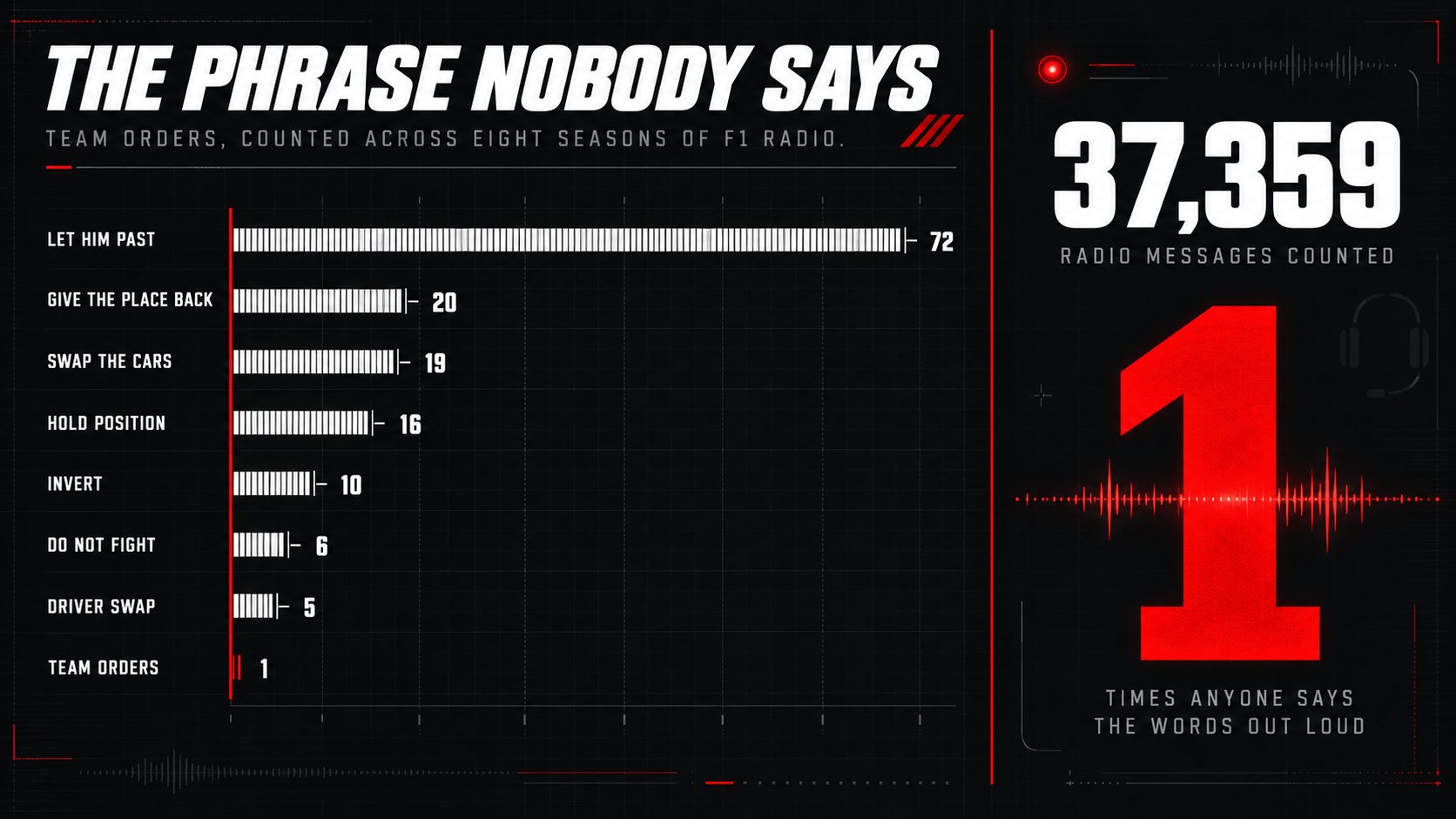
Team orders are the most argued-about thing in Formula 1 and among the rarest things you will ever hear on the radio. We counted every instance across eight seasons of our archive.