Formula 1 had a genuinely new problem to solve on 13 September 2026, and it was banked.
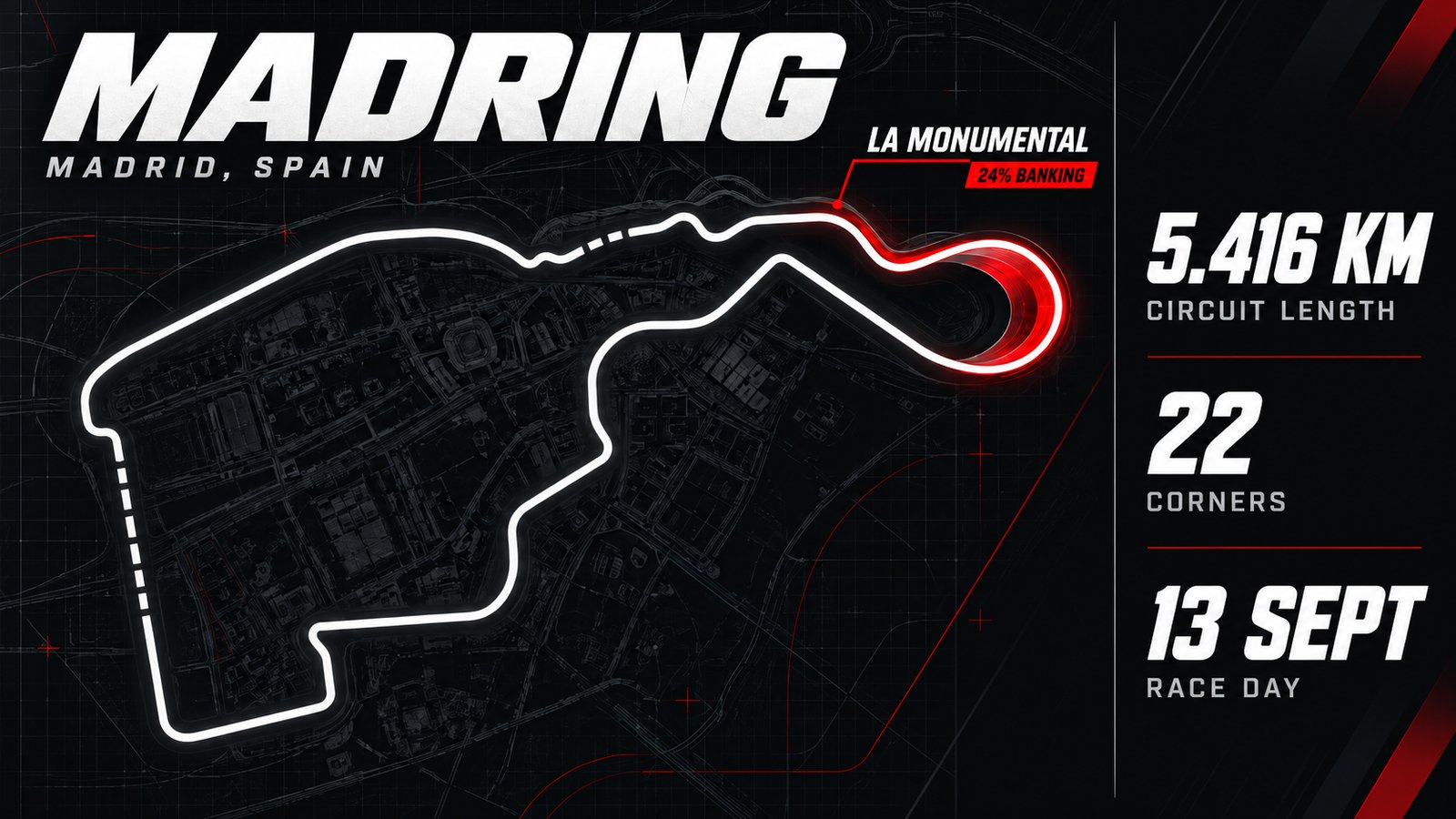
The Spanish Grand Prix moved to Madrid this year, onto a circuit called the Madring that no driver had raced, no team had data for, and no simulator had ever been correlated against. Its defining feature is a corner called La Monumental: a banked curve at a 24% gradient, which is 13.5 degrees, and it is set to be the longest banked corner in Formula 1.
There is nothing like it on the current calendar. Here is what the circuit is, and what the first race there actually measured.
The Madring, drawn from the car rather than traced: this is the path of Lando Norris's 1:31.824 pole lap, taken from position telemetry.
Madring circuit: the numbers
Length: 5.414 km
Turns: 22
Race distance: 57 laps, about 308 km
Race date: Sunday 13 September 2026, round 14
Capacity: 110,000, with a planned expansion to 140,000 within five years
Contract: 2026 to 2035, a ten-year deal
Designer: Jarno Zaffelli
Build cost: around 83.2 million euros
Lap record:1:35.587, George Russell, on lap 49 of the first Spanish Grand Prix here on 13 September 2026. The fastest lap anyone has driven here is Lando Norris's 1:31.824, his pole lap on 12 September.
That last line is the interesting one. Every other circuit on the calendar carries decades of setup data, tyre history and simulator correlation. Madrid carries none, and the first team to understand it will have a real advantage on Sunday.
One thing we can put a number on already. We measured what banking is worth at Zandvoort, the only other banked circuit on the calendar: through its final banked corner a 2026 car holds 267 km/h at full throttle and never lifts, against 211 km/h and a lift to 68% through Monza's unbanked Parabolica on the same machinery. Madrid's banking is shallower than Zandvoort's and much longer. The full measurement is in what banking actually does to an F1 corner.
How many laps is the Madrid Grand Prix?
57. It is worth showing the arithmetic, because the number is not chosen, it is forced.
Formula 1 sets a minimum race distance of 305 kilometres, and a Grand Prix runs the fewest whole laps that clear it. At 5.414 km a lap, 56 laps would come to 303.2 km and fall short. 57 laps clears it, and Formula 1 lists the official race distance as 308.399 km. Monaco is the sport's only exception at 260 km, which is why it runs 78 laps of a much shorter circuit.
That puts Madrid mid-table on lap count. Spa is the longest lap on the calendar at 7.004 km and runs only 44 laps; Monaco is the shortest and runs 78. We worked through every 2026 circuit and its lap count separately.
The practical consequence for a new circuit is worth noting. 57 laps is a lot of repetitions on a surface nobody has raced on, and green asphalt evolves fastest in its first weekend. The track on lap 57 will not be the track on lap 1.
The Madring, measured on its first day
Friday was the first time a Formula 1 car had ever turned a lap here. We measured it from the timing and telemetry feed the same afternoon, rather than waiting for somebody to describe it.
The fastest legal lap of the day was Kimi Antonelli's 1:33.662, set on softs in FP2 for Mercedes. George Russell had set the FP1 benchmark at 1:34.077.
Session
Fastest legal lap
Driver
Team
FP1
1:34.077
George Russell
Mercedes
FP2
1:33.662
Kimi Antonelli
Mercedes
FP2, second
1:33.775
Charles Leclerc
Ferrari
FP2, third
1:33.811
Lewis Hamilton
Ferrari
Fastest laps not deleted by the stewards, from the official timing feed.
The projection circulated before anyone drove here was around 1:34, and this page used to say that was a rough expectation rather than a number. It landed. FP1 came within a tenth of it, and FP2 went four tenths quicker.
What a lap of the Madring is actually made of
One note on method first, because it changes which lap we use. We take telemetry from the fastest lap that passes a health check, not the fastest lap outright, because a frozen speed channel inflates every distance figure on a lap. That guard exists because it caught a bad Monza lap that had already reached five of our pages. Antonelli's lap failed the check, so the measurements below come from Leclerc's 1:33.775, the next quickest, which passed cleanly.
Racing line: 5.324 km of ground actually covered, against the official centreline length of 5.414 km
Average speed: 204.8 km/h
Top speed on the lap: 330 km/h
Slowest point: 80 km/h
Full throttle: 64.1% of the lap, measured by distance
Braking events: 8
Longest run without lifting: 874 m
Conditions: dry, air 30.2°C, track 50.9°C
Qualifying was quicker. Norris's pole lap of 1:31.824 also passed the health check. It averaged 208.7 km/h, peaked at 334 km/h, spent 62% of the lap at full throttle and had 8 braking zones. The full results, the grid penalty and the radio are in our Spanish GP qualifying report. Kimi Antonelli won the race itself, and Russell set the first race lap record at 1:35.587. The full story is in our Spanish GP race report.
Madrid against the circuit it replaced
Barcelona held the Spanish Grand Prix until this year, and we measured its 2026 qualifying lap on the same machinery.
Madring (practice)
Barcelona (qualifying)
Fastest lap measured
1:33.775
1:14.679
Racing line
5.324 km
4.617 km
Average speed
204.8 km/h
222.6 km/h
Top speed
330 km/h
341 km/h
Slowest corner
80 km/h
103 km/h
Full throttle
64.1%
68.3%
Braking events
8
6
Longest flat-out run
874 m
682 m
Madrid figures from a practice lap, Barcelona from qualifying, so Madrid's gap will narrow once qualifying runs.
Two things stand out even allowing for that gap. Madrid is a slower, busier lap: two more braking events, a slowest corner 23 km/h slower, and less of the lap spent at full throttle. But it also has the longer single flat-out run, 874 metres against 682. That is the shape of a circuit with a real straight attached to a lot of slow corners, which is the combination that usually produces overtaking.
Turn 17 is where the lap is being lost
The old version of this page predicted more track limit trouble than usual. It was not close.
55 laps were deleted across FP1 and FP2, 54 of them for track limits. Monza, on a circuit every driver has known for years, produced 28 across its two sessions the weekend before.
Corner
Laps deleted
Turn 17
16
Turn 5
11
Turn 18
10
Turn 6
8
Turns 1, 7, 11, 13, 15 and 19
8 between them
Track limit deletions in FP1 and FP2 combined, by corner, from the stewards' decisions in the timing feed.
Turn 17 alone accounts for nearly a third of them, and Turns 17 and 18 together for almost half. If a lap time gets taken away on Saturday or Sunday, that is where to look first.
Degradation looks mild, on Friday's evidence
We took every stint of five or more timed laps, dropped in and out laps, dropped any lap more than 7% off that stint's best to remove traffic and cool-down laps, and fitted a slope to what was left. That leaves 19 usable long runs.
Medium: about 0.08 s a lap of loss, median across 12 runs
Soft: about 0.19 s a lap, median across 7 runs
That is low, which is what a brand-new surface usually gives you. Treat it as a Friday indication rather than a race prediction: fuel loads in practice are unknown, the sample is small, and a new circuit changes quickly across a weekend.
Hear them working it out
The numbers above are one half of a new circuit. The other half is 22 drivers saying out loud what they have just found, to engineers who have no reference for the answer, and it only happens once in a circuit's life.
The lazy description is "another street race". That is not quite right.
The Madring is a hybrid. It runs on public roads and on non-public land around the IFEMA exhibition centre, so parts of it are tight and street-like, threading between exhibition halls, and parts of it are a permanent circuit with genuine elevation change. Two short tunnels connect the two characters.
That matters for setup. A pure street circuit like Monaco wants maximum downforce and soft springs to ride kerbs. A permanent circuit with elevation and a banked corner wants something else entirely. Madrid asks for both on the same lap, which is precisely the kind of compromise that separates teams when nobody has prior data.
La Monumental, the banked corner
Turn 12 is the reason this circuit will be talked about.
On a banked corner the track presses the car down, so it carries more speed.
La Monumental is banked at a 24% gradient, or 13.5 degrees. For context, that is a regulatory maximum rather than an arbitrary choice, and it is enough to change how the car behaves rather than just how it looks.
Banking adds vertical load without asking the tyre to generate it through grip alone. On a flat corner, cornering force comes entirely from the tyre fighting sideways. On a banked corner, part of the load is pressed down through the suspension by the geometry of the track itself, so a car can carry more speed than its aerodynamic platform alone would allow.
Two consequences worth watching:
Ride height becomes a problem. The 2026 cars run ground effect floors that are extremely sensitive to how close they sit to the track. Compressing a car through banking at speed pushes the floor down. Teams will have to choose between running low for aerodynamic performance everywhere else and running high enough to survive La Monumental without the floor bottoming out. The mechanism is in F1 suspension explained.
Tyre loading is different. Sustained banking loads the tyre in a way flat corners do not, and no team has degradation data for it. Expect conservative first stints.
Where the overtaking is meant to happen
The design specifies four overtaking zones: Turns 1, 5, 11 and 17.
Designed overtaking zones and real overtaking are different things, and the calendar is littered with corners that were supposed to produce passes and did not. What makes Madrid worth watching is that 2026 removed DRS entirely, replacing it with active aerodynamics and a driver-triggered deployment the FIA calls Overtake. So this is a new circuit, designed for overtaking, being raced for the first time under a rulebook where the old overtaking aid no longer exists. What replaced DRS is covered in the 2026 F1 regulations explained.
Nobody knows how that combination behaves. That is not a criticism, it is the reason to watch.
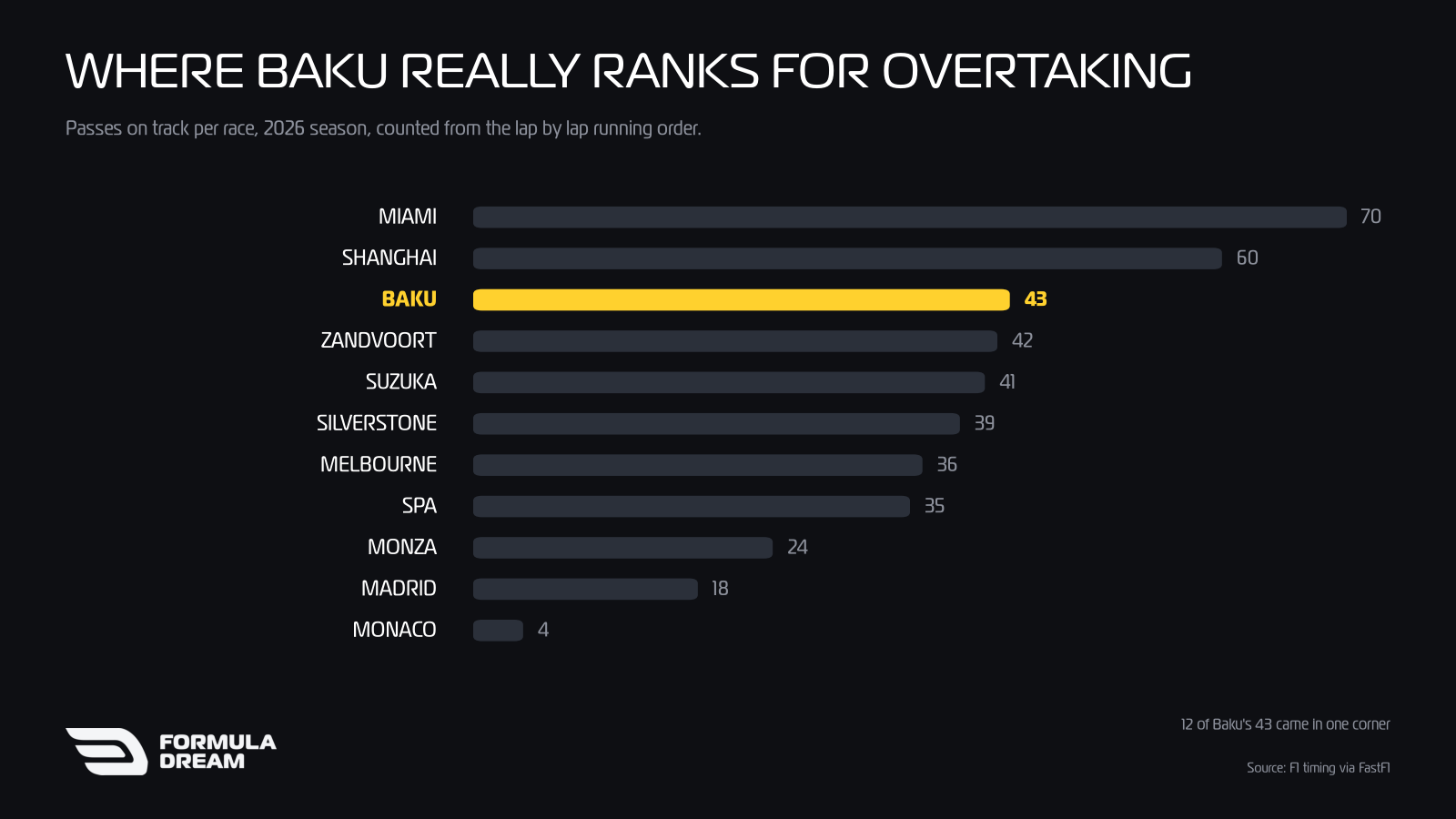
The measured answer, after the race: badly. The first Spanish Grand Prix here produced nine on-track passes in 57 laps, the fewest of 2026 outside Monaco, and drivers spent 129 laps within a second of the car ahead for only nine passes. The organisers now plan to change Turns 5 and 6, Turn 13 and Turn 20 for 2027. Every pass and the reasons are in Madrid had 9 overtakes in 57 laps. We checked every one.
Madrid Grand Prix 2026: session times
Our race preview covers the championship going into round 14 and a measured prediction for the weekend: at circuits teams already know, the field finds a median 2.41% between the fastest FP1 lap and pole. At a circuit nobody has driven it should be more, and we will check it after qualifying.
All five sessions, with the two time zones most of our readers are in alongside local time. Madrid is CEST, UTC+2.
Session
Madrid
UK
US Eastern
Practice 1, Friday 11 Sept
13:30
12:30
07:30
Practice 2, Friday 11 Sept
17:00
16:00
11:00
Practice 3, Saturday 12 Sept
12:30
11:30
06:30
Qualifying, Saturday 12 Sept
16:00
15:00
10:00
Race, Sunday 13 Sept
15:00
14:00
09:00
A conventional weekend format, three practices and no sprint.
Practice 1 on Friday is the one to watch, and not for the usual reasons. It will be the first time a Formula 1 car has ever turned a lap here, so the first genuine reference for the circuit arrives at 13:30 Madrid time on 11 September and not a moment earlier. Every lap time quoted before then, including any in this article, is a projection.
When it happens, the Madring becomes the 81st circuit to hold a Formula 1 Grand Prix.
Which circuit will it drive like?
This section was written before anyone had driven here. We have left the reasoning exactly as it stood and added the measured answer underneath, because a prediction is only worth anything if you check it afterwards.
The Madring is 5.414 km with 22 corners. The Miami International Autodrome is 5.412 km with 19. Two metres of difference in length, three more corners.
Corner density is the useful comparison, because it sets how much of a lap is spent turning rather than accelerating. Against the circuits we measured from 2026 qualifying telemetry:
Circuit
Length
Turns
Turns per km
Full throttle, measured
Monza
5.793 km
11
1.90
84%
Shanghai
5.451 km
16
2.94
70%
Hungaroring
4.381 km
14
3.20
54%
Zandvoort
4.259 km
14
3.29
63%
Miami
5.412 km
19
3.51
68%
Madring
5.414 km
22
4.06
64%, measured Friday
Monaco
3.337 km
19
5.69
51%
Full throttle share measured by distance from 2026 qualifying telemetry, except Madrid, which is measured from Friday practice.
Only Monaco packs corners more tightly than Madrid, and Monaco is a different kind of circuit entirely, a third shorter and hemmed in by barriers.
Now the honest part. The relationship between corner density and throttle is real but not tidy: the Hungaroring sits at 3.20 turns per km and runs only 54% full throttle, while Miami is denser at 3.51 and runs 68%. Corner type matters as much as corner count, and a circuit with a handful of long fast sweeps reads very differently from one with the same number of hairpins.
Madrid has an unusual answer to that, which is why the density number alone will mislead. Its headline corner is 550 metres of banking that drivers are expected to take while accelerating, so a large share of one of its 22 "corners" is not a corner in the throttle-lifting sense at all. We measured what banking does to a fast corner at Zandvoort, where the equivalent turn is taken at 267 km/h with the throttle never leaving 100%, in what banking actually does to an F1 corner.
The safe reading: Madrid should be a busier lap than Miami and a long way from Monza, but the banking makes it a poor fit for any circuit currently on the calendar. Which is presumably the point of building it.
The measured answer, from Friday: 64% full throttle. Busier than Miami's 68%, nowhere near Monza's 84%, and almost exactly where the corner density suggested it would land. The density number was a fair guide after all.
What drivers will call it
Every circuit develops its own vocabulary on the radio, and it takes years to settle. We counted the distinctive words across 34 circuits and found that Monaco says "tunnel" 22.3 times more often than the rest of Formula 1, Shanghai says "holes", and Mexico City's are "lift" and "coast", which is altitude and cooling rather than anything about the corners. Those words are not decoration. They are the parts of a lap that turn out to need talking about, and they only emerge once a circuit has been raced enough times for the same problem to keep coming back. The full count is in the vocabulary each circuit has of its own.
Madrid starts with none of it. From Friday afternoon drivers will be describing a corner that has no shorthand yet, to engineers who have no reference for the answer, and the first weekend of a circuit's life is the only time you get to hear that happen.
The nearest thing to a reference is Zandvoort, the calendar's only other banked circuit. The 2026 Dutch Grand Prix radio is what it sounds like once drivers know a banked corner well enough to stop remarking on it, which is a state Madrid will not reach for years. Every session of this weekend lands in our team radio archive as it is broadcast, with the transcript running alongside the audio.
What we still do not know
Friday answered most of what this section used to list. Here is what it did not.
Race pace in traffic. Long runs on Friday are run in clean air. This circuit's overtaking case rests on a long straight into a slow corner, and nobody has yet tried to follow another car through the twisty final sector for 57 laps.
How the surface evolves. New asphalt gains grip quickly across a weekend, and the race is 57 laps on a circuit that has existed for two days. The track on lap 57 will not be the track on lap 1.
Whether the track limits hold. On Saturday, they did. Friday's two practice sessions lost 55 laps to deletions, 16 of them at Turn 17. Qualifying lost six, and only one at Turn 17.
Why Madrid, and why now
The Spanish Grand Prix has been at Barcelona's Circuit de Barcelona-Catalunya since 1991, a circuit so well known that teams used it for testing precisely because they had so much reference data. Where it sits among the quickest venues is in the fastest F1 circuits. Madrid replaces it under a deal running to 2035.
The commercial logic is straightforward: a capital city, a purpose-designed venue next to an exhibition centre with existing infrastructure and transport, and a ten-year commitment. The sporting logic is the part that gets settled on track.
Watch the first laps anyone has ever driven here
There is one weekend a year where live timing genuinely matters more than usual, and it is the one where nobody has any data.
The Formula Dream app runs a live Dashboard through every session: every car on the circuit map, and a timing tower with lap times, gaps and intervals, tyre compound and age, plus flag and safety car alerts as race control calls them. On a circuit with no history, watching sector times evolve through FP1 is watching teams learn in real time. You also get live driver radio as it is broadcast, which is where the first real opinions of La Monumental will be voiced, and every FIA document of the weekend as it is published, which on a new circuit means the track limit notes that decide who keeps their lap time.
Free, no subscription, no ads, independent. Not affiliated with Formula 1.
The race lap record is 1:35.587, set by George Russell on lap 49 of the first Spanish Grand Prix here on 13 September 2026. The fastest lap anyone has set here is 1:31.824, Lando Norris's pole lap in qualifying on 12 September 2026. Before the circuit opened, the projection for a lap was around 1:34.
How fast is the Madrid F1 circuit?
A measured practice lap averages 204.8 km/h, with a top speed of 330 km/h and a slowest corner of 80 km/h. That makes it slower than Barcelona, the circuit it replaces, which averaged 222.6 km/h on its 2026 qualifying lap.
What is the Madring?
The Madring is the new Formula 1 circuit in Madrid, built around the IFEMA exhibition centre. It is 5.414 km long with 22 turns, and hosts the Spanish Grand Prix from 2026 under a contract running to 2035.
When is the 2026 Madrid Grand Prix?
The race is on Sunday 13 September 2026, the fourteenth round of the season, with track action across the weekend of 11 to 13 September.
What time does the Madrid Grand Prix start?
15:00 local on Sunday 13 September, which is 14:00 in the UK and 09:00 US Eastern. Qualifying is 16:00 local on the Saturday, and the first practice session of the weekend, and of the circuit's history, is 13:30 local on Friday 11 September.
How long is the Madrid F1 circuit?
5.414 km, with 22 turns. It is a hybrid of public roads and a permanent section on non-public land around the IFEMA campus, linked by two short tunnels.
What is La Monumental at the Madring?
A banked corner at a 24% gradient, equivalent to 13.5 degrees, set to be the longest banked corner in Formula 1. Banking presses load through the car rather than asking the tyres to generate all of it, so cars can carry more speed than a flat corner of the same radius would allow.
Is the Madrid Grand Prix replacing Barcelona?
Yes. The Spanish Grand Prix moves from Circuit de Barcelona-Catalunya, which had held it since 1991, to Madrid on a deal running to 2035.
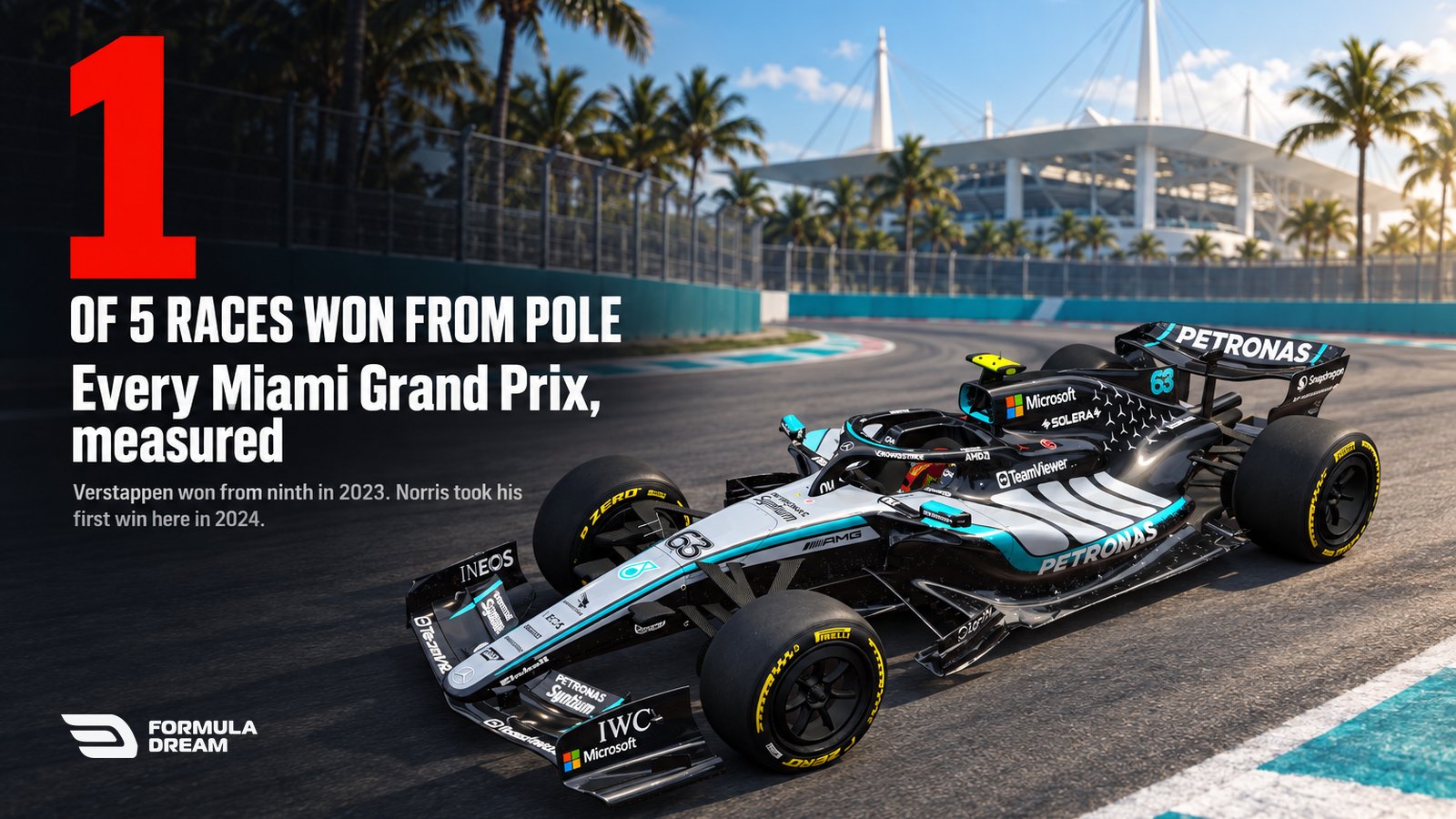
Every Miami Grand Prix winner, measured: five races, and pole has won only one of them
Five Miami Grands Prix have been held since 2022, and only one was won from pole: Kimi Antonelli's in 2026. Max Verstappen won from ninth in 2023, and Lando Norris took his first win there in 2024. Every winner, grid slot and safety car, measured.