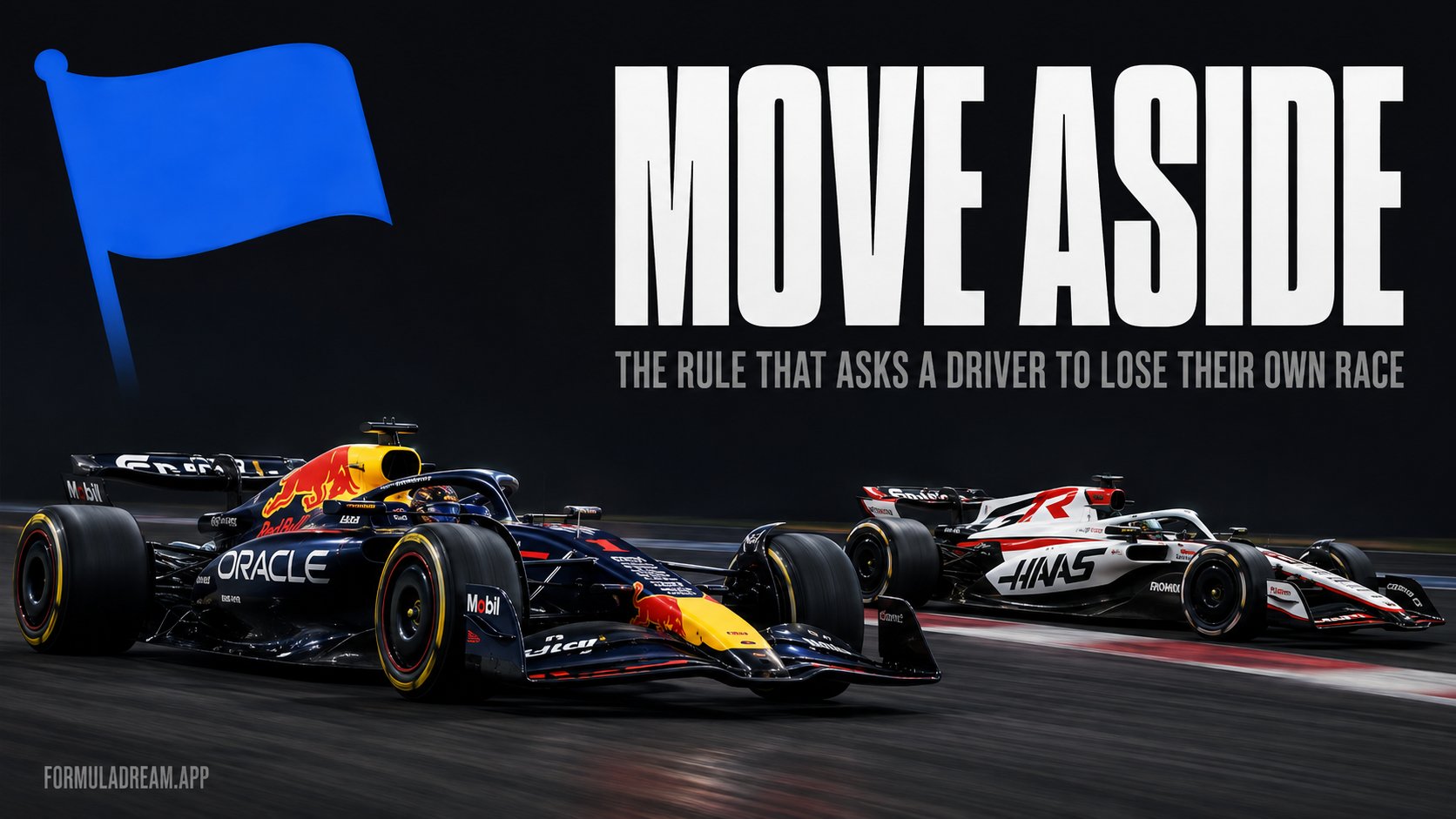
A blue flag in F1 tells a driver that a faster car is about to lap them. The FIA's flag rules say that when it is shown in a race, the driver "must allow the following car to pass at the earliest opportunity". In practice and qualifying it means something slightly different: a faster car is close behind and about to overtake.
Ignore it and the stewards step in. The three blue flag offences in the FIA documents we have collected since 2022 all ended the same way: a five-second time penalty.
It is the only rule in Formula 1 that asks a competitor to actively make their own race worse, and that is precisely why it produces an argument every few weekends.
What does a blue flag mean in F1?
The meaning is set out in Appendix H of the FIA International Sporting Code, the rulebook for flags and marshalling across motorsport. The blue flag has three uses:
In a race: it "should normally be shown to a car about to be lapped, if the driver does not seem to be making full use of his rear-view mirrors. When shown, the driver concerned must allow the following car to pass at the earliest opportunity."
In practice and qualifying: "A faster car is close behind you and is about to overtake you."
At the pit exit, at all times: a stationary blue flag warns a driver leaving the pits that traffic is approaching on the track.
Note what the rule does not say. It does not say the lapped driver must brake, pull off line, or lift dramatically. It says let the car past at the earliest opportunity. A driver who lets the leader through on a straight rather than throwing the car sideways in a corner is complying correctly.
In modern F1 the flag is rarely just a flag. Light panels around the circuit flash blue, and normally the car's dashboard tells the driver the warning is for them. When that part fails, it gets messy, as the 2026 Hungarian Grand Prix showed.
What happens if a driver ignores blue flags?
The rules do not set a number of flags after which a penalty is automatic. The stewards judge each case. What they have actually done is remarkably consistent.
Race
Driver
What happened
Penalty
2022 Azerbaijan GP
Nicholas Latifi, Williams
Stayed ahead of Pierre Gasly for 12 blue flag light panels
5 seconds and one penalty point
2022 Dutch GP
Sebastian Vettel, Aston Martin
Rejoined from the pits ahead of Lewis Hamilton and Sergio Perez, who were fighting over third, and held them up for several corners
5 seconds
2026 Hungarian GP
Oliver Bearman, Haas
Held up Isack Hadjar while being lapped, in a race where the dashboard blue flag alerts were not working
5 seconds
Blue flag offences in the FIA documents we collected from 2022 to the 2026 Italian Grand Prix
Both drivers in 2022 had a reason. Latifi said he had stayed ahead of Gasly so that Gasly would not lose DRS against Hamilton behind him. Vettel's answer was blunter: "Not even half a lap and I was out of the way. So obviously I can't disappear."
Bearman's case is the most sympathetic. At the Hungaroring in 2026 the in-car alerts that tell a driver the flag is for them stopped showing car numbers, and drivers were left reading the light panels alone. "Every lap I did I had blue-flag screens coming up," he said. The stewards still penalised him.
Three offences in more than four seasons is a small number for a flag shown at almost every race, and it says something about how the rule really works: the team usually tells a driver to move long before the stewards get involved.
Why is the blue flag rule so controversial?
Because it is the one rule that requires a driver to give something up for someone else's benefit.
Every other regulation constrains how you race. This one instructs you to stop racing, briefly, and hand over track position to a driver you are not competing with. If you are in a battle for tenth and the leader arrives, you must yield, even if yielding costs you the position you were fighting for. Nobody is compensated for it.
There is a counter-argument, and it is strong. Formula 1 has an enormous performance spread between the front and back of the grid. Without a firm rule, the leaders would spend a meaningful part of every race stuck behind cars several seconds a lap slower, and a championship would be decided by traffic luck rather than pace. Our measurements show why that risk is real: running within one second of another car costs about 0.49 seconds a lap in lost downforce, so being stuck behind a lapped car for even a few laps is a meaningful penalty applied at random. The data is in what dirty air costs.
Both things are true at once, which is why the argument never resolves. It is a genuine trade-off between two reasonable principles, not a rule that is simply wrong.
Why you hear so much arguing about them
Blue flags produce more radio traffic than almost any other rule, for a structural reason: the driver being asked to move has the least to gain and the most immediate reason to complain.
The judgement is also genuinely difficult. "The earliest opportunity" is a matter of interpretation on a narrow circuit, and moving off the racing line puts a driver on a dirty surface where grip is poor and a mistake is easy. Do it in the wrong place and you hand your own rival a free position, or crash.
Where overtaking is hardest, the flags matter most and are hardest to obey. Monaco produced three on-track overtakes in an entire Grand Prix in our count, against 57 at Abu Dhabi, so on those weekends the blue flag is effectively doing the passing that the circuit will not allow. The full count is in F1 overtakes per race.
Blue flags in qualifying: the version most fans get wrong
In practice and qualifying there is no lapping, so the flag simply warns a driver on a slow lap that a car on a flying lap is coming.
The obligation is similar in spirit, but the stakes are different. In qualifying, getting in the way is the offence usually recorded as impeding, and it draws its own penalties, frequently a grid drop. A recent example published as an ordinary stewards' document: the 2025 Abu Dhabi Grand Prix, Car 22 penalised for impeding Car 4.
So the same colour flag covers two related but distinct situations, which is a decent part of why people find the rule confusing.
There is also a piece of machinery behind the flag that almost nobody watching knows about. Blue flags are triggered automatically when a car comes within range, and when the system fails the engineers have to do it by hand. Nico Hulkenberg's engineer, 2023 Japanese Grand Prix:
"The automatic blue flag system isn't working so I'll tell you when he's in the range."
And the reason drivers get so exercised about it, in Lando Norris's own words at the 2023 Hungarian Grand Prix:
"They have to get out of the way, he's had so many blue flags! He's not racing for anything!"
Blue flag decisions, like all penalties, arrive as published stewards' documents naming the car, the offence and the reasoning. We have written a guide to reading those documents.
What to watch for
Watch the gap, not the flag. Once a lapped car has been shown the flag, a leader stuck behind it for more than a few corners usually means a penalty conversation is already happening on the radio.
Watch where they yield. A clean yield happens on a straight or a corner exit. A driver who waits for a corner entry to move is technically complying and practically making a point.
Watch the battle behind. The real cost of a blue flag is rarely to the driver being lapped. It is to whoever they were racing, who has just gained a free half-second.
Following it live
Gaps, flags and radio are all live during a session.
Our app puts every car on the circuit map with a full timing tower carrying gaps, intervals, tyre compound and tyre age, pit stop counts and positions gained or lost, plus alerts as flags are shown. Driver radio streams live with the transcript running beside the audio, which is where blue flag frustration is usually audible well before any penalty.
It also collects every FIA document published across the weekend, including the impeding and blue flag decisions that most fans never read.
Free, no subscription, no ads. Independent, and not affiliated with Formula 1.
In a race, it tells a driver they are about to be lapped, and they must let the faster car past at the earliest opportunity. In practice and qualifying, it warns that a faster car is close behind.
What happens if you ignore blue flags in F1?
The stewards can penalise you. The three blue flag offences we found in FIA documents from 2022 to 2026, for Nicholas Latifi, Sebastian Vettel and Oliver Bearman, were all punished with a five-second time penalty, and Latifi also received a penalty point.
How many blue flags before a penalty?
There is no fixed number in the rules. The stewards judge each case. Latifi was penalised after staying ahead of the faster car for 12 blue flag light panels at Baku in 2022.
Do blue flags apply in qualifying?
Yes, with a different meaning. In practice and qualifying a blue flag warns that a faster car is close behind. Getting in the way of a car on a flying lap is judged as impeding, which usually brings a grid penalty.
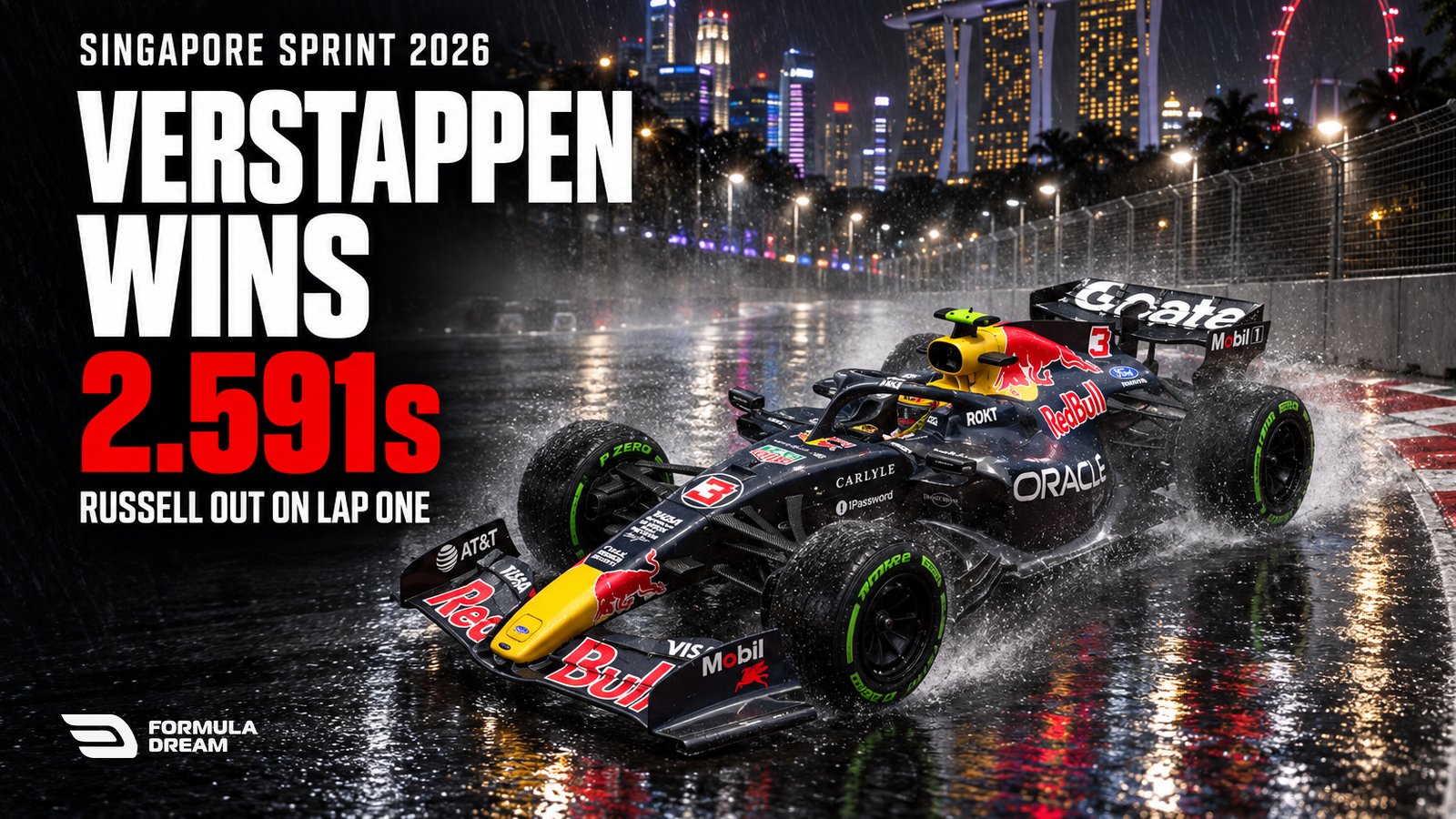
Singapore Sprint 2026 Results: Russell Crashes From the Lead
Russell took the lead at turn one and crashed at the final corner of the same lap. Verstappen won, Hamilton charged to second, and the McLarens hit each other.