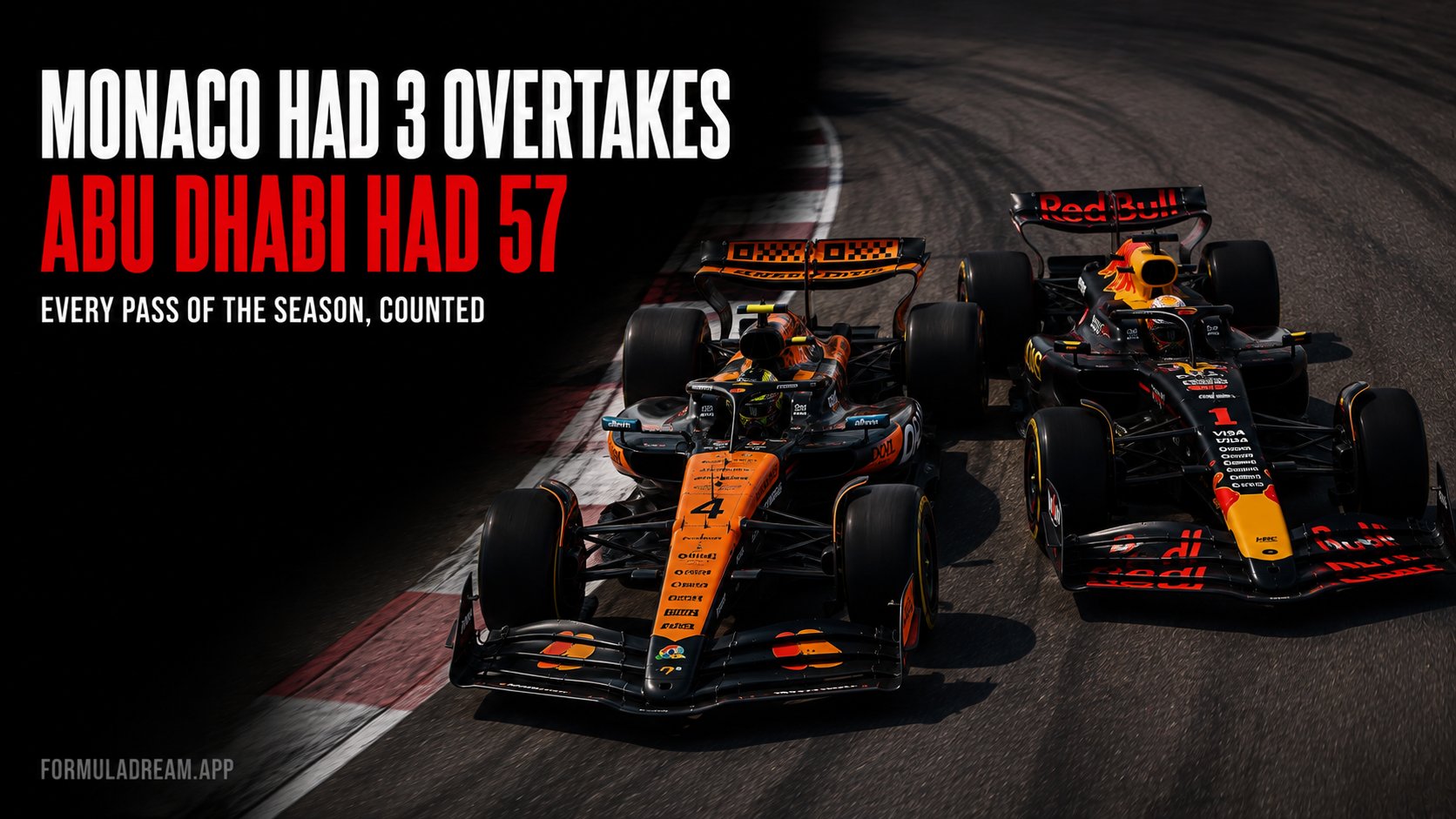
Across the 2025 season, the Monaco Grand Prix produced three on-track overtakes in 78 laps. The Abu Dhabi Grand Prix produced 57 in 58.
Passes are argued about on the radio before and after they happen. Every message from the most recent race is in our Spanish Grand Prix 2026 race radio archive, with the original audio.
Adjusted for race length that is 0.4 passes per ten laps against 10.2. A twenty-five fold difference.
And when we tested the thing everyone blames for the lack of overtaking, dirty air, against the actual number of passes, there was no relationship at all.
On-track passes per 10 racing laps by circuit, 2025 season
Counting overtakes is harder than it looks
Most position changes in a Formula 1 race are not overtakes. A driver pits, drops six places, and regains them over the next few laps as everyone else stops. Nobody passed anybody. If you count raw position changes you end up measuring pit stop cycles and calling it racing.
So we required four things to be true before counting a pass:
Driver A was behind driver B at the end of one lap and ahead at the end of the next.
Neither driver had a pit entry or pit exit on either of those two laps.
Both laps were under green flag for both drivers, so safety car shuffles are out.
Both drivers had valid times on both laps, so retirements are out.
Lap 1 is excluded entirely. The start is not overtaking, and we have already measured it separately.
The check that tells you it works is Monaco. If a method for counting overtakes does not put Monaco at the bottom, the method is wrong. That was written down before the analysis ran. Monaco came out at three passes, the lowest of the season by a distance.
The full season
Abu Dhabi: 57 passes, 10.2 per 10 laps
Imola: 46, 7.5
Bahrain: 41, 7.5
Interlagos: 43, 6.2
Jeddah: 30, 6.2
Montreal: 41, 6.0
Mexico City: 39, 5.7
Barcelona: 33, 5.2
Hungaroring: 33, 4.9
Spa: 20, 4.8
Monza: 16, 3.1
Baku: 15, 3.1
Suzuka: 12, 2.4
Miami: 12, 2.2
Lusail: 4, 0.7
Monaco: 3, 0.4
Total on-track passes per race across the 2025 season
The 2026 season has since produced a worse race than any of these. The first Grand Prix at Madrid's Madring managed nine on-track passes in 57 laps, and four of those were on cars with a problem or a driver who had run off the track: Madrid had 9 overtakes. We checked every one. We also applied this count to the ten circuits Formula 1 chose for its 2027 sprint weekends, and two of them are the hardest places to pass on the calendar: F1's 2027 calendar has 10 sprints.
Two results in that list are worth stopping on.
Monza is 17th. The circuit with the longest straights and the most famous slipstream produced 3.1 passes per ten laps, less than half of Imola. Long straights help you complete a pass but they also let the field string out, and Monza has very few slow corners where a pace difference can be converted into a position. The lap is short, the tow is powerful, and yet the racing is often a procession at the front.
Lusail is second from bottom, and there is a specific reason. Pirelli imposed a mandatory 25-lap maximum stint length at the 2025 Qatar Grand Prix after wear analysis showed the left front reaching its limit, which forced the entire field into an effectively identical two-stop race. When everyone runs the same strategy, nobody gains the tyre offset that creates a pace difference, and pace differences are what overtaking is made of. A rule intended to protect tyres produced 4 on-track passes.
Dirty air does not predict overtaking
Now the part that surprised us.
We measured separately that running within a second of another car costs about 0.49 seconds a lap, and that the cost varies enormously by circuit, from 1.58 seconds at Jeddah down to almost nothing at Monza. Dirty air is the standard explanation for why modern Formula 1 cars struggle to pass. It is the reason given for the 2022 regulations and again for the 2026 ones.
So the obvious hypothesis: circuits where dirty air is expensive should have less overtaking.
We have both numbers, measured the same way, for the same season. So we tested it.
On-track passes per 10 laps plotted against the measured cost of running in dirty air
There is no relationship. The correlation is +0.07, which is nothing.
Jeddah has the most punishing dirty air of any circuit we measured and above-average overtaking. Monza has almost no dirty air penalty at all and below-average overtaking. Abu Dhabi and Bahrain sit mid-table for dirty air and top the overtaking list.
Including Monaco pushes the correlation to +0.32, which looks like weak support for the hypothesis. It is not. Monaco is the one circuit where our dirty air method is known to break down, because there is so little clear air all afternoon that the baseline is itself a queue. Excluding it, the apparent relationship vanishes. That is worth stating plainly: a single known-bad data point was doing all the work.
So what does drive overtaking?
Not the wake alone. Overtaking needs a pace difference between two cars and a place to use it.
The pace difference usually comes from tyres: different compounds, different ages, different strategies. Lusail shows what happens when a rule removes that difference. Abu Dhabi and Bahrain, both high-degradation circuits with real strategic variety, top the list.
The place to use it means a long enough straight into a heavy braking zone. Monza has the straight but few of the slow corners that let a quicker car close up in the first place.
Dirty air makes it harder to stay close enough to attempt a pass. But it is one input, and on this evidence not the dominant one. A circuit can have brutal dirty air and still produce good racing if the tyres create pace differences and there is somewhere to attack.
What this changes about watching a race
Ignore the straight length when predicting a good race. Monza has the longest and finished 17th of 24.
Watch the strategy spread instead. When the field is split across different compounds and stint lengths, passes follow. When everyone is locked onto one strategy, they do not.
Three overtakes is what Monaco actually produces. Not "few". Three, in 78 laps, over nearly two hours.
Be careful with the dirty air explanation. It is real and we have measured it costing half a second a lap. It is not, on its own, what decides whether a race has any overtaking in it.
Method
Data: FastF1, all 24 races of the 2025 season.
A pass requires: position swap between consecutive laps, no pit in or pit out for either driver on either lap, green flag on both laps for both drivers, and valid times throughout. Lap 1 excluded.
Positions derived from cumulative end-of-lap session times, not from the position column, so a lapped car cannot register as a pass.
Per-10-lap figures normalise for race length, which matters a lot when comparing a 78 lap Monaco with a 44 lap Spa.
Known limitation: because laps involving a pit stop are excluded for both drivers, races with an unusually high number of stops have a smaller pool of eligible lap pairs. This slightly suppresses counts at high-stop races. Lusail had 44 stops and Monaco 41, so both figures should be read as "very low" rather than as exact.
The dirty air figures come from our own separate measurement of the same season, using the same race sessions.
Monaco is excluded from the dirty air comparison only, and the reason is stated in the body. It is included everywhere else.
Overtakes are easy to miss and easy to miscount without position data.
The Formula Dream app runs a live Dashboard through every session: every car moving on the circuit map, and a timing tower with lap times, gaps and intervals, tyre compound and age, pit counts and positions gained or lost. It is the same information these measurements come from, arriving live. You also get live driver radio as it is broadcast, and every FIA document of the weekend as it is published.
Free, no subscription, no ads, independent. Not affiliated with Formula 1.