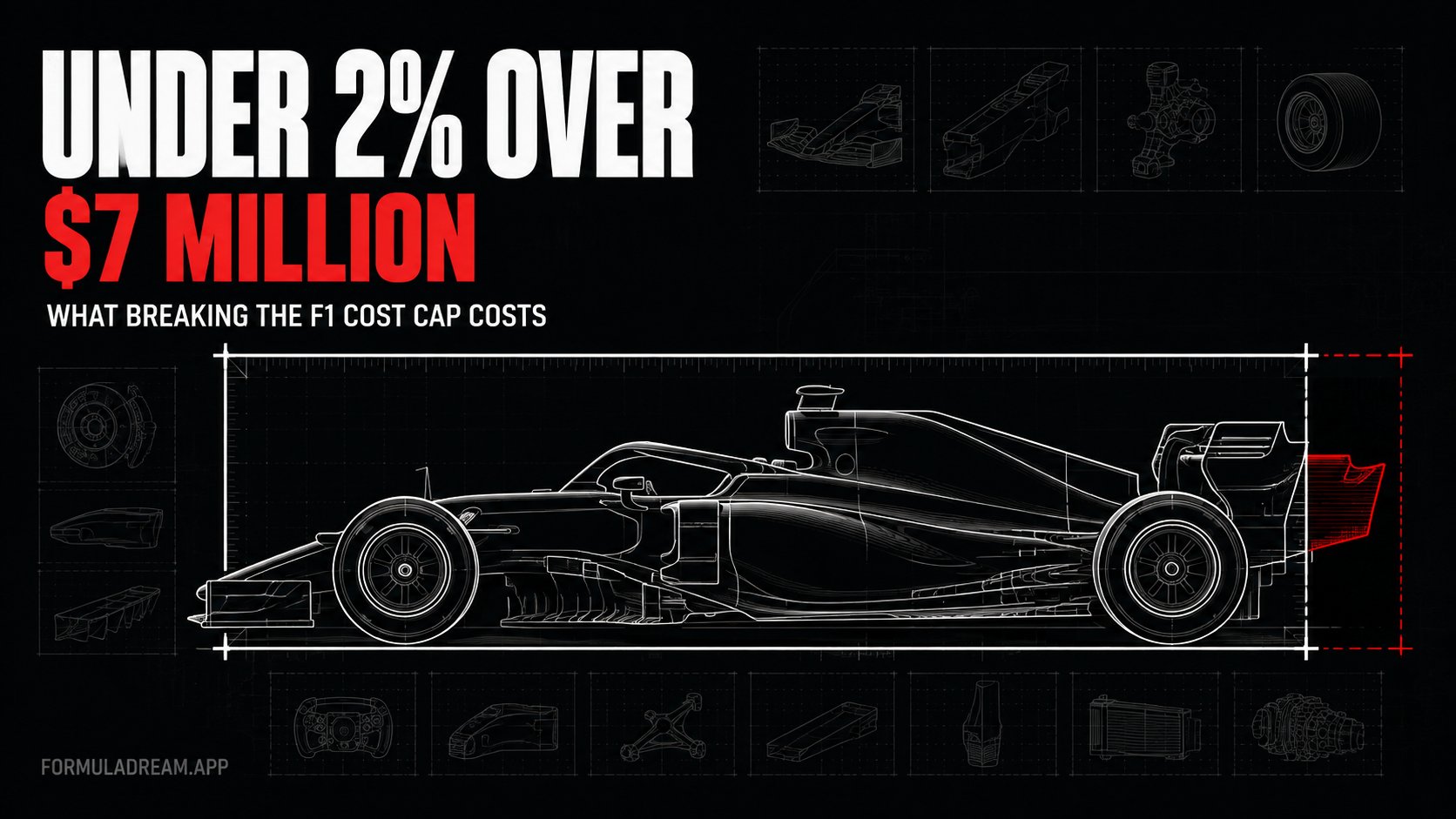
In 2021 Red Bull spent too much. The FIA found no dishonesty, no concealment and no bad faith. The team still paid a $7 million fine and had its wind tunnel allocation cut from 70% of baseline to 63% for the following year.
That case was the first real test of the cost cap enforcement system, and it tells you a lot about how the rules work in practice.
What is the F1 cost cap?
A hard limit on what a team may spend on the performance of its car in a season. Introduced to stop the sport being decided by budget, it caps the areas where money most directly buys lap time.
It does not cap everything. Driver salaries, the salaries of the highest-paid personnel, marketing and several other categories sit outside it. The cap is aimed at car development, not at the business as a whole.
The 2021 season, the first under the cap, ran to a limit of $145 million. For 2026 the cap is
for a season of up to 24 races, under Article D4.1.2 of the Financial Regulations.
The two categories of breach
The regulations split overspending into two tiers, and for 2026 the line between them has been pulled much tighter.
A minor overspend breach is now less than 2% over the cap. It brings a fine and any appropriate minor sporting penalties.
A material overspend breach is 2% or more, and here the headline sanction is not optional. Under Article D10.3.4 of the 2026 Financial Regulations, the Cost Cap Adjudication Panel must deduct constructors' championship points, and must also impose a fine, alongside any other appropriate penalties.
When Red Bull's 2021 spending was judged, the line between the two tiers was 5%.
Red Bull's 2021 case was a minor breach. Depending on which figure you use, the overspend was reported as £1,864,000, about 1.6%, or as roughly £432,652 once an unclaimed UK tax credit of £1.4 million was taken into account. Either way it sat well inside the minor band, and it would still count as minor under the tighter 2026 threshold.
Sitting inside that band is what kept the penalty financial and developmental rather than sporting.
What penalties are available
The regulations give the panel a menu rather than a fixed tariff, which is deliberate. Under Article D12.1 of the 2026 Financial Regulations:
A financial penalty, a fine set case by case
Minor sporting penalties: a public reprimand, deduction of constructors' or drivers' championship points, suspension from parts of an event other than the race itself, limits on aerodynamic or other testing, or a reduction of the team's cost cap for the following year
Material sporting penalties, which add suspension from whole events including the races, and exclusion from the championship
The points deductions, suspensions and exclusion are the penalties that would genuinely reshape a season, and none of them was used in the 2021 Red Bull case. There is also a change in how settlements work. Under the 2026 rules, an agreed settlement of the kind Red Bull signed cannot impose a points deduction at all: that can only come from the adjudication panel.
What Red Bull actually received
Two penalties, one obvious and one that mattered more.
A $7 million fine. For a team operating near a $145 million cap, that is real money, and it is money that cannot be spent on the car.
A 10% reduction in aerodynamic testing. This is the one that bites. Red Bull's allocation, already the lowest on the grid because they were champions, dropped from 70% of baseline to 63%.
Understanding why that hurts requires understanding the sliding scale: the constructors' champion already receives the smallest wind tunnel allowance in the sport, as a deliberate handicap. We explain that system in how F1 handicaps the team that wins.
So the penalty was applied on top of an existing handicap, compounding it. The champion went from developing on 70% of a midfield team's allowance to 63%.
No points were deducted. The 2021 championship, which Red Bull won, stood.
The part that gets misremembered
Two details from the FIA's findings are routinely left out of the retelling, and both matter.
The FIA explicitly found no bad faith. Its investigation concluded there was no evidence Red Bull had sought at any time to act dishonestly or fraudulently, or had wilfully concealed information from the Cost Cap Administration. That matters, because the current rules list bad faith, dishonesty, wilful concealment and fraud as aggravating factors that make a sanction heavier.
The penalty could not be appealed, because Red Bull entered an Accepted Breach Agreement. An ABA is a settlement: the team accepts the finding and the penalty, and in return the matter concludes. It is not a verdict imposed after a contested hearing.
That combination is why the case is argued about endlessly. People who think the penalty was too soft point at a champion keeping its title. People who think it was too harsh point at a sub-2% overspend, found in good faith, in the first year of a brand new financial regulation that nobody had operated before. Red Bull themselves described it as "draconian".
Both readings are available from the same facts, which is usually the sign of a genuinely difficult case rather than an obviously wrong decision.
Why enforcement is harder than it sounds
A cost cap is not a speed limit. It is an accounting rule, applied to organisations with complex group structures, shared facilities, related companies and years-long development programmes.
Deciding whether a particular cost belongs inside or outside the cap is a matter of interpretation, and interpretations can be wrong without anybody lying. That is exactly what a tax credit dispute of the kind in the Red Bull case looks like: not cheating, but a genuine disagreement about categorisation with millions attached.
This is why the FIA runs a dedicated Cost Cap Administration, and why breaches are assessed rather than simply detected.
What it means for the sport
The cost cap changed what winning costs, and by extension what prize money is worth. A team can no longer convert additional revenue directly into car performance, which was the entire point.
It also changed what a penalty can be. Before the cap, punishing a team financially was close to meaningless for the wealthiest. Under a cap, a fine and a development restriction are genuine sporting consequences, because both come out of the same finite pool as the car.
Financial regulation findings, like everything else the FIA decides, arrive as published documents.
Our app collects every FIA document from a race weekend as it is released, alongside a live dashboard putting every car on the circuit map during a session with a timing tower carrying gaps, intervals, tyre compound and tyre age, pit stop counts and positions gained or lost. Driver radio streams live with the transcript beside the audio.
Free, no subscription, no ads. Independent, and not affiliated with Formula 1.
$215 million for a season of up to 24 races, with an extra allowance for each race beyond that, under Article D4.1.2 of the 2026 Financial Regulations. Driver salaries and several other categories sit outside it.
What happens if an F1 team goes over the cost cap?
It depends how far over. Less than 2% is a minor overspend, punished with a fine and any appropriate minor sporting penalties such as reduced wind tunnel time. 2% or more is a material overspend, and the rules then require a constructors' championship points deduction as well as a fine.
What was Red Bull's cost cap penalty?
For overspending in 2021, Red Bull agreed to a $7 million fine and a 10% cut in its aerodynamic testing allowance, taking it from 70% to 63% of the baseline. No points were deducted, and the FIA found no bad faith.
---
Sources
The 2026 cap, breach categories, sanctions, settlements and aggravating factors: FIA 2026 Formula 1 Financial Regulations (F1 Teams), Section D, Issue 04, Articles D4.1.2, D8.10, D10.3, D12.1 and D12.3
Singapore Sprint 2026 Results: Russell Crashes From the Lead
Russell took the lead at turn one and crashed at the final corner of the same lap. Verstappen won, Hamilton charged to second, and the McLarens hit each other.