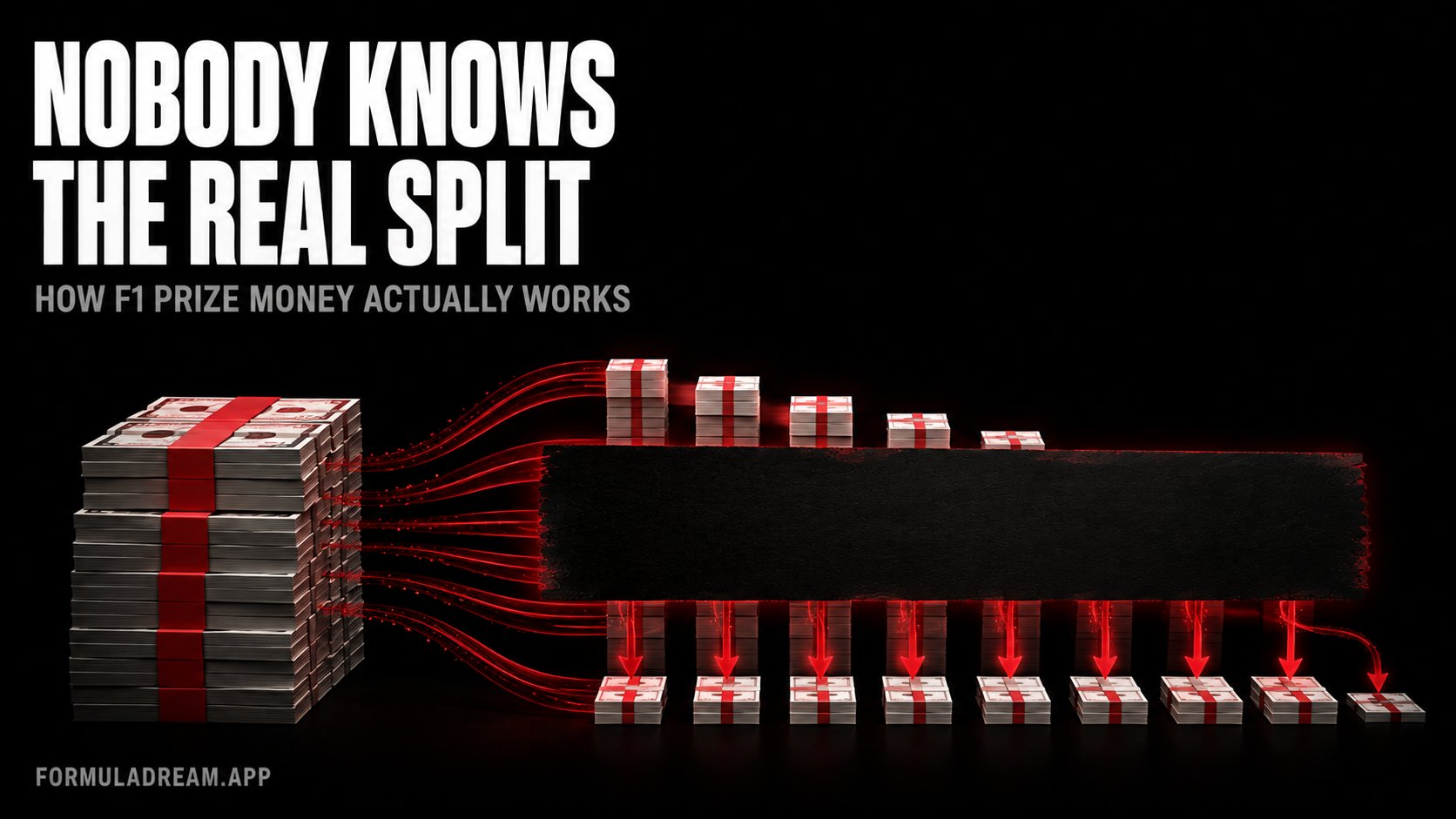
Formula 1 teams are paid from a shared pool of the sport's revenue. Roughly half of the distributable amount is split by finishing position in the constructors' championship, and some teams receive additional payments for historic reasons. The exact percentages are not public, and the figures you will find online contradict each other.
The split between teams is secret. The total is not. Formula 1's owner, Liberty Media, reports what it pays the teams every year.
2024
2025
Total Formula 1 revenue
$3.411 billion
$3.873 billion
Primary Formula 1 revenue
$2.757 billion
$3.086 billion
Payments to the teams
$1.266 billion
$1.400 billion
Races
24
24
Formula 1 revenue and payments to teams, from Liberty Media's full-year results. Team payments exclude Concorde incentive payments.
In 2025 Formula 1 paid its teams $1.4 billion, up from $1.266 billion in 2024. Liberty put the increase down to growth in F1's profitability, which is the point: the teams' share rises and falls with how much money the sport makes. That $1.4 billion is about 36% of all Formula 1 revenue, and about 45% of its primary revenue, the money from race hosting fees, media rights and sponsorship.
Is there prize money for each race?
No. Formula 1 does not pay a prize for winning a Grand Prix. The money is divided according to the championship over a whole season. Spread across 24 races, the 2025 total works out at about $58 million per race for the entire grid, or under $6 million per team per race on average, but no team is actually paid that way.
Where the money comes from
Formula 1 sells things: television and streaming rights, race hosting fees paid by circuits, trackside advertising, and licensing.
Teams enable that by granting the commercial rights holder the rights to their image, which is what makes a broadcast saleable in the first place. In return they are paid from the revenue. That trade is written into the Concorde Agreement, the contract between the FIA, the commercial rights holder and the teams, which we explain in our piece on the Concorde.
So prize money is not a prize in the ordinary sense. It is a contractual revenue share, and finishing position is the formula by which it is divided.
The structure, as generally understood
Three layers, in this order.
Layer one: an equal share. A portion of the distributable revenue is split evenly among the teams that qualify for it, historically the top ten in the championship. Commonly described as the Column 1 payment. Every qualifying team gets the same amount regardless of where it finished.
Layer two: a performance share. A second, similarly sized portion is divided according to constructors' championship position, descending from the champion down. This is the Column 2 payment, and it is where finishing eighth instead of ninth is worth real money.
Layer three: historic and special payments. Additional sums paid to specific teams for reasons that are not about last season's results. Ferrari receives a long-standing bonus in recognition of having been in Formula 1 since the beginning and never having left. Other teams have historically received payments based on sustained past success, measured over a rolling multi-year window, which is why a team that dominated for a decade continues to benefit after the dominance ends.
That third layer is the one that generates argument, because it means two teams finishing in identical positions can be paid very differently.
Why the published percentages disagree
Now the part that most articles skip.
You will find the equal-share and performance-share portions quoted at figures like 23.7% each. You will find Ferrari's bonus quoted at 2.5% in one source and 5% in another. These are not typos and one of them is not simply wrong. They are reconstructions.
The Concorde Agreement is confidential. It has never been published. Every percentage in circulation traces back to leaks, litigation disclosures, financial filings, and journalism, from different agreements in different years.
The percentages also genuinely change. Each Concorde renegotiates the split, and the ninth agreement now runs to 2030. A figure that was accurate under the seventh agreement is not evidence about the current one.
So the honest position is: the structure is well established, the exact numbers are not verifiable, and any article stating them to one decimal place without a caveat is presenting reconstruction as fact.
What we can say with confidence
Several things are solid, and they matter more than the decimals.
Championship position is worth real money, which is why teams fight over positions that look meaningless. A battle for seventh in the constructors' on the last lap of the last race is a battle over a payment.
The gap between finishing positions is not evenly spaced. The scale is weighted towards the front, so moving up near the top is worth more than the equivalent move at the back.
Not all teams are paid on the same terms. Historic payments break the symmetry deliberately.
Prize money is not the whole picture. Teams also earn from sponsorship and manufacturer backing, and for some teams those dwarf the prize payment. Prize money is the floor, not the ceiling.
And it is spent against a cost cap. The cost cap limits what a team may spend on car performance, which changes what an extra payment is worth. More revenue no longer straightforwardly buys more speed, which was the entire point of introducing it.
Why the constructors' championship matters more than the drivers'
For a team, this is not close.
The drivers' championship is the one with the fame. The constructors' championship is the one attached to the payment schedule. Teams optimise for the constructors' title, and that explains a lot of otherwise strange behaviour: team orders protecting a lower position, a driver being asked to hold station rather than risk contact, and the reluctance to let two cars race hard for a place they already hold.
None of that is a team being unsporting. It is a team defending a line in its own accounts.
Watching it play out
The championship positions that decide payments move race by race, and the documents that confirm classifications and any post-race changes are published by the FIA, usually without announcement.
Our app collects every one of those documents as it is released, including the ones that alter a result after the flag. During a session it also puts every car on the circuit map with a timing tower carrying gaps, intervals, tyre compound and tyre age, pit stop counts and positions gained or lost, and streams driver radio live with the transcript beside the audio, which is where team orders are actually given.
Free, no subscription, no ads. Independent, and not affiliated with Formula 1.
Formula 1 paid its teams $1.4 billion in total in 2025, up from $1.266 billion in 2024, according to Liberty Media's full-year results. How that total is split between the teams is not published.
Is there prize money for winning an F1 race?
No. Payments are based on a team's position in the constructors' championship over a season, not on individual races.
Why does the constructors' championship matter more than the drivers' for money?
Because the payment schedule follows the constructors' championship. The drivers' title brings the fame, but the team's finishing position decides its share.
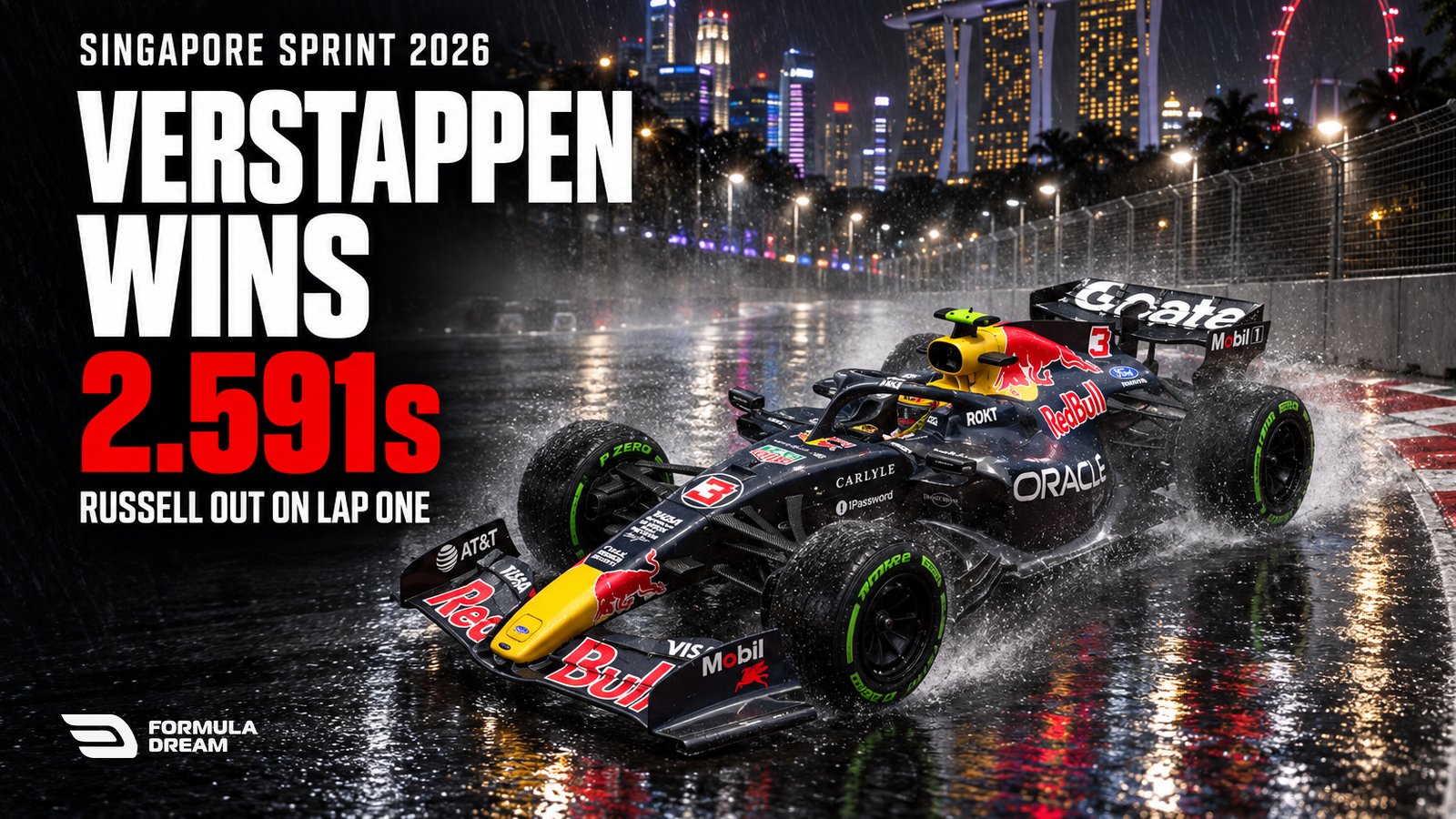
Singapore Sprint 2026 Results: Russell Crashes From the Lead
Russell took the lead at turn one and crashed at the final corner of the same lap. Verstappen won, Hamilton charged to second, and the McLarens hit each other.