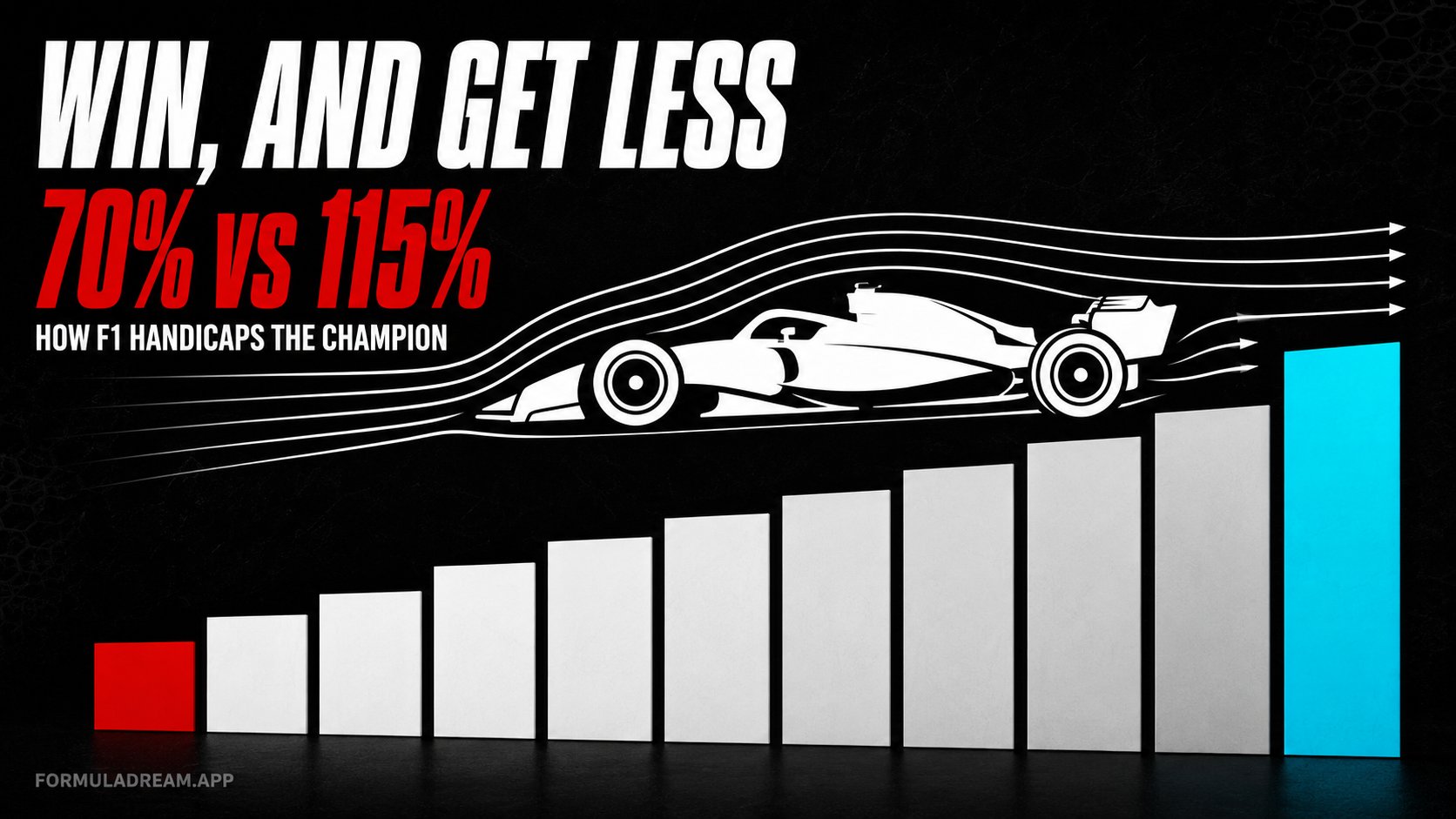
Win the Formula 1 constructors' championship and your reward is less time to develop next year's car. The champion gets 70% of the baseline aerodynamic testing allowance. The team that finished tenth gets 115%.
It is the most openly interventionist rule in the sport. F1 does not merely permit teams to catch up. It actively slows the winner down.
What are the aerodynamic testing restrictions?
The ATR, introduced in 2021, caps two things: wind tunnel runs and CFD, the computational fluid dynamics simulations that model airflow without a physical model.
Both are metered. Each team gets an allocation for a defined aerodynamic testing period, and when the allocation is spent, the team stops. There is no buying more.
The baseline sits with the team ranked seventh in the constructors' championship, which is treated as the neutral middle of the grid. That baseline is 320 wind tunnel runs and 2,000 CFD items across a two-month period.
Everyone else is scaled against that reference.
The sliding scale
The scale runs in 5% steps by championship position:
1st: 70% of baseline
2nd: 75%
3rd: 80%
and so on, rising 5% per position
7th: 100%, the baseline itself
down to 10th: 115%
So the champion is working with 70% of what a midfield team gets, while the team at the back of the top ten gets 115%. The gap between the best-resourced and worst-performing team is not just closed, it is inverted.
Put in raw terms against the 320-run baseline: the champion is running well under 250 wind tunnel runs in a period where a struggling team runs over 350.
Why F1 does this
Because aerodynamic development compounds, and left alone it produces permanent hierarchies.
A team that is ahead learns faster. It has more parts to test, more understanding of its own concept, and usually more money to exploit both. Next season it starts further ahead, and the gap widens rather than closes. F1 spent long stretches of its history in exactly that state, with the same team winning for years and the racing suffering for it.
The sliding scale attacks the mechanism directly. If development time is the currency, take some from the leader and hand it to the chasers.
It works alongside the cost cap, and the two are deliberately complementary. The cost cap limits how much you can spend. The ATR limits what you can spend it on, in the one area where money most reliably converts into lap time. Together they mean a dominant team cannot simply outspend and out-develop its way to a decade at the front.
The twice-yearly reset that catches people out
This is the detail most explanations miss, and it changes how the rule actually behaves.
The allocations reset twice a year, not once. One allocation period runs from 1 January to 30 June, the other from 1 July to 31 December, and each is set by the constructors' standings at the time.
That means a team's testing allowance can change mid-season, based on where it currently sits rather than where it finished last year.
The consequences are strange and real. A team having a poor season gets more development time from July onwards, which helps it build a better car for next year. A team that has climbed the table over the first half of a season is rewarded with a cut. Performance now is paid for with resource later, twice a year, continuously.
It also means a slump has an upside. A team that drops down the order mid-season picks up additional wind tunnel and CFD time for the second half, precisely when it is designing the following year's car.
Why it matters more in a rules reset year
The scale bites hardest when there is most to learn.
In a season where the technical regulations change substantially, every team is exploring an unfamiliar design space, and wind tunnel time converts into understanding faster than at any other point. A 30% handicap on a mature, well-understood car costs something. The same handicap when nobody knows what the optimum looks like costs far more.
That is why teams talk about the ATR as potentially decisive around a regulations reset, and why a team's championship position in the year before a rules change carries consequences well beyond that season's trophies.
The uncomfortable part
There is a real argument against all this, and it deserves stating rather than dismissing.
Formula 1 has historically presented itself as a meritocracy of engineering. A rule that explicitly penalises the best engineering organisation for being best is, on its face, in tension with that. Success handicaps exist in plenty of sports, but F1 has usually preferred to describe itself as a technology contest rather than an entertainment product.
The counter-argument is that a technology contest nobody can win is not a contest. If the compounding effect is real, and the evidence suggests it is, then unrestricted development does not produce a meritocracy. It produces a monopoly, quite quickly.
Both positions are coherent. The sport has chosen one, deliberately, and the sliding scale is what that choice looks like in the regulations.
Our app collects every FIA document as it is released, and during a session puts every car on the circuit map with a timing tower carrying gaps, intervals, tyre compound and tyre age, pit stop counts and positions gained or lost. Driver radio streams live with the transcript beside the audio, which is where the effect of a new aero package gets described in a driver's own words before any analyst gets to it.
Free, no subscription, no ads. Independent, and not affiliated with Formula 1.
Singapore Sprint 2026 Results: Russell Crashes From the Lead
Russell took the lead at turn one and crashed at the final corner of the same lap. Verstappen won, Hamilton charged to second, and the McLarens hit each other.