What Happens When It Rains in F1, and Why Races Get Stopped
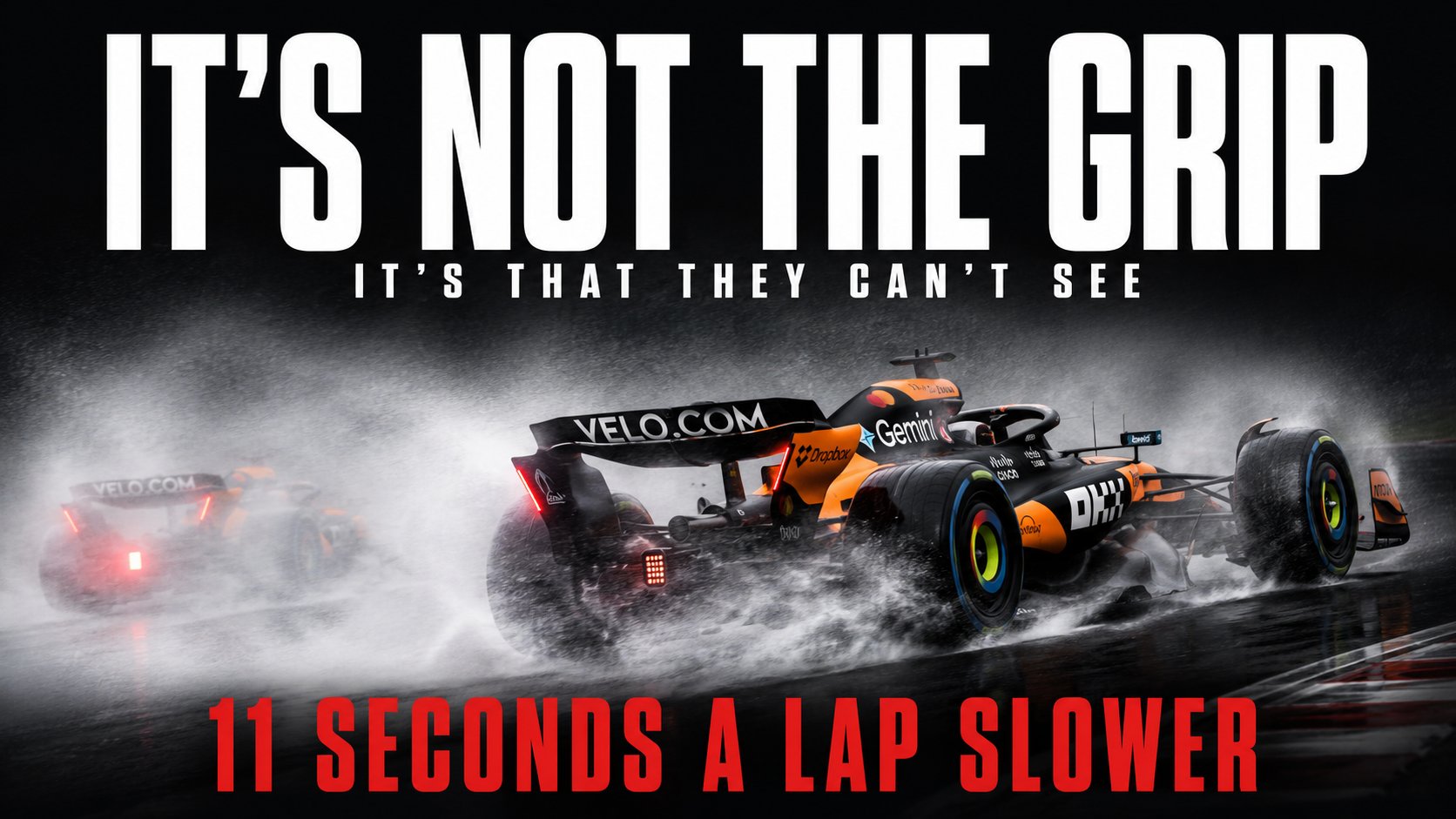
F1 does not stop for rain because the cars cannot grip. It stops because nobody can see. The wet tyres, the procedures, and the spray problem the sport has failed to solve.
So when a race is delayed or suspended for rain, the reason is almost never that the cars cannot grip. It is that the drivers cannot see. Twenty cars throwing water into the air produces a wall of spray that makes the car in front invisible, and no amount of tyre technology fixes that.
Here is what actually happens when it rains: the tyres, the procedures, and the problem the sport has spent years failing to solve.
The two wet tyres
Pirelli brings two wet-weather compounds, and they do different jobs.
Intermediates are the tyre for a damp or drying track, and for light rain. They are the workhorse: most wet running in modern F1 happens on inters, and they are usually the right call the moment rain starts or a track is only partly dry.
Full wets are for standing water and heavy rain, with far more tread to displace it. They are used much less often than people assume, for reasons that have little to do with the tyre itself.
Neither is a slick, and the cost is large. We measured it across 140 driver records from eight mixed-condition races: a car on intermediates is 13.2% slower than the same car on slicks, roughly 11 seconds a lap. Not one driver in that sample got within 6% of their own dry pace. The full method is in how much slower F1 cars are in the rain.
What race control can do
The race director has an escalating set of options, and they are used in roughly this order.
Run normally. Teams choose their own tyres and race. Most wet running looks like this.
Deploy the safety car. If conditions deteriorate mid-race, the safety car neutralises the race and gives teams a window to fit inters or full wets. How that changes the race is covered in safety car versus virtual safety car.
Start behind the safety car. In heavy rain the race can begin with a rolling start behind the safety car rather than a standing one. When this happens, cars must be on wet tyres until they pit. If the track dries out during those laps, the race director can switch the mandated specification to intermediates and give teams time to fit them.
Delay the start, or suspend the race. A red flag stops everything, and everyone returns to the pit lane to wait. This also hands every driver a free tyre change, which is why a rain red flag reshapes a race so completely. The details are in F1 red flag rules.
Abandon it. If conditions never improve, the race can be shortened or not resumed at all.
Why full wets are so rarely used
This is the part that confuses people. F1 has a tyre built specifically for heavy rain, and in heavy rain the race is usually stopped instead of run on it.
The reason is spray. A full wet tyre displaces an enormous amount of water, and all of it goes into the air. With a full grid running, the car behind is driving into a cloud. Drivers have described visibility so poor in a queue of cars that they were not flat out on the straights, because they could not see fifty metres ahead.
The FIA has been explicit that this, rather than grip, is the deciding factor. In its own words, driver feedback reported reduced visibility in extremely wet conditions with the current generation of cars, and that this is a key determinant in starting a session or needing to suspend one.
So the sequence is not "too wet to grip, therefore stop". It is "wet enough that full wets are needed, therefore too much spray to see, therefore stop". The tyre that exists for the conditions is the same tyre that creates the conditions in which nobody can race.
The fix that did not work
F1 took the problem seriously and tried to engineer it away.
In 2023 and 2024, teams including Ferrari, Mercedes and McLaren tested spray guards: wheel arches covering the top half of the tyre, with cutouts for brake cooling, designed for extremely wet running. Some versions were fairly aggressive, essentially mudguards on a Formula 1 car.
They had little effect. The tests established something the sport had not fully appreciated: a great deal of the spray is not coming off the tyres at all. It comes off the diffuser, the shaped underfloor that generates most of a modern car's downforce by accelerating air, and water, out of the back of the car. Covering the wheels does not help with water leaving the floor.
That is an unusually clean example of a fix failing because the diagnosis was wrong, and it is why you have not seen wheel arches on a grid despite several years of work.
Why 2026 might genuinely help
The 2026 regulations were not written to solve the rain problem, but they may improve it as a side effect.
The new rules cut aerodynamic downforce substantially, and changed the floor. Less aggressive underfloor aerodynamics means less water being accelerated out of the diffuser, which is where the spray problem was found to originate. The cars are also about 3% slower per lap than 2025, and lower speeds mean less energy thrown into the air.
None of this is confirmed by a wet race until there is one. But for the first time the change is aimed, accidentally, at the actual cause rather than the assumed one.
What to watch in a wet session
Wet running is the most volatile thing in the sport, and the timing screen tells you what is happening well before the pictures do.
Watch the crossover. There is a moment when the track dries enough that slicks become quicker than inters, and it arrives suddenly. The first driver to gamble either gains half a minute or loses a place to a spin.
Watch individual lap times, not the order. In changing conditions the fastest driver is often several places back on a different tyre, and the order is about to rearrange itself.
Listen to the radio. Track condition reports from drivers are the most current information anybody has, including the teams.
Follow a wet session properly
Rain is where a live timing screen is worth the most, because conditions change faster than any broadcast can narrate.
The Formula Dream app runs a live Dashboard through every session: every car on the circuit map, and a timing tower with lap times, gaps and intervals, tyre compound and age, plus flag and safety car alerts the moment race control calls them, which in the wet is often the most important information on the screen. You also get live driver radio as it is broadcast, which is where the real track report comes from, and every FIA document of the weekend as it is published, including the decisions to suspend or resume.
Free, no subscription, no ads, independent. Not affiliated with Formula 1.
Because of visibility, not grip. Cars running on full wet tyres throw up so much spray that drivers behind cannot see, and the FIA has said this is the key factor in deciding whether to start or suspend a session.
What is the difference between intermediate and full wet tyres?
Intermediates are for a damp or drying track and light rain, and are used for most wet running. Full wets have far more tread for standing water and heavy rain, but are used much less often because of the spray they generate.
How much slower are F1 cars in the wet?
About 13.2% slower on intermediates than on slicks, which is roughly 11 seconds a lap. Across 140 wet stints we measured, no driver got within 6% of their own dry pace.
What happens if a race starts in heavy rain?
It can begin with a rolling start behind the safety car instead of a standing start. Cars must run wet tyres until they pit, and if the track dries the race director can switch the mandated tyre to intermediates.
Why did F1 spray guards fail?
Because most of the spray does not come from the tyres. Testing showed a large amount comes off the diffuser, the shaped underfloor, so covering the wheels made little difference.
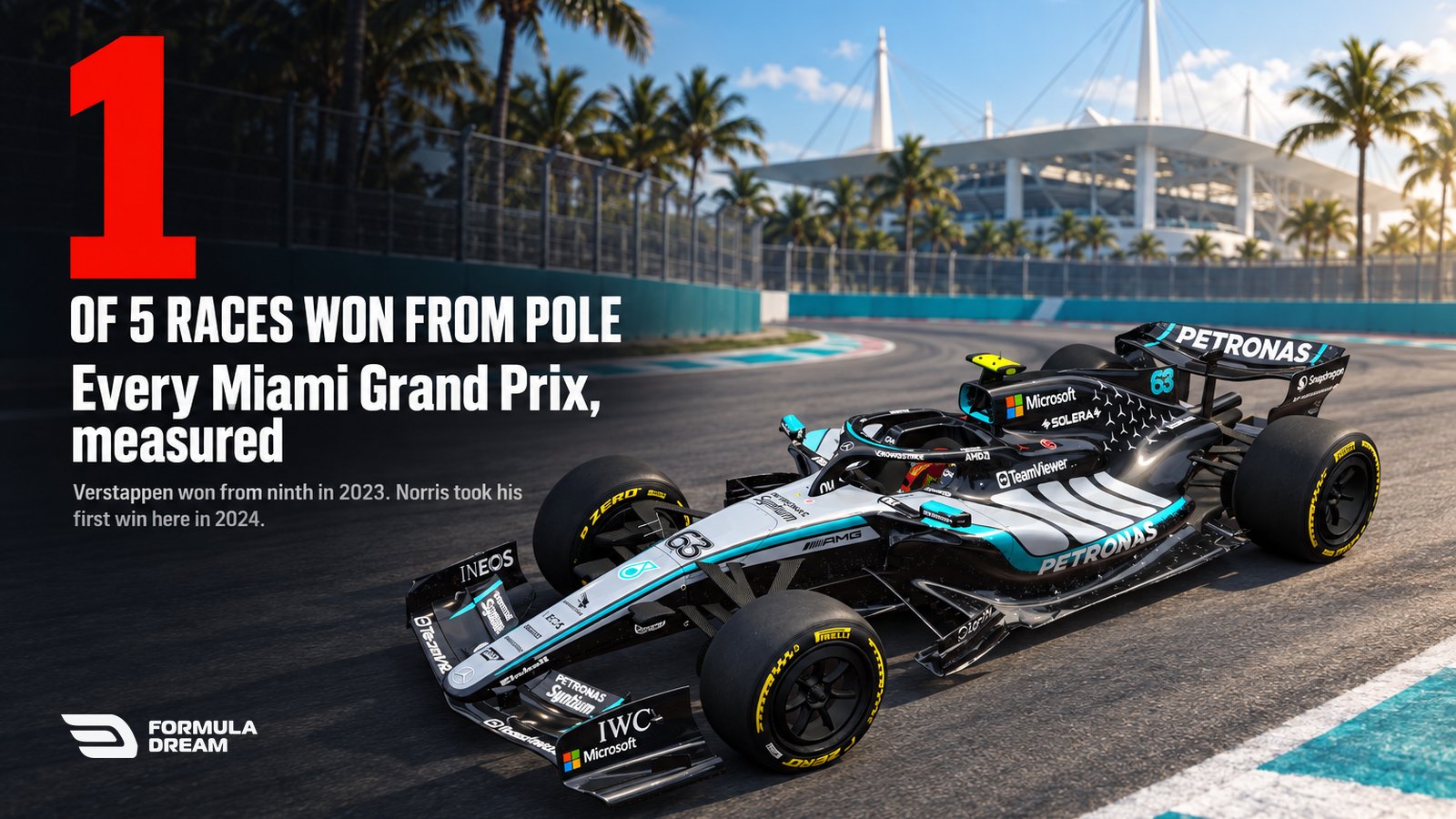
Every Miami Grand Prix winner, measured: five races, and pole has won only one of them
Five Miami Grands Prix have been held since 2022, and only one was won from pole: Kimi Antonelli's in 2026. Max Verstappen won from ninth in 2023, and Lando Norris took his first win there in 2024. Every winner, grid slot and safety car, measured.