Pole is the cleanest measure of what a Formula 1 car can do. One lap, minimum fuel, best tyre, best driver, track at its fastest point of the weekend. Nothing is being managed.
We took the fastest qualifying lap from every session between 2021 and 2026, then compared each circuit against itself across years. Monza 2024 against Monza 2023, and so on. Circuit layout, which is the single biggest determinant of lap time, is held constant by construction.
Wet qualifying sessions are excluded, since a wet lap says nothing about car performance.
The 2022 reset, and how long recovery took
Measured against 2021 as a baseline:
2022: 1.754% slower (13 circuits)
2023: 1.449% slower (13 circuits)
2024: 0.025% slower, which is level (14 circuits)
2025: 0.352% faster (16 circuits)
The 2022 aerodynamic regulations, the ones that brought back ground effect, cost the cars 1.75% of lap time immediately.
Then development went to work. Year on year the cars found 0.848%, then 1.065%, then 0.472%.
It took until 2024, three full seasons, for the cars to match 2021 pace again. By 2025 they were marginally quicker than the cars the rules had replaced.
Year-on-year change in pole time at the same circuits, with regulation resets highlighted
That is the pattern the sport runs on. A reset slows everything down, and then the engineering claws it back at roughly half a percent to one percent a year until the next reset.
2026 cost nearly twice as much
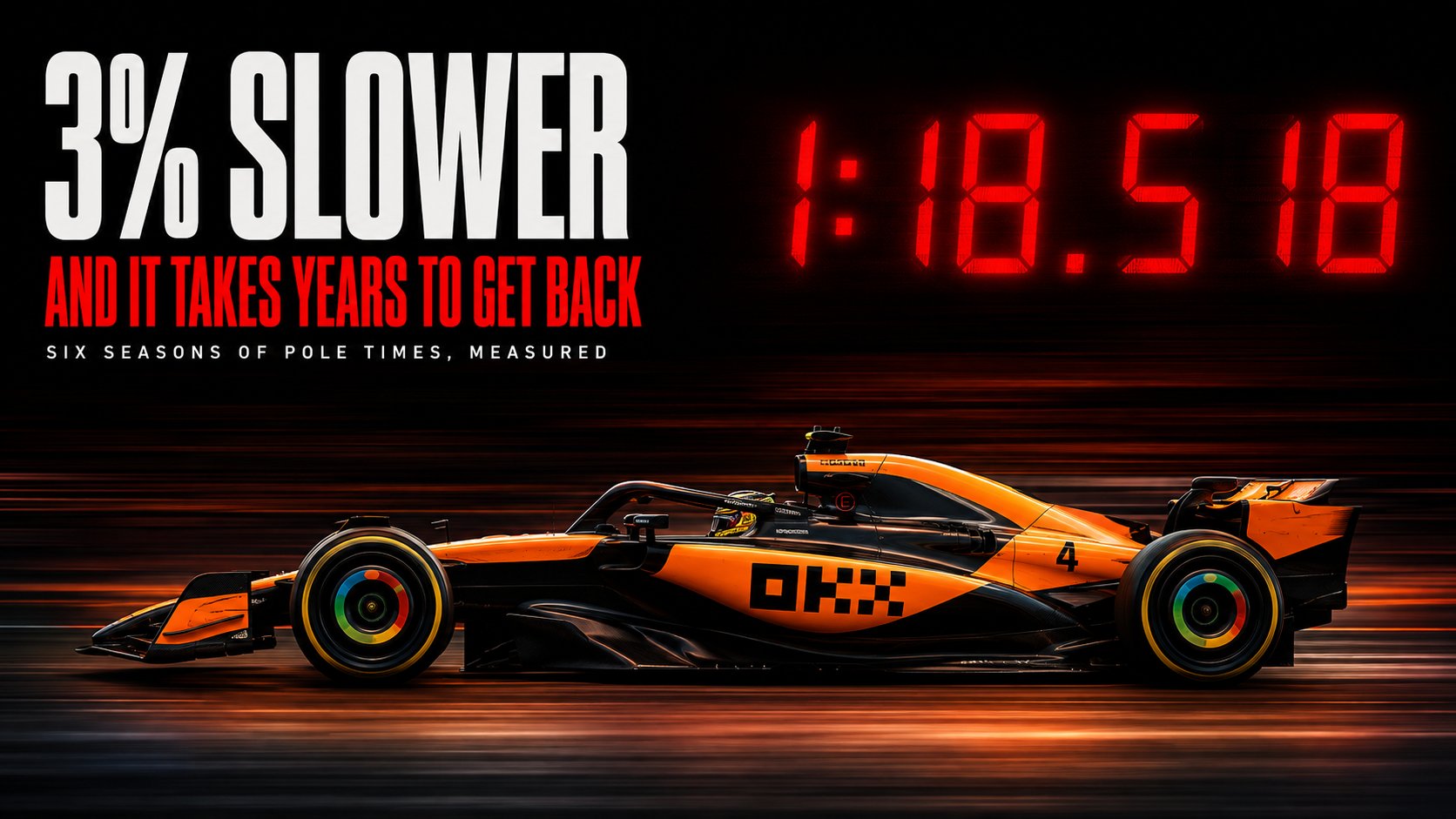
The 2026 regulations cost 3.046%.
That is not a like-for-like reset. 2022 changed the aerodynamics. 2026 changed the aerodynamics and the power unit, moving to a roughly even split between internal combustion and electrical power, with active aerodynamics replacing DRS entirely. A bigger change has produced a bigger drop, and the ratio is about what you would guess.
How much slower the 2026 pole lap was than 2025 at each of the ten comparable circuits
Melbourne: 4.56% slower
Silverstone: 3.79%
Spa: 3.78%
Red Bull Ring: 3.35%
Hungaroring: 3.09%
Monaco: 3.00%
Montreal: 2.37%
Suzuka: 2.06%
Miami: 1.85%
Shanghai: 1.57%
Melbourne is the worst affected at 4.56%, which on that lap is 3.4 seconds. Pole went from 1:15.096 to 1:18.518.
The circuits at the bottom of the list, Shanghai and Miami, are the ones with the longest full-throttle sections, where a power unit change matters less than it does through corners.
What happens next, if 2022 is a guide
Nobody has to guess at the shape of the recovery, because we have just measured one.
If 2026 follows the 2022 pattern, the cars will find something like half a percent to one percent a year. From 3.046% down, that is roughly three to four seasons to get back to 2025 pace, which would be some time around 2029 or 2030.
Two caveats on that, and they matter.
The 2026 deficit is nearly double the 2022 one, so the recovery has further to travel. And the 2026 change includes a power unit, where development is far more constrained by the rules than aerodynamics is. Aero recovery in 2022-2025 came substantially from floor and bodywork development that the 2026 rules restrict more tightly.
So three to four years is the optimistic reading of our own data, not a prediction.
What this changes about watching F1
Lap records will stand for years. Almost every circuit record was set in 2024 or 2025, and on this evidence they are safe for most of a decade.
"The cars are slow now" is true and temporary. It was equally true in 2022, and by 2025 the cars were quicker than they had ever been under the previous rules.
Slower does not mean worse racing. We have measured the 2026 cars separately and found more retirements but also more overtaking per lap in sprints. Outright pace and quality of racing are different things, and the sport traded one for the other deliberately.
Watch the recovery rate, not the deficit. How fast the field claws back that 3% will tell you more about the 2026 rules than the initial drop does.
Method
Data: FastF1 qualifying sessions, 2021 to 2026. Pole is the fastest lap of the session.
Every comparison is a circuit against itself in adjacent or reference years. No cross-circuit comparison is made anywhere.
Wet qualifying sessions excluded. These are identified by intermediate or wet tyres appearing in the session.
Circuit counts vary by comparison because the calendar changes: 13 circuits for 2021 to 2022, 20 for 2024 to 2025, and 10 for 2025 to 2026, the season being incomplete.
Figures are medians across the available circuits, so one anomalous session cannot drive the result.
2026 covers 11 rounds. The 3.046% will move as the season continues and as teams develop, and it should be re-measured at season end.
Track resurfacing and layout tweaks are not controlled for. A resurfaced circuit can produce a jump unrelated to the cars. Using medians across ten or more circuits limits the damage but does not eliminate it.
The recovery projection is an extrapolation from the 2022-2025 cycle, explicitly labelled as such, and is not a measurement.
The pace loss in this article is a number. It is more interesting as a lap time arriving live.
The Formula Dream app runs a live Dashboard through every session: every car moving on the circuit map, and a timing tower with lap times, gaps and intervals, tyre compound and age, pit counts and positions gained or lost. It is the same information these measurements come from, arriving live. You also get live driver radio as it is broadcast, and every FIA document of the weekend as it is published.
Free, no subscription, no ads, independent. Not affiliated with Formula 1.
Singapore Sprint 2026 Results: Russell Crashes From the Lead
Russell took the lead at turn one and crashed at the final corner of the same lap. Verstappen won, Hamilton charged to second, and the McLarens hit each other.