A Formula 1 car has exactly eight forward gears and a reverse, and every change is made by the driver on a paddle. The 2026 rules require an upshift to be completed within 200 milliseconds and a downshift within 300, and a seamless-shift gearbox is built so that the handover from one gear to the next never interrupts the drive.
Gearbox trouble reaches the pit wall by radio long before it shows on a timing screen. You can hear a full race of it in our Spanish Grand Prix 2026 race radio archive.
Here is how that works, and what the rules actually require.
How does a seamless-shift gearbox work?
A conventional sequential gearbox disengages one gear, then engages the next. However quick you make that, there is a moment where no gear is driving the wheels, and in that moment the car is not accelerating.
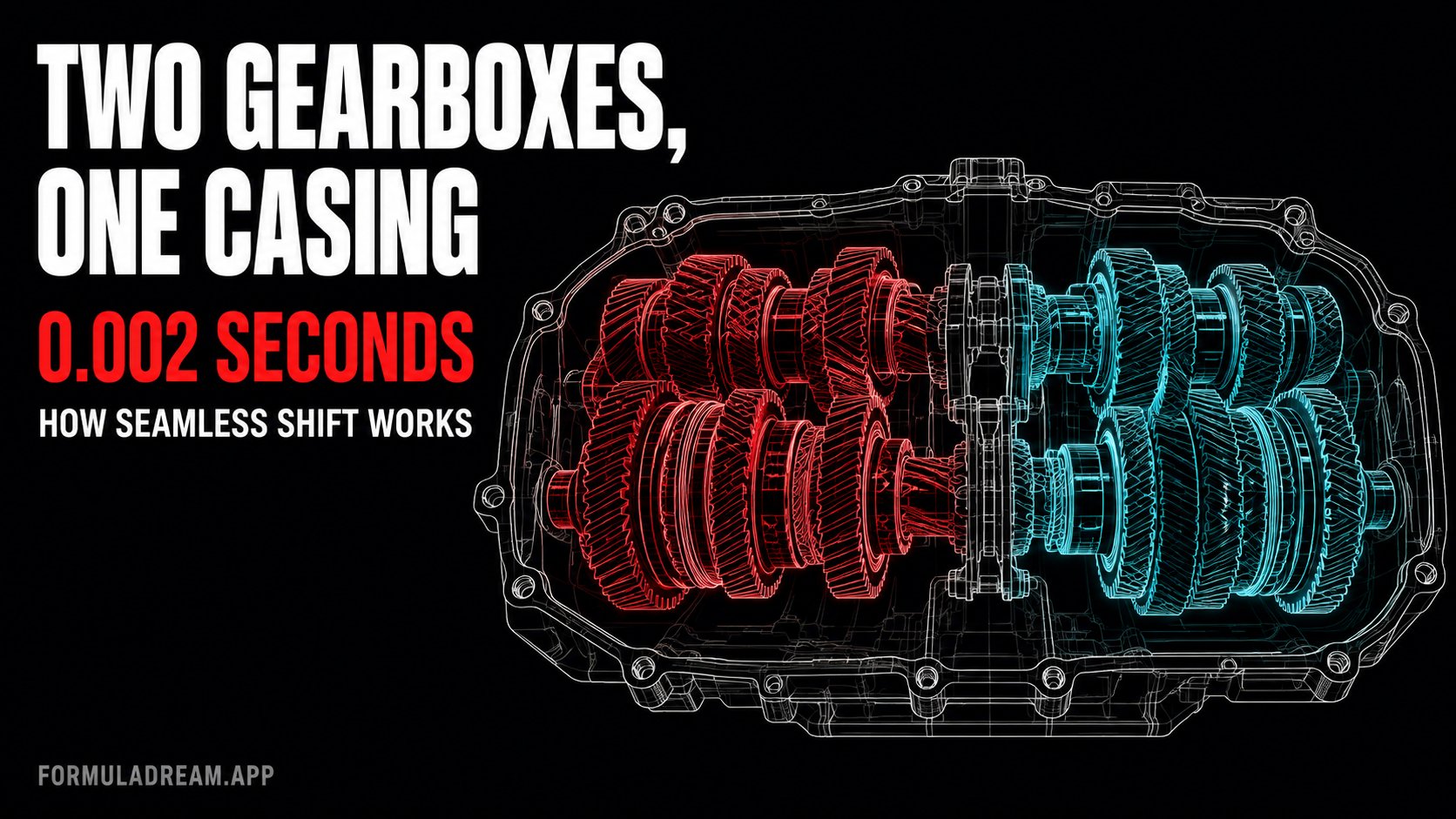
The designs are secret, but seamless-shift gearboxes are generally described as removing that gap by splitting the gears across two shift barrels.
One barrel handles the odd gears: 1, 3, 5, 7. The other handles the even gears: 2, 4, 6, 8.
Because they are independent, the next gear can be pre-selected and brought into engagement while the current one is still driving. For a microscopic overlap window, two gears are effectively engaged at once, but only one is actually transmitting drive. The handover happens inside that window.
The result is a shift with no meaningful interruption in torque. Teams do not publish their shift times, but the rules set the outer limit: under Article C9.8.4 an upshift must be completed within 200 milliseconds and a downshift within 300, with no more than 80 milliseconds between the driver's request and the old gear disengaging.
Are F1 cars manual or automatic?
Neither, which is why the question keeps coming up.
There is no clutch pedal and no H-pattern lever. But there is also no automatic gear selection: every single shift is commanded by the driver through the paddles behind the steering wheel. The car does not decide when to change gear.
It is a manual transmission operated electronically. The driver chooses; the hydraulics and the electronics execute faster than any human limb could.
The rules are explicit about this. Article C9.8.1 says automatic gear changes are a driver aid and are not permitted, and each gear change must be separately initiated by the driver. The clutch is on paddles too, no more than two of them on the steering wheel, and traction control is banned.
Shifting is also sequential, meaning gears must be taken in order. You cannot jump from sixth to second. Going down through a heavy braking zone means a rapid series of individual downshifts, each one commanded, which is part of why braking zones are so busy for a driver.
At Singapore that adds up to at least 53 gear changes on a single qualifying lap, a figure we measured from telemetry in our piece on how much of a lap is spent at full throttle. Over a Grand Prix distance it runs past three thousand. At the other extreme, the 2026 Monaco pole lap never used eighth gear at all.
Why exactly eight gears?
Because the rules say so, and they say so to stop an arms race.
Eight forward gears have been mandatory since 2014. The 2026 rules are exact: under Article C9.6.1 the number of forward gear ratios must be 8, every car must be able to be driven in reverse, and continuously variable transmissions are banned. Teams also have to declare their eight ratios to the FIA by the first race, and the gear pairs must be made of steel.
Without that rule, gear count and ratio optimisation would become a development battleground with real performance on offer and enormous cost attached. A CVT, which can hold an engine at its ideal rpm continuously, would be quicker still and would remove gear changes from the sport entirely.
So the eight-speed rule is a deliberate freeze on a whole area of competition. It also preserves something the sport values: a gearbox you can hear working.
The homologation rules nobody explains
This is the part that produces grid penalties, and it is poorly understood.
F1 gearboxes are homologated. Under Article C9.4 the design of the internal components is fixed for a four-year period, with a single upgrade allowed between two consecutive seasons, and a supplier's upgrade must be offered to its customer teams. That is a cost control measure rather than a sporting one.
What used to sit on top of that, an allocation with grid penalties, is gone. Drivers were limited to five of each gearbox component a season, with a five-place grid penalty for each one beyond that, until the F1 Commission scrapped the quota from 2025 on the grounds that gearboxes had become reliable enough to make it obsolete. The 2026 Sporting Regulations still ration power unit components, but not gearboxes.
So a gearbox failure now costs a race, not grid positions at the next one. Engine parts are a different story: they are still rationed, and exceeding the allocation still brings a grid penalty, as explained in F1 engine penalties.
The running tally of which components each driver has used is published by the FIA across a race weekend, which is how you can often see a penalty coming before it is announced. We wrote a guide to what the FIA publishes and how to read it.
Why the gearbox is under more strain than you would think
Three things combine.
The shift count. Thousands per race, each a hydraulically actuated event under full load.
The loads. The gearbox casing is a structural member of the car. The rear suspension mounts to it. It carries aerodynamic loads from the rear wing and the crash loads the regulations demand. It is not just a box of gears; it is part of the chassis.
The cost cap. With no allocation left, what stops a team replacing gearboxes freely is money, since every rebuild is paid for under the cost cap. And there is no gram-shaving race either: under Article C9.5.2 the driveline and gear-change components must weigh at least 22kg combined.
That combination is why gearbox reliability remains a genuine engineering problem in a sport where almost everything else has been solved into submission.
When it fails, you hear it first
A gearbox rarely fails silently. It announces itself: a driver reporting he is stuck in gear, an engineer asking for a downshift check, or the flat instruction to stop the car. Because the failure is mechanical and immediate, the radio usually carries it before the timing screen shows anything at all.
Those exchanges are in the team radio archive, which is the only place a gearbox problem exists as words rather than as a retirement in a results table.
Hearing it work
Downshift sequences into heavy braking zones are one of the most distinctive sounds in the sport, and shift problems are among the first things a driver reports on the radio.
Our app streams driver radio live with the transcript running beside the audio, so you can follow those reports as they happen. During a session it also puts every car on the circuit map with a timing tower carrying gaps, intervals, tyre compound and tyre age, pit stop counts and positions gained or lost.
It collects every FIA document from the weekend too, including the component allocation tables that make gearbox and power unit penalties predictable in advance.
Free, no subscription, no ads. Independent, and not affiliated with Formula 1.
Eight forward gears and a reverse. The 2026 Technical Regulations require exactly eight forward gear ratios and ban continuously variable transmissions.
Are F1 cars manual or automatic?
Manual, in the sense that matters: every gear change is made by the driver on a paddle, and automatic gear changes are banned as a driver aid. There is no clutch pedal.
How fast is an F1 gear change?
Teams do not publish shift times. The rules only set the limits: an upshift must be completed within 200 milliseconds and a downshift within 300.
How many gearboxes can an F1 driver use in a season?
There is no longer a limit. The gearbox quota, five of each gearbox component with a five-place grid penalty for each extra one, was scrapped from the 2025 season.