F1 Minisector Analysis: Who Owned Each Corner | FormulaDream
Guides
Who Owned Each Corner? Reading an F1 Lap in Minisectors
We split the three closest poles of 2026 into 25 minisectors each. Twice, the driver who took pole was faster in fewer of them than the driver he beat.
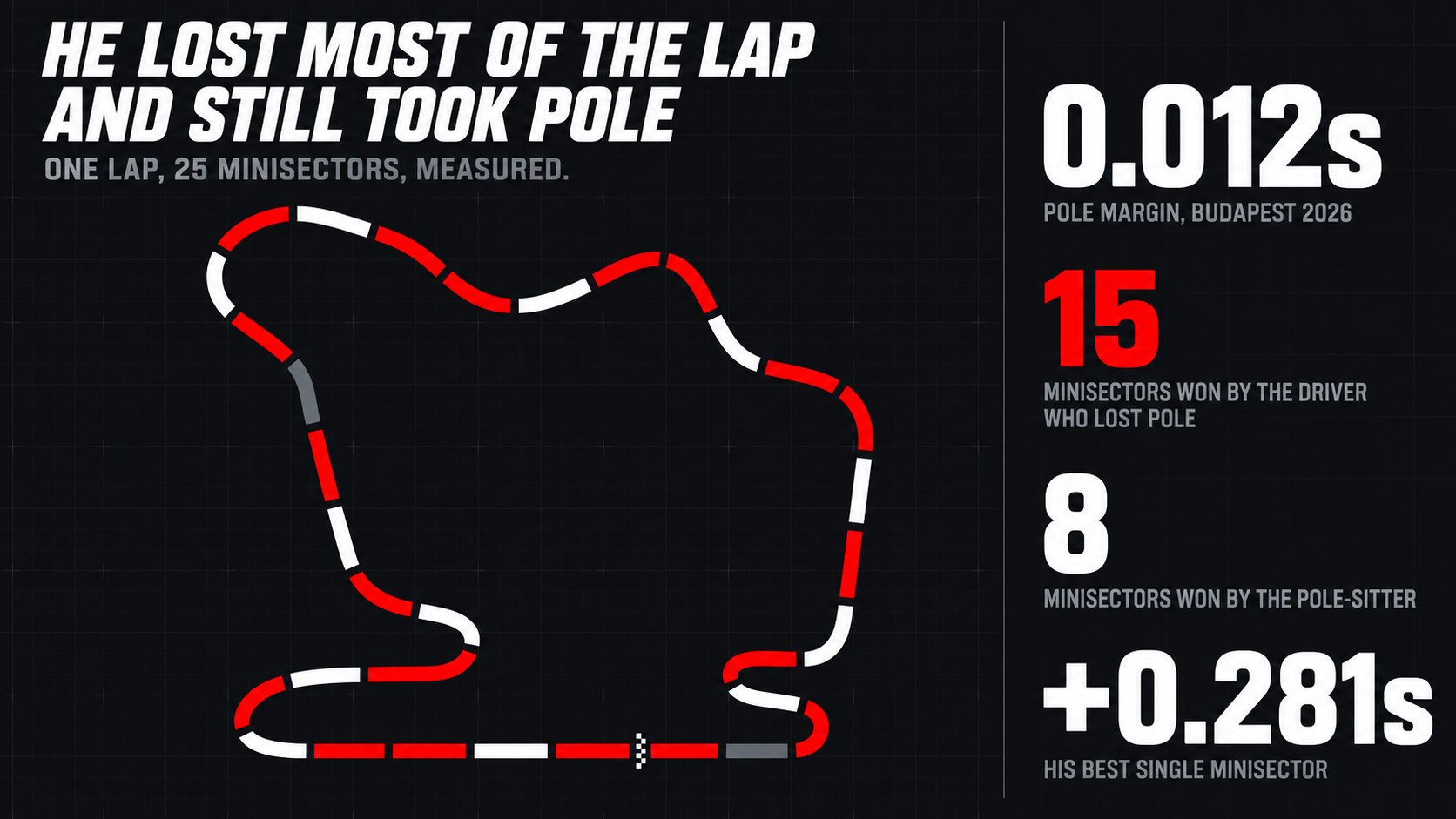
Lando Norris took pole in Hungary by 0.012 seconds. Lewis Hamilton was faster than him through most of the lap.
Both of those things are true, and the second one never appears on a timing screen. A pole lap looks like a single number. It is really dozens of small battles, one for each piece of the track, and the number only tells you the sum.
So we split the closest qualifying laps of 2026 into 25 minisectors each and counted who won them.
Splitting the lap into minisectors
Break a lap into minisectors, short segments a few hundred metres each, and compare who set the fastest time through each one. Colour the racing line by the quickest driver in every segment, and the whole story of the lap appears at a glance.
You stop seeing a laptime and start seeing a map: this driver owned the first sector, that one came alive in the twisty middle, a third was untouchable on the run to the line.
The three closest poles of 2026, counted
We took the fastest legal qualifying lap from the top two drivers at the three closest pole fights of the season, divided each lap into 25 equal-length segments by distance, and timed both cars through every one.
Grand Prix
Pole
Margin
Minisectors won by the pole-sitter
Won by the driver beaten
Budapest
Norris, over Hamilton
0.012s
8
15
Zandvoort
Norris, over Russell
0.102s
8
12
Montreal
Russell, over Antonelli
0.068s
12
9
2026 qualifying, 25 minisectors per lap. Only minisectors resolved above the method's noise floor are counted, so the totals are less than 25.
In two of the three, the driver who took pole was faster in fewer minisectors than the driver he beat. Both times it was Norris.
That is not a quirk of the counting. It is a description of how he took those poles.
Pole was won in two corners
Look at where the time actually moved, rather than how often.
In Hungary, Hamilton was faster in 15 of the 23 resolved minisectors, and his best single one gained him 0.173s. Norris was faster in 8, but his best two were worth +0.281s and +0.253s. He lost most of the lap in small amounts and took it back in two big ones.
Zandvoort was the same shape. Russell led 12 minisectors to 8, and Norris's single best segment was worth +0.376s, more than three times the final margin of 0.102s.
Montreal is the control case. Russell took pole and also won the minisector count, 12 to 9, and his advantage was spread rather than concentrated. That is what a conventional pole looks like, and it is why the other two stand out.
This is the thing a lap time cannot tell you, and the reason to draw the lap rather than read it. Norris's 0.012s in Hungary describes a driver who was slower nearly everywhere and found half a second in two corners. The number "0.012" describes none of that.
See it on a real lap
The Track Domination tool, one colour per driver, one segment at a time.
Here is Montreal 2026 qualifying, the one where the pole-sitter really was faster in more places, coloured by who was fastest through each part of the lap.
Every coloured segment is a driver winning that stretch of track. Where one colour dominates, that driver was building the lap. Where it flickers between colours, the field was trading tenths corner by corner.
How accurate is this, honestly
Worth stating, because a minisector count can be made to say anything if you do not check it.
Segment times come from car telemetry sampled at intervals, so slicing a lap at fixed distances introduces a small error at every boundary. We measured that error directly: add all 25 minisector deltas together and compare the total with the real lap time margin. In Hungary the two agreed to within 0.020 seconds across the whole lap, in Zandvoort to 0.133s and in Montreal to 0.178s.
That sets a noise floor. A minisector delta smaller than the floor is not a result, it is rounding. So for each race we discarded every segment closer than twice the per-segment noise, which is why the table counts 23 minisectors in Hungary and 20 at Zandvoort rather than 25.
The surviving margins are large: Norris's decisive Hungary minisectors were worth 0.281s and 0.253s, more than ten times the noise floor. Those are real. A 0.002s minisector is not, and we have not counted any.
The lap nobody drove
Take the fastest minisector from anyone across the whole session and stitch them together, and you get a theoretical best lap: the time that was physically on the table if a single driver had strung every segment's best together. It is always quicker than the actual pole, sometimes by more than a second, and it is a neat measure of how much time was left out on the track.
The same idea works at the coarser three-sector resolution, and Monza 2026 is the cleanest example of it: Pierre Gasly took pole holding no purple sectors at all, and the three purples added up to a lap 0.330 quicker than his. We worked that one through in what purple, green and yellow actually mean.
Why it matters
Two drivers can set nearly identical laptimes in completely different ways, and the minisector map shows how. It is the difference between "he was 0.012s quicker" and "he was slower through fifteen segments and took it all back in two corners."
It also shows a car's character. A team strong through high-speed corners lights up the fast sections. One with better traction owns the slow-corner exits. Over a weekend, that pattern tells you where each car wants to be.
And it puts a real size on a small number. Hungary's 0.012s pole margin works out at about 0.7 metres of racetrack, roughly one seventh of a car length, which we worked through in turning F1 time gaps into metres.
You can run this on any available session yourself in Track Domination, or see the gaps drawn to scale in the Gap Visualizer.
Watch the sectors live
Minisectors are a post-session view. During a session, sector times are the live version of the same idea.
The Formula Dream app runs a live Dashboard through every session: every car moving on the circuit map, and a timing tower with lap times, gaps and intervals, tyre compound and age, plus flag and safety car alerts the moment race control calls them. In qualifying the column worth watching is sector times, because a driver who is losing the first sector and winning the last is doing exactly what Norris did in Hungary, and you can see it happening rather than reading about it afterwards. You also get live driver radio as it is broadcast, and every FIA document of the weekend collected as it is published, which is where deleted laps appear before anyone reports them.
Free, no subscription, no ads, independent. Not affiliated with Formula 1.
A short segment of a lap, typically a few hundred metres, used to compare drivers piece by piece instead of only by total lap time. Splitting a lap into 20 to 30 minisectors shows which driver was fastest through each part of the circuit.
Can a driver take pole while being slower through most of the lap?
Yes. In Hungary in 2026, Norris took pole by 0.012s while Hamilton was faster through 15 of the 23 minisectors we could resolve. Norris made it up in two segments worth 0.281s and 0.253s.
How many minisectors are in an F1 lap?
There is no fixed number. Formula 1's own graphics have used varying counts, and analysts pick a resolution that suits the circuit. We used 25 equal-length segments per lap, which works out at roughly 170 metres each on a 4.3 km circuit.
How accurate is minisector timing?
It depends on the session. We check it by summing every minisector delta and comparing with the true lap time margin. That agreed to within 0.020s in Hungary, 0.133s at Zandvoort and 0.178s at Montreal, and we discard any minisector smaller than that noise floor.
What is a theoretical best lap?
The time you get by taking the fastest minisector set by anyone in the session and adding them together. It is always faster than the actual pole lap, and the gap shows how much time was available but not strung together on one lap.
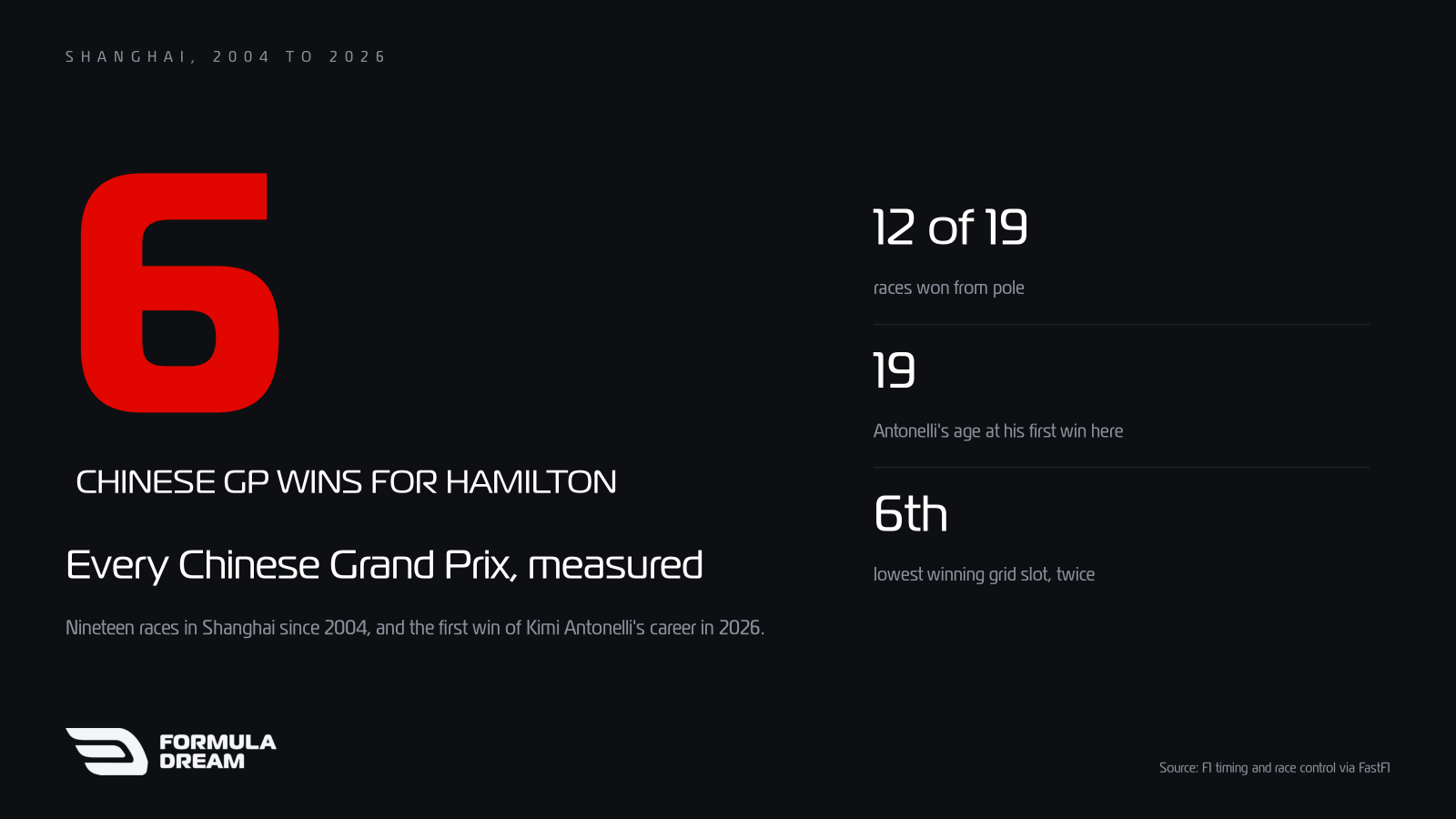
Nineteen Chinese Grands Prix have been held in Shanghai since 2004. Lewis Hamilton won six, pole won twelve, and in 2026 Kimi Antonelli took the first win of his career there, at 19, with Hamilton on the podium for Ferrari for the first time. Every winner, grid slot and safety car, measured.