F1 Sector Colours: What Purple, Green and Yellow Mean
F1 sector colours: what purple, green and yellow actually mean
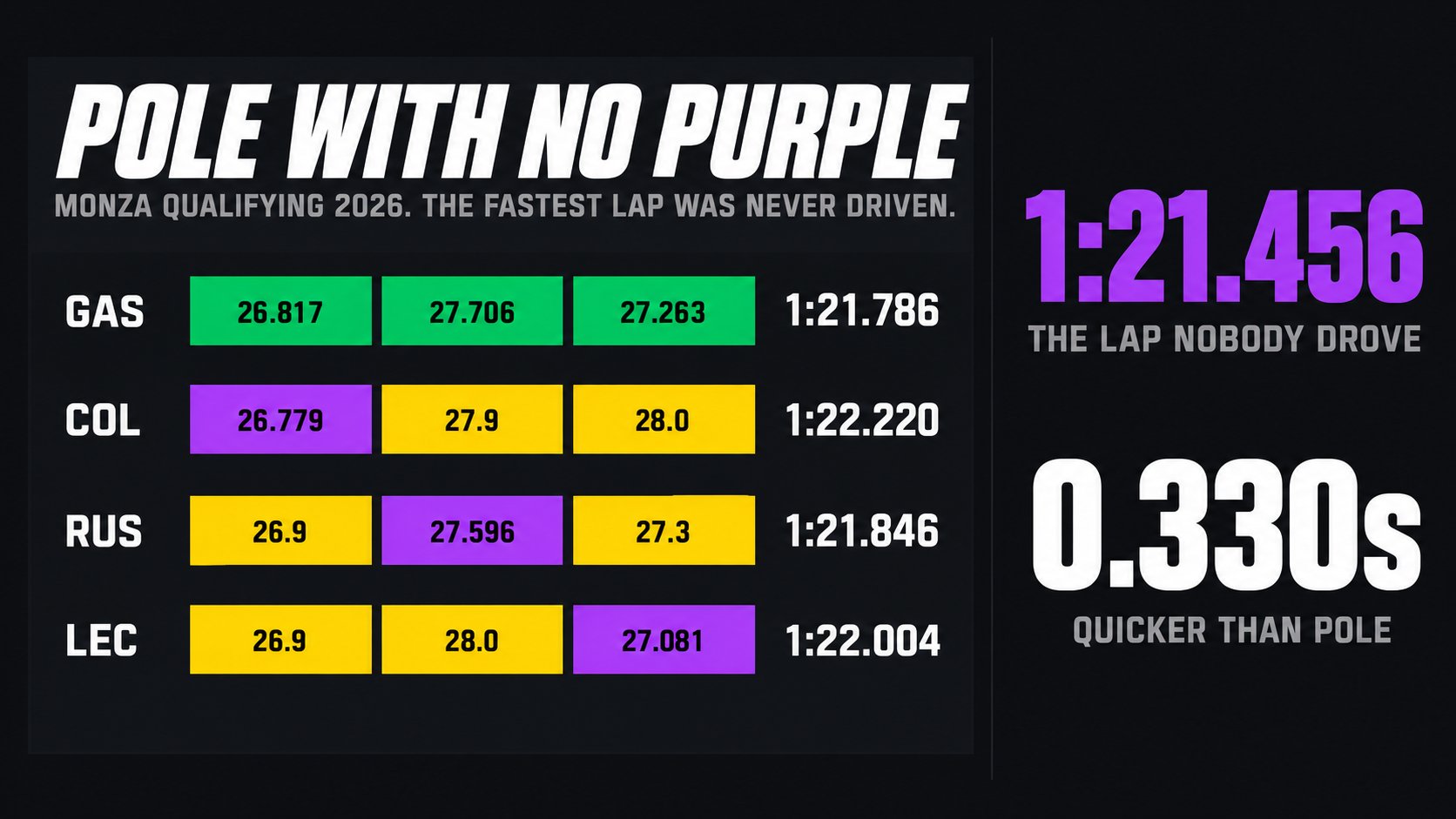
Three colours on a timing screen carry more information than the lap time does, and the Monza pole lap is the cleanest proof of it: Gasly took pole without setting a single fastest sector.
Pierre Gasly took pole at Monza with a 1:21.786 and did not hold a single purple sector when he crossed the line. The three fastest sectors of that qualifying session belonged to Franco Colapinto, George Russell and Charles Leclerc, and none of them started on pole.
That is not a glitch. It is the whole reason the colours exist.
What the three colours mean
Every lap is divided into three timed sectors. As a driver crosses each split, the timing screen colours that sector according to one comparison, and only one.
Colour
What it means
Purple
The fastest time anyone has set in that sector so far in this session
Green
The driver's own personal best in that sector, but not the session's fastest
Yellow
Slower than that driver's own personal best in the sector
White or grey
No time set yet in that sector this session
The same rule applies to the completed lap time. A purple lap time is the fastest lap of the session by anybody. A green lap time is that driver's own best, and yellow is slower than their own best.
That is the entire system. It is worth being precise about it, because the common mistake is reading green as "good" and yellow as "bad". Green only ever means better than yourself. A driver two seconds off the pace who improves by a tenth goes green.
Purple is a running record, not a verdict
The colour compares against the session so far, so it changes hands as the session progresses. Early in qualifying, when the track is slow and rubber is still going down, the bar is low and almost anyone can hold it.
At Monza on Saturday, across the whole of qualifying:
Six different drivers held the purple first sector at some point
Twelve held the purple second sector
Six held the purple third sector
Twelve drivers out of twenty two held purple in sector two at some stage of one qualifying hour. By the end, one held each. A purple sector at 15:05 and a purple sector at 16:00 are not the same achievement, and the screen does not distinguish them.
This is also why the first runs of Q1 look deceptively dramatic. The purples are mostly being set by whoever went out first on a track that keeps getting quicker.
Add the three purples together
Take the three purple sectors from Monza qualifying and add them together.
Sector
Fastest of session
Driver
1
26.779
Colapinto
2
27.596
Russell
3
27.081
Leclerc
Total
1:21.456
Nobody
The theoretical best lap of Monza qualifying, 2026. It is 0.330 quicker than the lap that took pole.
That combined time is usually called the ideal lap or the theoretical best. It is 0.330 seconds faster than pole, and no car ever did it, because a lap is not three independent problems. The line and speed that make sector one quick cost you the entry to sector two. Every quick lap is a compromise, and the theoretical best is the lap where you refuse to compromise anywhere, which is not a lap that exists.
The gap between a driver's own best lap and their own three best sectors is a useful number on its own. It measures how much of their pace they managed to put into one lap rather than spread across several.
Driver
Best lap
Own best sectors
Left on the table
Gasly
1:21.786
1:21.786
0.000
Antonelli
1:21.882
1:21.882
0.000
Hamilton
1:22.011
1:22.011
0.000
Verstappen
1:22.070
1:22.067
0.003
Piastri
1:21.966
1:21.951
0.015
Leclerc
1:22.004
1:21.951
0.053
Norris
1:22.067
1:22.012
0.055
Colapinto
1:22.220
1:22.125
0.095
Lindblad
1:22.286
1:22.096
0.190
Russell
1:21.846
1:21.633
0.213
Monza qualifying, ordered by how much each driver left on the table. Gasly, Antonelli and Hamilton each set all three of their best sectors on the same lap.
Russell is the interesting line. His three best sectors add up to 1:21.633, which is quicker than Gasly's pole, and he lost pole by 0.060. He had the pace. He never assembled it into one lap. Gasly did, on his last run, and he beat a faster car by being complete rather than by being fastest anywhere.
Gasly's pole, sector by sector
Sector
Gasly
Purple
Deficit
1
26.817
26.779
+0.038
2
27.706
27.596
+0.110
3
27.263
27.081
+0.182
Lap
1:21.786
1:21.456
+0.330
Pole at Monza was three green sectors, not three purple ones.
Three green sectors, three small deficits, one pole position. On a broadcast that lap looked ordinary right up until the time appeared.
Why the colours matter more than the lap time
The lap time tells you the result. The sector colours tell you where it came from, and they tell you while the lap is still happening.
If a car goes purple in sector one and yellow in sector three, you are watching a driver who has overdriven the entry of the lap and paid for it later, or a car whose tyres are dropping off within a single lap. If a car is green everywhere and never purple, you are watching what Gasly did at Monza. If a car goes purple in the same sector every single run and yellow everywhere else, you are looking at a car with a very specific strength, which at Monza usually means straight-line speed.
None of that is visible in the final classification. All of it is visible on the screen, live, three times a lap.
Sectors, minisectors and where the detail is
Three sectors is a coarse view. A Formula 1 lap is also divided into far smaller segments for analysis, usually around twenty five of them, and comparing two drivers at that resolution shows the trade in detail rather than in summary.
For the columns either side of the sector times, GAP, INTERVAL, tyre and stint, we wrote a separate guide to reading an F1 timing tower.
Watch the colours change live
Sector colours are only useful in real time. After the session they collapse into a results table and all of the information about how a lap was built is gone.
The Formula Dream app runs a live Dashboard through every session, currently in beta, with a full timing tower: sector times colour-coded as they are set, lap times, gaps and intervals, tyre compound and age, the track map with every car on it, and race control messages and flags as they are called. There is a lap scrubber, so you can rewind inside a session and watch a specific lap build sector by sector rather than trying to catch it live. It also carries driver radio with a transcript, and every FIA document of the weekend as it is published.
Free, no subscription, no ads, independent. Not affiliated with Formula 1.
Purple means the fastest time set in that sector, or that lap, by any driver so far in the session. It is a session record, not a personal one, and it changes hands whenever somebody goes quicker.
What does a green sector mean in F1?
Green means the driver has beaten their own previous best in that sector but has not beaten the session's fastest. It says nothing about how they compare to anyone else.
What does yellow mean on the F1 timing screen?
Yellow means slower than that driver's own personal best in that sector. It is not a flag and it is not a warning, it is simply the absence of an improvement.
How many sectors are there in an F1 lap?
Three. Each circuit has two fixed timing splits that divide the lap into sector one, sector two and sector three. For analysis the lap is also broken into roughly twenty five smaller minisectors.
What is a theoretical best lap in F1?
The sum of a driver's three fastest sector times, regardless of which laps they came from. It is always equal to or faster than their actual best lap, and it is a measure of pace they had but did not assemble into a single lap.
Can you take pole without a purple sector?
Yes. Gasly did it at Monza in 2026, taking pole with a 1:21.786 while the three fastest sectors of the session belonged to Colapinto, Russell and Leclerc. The theoretical best lap of that session was 1:21.456 and nobody drove it.
All sector times in this article were measured from the official timing data for 2026 Italian Grand Prix qualifying.
Singapore Sprint 2026 Results: Russell Crashes From the Lead
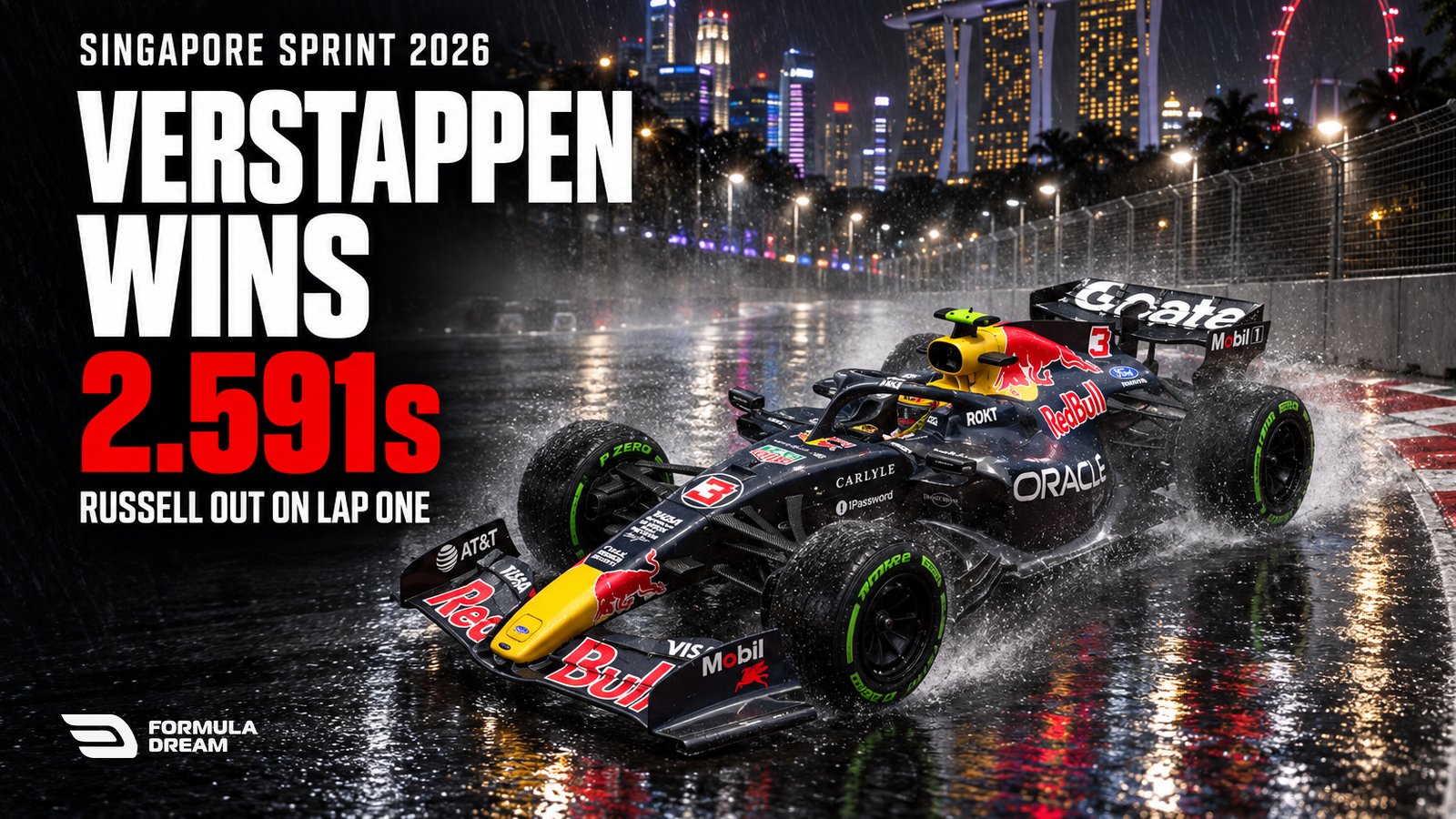
Russell took the lead at turn one and crashed at the final corner of the same lap. Verstappen won, Hamilton charged to second, and the McLarens hit each other.