What Is an Apex in F1? Racing Line Explained | Formula Dream
Guides
The Racing Line and Apex Explained: How Drivers Corner Fast
The racing line and apex explained in depth, the physics of why straightening a corner is faster, late versus early apex, trail braking, compromise corners, and why the wet line is different.
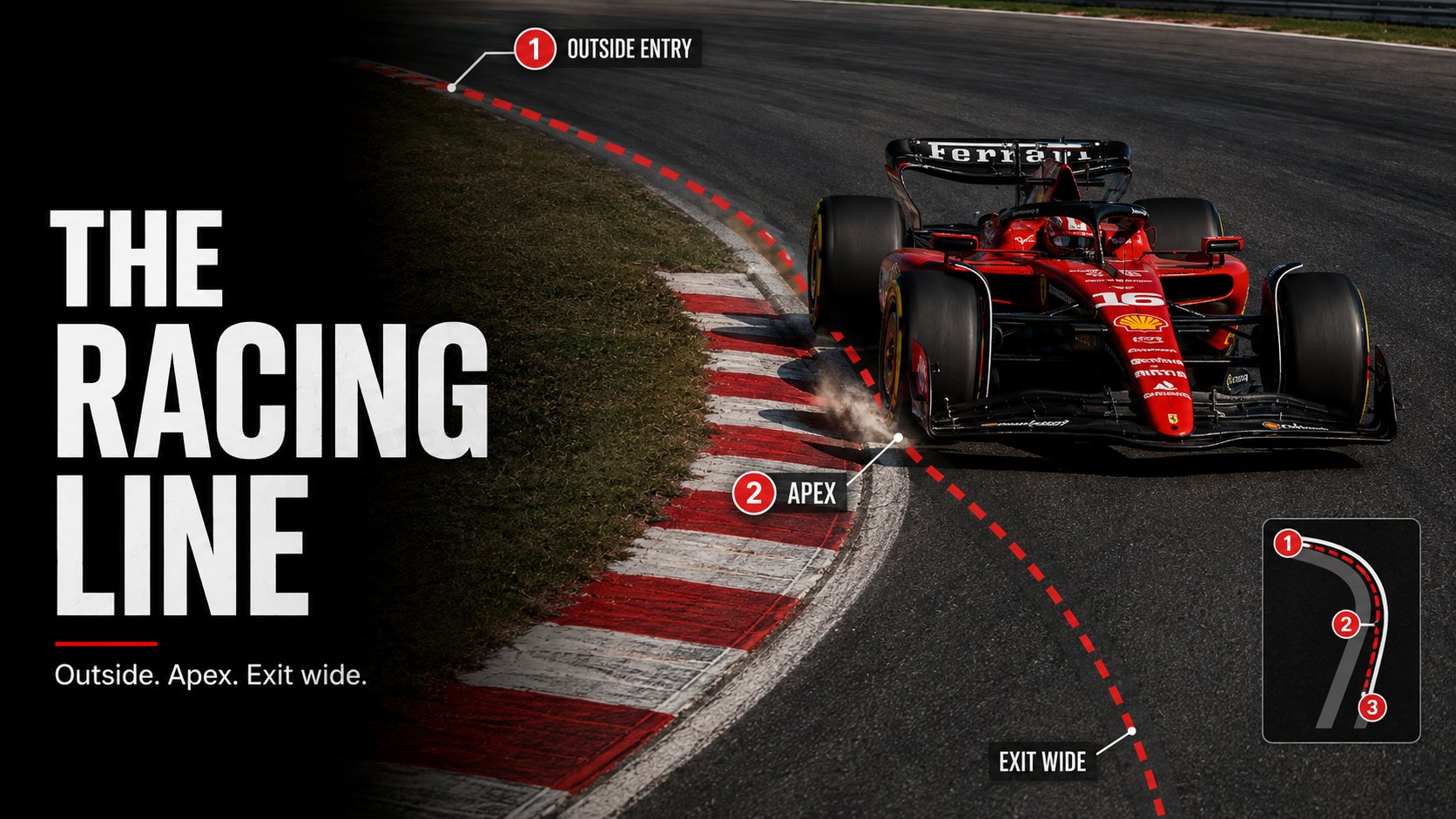
The apex is the point where a car runs closest to the inside of a corner. In F1, as in every kind of racing, the driver aims for it on the way in and builds the rest of the corner around it: turn in from the outside, clip the apex on the inside, and run back out to the outside on the exit. That path is the racing line.
An F1 car's straight-line speed is spectacular, but the straights are the easy part. Races are won and lost in the corners, and specifically in the exact path a driver traces through each one. That path is the racing line, and choosing it well is the single most important skill in motorsport, the thing that separates a quick driver from a slow one in identical machinery. It looks simple. It is one of the deepest subjects in the sport. Here is how it really works.
Why the corner is the problem
Start from the basic fact: a car is fastest in a straight line and slowest in a corner. So the entire goal through any bend is to lose as little speed as possible, and get back to full throttle as early as possible. Everything about the racing line flows from that one objective.
The reason it is not obvious is that the fastest line is almost never the shortest one. The shortest way round hugs the inside of the corner, but it forces the tightest, slowest arc and spits the car out slowly. The fastest way round is longer in distance but far higher in speed, and in racing, speed beats distance almost every time.
The physics: straightening the corner
Here is the idea that makes sense of everything. A tyre has a fixed limit of grip. It can only generate so much force, and that force has to be shared between turning, braking and accelerating. The tighter you ask a car to turn, the more of its grip is used just to change direction, and the less is left for speed.
A corner has a fixed shape, but the path you take through it does not. By starting from the outside, cutting to the inside at the middle, and running back out to the outside, a driver turns a tight bend into the widest, gentlest possible arc. A gentler arc has a larger radius, and a larger radius can be taken at a higher speed for the same amount of grip. In effect, the driver is straightening the corner, making it less of a corner and more of a fast curve. That is the whole secret, and it is why the racing line takes the shape it does.
Enter wide, clip the apex, exit wide
That shape is often described as "out-in-out", and it is built around three reference points:
The ideal line (green) turns in later, clips a late apex, and fires out onto the straight. The early-apex line (red) looks tidy on entry but runs wide and slow on the exit.
The turn-in is where the driver first commits the car to the corner, from the outside edge of the track. Starting wide opens the corner up.
The apex is the point where the car runs closest to the inside of the corner. It is the pivot of the whole corner, and where the driver aims on the way in.
The exit is where the car unwinds back out to the outside edge, using every centimetre of track as it gets back on the power.
Hit those three points in the right places and the corner is as fast as it can possibly be.
Late apex versus early apex
This is where good drivers pull away from beginners, and it is all about where you place the apex.
Early apex
Late apex
Turn-in point
Too soon
Slightly later
Entry speed
Higher, feels fast
Slightly lower
Where the car points at the apex
Across the track
At the exit
Exit
Runs wide, forces a lift
Straighten and get on the throttle early
Faster on most corners
No
Yes
The two ways to place an apex, and why one of them is a trap.
An early apex means turning in too soon and reaching the inside of the corner early. It feels fast, because the car dives into the corner quickly, but it is a trap: reaching the apex early means the car is still pointing across the track when the corner runs out, so it runs wide on the exit, forcing the driver to lift off the throttle, or run off the track entirely. It is one of the most common mistakes in all of driving.
A late apex means turning in slightly later and reaching the apex a little further round the corner. It sacrifices a touch of entry speed, but in return it points the car at the exit sooner, so the driver can straighten the wheel and get hard on the throttle earlier. On the vast majority of corners, the late apex is faster, because of a rule that governs everything.
Exit speed is king
The golden rule of cornering: exit speed matters far more than entry speed. A little extra speed carried out of a corner is not a one-off gain, it is multiplied down the entire length of the following straight, growing with every metre. A tenth gained at the exit of a slow corner onto a long straight can be worth several tenths by the braking zone at the end of it.
That is why drivers will happily give up a fraction on the way in to nail the way out. A good exit is what launches a slipstream attack on the car ahead, and it is what a whole lap of lap time is quietly built from.
Trail braking: the pro's tool
The textbook advice is to finish braking before you turn in. The fastest drivers do not do this. Instead they use trail braking: carrying a decreasing amount of brake pressure past the turn-in point and gradually releasing it as they approach the apex.
Trail braking is fast for two reasons. It lets a driver brake later into the corner, because they are still slowing while beginning to turn. And keeping the brakes on shifts the car's weight forward onto the front tyres, pressing them into the track and giving them more grip to bite into the corner, which helps the car rotate and reduces understeer. It is a delicate balancing act, releasing the brake in perfect proportion to how much the car is turning, and it is one of the clearest signs of a driver operating at the limit.
What 2026 qualifying laps show
Trail braking and the slow-in, fast-out rule are not just textbook ideas. You can see both in the public timing data. We took the fastest qualifying lap at three 2026 Grands Prix, Pierre Gasly's at Monza and Kimi Antonelli's at Monaco and Silverstone, and looked at what happens around the slowest point of each corner. On a slow corner that point sits close to the apex, which makes it the nearest thing to the apex the data can locate.
Corner
Slowest speed
Brake released
Full throttle again
Monza, first chicane (turn 2)
71 km/h
0.5 s before
2.0 s after
Silverstone, The Loop (turn 4)
87 km/h
1.0 s before
2.4 s after
Monaco, Grand Hotel hairpin (turn 6)
46 km/h
0.6 s before
Not until after Portier
Silverstone, Stowe (turn 15)
236 km/h
1.2 s before
0.6 s after
Silverstone, Copse (turn 9)
282 km/h
Not used
0.2 s after
Fastest 2026 qualifying laps at Monza, Monaco and Silverstone, measured from Formula 1 timing data.
Two patterns stand out.
The brake stays on almost to the apex. At every braking corner in the table, the brake was still on within about a second of the slowest point, and at Monza's first chicane it came off just half a second before it. That is trail braking showing up in the data. The public feed only records the brake as on or off, not how hard it is pressed, so it cannot show the pressure being eased away, only how late it lasts.
The slower the corner, the longer the wait for full throttle. Out of The Loop, the slowest corner at Silverstone, it took 2.4 seconds to get back to full throttle. Out of Stowe it took 0.6 seconds, and Copse needed no brake at all. In a slow corner the driver has to wait until the car is pointing down the next straight before the rear tyres can take full power, which is exactly why a late apex, one that straightens the car sooner, pays off most in the slowest corners.
Not every corner is taken for itself
Here is the layer that surprises people: on a real circuit, a driver often does not take the fastest line through a corner in isolation. Corners come in sequences, and the line through one is dictated by what comes next. This is the idea of a compromise corner.
If a corner leads onto a long straight, it is the most important corner around, and the driver will sacrifice everything to maximise the exit, using a very late apex to fire out with as much speed as possible. But if a corner leads directly into another corner, taking the perfect line through the first might leave the car badly positioned for the second. So the driver deliberately gives up some speed in the first corner to set up a better run through the more important one. Reading a full lap as a chain of these compromises, rather than a series of separate corners, is a huge part of what makes an elite driver.
The wet line is a different line
One of the clearest demonstrations that the "line" is not fixed comes in the rain. Over a dry race weekend, the racing line gets polished with a layer of rubber, which grips beautifully when dry but becomes treacherously slippery when wet. So in the wet, drivers abandon the usual line entirely and run off-line, on the dirtier, greasier-looking parts of the track that actually offer more grip. It looks wrong, and it is one of the great skills of wet-weather driving, shown at its best by masters like Max Verstappen, whose off-line overtakes in the soaking 2016 Brazilian Grand Prix are a modern benchmark for reading grip that no one else could see.
Drivers talk about lines constantly
The racing line is not something a driver works out once and then repeats. It moves with fuel load, tyre age, wind and where the rubber has gone down, and a lot of a session is spent negotiating it out loud: a reference being moved, a different entry being tried, an engineer relaying where a rival is finding time.
That makes team radio one of the few places the line exists as a stated intention rather than as a trace after the fact. The archive carries the sessions with the audio.
See who owns the lap
Want to see which driver actually carries the most speed through each part of a circuit? Our Track Domination map splits the lap into micro-sectors and colour-codes who is fastest through each one, so you can see exactly where a lap, and a better racing line, is won and lost.
See who is finding the time
The racing line is invisible on a broadcast. The lap time it produces is not.
The Formula Dream app runs a live Dashboard through every session: every car moving on the circuit map, and a timing tower with lap times, gaps and intervals, tyre compound and age, pit counts and positions, plus flag and safety car alerts the moment race control calls them. You also get live driver radio as it is broadcast, and every FIA document of the weekend collected as it is published, which is where the stewards' decisions that change results actually appear.
Free, no subscription, no ads, independent. Not affiliated with Formula 1.
The path through a corner that carries the most speed: entering from the outside, clipping the apex on the inside, and exiting back to the outside. It straightens the corner into the widest, fastest possible arc.
What does apex mean in F1?
The apex is the point where a car runs closest to the inside edge of a corner. It is the key reference point of the whole corner: the driver aims for it on the way in, and where it is placed decides how early they can get back on the throttle on the way out.
What is the geometric apex?
The geometric apex is the middle of the inside of the corner, the point a perfectly symmetrical line would touch. Drivers usually clip the inside later than that, a late apex, because it straightens the exit and lets them get on the power sooner.
What is the difference between a late and early apex?
A late apex is reached slightly further round the corner, sacrificing a little entry speed for a much faster exit. An early apex is reached too soon, giving a quick entry but a slow, wide exit, and it is usually a mistake.
What is trail braking?
Continuing to brake gently past the turn-in point and releasing the brake gradually toward the apex. It lets a driver brake later and shifts weight onto the front tyres for better turn-in, so it is faster but harder to master.
Why is exit speed more important than entry speed?
Because any speed gained at the exit is carried all the way down the following straight, where it compounds with every metre. A fast exit is worth far more lap time than a fast entry.
---
Sources
Corner speeds, brake and throttle timing: Formula 1 timing and car data for 2026 qualifying at the Italian, Monaco and British Grands Prix, accessed through the FastF1 library and measured by Formula Dream
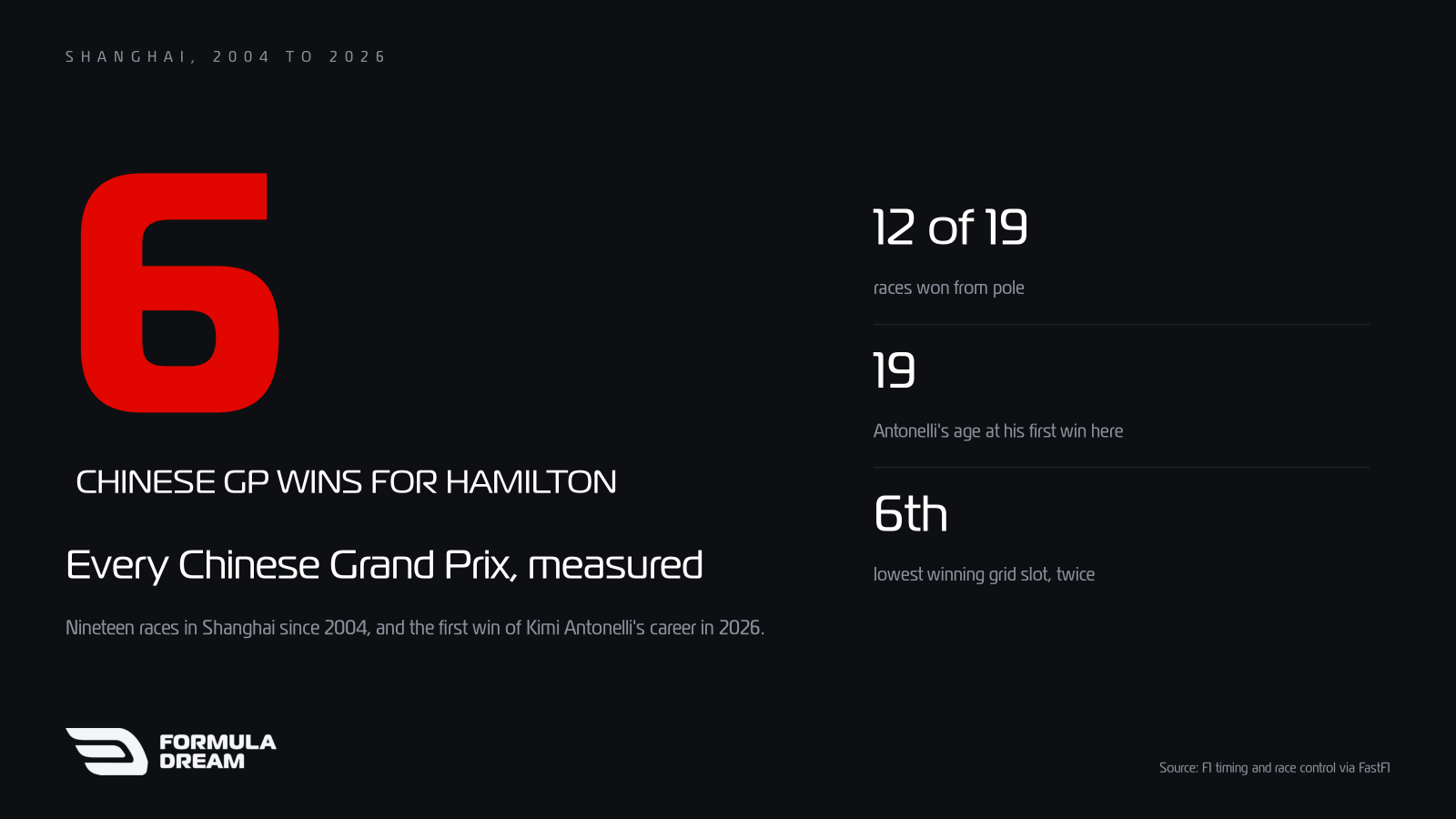
Nineteen Chinese Grands Prix have been held in Shanghai since 2004. Lewis Hamilton won six, pole won twelve, and in 2026 Kimi Antonelli took the first win of his career there, at 19, with Hamilton on the podium for Ferrari for the first time. Every winner, grid slot and safety car, measured.