What Is a Tow in F1? Slipstream Explained | Formula Dream
Guides
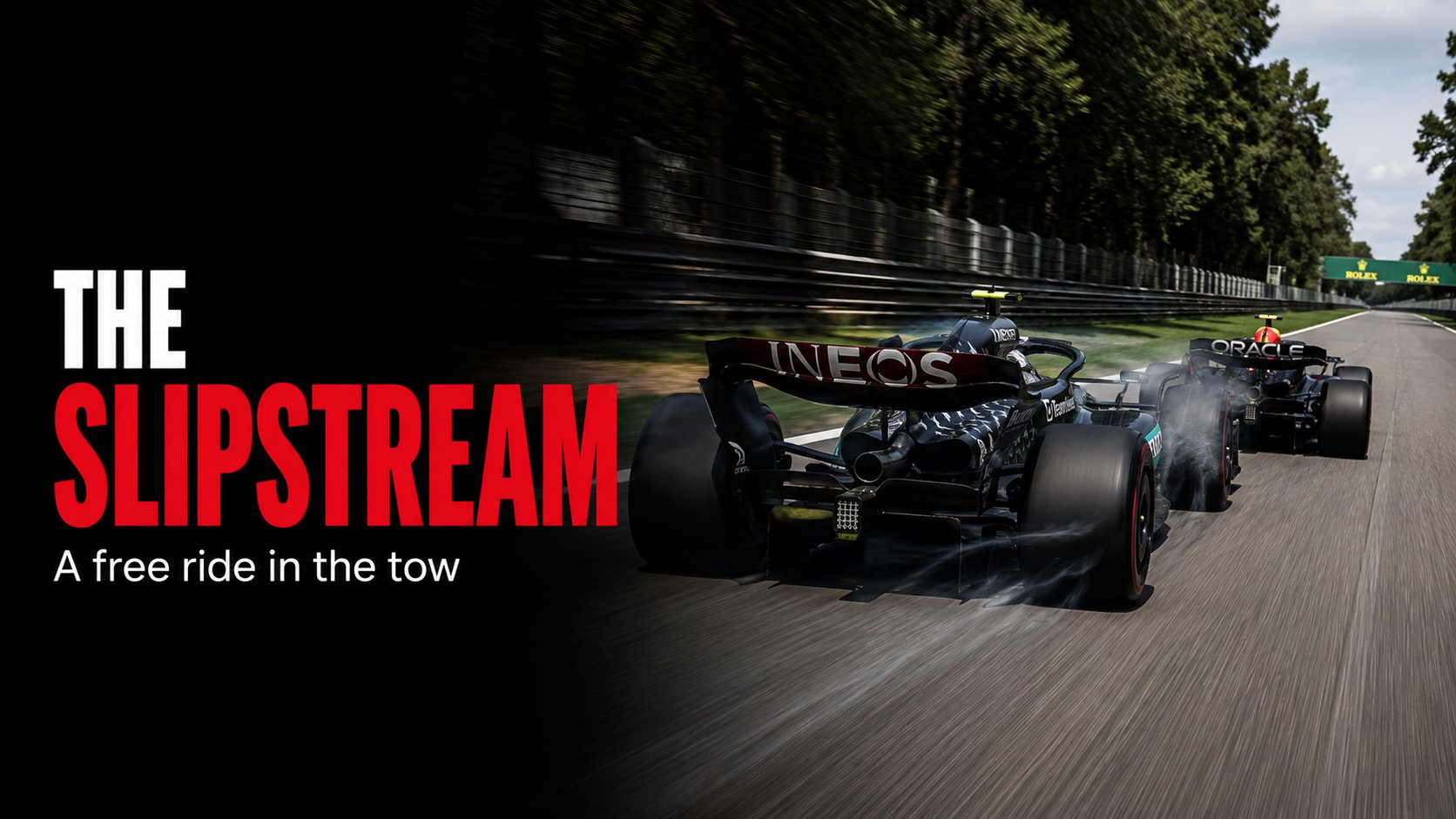
What Is a Slipstream in F1? The Tow, and F1's Closest Finish
What a tow or slipstream is in F1, how much it is actually worth (we measured 31,833 race laps), what giving a tow means, how 2026 changed it, and the 1971 Monza finish it decided.
A tow, or slipstream, is the pocket of low-drag air behind another car. A driver who sits in it meets less air resistance on a straight, so they carry more speed without doing anything different with the engine.
We measured how much it is worth across 31,833 race laps from 2024 to 2026. Inside one second of the car ahead, drivers in 2024 and 2025 were a median 10.5 km/h faster at the speed trap than on their own clean-air laps. But most of that was DRS. Between one and two seconds back, where DRS was not allowed, the tow on its own was worth about 2 km/h.
There is a strange contradiction at the heart of following another F1 car. In the corners, running close is a curse: the turbulent air ruins your grip. But on the straights, that exact same air is a gift. It has produced the closest finish in the history of the sport, and once made an entire qualifying session collapse into farce. Here is how it works, and what it is really worth.
As an F1 car powers down a straight, it has to shove a huge amount of air out of its way, and doing so leaves a pocket of low-pressure, disturbed air directly behind it, effectively a hole punched in the atmosphere. A car that tucks in close behind drops into that hole, and suddenly it is no longer fighting through undisturbed air. The leading car has done the hard work of parting the air; the following car gets to ride through the gap it left. Sitting in that pocket is called getting a tow or a slipstream.
The physics: someone else does the work
The reason it is worth so much comes down to drag. Most of the power an F1 car uses at top speed goes into simply pushing air aside. The lead car takes that full aerodynamic hit. The car behind, sitting in the wake, meets much less air resistance, so it needs less power to go the same speed. With drag cut, it accelerates harder and reaches a higher top speed, without doing anything different with the engine. It is, quite literally, getting a free ride on the leading car's effort.
The leading car does the work of parting the air. The following car drops into the low-drag pocket in its wake and gets a free run of extra speed.
The same wake, opposite effect
Here is the part that ties it all together, and it is the single most useful idea in F1 aerodynamics. The slipstream is the exact same turbulent wake as dirty air, the thing that destroys a following car's grip in corners. The difference is entirely about what you need at the time. In a corner, you need clean air flowing over your wings and floor to make downforce, so the wake hurts you. On a straight, you do not need downforce at all, you just want low drag, so the wake helps you. One phenomenon, two completely opposite effects, depending only on whether you are turning or going straight.
How much is a tow worth? We measured it
For every racing lap in 2024 and 2025 run under green flags without a pit stop, we took the gap to the car directly ahead at the end of the previous lap and the driver's speed at the speed trap. Then we compared that speed with the same driver's clean-air laps, more than three seconds behind anyone, within five laps either side. Same driver, same car, same tyres, near enough the same fuel.
Gap to the car ahead
Laps
Speed-trap gain (median)
Under 1 second
1,564
+10.5 km/h
1 to 1.5 seconds
833
+2.5 km/h
1.5 to 2 seconds
937
+2.0 km/h
2 to 3 seconds
2,545
+1.0 km/h
More than 3 seconds
15,742
0 (the baseline)
Speed-trap gain from following another car, 2024 and 2025 races, against the same driver's clean-air laps
The jump at one second is the giveaway. That is the DRS threshold. A driver inside a second at the detection point could open the rear wing, and that is where the speed arrives. The slipstream itself is a gentler thing: worth about 2 to 2.5 km/h at one to two seconds, fading to 1 km/h by three seconds, and gone after that.
The size of the gain inside a second varies enormously between circuits, from a median of 26 km/h at Bahrain and 22.5 km/h in Spain in 2025 to almost nothing at Monaco and Imola. Much of that is where each circuit's speed trap sits, and whether it catches a car at the end of a long straight or somewhere else entirely, so treat the circuit figures as a property of the measurement as much as of the track.
In qualifying the tow matters more, because a single lap is decided by tenths. At Monza in 2026, asked whether a slipstream there was worth two or three tenths, Lando Norris answered: "No, it's more like half a second, maybe even more."
2026: no DRS as we knew it, but one second still matters
The 2026 rules changed the tools. Every car can now open its wings to a low-drag setting on defined straights, whether or not anyone is ahead, so that part of the old DRS advantage is gone. The help for a chasing car now comes from Overtake Mode: a driver within one second of the car in front at the detection point, nominally the final corner, gets an extra 0.5MJ of energy recharge and more electrical power to use on the following lap.
The same measurement over the first 13 races of 2026 shows the change:
Gap to the car ahead
Laps
Speed-trap gain (median)
Under 1 second
543
+8.0 km/h
1 to 1.5 seconds
279
+5.0 km/h
1.5 to 2 seconds
233
+2.0 km/h
2 to 3 seconds
573
+1.0 km/h
More than 3 seconds
5,545
0 (the baseline)
Speed-trap gain from following another car, 2026 races to the Italian Grand Prix
Being inside a second is still worth the most, but the cliff at one second has softened into a slope. That fits how the new system works: the extra energy can be deployed wherever the driver chooses on the next lap, not only in a fixed zone past the speed trap. At Monza this year a car inside a second gained a median 12 km/h, and one to two seconds back still gained 6.
What does giving a tow mean in F1?
"Giving a tow" is when a driver deliberately runs ahead of another car on a straight, usually a team-mate in qualifying, so the car behind can use the slipstream on its flying lap. The driver in front gets nothing back, and often loses a little by having to start their own lap in a compromised spot.
That is why teams plan it, and why nobody wants to do it for a rival. At a low-downforce circuit it can be the difference between pole and the second row, which is exactly the logic that broke qualifying at Monza in 2019.
Monza 1971: the closest finish in F1 history
Nowhere shows the power of the tow like Monza, and no race shows it like the 1971 Italian Grand Prix. Back then, before the chicanes were added, almost the entire lap was a flat-out dash, and the slipstream was everything. The lead swapped constantly as cars towed past one another down the straights, and it came down to a five-car sprint to the line. Peter Gethin won by one hundredth of a second from Ronnie Peterson, with the top five covered by just 0.61 seconds, still the closest finish Formula 1 has ever seen. At an average of 150.7 mph, it was at the time the fastest F1 race ever run. That is the slipstream at its purest: cars that could not escape each other, dragged together lap after lap by the air itself.
Monza 2019: the tow that broke qualifying
Because a tow is worth so much at Monza, nobody wants to be the car in front, handing a rival the benefit while getting nothing back. In the final part of qualifying in 2019, that logic broke the whole session. The drivers hung back on their out-laps, each waiting for someone else to go ahead and provide the tow, and they misjudged how long it would take. Seven of the nine drivers still running never got to start their final lap before the chequered flag, including both Mercedes and Sebastian Vettel. Only Charles Leclerc and Carlos Sainz made it round in time. It was faintly ridiculous, and it was the clearest proof imaginable of how much drivers value a slipstream: they will risk missing the flag entirely to get one. The standoff is audible in the 2019 Monza qualifying radio, where engineers spend the closing minutes trying to work out what everyone else is waiting for.
The tow and overtaking today
The slipstream rarely works alone. Up to 2025, a chasing driver used the tow to close up on the straight and then opened DRS, and our figures above show which of the two did most of the work. From 2026 the extra energy of Overtake Mode takes that role. The fundamental prize is unchanged: get into the wake of the car ahead on a straight, and the air itself helps sling you towards it.
See a one-second gap to scale
The tow is strongest inside about a second of the car ahead, and one second at racing speed is a surprising amount of track. Our Gap Visualizer turns the gap between any two cars into real metres, so you can see exactly how far a slipstreaming driver actually has to close.
Watch the tow happen
A tow only matters inside a certain gap, and that gap is a live number you can actually follow.
The Formula Dream app runs a live Dashboard through every session: every car moving on the circuit map, and a timing tower with lap times, gaps and intervals, tyre compound and age, pit counts and positions, plus flag and safety car alerts the moment race control calls them. You also get live driver radio as it is broadcast, and every FIA document of the weekend collected as it is published, which is where the stewards' decisions that change results actually appear.
Free, no subscription, no ads, independent. Not affiliated with Formula 1.
Another name for a slipstream: the low-drag pocket of air behind a car. A driver sitting in it on a straight meets less air resistance and carries more speed.
How much is a tow worth in F1?
In races, the tow on its own is worth about 2 km/h at the speed trap when a car is one to two seconds behind, based on 31,833 laps we measured from 2024 to 2026. Inside one second, where DRS or Overtake Mode also applies, the gain was a median 10.5 km/h in 2024 and 2025 and 8 km/h in 2026. In qualifying at Monza, Lando Norris put a tow at "more like half a second, maybe even more".
What does giving a tow mean in F1?
A driver deliberately runs ahead of another car, usually a team-mate in qualifying, so the car behind can use the slipstream on its flying lap. The car in front gains nothing from it.
Does the tow still work in 2026?
Yes. The slipstream is physics, not a rule. What changed is DRS: every car can now open its wings on defined straights, and a car within one second gets Overtake Mode's extra energy instead. Our 2026 figures still show a median gain of 8 km/h inside a second and 2 km/h at one and a half to two seconds.
What is the difference between a slipstream and dirty air?
They are the same turbulent wake. On a straight it helps, cutting the following car's drag for more speed (slipstream). In a corner it hurts, robbing the following car of the clean airflow it needs for grip (dirty air).
What is F1's closest ever finish?
The 1971 Italian Grand Prix at Monza, decided by a five-car slipstream battle where Peter Gethin beat Ronnie Peterson by 0.01 seconds, with the top five covered by 0.61 seconds.
Method
Data: FastF1 lap data, every race of 2024 and 2025 and the first 13 races of 2026 (to the Italian Grand Prix). 31,833 laps in total.
Laps counted only when green for the whole lap, with no pit entry or exit, from lap 3 onward.
Gap to the car ahead is taken from cumulative session time at the end of the previous lap, which is close to, but not exactly, the gap at the speed trap or the DRS detection point.
Baseline is the same driver's median speed-trap reading on clean-air laps (more than 3 seconds behind the car ahead) within five laps either side, with at least three such laps required.
Figures are medians. Speed traps sit in different places at different circuits, so circuit-by-circuit gains partly reflect where the trap is.
Nineteen Chinese Grands Prix have been held in Shanghai since 2004. Lewis Hamilton won six, pole won twelve, and in 2026 Kimi Antonelli took the first win of his career there, at 19, with Hamilton on the podium for Ferrari for the first time. Every winner, grid slot and safety car, measured.