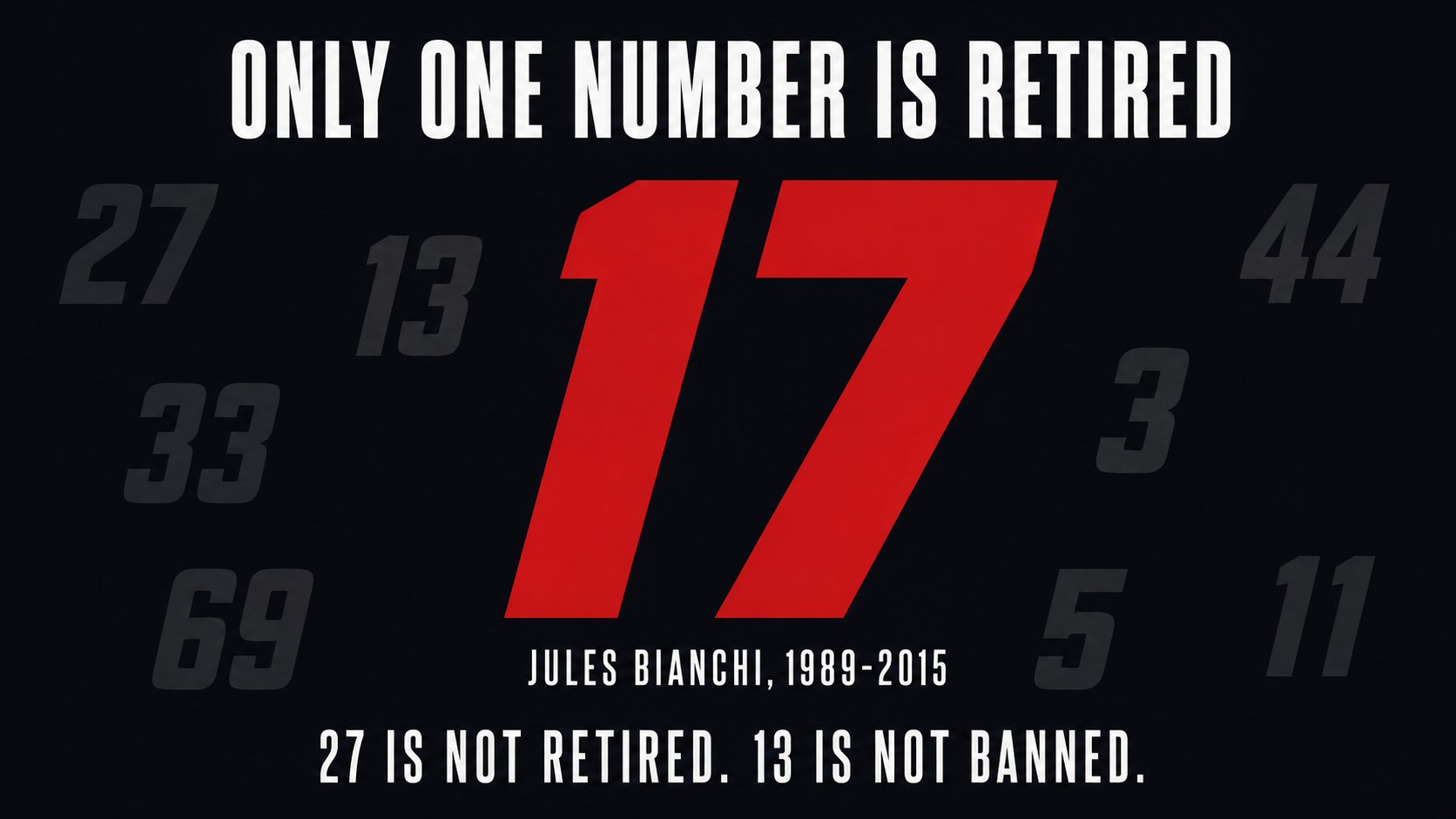
Formula 1 has retired exactly one number. It is 17.
That surprises people, because several others feel retired. Nobody has raced 27 since Gilles Villeneuve made it famous, you rarely see 13, and there is a persistent belief that certain numbers are banned outright.
None of that is true. There is one retired number in the sport's history, and everything else you have noticed has a different explanation.
chose 17 for the 2014 season, the first year drivers picked permanent numbers. He scored Marussia's only points in Monaco that year, the first the team ever took.
At the Japanese Grand Prix in October 2014 he suffered catastrophic head injuries in a crash at Suzuka. He died on 17 July 2015, Formula 1's first fatality in more than twenty years.
The FIA withdrew number 17 from use within days. It cannot be chosen by any driver competing in the Formula 1 World Championship.
The gesture only carries weight because of the system it sits in. Before 2014, numbers were allocated to teams by championship position and reshuffled constantly, so retiring one would have meant very little. Once drivers chose their own and kept them, a number became a personal identifier, and removing one permanently became a real tribute. The mechanics are in F1 driver numbers explained.
Number 27 is not retired
This is the most common misunderstanding, and it is understandable.
27 is one of the most storied numbers in the sport, carried by Gilles Villeneuve and later by Ayrton Senna and Jean Alesi, and it acquired an emotional weight after Villeneuve's death in 1982. Many fans assume it was withdrawn.
It was not. 27 remains available and has been used since. Nico Hulkenberg has raced with it for years.
The distinction matters: 27 is a number with history, not a number with protection.
Number 13 was avoided, not banned
For most of Formula 1's history you would not see a 13 on a car, which looks like a rule and was not.
Under the old system, numbers were allocated to teams, and 13 was simply skipped out of superstition. It was a convention rather than a regulation.
When drivers began choosing their own numbers in 2014, that convention had nothing to enforce it. Pastor Maldonado chose 13 immediately, and raced with it.
No number is banned
The other belief worth clearing up is that certain numbers are prohibited for being rude or unlucky. They are not. Drivers may choose almost any number from 2 to 99. The only two restrictions are:
17 is retired.
1 is reserved for the reigning World Champion, and only they may use it. That is a reservation rather than a retirement, and taking it is optional. Lewis Hamilton famously declined it through every one of his titles, keeping 44.
Why numbers disappear without being retired
Here is the explanation for most of the numbers you have stopped seeing.
If a driver does not enter a Grand Prix for two consecutive seasons, the FIA treats their career as finished for numbering purposes and the number returns to the pool. It is not retired, it is simply unclaimed, and the next driver who wants it can take it.
So a number vanishing from the grid usually means the driver left, not that the number was withdrawn. It sits unused until somebody picks it.
The 2026 change that freed a famous number
For a decade the rule was that a chosen number was yours for your entire career, locked. The FIA scrapped that ahead of 2026, and drivers may now change their assigned number.
The immediate consequence was visible at the front of the grid. Max Verstappen had run 33 since arriving in Formula 1, and 1 during his championship years. For 2026 he switched to 3, which released 33 back into the pool.
That is a genuinely new category: a number that is neither retired nor abandoned, but deliberately given up by a driver still racing.
So which numbers are actually unavailable?
The complete list is short:
17, retired for Jules Bianchi.
1, reserved for the reigning World Champion.
0, not part of the permitted 2 to 99 range for permanent numbers.
Anything currently held by an active driver, until they stop competing for two seasons or choose to change it.
Everything else is available to whoever asks for it.
Follow the grid as it is now
Numbers change more than they used to, which makes identifying a car on track less automatic than it was.
The Formula Dream app runs a live Dashboard through every session with every car on the circuit map by number, and a timing tower carrying lap times, gaps, intervals, tyre compound and age, plus flag and safety car alerts as race control calls them. Race Center has the standings, results and the full weekend timeline. You also get live driver radio as it is broadcast, and every FIA document of the weekend as it is published, which is where entry lists and number allocations actually appear.
Free, no subscription, no ads, independent. Not affiliated with Formula 1.
One. Number 17 was withdrawn in July 2015 in memory of Jules Bianchi, and it is the only number ever officially retired in Formula 1.
Is number 27 retired in F1?
No. Despite its association with Gilles Villeneuve, 27 was never withdrawn and has been raced since, including by Nico Hulkenberg.
Why is number 13 rarely seen in F1?
Superstition rather than regulation. Under the old team-allocated system it was simply skipped, and there was no rule behind it. Pastor Maldonado chose 13 in 2014 once drivers could pick their own.
Are any F1 numbers banned?
No. Drivers may choose almost any number from 2 to 99. Only 17 is retired and 1 is reserved for the reigning champion, which a champion may decline.
What happens to a driver's number when they leave F1?
It stays reserved for two seasons. If they have not entered a Grand Prix in that time, the FIA treats the career as ended for numbering purposes and the number returns to the pool for anyone to take.
Every Miami Grand Prix winner, measured: five races, and pole has won only one of them
Five Miami Grands Prix have been held since 2022, and only one was won from pole: Kimi Antonelli's in 2026. Max Verstappen won from ninth in 2023, and Lando Norris took his first win there in 2024. Every winner, grid slot and safety car, measured.