F1 Driver Numbers 2026 and Hamilton's 44 | Formula Dream
Guides
F1 Driver Numbers Explained: Every Number on the 2026 Grid
Every F1 driver number on the 2026 grid, why drivers pick their own, what number 1 means, the story behind Hamilton's 44, and the number retired forever for Jules Bianchi.
Since 2014, F1 drivers have picked their own race number rather than being handed one by the standings. Lando Norris runs 1 in 2026 as reigning champion, Max Verstappen runs 3, and Lewis Hamilton runs 44. Number 17 is retired forever.
One thing has just changed, and most explanations of F1 numbers have not caught up with it. For a decade the rule was that your chosen number was yours for your whole career, locked. A rule change approved at the end of 2025 ended that. Drivers may now switch, and Verstappen immediately did, dropping the 33 he had carried since 2015 for a plain 3.
Here is every number on the current grid, and what each one means.
Every race number on the 2026 Formula 1 grid, taken from the entry list in F1's own timing data.
Twenty-two drivers, eleven teams, with Cadillac joining the grid as the eleventh.
That list changed during the season, and most published grids have not caught up. Through the first eleven rounds, from Melbourne to Budapest, Red Bull Racing ran Verstappen and Isack Hadjar, number 6, while Racing Bulls ran Liam Lawson, number 30, alongside Arvid Lindblad.
Then Hadjar injured his wrist during the summer break and was ruled out of round 12 at Zandvoort, and the Red Bull family reshuffled:
Liam Lawson was promoted to Red Bull Racing, keeping number 30, alongside Verstappen
Yuki Tsunoda came into Racing Bulls with number 22, alongside Lindblad
Isack Hadjar and number 6 left the entry list, and were still missing at round 13 at Monza
So a 2026 grid list that still shows 6 Hadjar, or Lawson at Racing Bulls, is describing the first eleven rounds rather than the current entry list. We check ours against the entry list in Formula 1's own timing data, which is why 22 is on it.
Numbers are how the timing screen identifies a driver. The radio is how you identify them by voice, and it is a very different thing: a number tells you which car crossed the line, a radio channel tells you what the person inside it made of it. Every driver on that grid has one in our archive, with the transcript and the original audio. Lando Norris, Max Verstappen, Lewis Hamilton, Charles Leclerc, George Russell, Kimi Antonelli, Oscar Piastri and Pierre Gasly are the busiest channels of 2026.
The 2026 rule change: drivers can now switch numbers
This is the part that makes most older articles on this subject wrong.
From 2014 until the end of 2025, a driver chose a permanent number once and was stuck with it for the rest of their F1 career. A change to the rules, approved at the end of 2025, now allows drivers to change the number they first chose.
Max Verstappen is the first real example. He had run 33 since arriving in F1, and 1 during his championship years. For 2026 he has settled on 3, a number that would previously have been off limits to him for good once he picked 33. It was Daniel Ricciardo's number, and a departed driver's number is normally held back for two seasons. Ricciardo, who last raced in 2024, agreed to let it go a year early.
It is a small rule with a real consequence: a driver's number is no longer a permanent identifier. If you are trying to identify a car on track by memory, 2026 is the season to check rather than assume.
Why F1 drivers choose their own numbers
Before 2014, drivers did not own their numbers at all. They were assigned to teams based on the previous season's constructors' championship, so the champion team ran 1 and 2, the runners-up 3 and 4, and so on down the grid. They were also reshuffled whenever a driver changed teams, so the same person could be number 3 one year and number 11 the next. For anyone trying to follow a favourite driver, it was a mess.
From 2014, every driver chose a permanent number between 2 and 99. The point was to give each driver a stable identity that fans, broadcasters and timing screens could rely on, and to let drivers build something recognisable around it. It worked, to the extent that the numbers are now a genuine part of driver merchandise and branding.
If a driver does not enter a Grand Prix for two consecutive seasons, the FIA treats their career as finished for numbering purposes and the number returns to the pool.
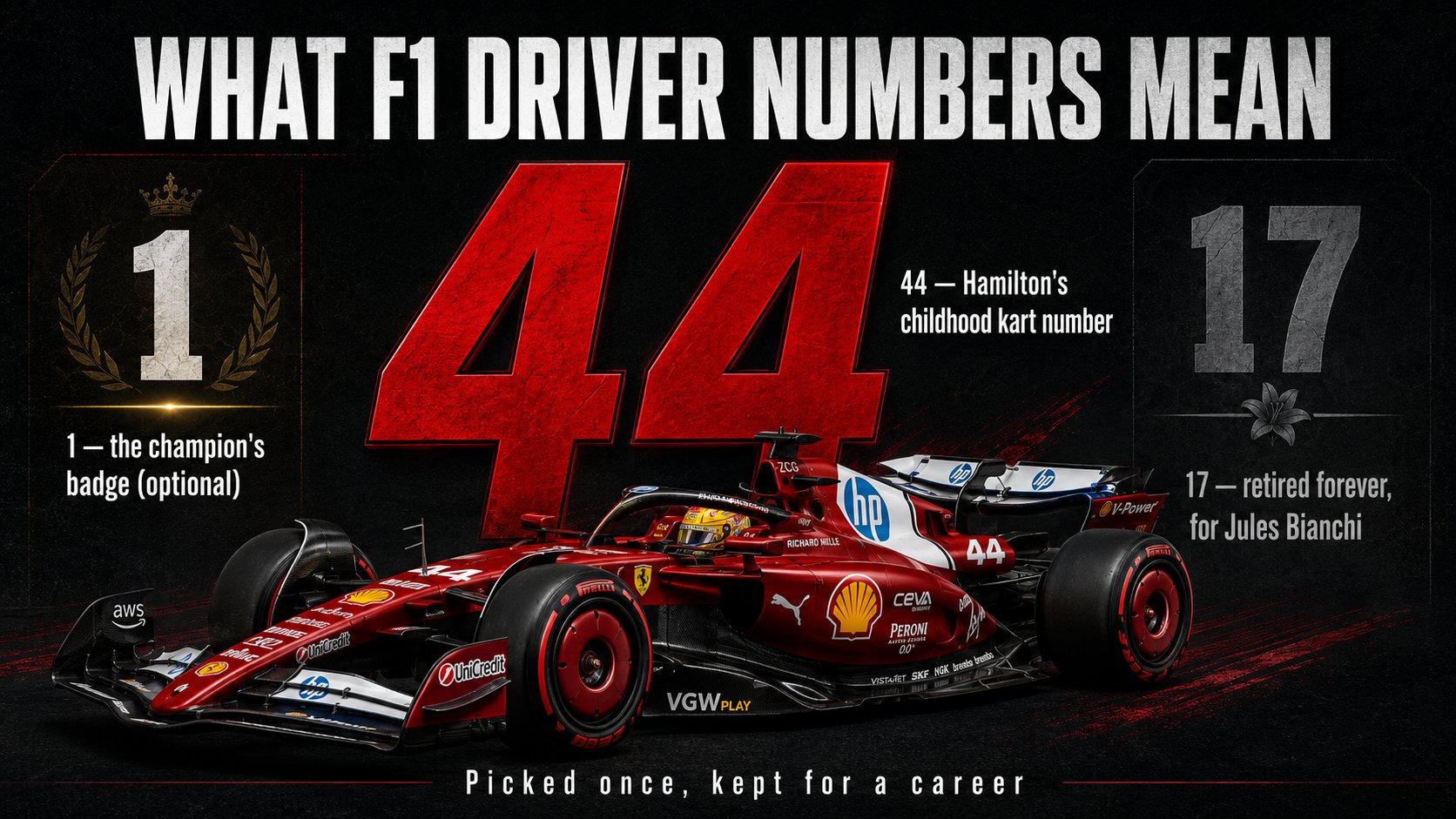
Number 1: the champion's badge, and it is optional
Number 1 is reserved for the reigning World Champion, and nobody else may use it. But since 2014 it has been the champion's choice whether to run it.
Lando Norris took it for 2026 after winning the title. Verstappen used it throughout his championship years. Lewis Hamilton went the other way, keeping 44 through every one of his titles from 2015 onwards rather than switching to 1.
Hamilton has run number 1 in F1, though. It was 2009, the season after his first championship, back when the old system still applied and the champion simply got the number.
Why is Lewis Hamilton number 44?
Because drivers choose their own, most numbers carry something personal, and Hamilton's 44 is the best known.
It was the number on his kart when he was eight years old, and it came from his father's car. As Hamilton told Petronas Motorsports: "When I started racing when I was eight, the number plate on my dad's car, he had this red Cavalier, was F44. So he used 44, it was his idea. And then it became the family lucky number."
He has carried it through Mercedes and now Ferrari, through seven world championships, and turned down the number 1 six times to keep it.
Others followed the same instinct. Valtteri Bottas picked 77 and branded himself "Valtteri 77 Bottas". What was once a bureaucratic label handed out by the standings is now a real piece of each driver's identity.
Retired F1 numbers: why 17 will never return
There is one number no one will ever wear again. Number 17 is permanently retired, the only retired number in Formula 1.
It belonged to Jules Bianchi, the young French driver who suffered catastrophic head injuries in a crash at the 2014 Japanese Grand Prix at Suzuka and died on 17 July 2015. He was F1's first fatality in over twenty years, and the accident was one of the drivers behind the arrival of the halo.
The FIA retired his number within days of his death, in July 2015. It is the only number ever retired in Formula 1, and the others people assume are gone, including 27 and 13, are all still available. The full list is in retired F1 numbers. Because numbers are now personally chosen rather than allocated, retiring one meant something: it is a permanent tribute written into the sport's own numbering, and a reminder that behind the safety advances of the modern era there is a real human cost.
Follow the numbers live
Knowing the numbers is the first step to actually reading a session.
The Formula Dream app runs a live Dashboard through every session: all the cars moving on the circuit map by number, a timing tower with lap times, gaps, intervals, tyre compound and age, and flag or safety car alerts the moment they happen. You also get live driver radio as it is broadcast, and every FIA document of the weekend as it is published, which is where the stewards' decisions that change results actually appear.
Free, no subscription, no ads, independent. Not affiliated with Formula 1.
Lewis Hamilton races with 44, at Ferrari in 2026. It was the number on his first kart, taken from the F44 registration plate on his father's car, and he kept it through all seven of his world championships rather than switching to number 1.
Who is number 1 in F1 in 2026?
Lando Norris. Number 1 is reserved for the reigning World Champion, and Norris chose to run it after winning the title. Using it is optional.
Can F1 drivers change their number?
Yes, as of 2026, after a rule change approved at the end of 2025. Before that, a number chosen from 2014 onwards was locked for a driver's entire career. Max Verstappen used the new freedom to move from 33 to 3.
Why is number 17 not used in F1?
It is permanently retired in memory of Jules Bianchi, who died in July 2015 from injuries sustained in a crash at the 2014 Japanese Grand Prix. It is the only retired number in Formula 1.
What number does Max Verstappen use?
Number 3 in 2026. He ran 33 from his debut, then 1 during his championship years, and switched to 3 once the rules allowed drivers to change their permanent number.
What number does Yuki Tsunoda use?
Number 22, at Racing Bulls. He returned from round 12 of 2026 at Zandvoort, taking Liam Lawson's seat when Lawson moved up to replace the injured Isack Hadjar at Red Bull.
Who replaced Isack Hadjar?
Liam Lawson. Hadjar injured his wrist during the 2026 summer break and missed the Dutch Grand Prix, so Lawson moved up from Racing Bulls to Red Bull Racing, keeping number 30, and Yuki Tsunoda took his Racing Bulls seat with number 22. Lawson was still in the Red Bull at Monza.
How did F1 numbers work before 2014?
Numbers were assigned to teams based on the previous year's constructors' championship and reshuffled whenever drivers changed teams, so a driver's number could change almost every season.
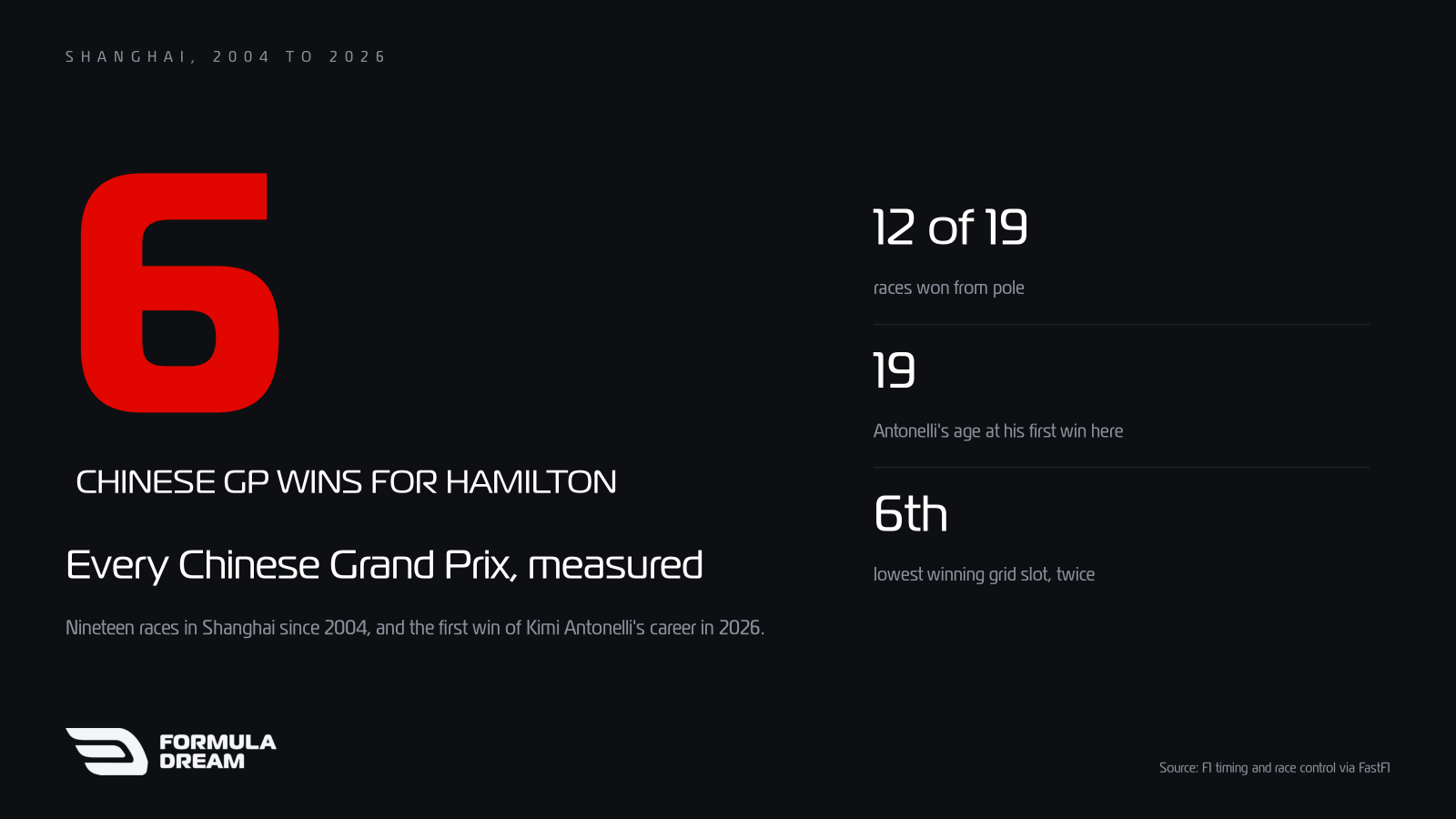
Nineteen Chinese Grands Prix have been held in Shanghai since 2004. Lewis Hamilton won six, pole won twelve, and in 2026 Kimi Antonelli took the first win of his career there, at 19, with Hamilton on the podium for Ferrari for the first time. Every winner, grid slot and safety car, measured.