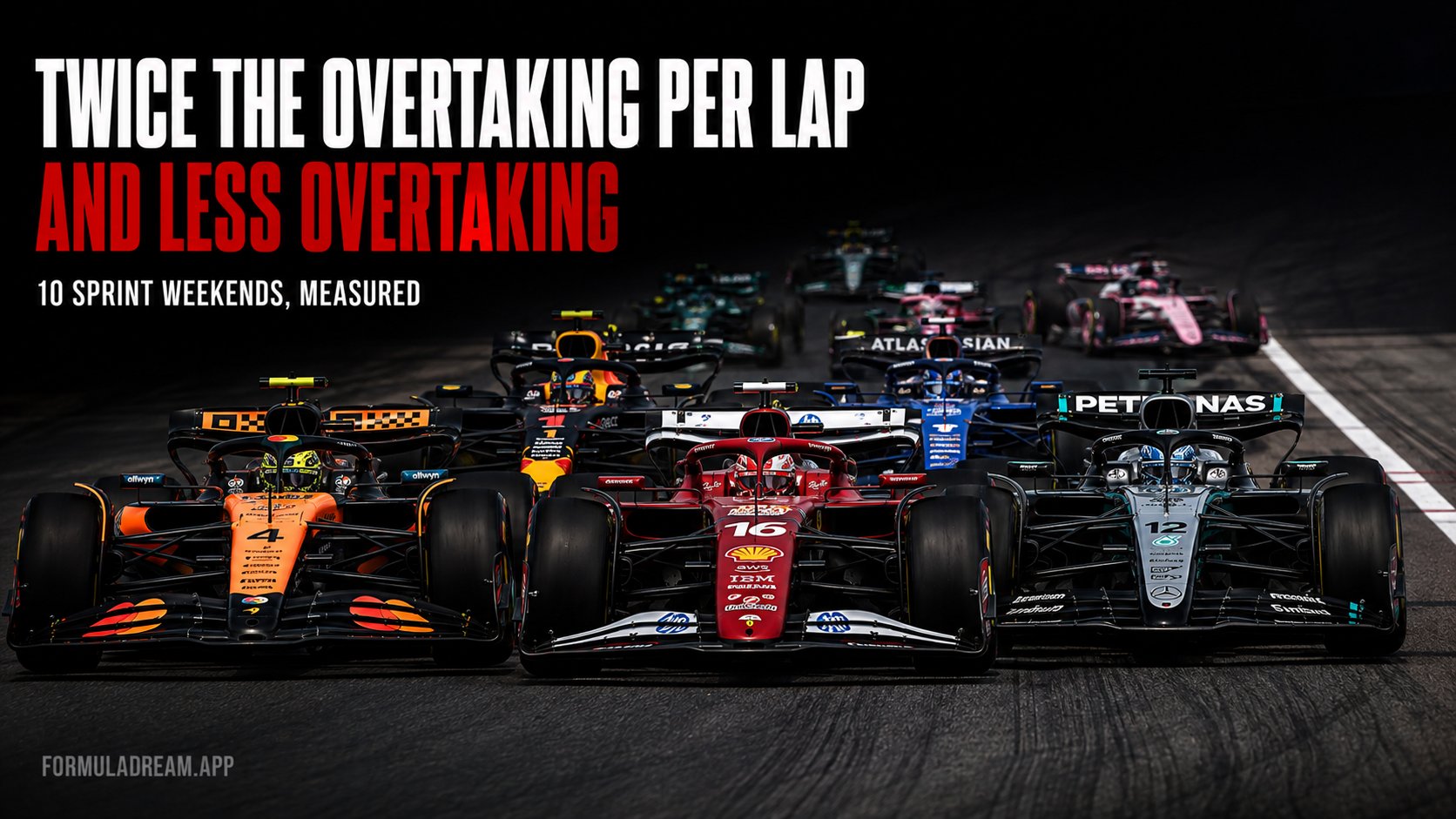
Across 10 sprint weekends, sprint races produced 0.90 on-track passes per lap. The Grands Prix at the same circuits produced 0.44. Sprints are twice as dense.
Over a whole session, a sprint produced 15.4 passes and a Grand Prix produced 24.6. The Grand Prix gives you more.
Both statements are true, and which one you quote decides the argument.
On-track passes per lap in each sprint compared with the Grand Prix at the same circuit
We used exactly the same pass definition as our count of every on-track overtake in a season: a driver behind another at the end of one lap and ahead at the end of the next, with neither driver pitting on either lap, both laps green for both, and lap 1 excluded.
Then we compared each sprint against the Grand Prix at the same circuit on the same weekend. That controls for the track completely. Shanghai's sprint is measured against Shanghai's Grand Prix, not against a season average.
That gave 10 sprint weekends across 2025 and 2026 where both sessions loaded cleanly.
Sprints run about a third of the distance: 15 to 24 racing laps against 44 to 71.
Denser, not bigger
7 of the 10 sprints had a higher passing rate than the Grand Prix that weekend.
2026 Shanghai: sprint 2.24 per lap, GP 0.70
2026 Montreal: 1.62 against 0.39
2025 Miami: 1.50 against 0.22
2026 Silverstone: 0.87 against 0.50
2025 Spa: 0.31 against 0.48
2025 Interlagos: 0.18 against 0.62
Pooled across everything, the sprint rate is 0.90 passes per lap against 0.44. Slightly more than double.
The sprint wins on passes per lap; the Grand Prix wins on passes per session
But a sprint is a third of the length, so the total is lower. 15.4 passes in a sprint, 24.6 in a Grand Prix.
This is the whole argument about sprints in one pair of numbers. If you want the highest density of action per minute of viewing, the sprint delivers. If you want the most racing, the Grand Prix still does.
The mechanism is not mysterious. A sprint has no mandatory pit stop, no fuel saving to speak of, a shorter tyre life to manage and nothing to protect for later. Everyone races flat out for twenty laps. A Grand Prix has long phases where drivers are deliberately not attacking, which we have measured elsewhere: running within a second of another car costs about half a second a lap, so an attack you cannot complete is expensive.
The awkward part: it only started working in 2026
Splitting by season complicates the story considerably.
Median passes per lap in sprints and Grands Prix, 2025 against 2026
2025: sprints 0.30 per lap, Grands Prix 0.44
2026: sprints 1.25 per lap, Grands Prix 0.53
In 2025, sprints had LESS passing per lap than the Grands Prix they accompanied. The entire "sprints are denser" finding comes from 2026.
We are not going to over-claim on this. 2025 contributes six weekends and 2026 contributes four. Those are small samples, and 2026 Shanghai at 2.24 passes per lap is doing a lot of work in that average.
What can be said is that the 2026 cars appear to be producing more passing in sprints specifically, and that the 2025 sprint format was not delivering the concentrated racing it was sold on. Whether the 2026 pattern holds over a full season is exactly the kind of thing to check again in December.
What this changes about the sprint argument
"Sprints produce more overtaking" is not true as usually stated. A Grand Prix contains more overtaking. A sprint contains it more densely.
Density is a real thing to value. If you have twenty minutes rather than two hours, the sprint is genuinely the better use of them.
The 2025 sprints were not delivering. Six weekends, and the sprint had a lower passing rate than the Grand Prix in most of them.
Check the year before quoting any of this. The 2025 and 2026 numbers point in opposite directions, and anyone citing sprint statistics from a single season is on thin ice. Including us, which is why both are shown.
Method
Data: FastF1, sprint weekends of 2025 and 2026 to date. 10 weekends where both the sprint and the Grand Prix loaded with usable lap data.
Pass definition identical to our Grand Prix analysis: position swap between consecutive laps from cumulative end-of-lap times, no pit in or pit out for either driver on either lap, green flag on both laps for both, lap 1 excluded.
Rates are per racing lap, being total laps minus the excluded opening lap.
Each sprint is compared against the Grand Prix at the same circuit in the same year, so circuit effects cancel.
Sample is small: 6 sprint weekends in 2025 and 4 in 2026. Per-season medians rest on those counts and the seasonal split should be treated as provisional.
The same pit-lap exclusion applies to both session types, which affects the Grand Prix more because it has far more pit stops. This slightly reduces the Grand Prix's eligible lap pool and is a known limitation of the comparison, flagged in our original overtaking analysis too.
2026 is incomplete, with further sprint weekends still to run.
A sprint is short enough that every position change matters immediately.
The Formula Dream app runs a live Dashboard through every session: every car moving on the circuit map, and a timing tower with lap times, gaps and intervals, tyre compound and age, pit counts and positions gained or lost. It is the same information these measurements come from, arriving live. You also get live driver radio as it is broadcast, and every FIA document of the weekend as it is published.
Free, no subscription, no ads, independent. Not affiliated with Formula 1.
Singapore Sprint 2026 Results: Russell Crashes From the Lead
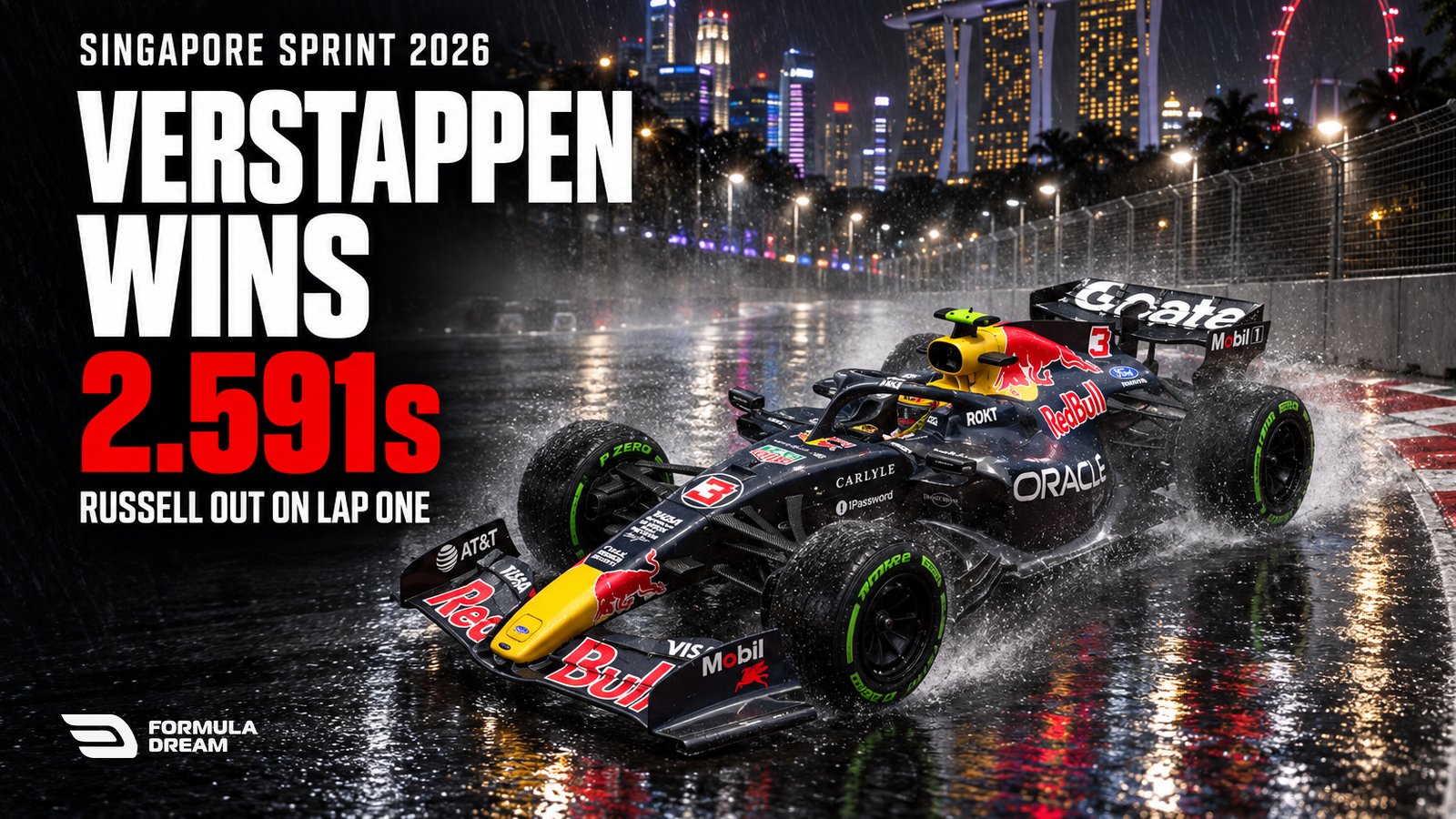
Russell took the lead at turn one and crashed at the final corner of the same lap. Verstappen won, Hamilton charged to second, and the McLarens hit each other.