F1 Super License Points: How Many You Need | Formula Dream
Guides
F1 Super Licence Points: How a Driver Actually Qualifies
The FIA Super Licence explained, the hardest driving licence in the world, the 40-point system that gets you into F1, the junior ladder, the age rule Verstappen triggered, and the theory test.
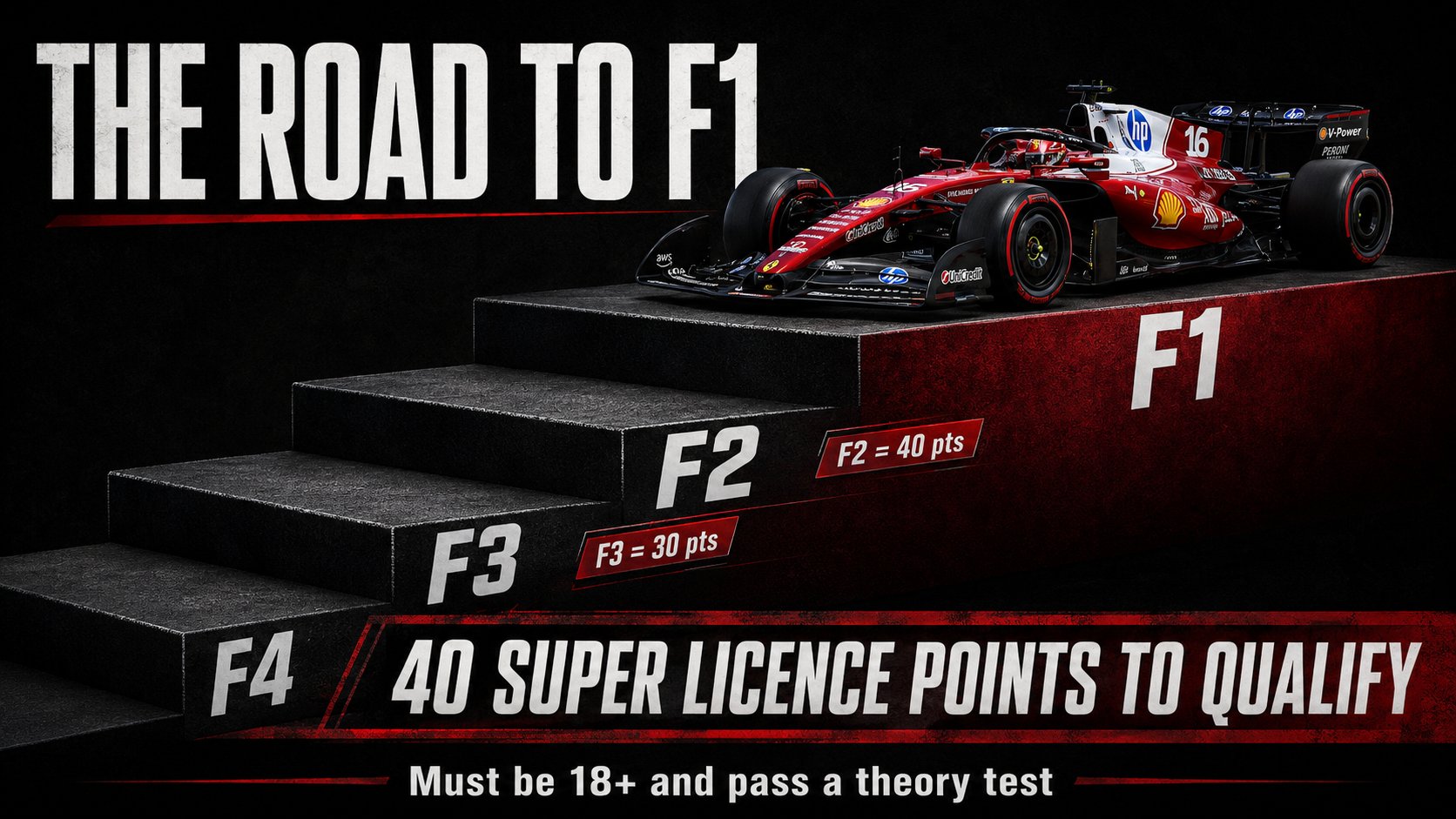
To race in Formula 1 a driver needs an FIA Super Licence, and to get one they usually need 40 super licence points from results in approved championships over the previous three years. They also have to be 18, hold an International Grade A licence, and pass a question session on the sporting rules. The rules are in Appendix L to the FIA International Sporting Code.
What a driver sounds like in their first races is part of the record too. Every message from the last Grand Prix is in our
The FIA spells it Super Licence, and you will also see it written as super license, which is the more common spelling in American English. They are the same thing.
The points are not championship points. They are a separate currency, and how many each series pays out is the part almost nobody spells out. Here are the actual numbers, including what changed for IndyCar drivers in 2026.
What is the Super Licence?
The Super Licence is the FIA's official permit to compete in Formula 1. It exists for one main reason: safety. F1 cars are extraordinarily fast and dangerous, and the sport does not want inexperienced or unproven drivers on the grid, however much money or talent they might have. The licence is the gatekeeper that makes sure everyone racing has earned their place.
The 40-point system
The heart of it is a points system. Under Article 13.1.5 of Appendix L, a driver must have accumulated at least 40 Super Licence points, counted in whichever way gives the higher total: the three calendar years before the year of application, or the two calendar years before it plus the current year. Crucially, these are not the same as championship points, they are a separate currency that only counts toward the licence.
The higher the category and the better you finish, the more points you earn. For the main routes into F1:
Series
1st
2nd
3rd
4th
5th
FIA Formula 2
40
40
40
30
20
IndyCar
40
30
25
20
15
FIA Formula 3
30
25
20
15
12
FIA Formula E
30
25
20
10
8
FIA WEC, Hypercar
30
24
20
16
12
Japanese Super Formula
30
25
20
15
12
FIA Formula Regional European Championship
25
20
15
10
7
F1 Academy
10
7
5
3
1
Super Licence points for the top five in each championship, from Supplement 1 of Appendix L to the FIA International Sporting Code, 2026.
Formula 2 is the striking one. The category directly below F1 pays the full 40 to all three podium finishers, so a driver does not have to win F2 to qualify, only to finish top three. F2 continues to tenth at 30, 20, 10, 8, 6, 4 and 3, and IndyCar at 20, 15, 10, 8, 6, 3 and 1. The results from at most two championships can count in a single calendar year.
A driver can mix and match, banking points from several seasons and categories to reach the magic 40. The junior drivers doing exactly that turn up in F1 practice sessions long before they race.
There are also smaller top-ups that decide borderline cases:
2 points for completing a whole season, in an FIA championship with a penalty points system, without receiving any penalty points.
3 points for winning the FIA Formula Regional World Cup, and 2 points for winning the FIA Formula 4 World Cup.
1 point per F1 event at which a Free Practice Only Super Licence holder completes at least 100km in a practice session without penalty points, up to a maximum of 10. This is why teams put junior drivers in FP1, as four teams did at Monza in 2026.
What changed for IndyCar in 2026
The most significant recent change is that the FIA increased IndyCar's allocation, effective 1 January 2026.
IndyCar's top ten now scores 40, 30, 25, 20, 15, 10, 8, 6, 3, 1, replacing the old 40, 30, 20, 10, 8, 6, 4, 3, 2, 1. The gain is in the middle of the field: finishing fourth in IndyCar used to be worth 10 points and is now worth 20, and sixth went from 6 to 10.
There is a catch worth knowing if you are doing the maths on a particular driver. The new scale is not retrospective. Results from 2023 to 2025 stay on the old allocation, and only 2026 onwards uses the new one. Since the licence works on a rolling three-year window, a driver's total right now can be a mix of both scales.
The effect is to make IndyCar a more realistic route into F1 than it has been, which is the FIA's stated intent.
The rest of the requirements
Points alone are not enough. To be eligible, a driver must also:
Be at least 18 years old.
Hold an International Grade A competition licence, the top tier of racing licence.
Have completed at least 80 percent of two full seasons in qualifying junior single-seater championships.
Pass a question session on the most important points of the International Sporting Code and the F1 Sporting Regulations.
Those requirements sit alongside the points, not instead of them. A driver with 40 points and no Grade A licence is not eligible.
The age rule, and the driver who caused it
The 18-year-old minimum age has a specific origin: Max Verstappen. When he made his F1 debut in 2015 at just 17 years old, the youngest driver in the sport's history, it prompted the FIA to tighten the rules, bringing in both the strict 40-point system and the minimum age from 2016 to ensure future rookies were older and more experienced. The 2026 rules keep a narrow exception: the FIA may grant a Super Licence at 17 to a driver judged to have "recently and consistently demonstrated outstanding ability and maturity" in single-seaters, but the bar remains deliberately high.
Why it matters
The Super Licence is the reason F1 cannot simply be bought into. A driver has to climb the ladder, karting, then the junior single-seater categories, winning and scoring against the best young talent in the world, and prove themselves worthy over years before they are even eligible. It is a filter designed to make sure that every one of the twenty drivers on a Grand Prix grid has genuinely earned the right to be there.
Follow the drivers who are earning them
The junior drivers collecting these points are the ones who turn up in Friday practice, which is where those 1-point-per-session top-ups come from.
The Formula Dream app runs a live Dashboard through every session including FP1: every car on the circuit map, a timing tower with lap times, gaps, intervals, tyre compound and age, and flag or safety car alerts as race control calls them. You also get live driver radio as it is broadcast, and every FIA document of the weekend as it is published, which is where entry lists and stewards' decisions actually appear.
Free, no subscription, no ads, independent. Not affiliated with Formula 1.
The FIA's official licence required to race in Formula 1. It ensures only experienced, proven drivers compete. There is also a Free Practice Only Super Licence, with a lower bar of 25 points, for drivers who run in Friday practice.
How do you qualify for a Super Licence?
By accumulating at least 40 Super Licence points over three years in approved championships, being at least 18, holding a Grade A competition licence, completing 80 percent of each of two full single-seater seasons, and passing a question session on the sporting rules.
How many super license points do you need for F1?
40, accumulated over a rolling three-year period from results in FIA-approved junior championships. Championship points and super licence points are separate things.
How many points is an F2 title worth?
Winning the Formula 2 championship is worth the full 40 Super Licence points, enough to qualify for the licence in a single season. The Formula 3 title is worth 30.
Why is there a minimum age of 18 for F1?
The rule was introduced from 2016 after Max Verstappen debuted at 17 in 2015. It, along with the 40-point system, was designed to make sure drivers are older and more experienced before reaching F1.
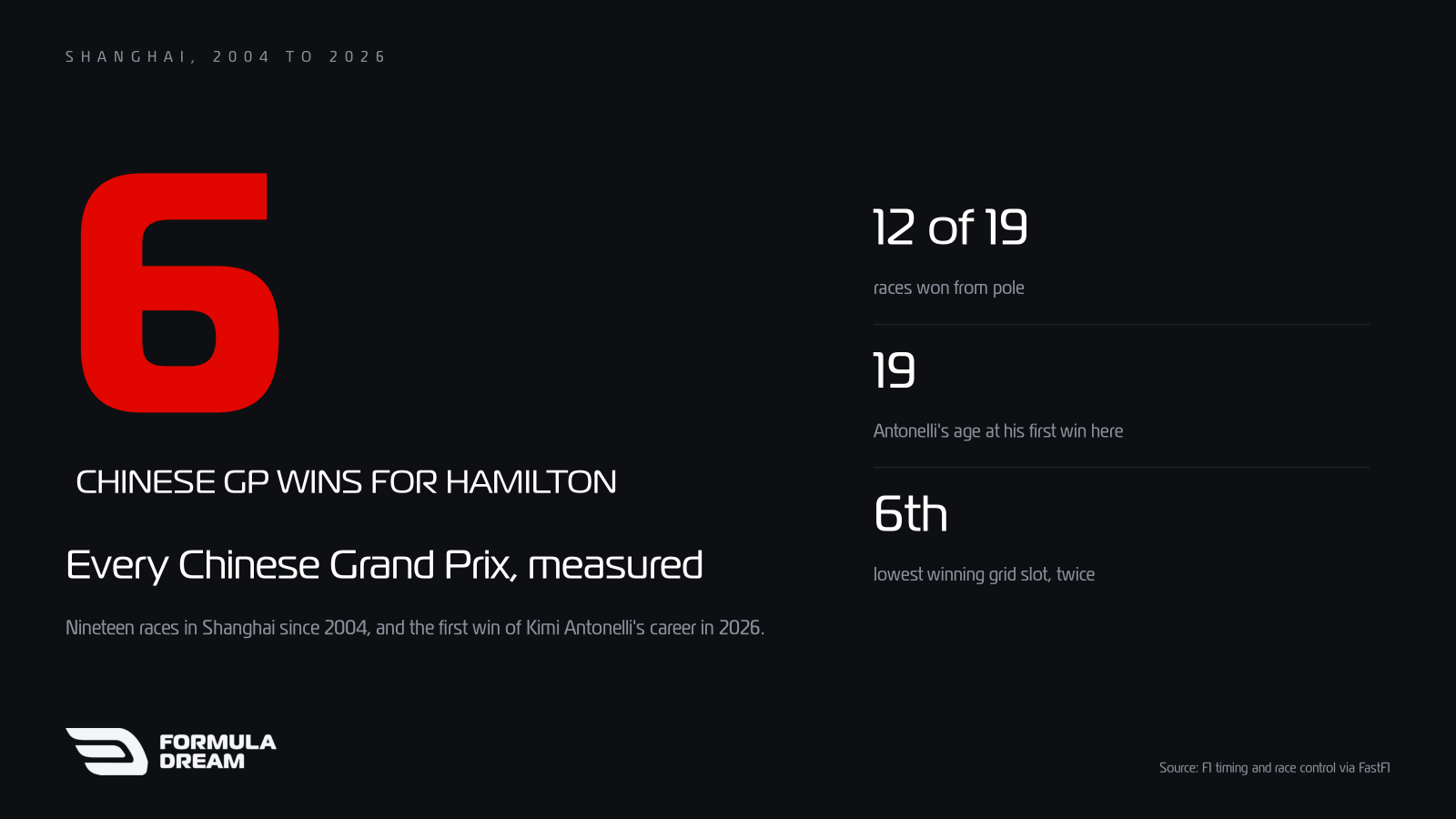
Nineteen Chinese Grands Prix have been held in Shanghai since 2004. Lewis Hamilton won six, pole won twelve, and in 2026 Kimi Antonelli took the first win of his career there, at 19, with Hamilton on the podium for Ferrari for the first time. Every winner, grid slot and safety car, measured.